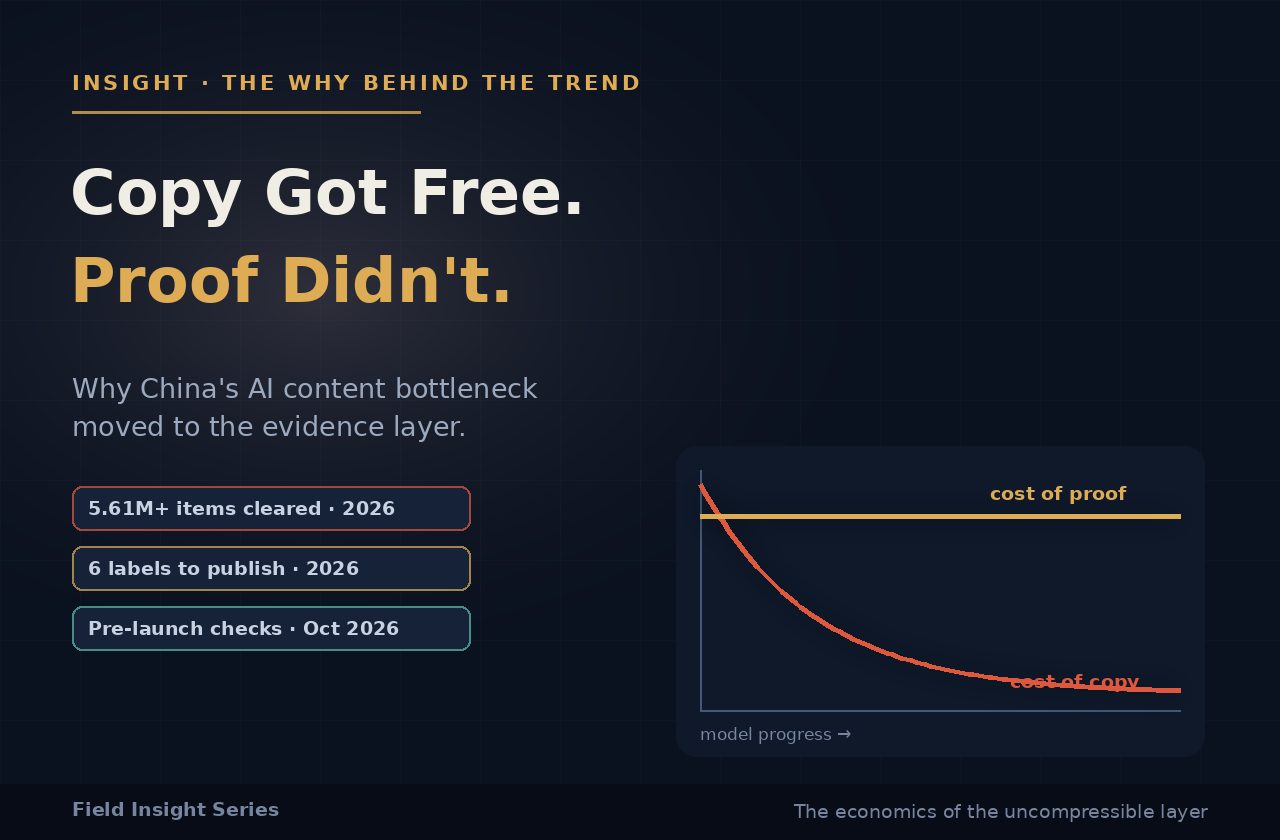
Here is a puzzle worth sitting with. Chinese AI tools now draft platform-ready copy in seconds, at effectively zero marginal cost. By every instinct we have about technology, content should be flooding through the gates faster than ever. Instead, the gates got heavier: 5.61 million illegal items cleared in one 2026 enforcement campaign, six mandatory labels wired into the publish button, authorization checks moved to before launch. Cheaper production, harder shipping. Why?
Because a content operation is really two factories under one roof, and they run on different physics.
The first factory turns compute into expression: drafts, translations, variants, polish. Its cost curve collapses with every model release. The second factory turns real-world events into evidence: a garment actually tested at UPF 50+, a celebrity actually signing a release, a human actually reviewing the claim and putting their name under it. No amount of GPU time manufactures a lab result that never happened. This layer does not compress — it can only be scheduled.
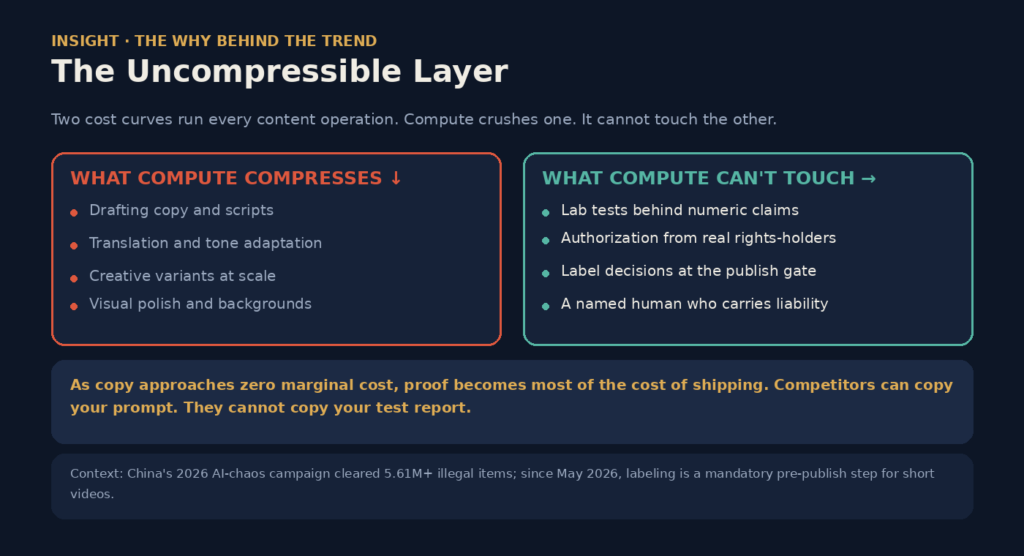
Now watch what happens when one curve collapses and the other doesn’t. Verification becomes the dominant share of shipping cost. A brief that once spent most of its budget on words now spends most of its risk on attachments. And the enforcement numbers stop looking like a crackdown on AI and start looking like something more structural: a system re-pricing claims at the exact moment claims became free to produce. When anyone can generate “clinically proven 3x better” in a keystroke, the only scarce input left is the document that makes it true.
This also explains a behavior that puzzles Western observers: why Chinese platforms keep adding human checkpoints while adopting AI faster than anyone. It is not technophobia. It is cost logic. If expression is abundant, the platform’s differentiating asset is the credibility of what passes through — so verification moves upstream, into pre-launch authorization and mandatory label decisions, where it can gate supply instead of mopping up after it. The checkpoint is the product.
The strategic implication is quietly brutal for global teams. Your competitor can copy your prompt, your model, your style guide — the entire compressible layer is copyable by definition. What they cannot copy is your evidence infrastructure: the testing relationships, the authorization ledgers, the reviewer of record who has signed a thousand claims and knows which ones smell wrong. In an economy of free copy, the moat is the filing cabinet.
So the next time a demo shows flawless Chinese copy generated in four seconds, ask the only question that matters: what did it cost to make those four seconds true?