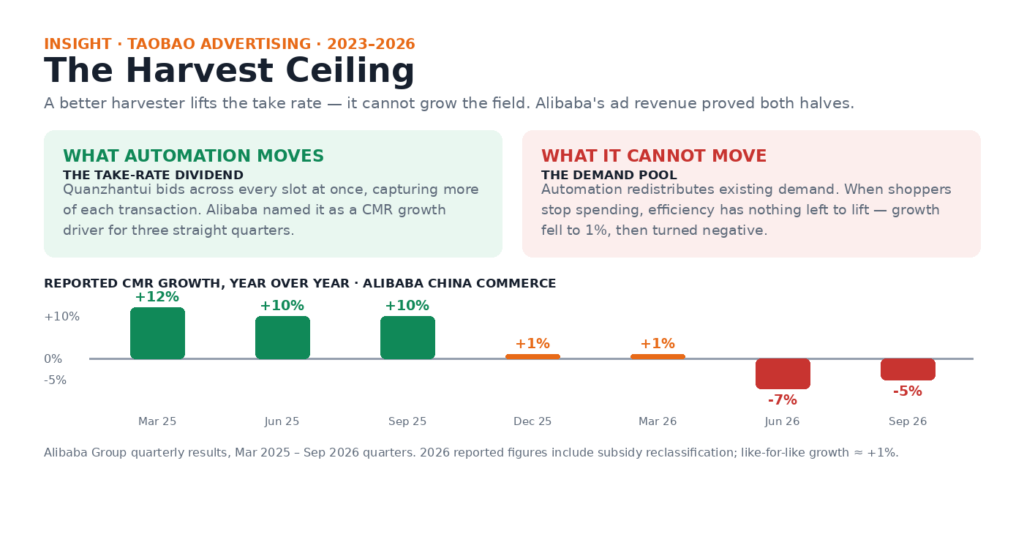
Here is a puzzle worth sitting with. Between March and September 2025, Alibaba’s customer management revenue — the ads-and-commissions line that Taobao’s ad tools feed — grew 12%, then 10%, then 10% year over year. In its earnings releases, the company named the driver explicitly: broader penetration of Quanzhantui, its AI-run Full-Site Promotion tool. The machine was working. Then, in the December 2025 quarter, growth collapsed to 1%. By mid-2026, reported growth went negative. The AI didn’t get dumber. So what happened?
The answer is a distinction most automation coverage misses: the difference between harvesting a field and growing one.
What the Machine Actually Improved
Quanzhantui’s real innovation is take-rate mechanics. Instead of a merchant bidding on a keyword here and a crowd segment there, the system allocates spend across every monetizable slot at once — search, recommendation feeds, content — and links paid traffic to organic reach. More of each transaction gets monetized, with less merchant effort. That is a genuine efficiency gain, and for three quarters it showed up in audited revenue. Alibaba wasn’t spinning a story; the numbers were real.
What No Machine Can Move
But take rate is a ratio, and ratios have two sides. The numerator — monetization per transaction — is what automation lifts. The denominator — how much shoppers actually spend — is set by wages, confidence, and competition for wallets. Through late 2025 and 2026, Chinese consumption stayed soft, Pinduoduo and Douyin kept splitting demand, and Alibaba’s own earnings cited weaker transaction activity. Once the one-time boosts faded (a new software service fee, the initial penetration wave), the honest arithmetic reasserted itself: a stagnant pool, harvested more efficiently, is still a stagnant pool.
The 2026 numbers even flatter the machine in reverse: reported CMR fell 7% and 5% in the June and September quarters largely because merchant subsidies were reclassified as revenue deductions — an accounting change, not an AI failure. Like-for-like growth was about 1%. Which is precisely the point: 1% is what the ceiling looks like. Not collapse. Not triumph. A flat field.
Why This Travels
Every platform selling you automation is selling a harvester. Google’s Performance Max, Amazon’s automated campaigns, Meta’s Advantage+ — all promise to extract more from existing demand, and all genuinely do, for a while. The penetration phase produces a visible dividend, which vendors trumpet in case studies. Then penetration saturates, and growth quietly reverts to whatever the underlying demand pool is doing. China ran this tape first and publicly, in audited quarterly numbers. That’s the gift: you can watch the whole curve — dividend, saturation, ceiling — before your own platform finishes act one.
The operator’s takeaway isn’t “automation bad.” It’s sequencing. Let the machine harvest; spend your own effort growing the field — new products, new crowds, new reasons to buy. Platforms that confuse the two will keep announcing record efficiency against flat revenue, and keep wondering why nobody’s impressed.






