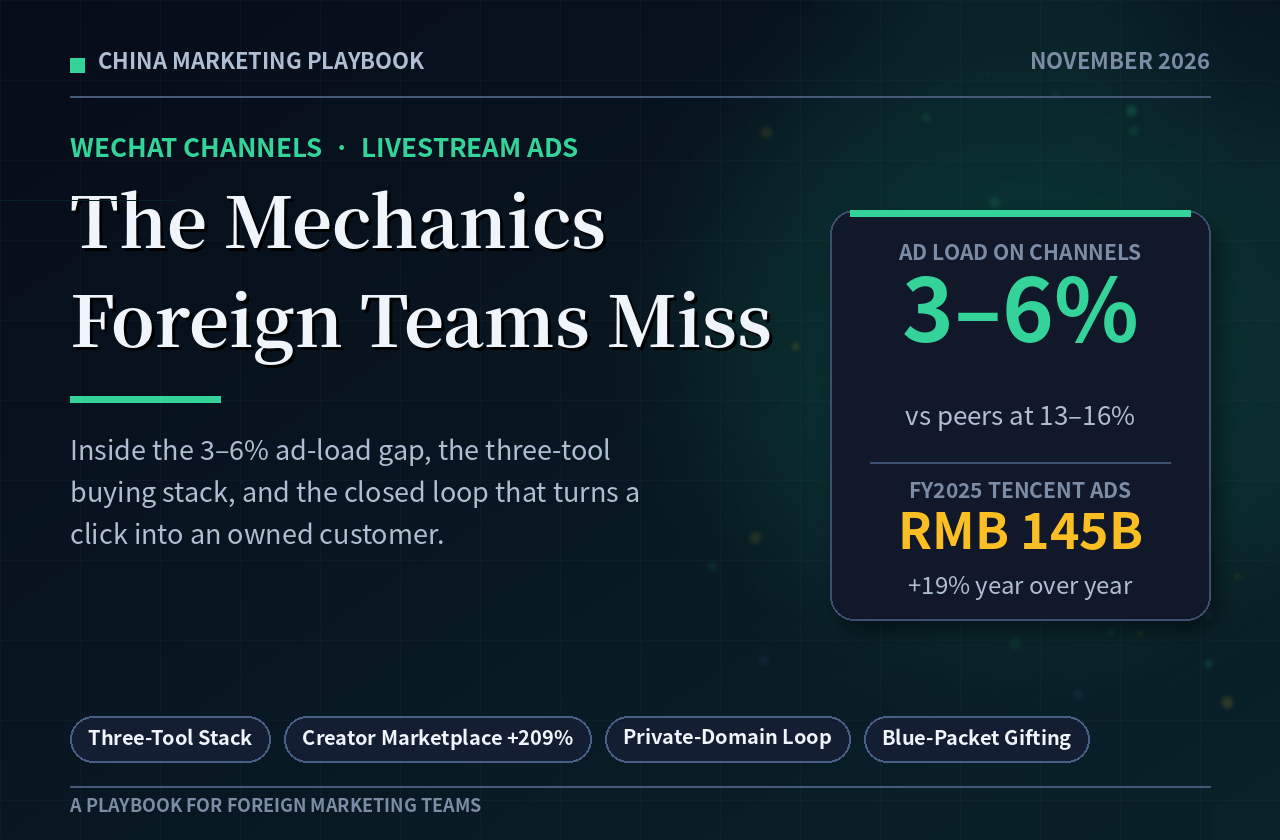
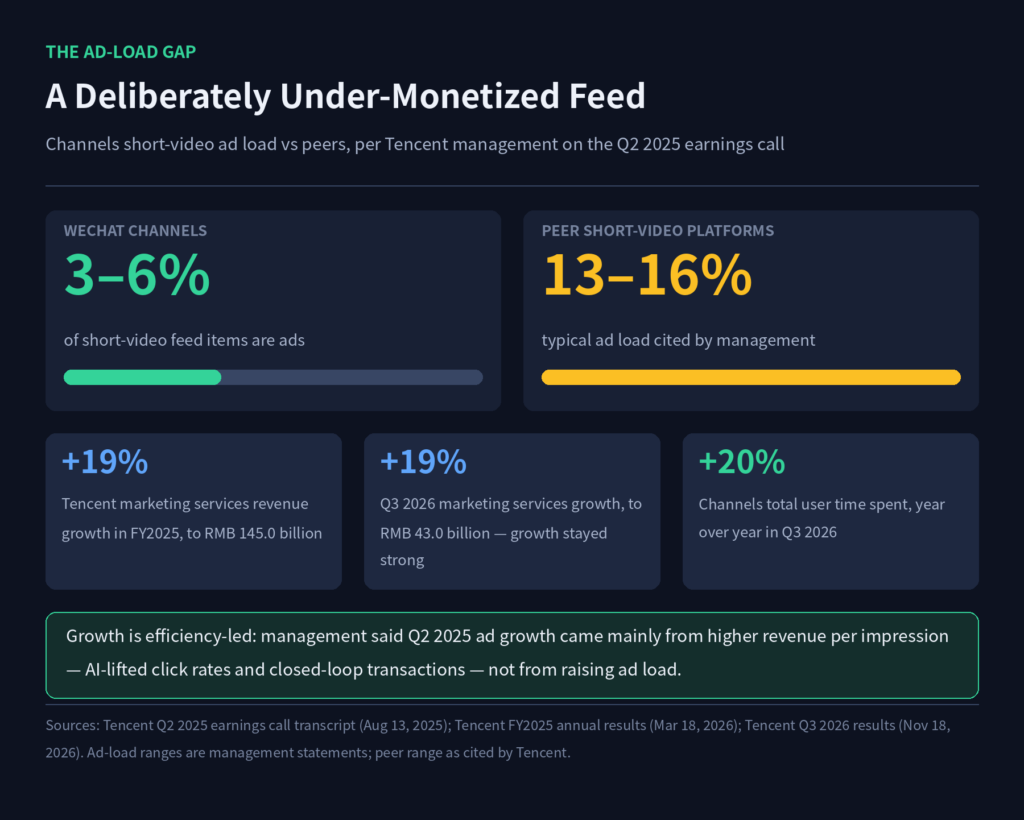
Open Tencent’s latest earnings deck and you’ll find a strange kind of brag: management telling investors, essentially, that we could show a lot more ads than we do. On the Q2 2025 earnings call, Tencent’s chief strategy officer put numbers on it. Short-video ad load on WeChat Channels sits around 3–6%. Peers run at 13–16%. Read that again. The fastest-growing ad surface inside China’s most-used app is deliberately carrying roughly a third of the advertising its competitors squeeze into comparable feeds.
Most foreign teams look at Channels and see “China’s TikTok clone, but smaller.” That misreading costs them real money. Channels isn’t a smaller TikTok. It’s a different machine — a trust-weighted feed bolted onto a 1.4-billion-user relationship graph, with three separate buying tools, a checkout that never leaves the app, and an ad endpoint that isn’t a sale at all. It’s an owned contact.
This playbook walks through the mechanics that don’t survive the translation into English dashboards: the ad-load gap and why it’s an opportunity rather than a weakness, the three-tool stack most agencies collapse into one, the livestream-specific formats, and the private-domain capture loop that turns a media buy into a compounding asset.
The Numbers That Frame the Opportunity
Let’s anchor on what Tencent actually discloses, because this topic is a minefield of broker estimates dressed up as facts.
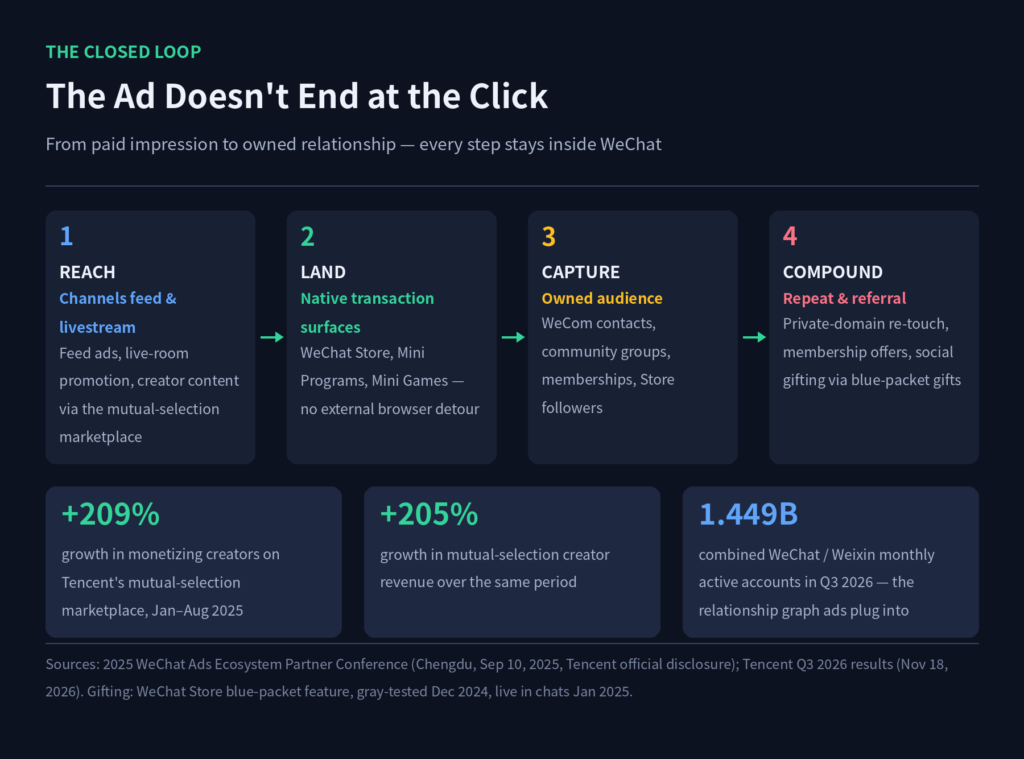
For full-year 2025, Tencent’s marketing services revenue grew 19% to RMB 145.0 billion (precisely 144.97 billion), with Q4 alone at RMB 41.1 billion, up 17%. The freshest quarter — Q3 2026, reported November 18, 2026 — kept the streak alive: marketing services revenue of RMB 43.05 billion, up 19% year over year, contributing nearly half of the group’s total revenue increase. Combined WeChat and Weixin monthly active accounts reached 1.449 billion, and total user time spent on Channels grew more than 20% year over year.
Notice what’s absent from every official filing: a standalone Channels ad-revenue number, a Channels DAU figure, or any confirmation that Channels ad revenue has overtaken Moments. Broker estimates fill that vacuum — and they contradict each other. Some sell-side models put Channels ahead of Moments by late 2025; others still rank Moments first. Tencent itself has only confirmed that Channels user time surpassed Moments years ago, and management has said short-video feeds should eventually out-monetize social feeds, citing Meta’s trajectory. Treat any precise Channels revenue or DAU figure you see in a pitch deck as an estimate, not a disclosure. We’ll do the same here.
Why the Ad-Load Gap Is a Feature, Not a Bug
Here’s the part foreign teams routinely get backwards. A 3–6% ad load isn’t Channels failing to monetize. It’s WeChat’s product philosophy — the long-standing principle of not annoying the user — encoded as an inventory decision. WeChat treats attention as a shared commons it has to protect, because the same feed sits two taps away from your family group chat.
And the growth still shows up. On that same Q2 2025 call, management broke down the 20% ad-revenue growth: the biggest driver was higher revenue per impression, powered by AI-improved click-through rates and more closed-loop transactions lifting revenue per click. Second came more impressions from Channels and Search traffic growth. Ad load, management explicitly said, was not really a driver that quarter.
Think about what that means for you as an advertiser. You’re buying into a feed where the platform is squeezing more value out of each ad slot instead of flooding the zone with slots. Scarcity keeps user tolerance high, which keeps click quality high. And the runway — the gap between 3–6% and 13–16% — is inventory Tencent can release gradually for years without ever shocking the ecosystem. Restraint today is your pricing power tomorrow.
The Three-Tool Stack Everyone Collapses Into One
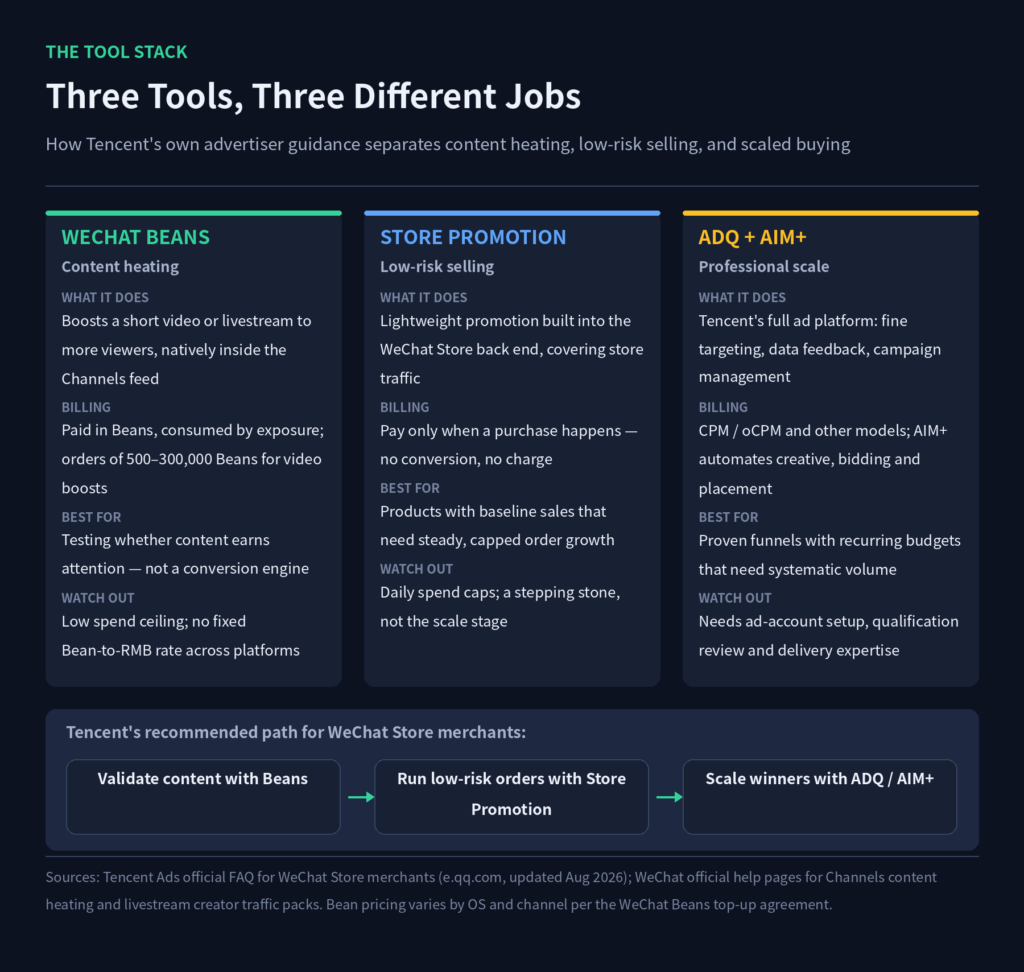
Ask a typical overseas agency how to buy Channels traffic and you’ll hear “boost posts or run ads.” Tencent’s own advertiser guidance is more precise than that. As of its August 2026 official FAQ for WeChat Store merchants, there are three distinct tools solving three distinct problems — and treating them as good-better-best tiers of the same thing is the classic beginner error.
WeChat Beans: The Content Thermometer
WeChat Beans is the native heating tool inside Channels. From the creator center, you spend Beans to push a short video or a livestream room to more viewers. Short-video boost orders run 500 to 300,000 Beans, in multiples of 500. The boosted content appears natively — WeChat’s official help pages state heating is not treated as fake traffic and does not affect the content’s organic distribution.
But read the fine print that trips up foreign teams: Beans are a virtual item, and the top-up agreement explicitly says pricing differs across operating systems and channels, with balances that don’t transfer between them. There is no single honest Beans-to-dollar exchange rate you can put in a global media plan. And Tencent’s own FAQ is blunt about the tool’s job: Beans validate whether content earns attention. They are a thermometer, not a conversion engine, with a deliberately low spend ceiling.
Store Promotion: The Pay-Per-Conversion Middle Gear
The second tool barely exists in English-language playbooks: the lightweight promotion built into the WeChat Store back end. Its defining mechanic is radical simplicity — no conversion, no charge. You pay only when a purchase happens. Daily spend caps keep it a steady, low-risk order-growing tool for products that already sell organically. For a foreign brand testing China commerce without an agency retainer, this is often the correct starting line, not Beans and not ADQ.
ADQ and AIM+: The Professional Engine
ADQ — Tencent’s ad delivery platform, the artist formerly known as Guangdiantong — is where serious budgets live: fine-grained targeting, conversion data feedback, campaign structures, CPM and oCPM buying across Tencent’s full inventory. Since 2025 it’s been layered with AIM+, Tencent’s smart-delivery product matrix that automates the path from creative production to bidding to placement. The scenario products carry the nickname “Amy”: Store Amy, Content Amy and Leads Amy existed first; App Amy and Product Amy joined in Q4 2025. Tencent says its one-click AI creative selection lifts creative supply fivefold versus manual picking — a vendor claim from Tencent’s own results release, so weight it accordingly, but the direction is unmistakable: Channels buying is going autopilot.
Tencent’s recommended path strings the three together: validate content with Beans, run low-risk orders with Store Promotion, then scale proven winners through ADQ and AIM+. Three tools, three jobs, one ladder.
The Mutual-Selection Marketplace: Creator Trust as Ad Inventory
Between official ad buying and organic content sits a third surface foreign teams rarely use well: the mutual-selection platform, Tencent’s creator marketplace where brands and Channels creators negotiate sponsored content directly.
The growth here is not subtle. At the September 2025 WeChat Ads Ecosystem Partner Conference in Chengdu, Tencent disclosed that from January to August 2025, the number of monetizing creators on the mutual-selection platform rose 209% year over year, and creator revenue through it rose 205%. That’s official conference disclosure, not a broker guess — and the near-parity of the two numbers tells you the boom is broad-based, spreading from head creators into the mid-tier, not just inflating a few superstar contracts.
The mechanic that matters for your media plan: per Tencent’s FY2025 results release, advertisers can now promote authorized content as ad material — their own published Channels posts, mutual-selection sponsored videos, and partnered creator content. Read that as a fusion of influencer marketing and paid media. You’re not choosing between “creator trust” and “paid reach.” You commission the creator video, then amplify the exact asset through the ad system, with authorization intact. On a feed where distribution is weighted by social endorsement, borrowed trust plus paid amplification is the closest thing Channels has to a cheat code.
Livestream-Specific Mechanics: Formats Foreign Dashboards Don’t Show
Channels livestream advertising isn’t one button. The working formats include live-room promotion (pushing the stream itself into discovery surfaces), short-video-to-livestream funnels (a boosted clip that carries a live badge into the room), and reservation ads that bank an audience before you go on air. On the AIM+ side, dedicated livestream scenarios exist — including a dual-link mode that promotes the live room and a store product card simultaneously, switching to product-only promotion when the stream ends. That last detail solves a real problem: your ad spend keeps converting after the host says goodnight.
The heating-versus-ADQ choice inside livestreams follows the same logic as the tool stack. Beans heating is cheap, native and immediate — useful for cold-starting a room, testing a host, or nudging a stream that’s already trending. Official livestream heating even includes a cost-guarantee mechanism that refunds excess spend as traffic coupons when conversion costs overshoot targets under qualifying conditions. ADQ buying is the scalable, targeted layer for rooms with proven conversion. Serious operators run both: Beans to test and warm, ADQ to scale what works.
One more trust detail worth internalizing: Channels comments sit on real-name social identities. Your livestream’s comment section is visibly populated by people whose friends can see them. That suppresses the bot-chorus feel of other platforms — and it means a hostile comment thread is a social event, not just a moderation queue. Staff it accordingly.
The Closed Loop: No Browser Detour, No Lost Clicks
Here is the quiet structural advantage. When a user clicks a Channels ad, they land on a WeChat Store product page, a Mini Program, or a Mini Game — native surfaces inside the same app. No external browser. No app switch. No cookie-consent interstitial. Payment runs through WeChat Pay, already trusted, already funded.
Tencent’s filings keep pointing at this as a revenue driver: the rising share of closed-loop ads — clicks that land directly in native transaction scenes — is explicitly credited with lifting revenue per click. Every removed hop is recovered conversion probability. If your China plan still routes Channels clicks to a translated global website, you are voluntarily reinstalling every point of friction the ecosystem was designed to delete. Build the Store or Mini Program landing first; treat your .com as the brochure, not the checkout.
Private-Domain Capture: The Ad That Ends in a Relationship
Now the mechanism that genuinely has no Western equivalent at this scale. On Channels, the smart endpoint of an ad isn’t the order — it’s the owned relationship. Viewers become WeCom (enterprise WeChat) contacts, community group members, program enrollees, Store followers. The public-traffic click converts into a private-domain asset you can re-touch without paying the auction again.
Run the arithmetic. A last-click ROAS frame says a campaign that breaks even failed. A capture frame says the same campaign acquired a thousand re-touchable contacts inside the app those people open dozens of times a day — and the second purchase, the third, the referral, all arrive without re-buying the impression. The ad is acquisition; the private domain is retention; the loop is the business model.
But — and this is where foreign pilots die — capture without operations is a leaky bucket. WeCom contacts and community groups need staffing: welcome flows, content cadence, human replies, membership mechanics. Budget the ops team before you scale the media, or you’ll pay to fill a pool with no bottom.
The Gifting Loop: When Your Customer Becomes the Channel
In December 2024, WeChat began gray-testing a feature that completes this picture: gifting through WeChat Store. Buy a product, send it to a friend as a blue envelope — the “blue packet” — and the recipient fills in their own address to claim it. The chat-window entry went live January 17, 2025, days before Lunar New Year, and extended to group chats on January 25. By May 2025, livestream rooms could run blue-packet gift draws as a cleaner replacement for traditional lucky bags.
The results were immediate and documented. Beijing Daily reported that during the 2025 holiday season, broadcaster-turned-retailer East Buy’s WeChat Store gift orders jumped over 1,600% on New Year’s Day versus the prior day, exceeded 50,000 orders on Lunar New Year’s Eve with daily GMV above RMB 5 million, and that gifting reached 85% of the store’s total orders — with lower return rates than ordinary orders. (Those are merchant-disclosed figures relayed via Tencent’s official creator program account, so treat them as a showcased case, not an industry average.)
The strategic point outlives the holiday spike: in the gifting flow, the buyer is your customer and the recipient is your next prospect, acquired through a friend’s endorsement rather than an auction. Products as social messages — that’s the design philosophy WeChat’s leadership has articulated publicly, and it’s why gifting plugs into livestreams, creator showcases and Store pages alike. For categories with emotional value — food, flowers, books, wellness — the gift loop is a legitimate acquisition channel, not a gimmick.
The Practitioner Playbook: Five Moves in Order
Pulling the mechanics together, here’s the sequence we’d run for a foreign brand entering Channels:
- Pick the tool by the job. Beans to test content heat, Store Promotion for no-conversion-no-charge order growth, ADQ/AIM+ for scaled targeted buying. Don’t skip the ladder; don’t camp on the first rung.
- Build native landing before spending. WeChat Store or Mini Program with WeChat Pay. The closed loop is the conversion strategy — your global site is not.
- Wire capture into every campaign. WeCom adds, group joins, membership enrollments as explicit campaign objectives, with ops staffed before scale.
- Commission creators, then amplify. Use mutual-selection to buy trusted content, then promote the authorized asset as ad material. Trust first, reach second.
- Measure the loop, not the click. Track captured-contact cost and 90-day private-domain revenue alongside ROAS. A break-even first order with a thousand captured contacts is a win; a “profitable” last-click campaign that captures nothing is a rental.
Risks and Honest Caveats
Four things to hold in mind before you brief the CFO.
First, the runway releases slowly. Management has repeated for years that ad load stays far below peers by design; the FY2025 release still describes load increases as modest. Don’t build a plan that assumes Douyin-level inventory arrives next year.
Second, the estimate minefield is real. Channels DAU figures, standalone ad-revenue numbers and overtake-Moments claims circulate widely, conflict with each other, and carry no official confirmation. This article deliberately uses none of them as facts.
Third, the economics have a cost side. In Q3 2026, marketing services gross margin fell from 57% to 52% year over year — Tencent attributed the decline to AI-related operating costs and short-drama content costs. The efficiency story is real, but it isn’t free, and platform economics will shape pricing.
Fourth, you’re a tenant. Everything here — heating rules, closed-loop surfaces, gifting categories, capture mechanics — lives under WeChat’s governance. Rules change; categories get excluded (gifting, for instance, excludes jewelry and education categories above certain thresholds); accounts get restricted. The moat you build is the relationship with your customers, but the land it sits on belongs to Tencent. Diversify capture into your own CRM exports where permitted, and read the platform’s terms like the contract they are.
Conclusion: Restraint Is the Runway, Relationships Are the Moat
WeChat Channels livestream advertising is closed-loop, trust-feed media with a long, deliberately gated inventory runway. The mechanics foreign teams miss are now on the table: a 3–6% ad load against peers’ 13–16% that signals opportunity rather than weakness; a three-tool stack — Beans, Store Promotion, ADQ/AIM+ — that Tencent itself says to climb in order; a creator marketplace growing over 200% whose content doubles as authorized ad material; a checkout with no browser detour; and a capture loop that ends campaigns in owned relationships, with social gifting turning customers into acquisition channels.
The reusable lesson fits in one line: on Channels, the ad doesn’t end at the click — it ends at the relationship. Buy accordingly, staff accordingly, measure accordingly. The restraint is the runway. The private domain is the moat. And the teams that understand both are buying tomorrow’s inventory at today’s understanding.





