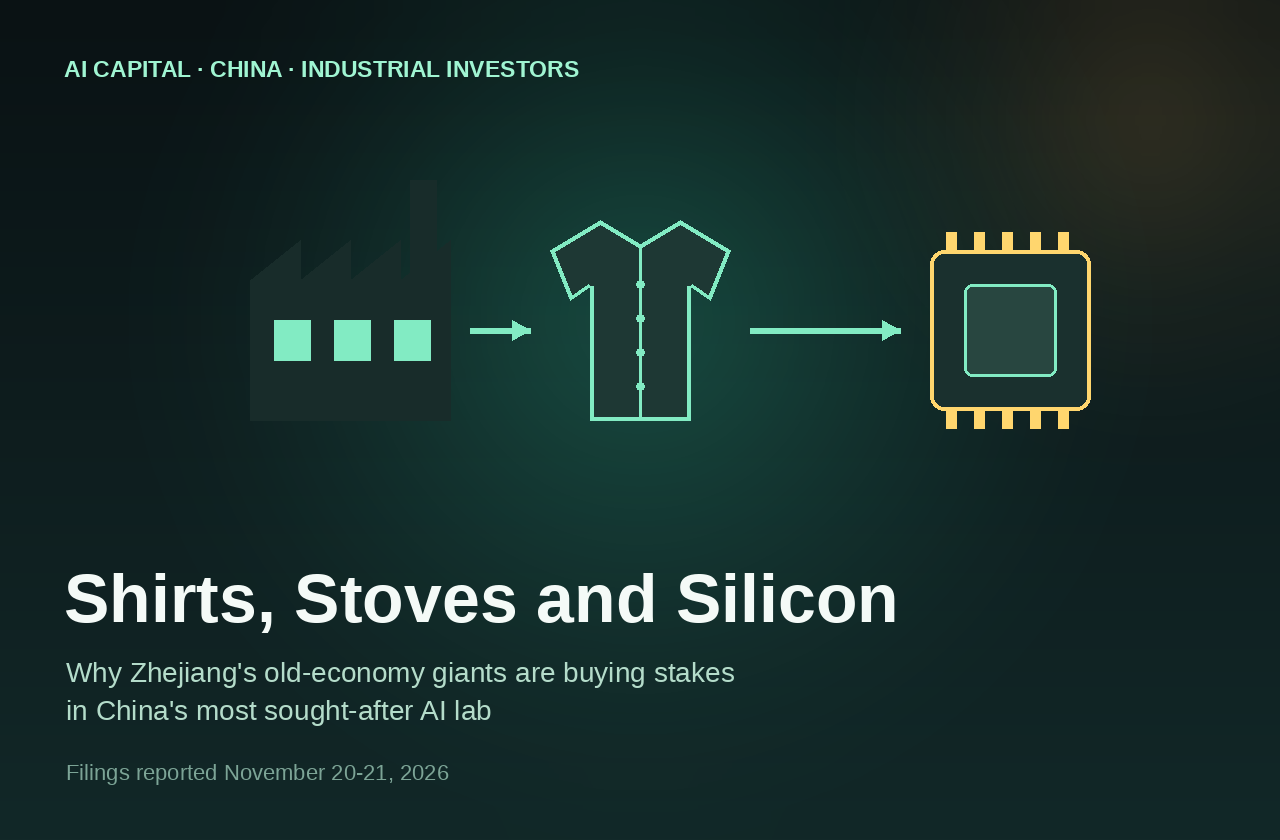
The most interesting investors in China’s hottest AI lab don’t build software. They build shirts, kitchen hoods, magnetic materials and logistics networks. Filings reported this week by National Business Daily and confirmed in November 21 morning coverage reveal that twelve listed companies — most of them Zhejiang industrial stalwarts — have bought indirect stakes in DeepSeek through a three-layer structure that says as much about Chinese capitalism as about artificial intelligence.
Follow the chain, because the structure is the story. The twelve companies subscribed roughly 84% of a 1.65-billion-yuan private fund called Hengdian Baihui, managed by Hengdian Capital. That fund holds 1.43% of an investment vehicle named Hangzhou Chengyan. And Hangzhou Chengyan, per business-registry changes reported November 19, now owns about 17.27% of DeepSeek’s operating entity, whose registered capital rose roughly 21% to 19.92 million yuan. Multiply the layers through and the fund’s look-through stake in DeepSeek is a fraction of one percent. Nobody is buying control. Everybody is buying a seat.
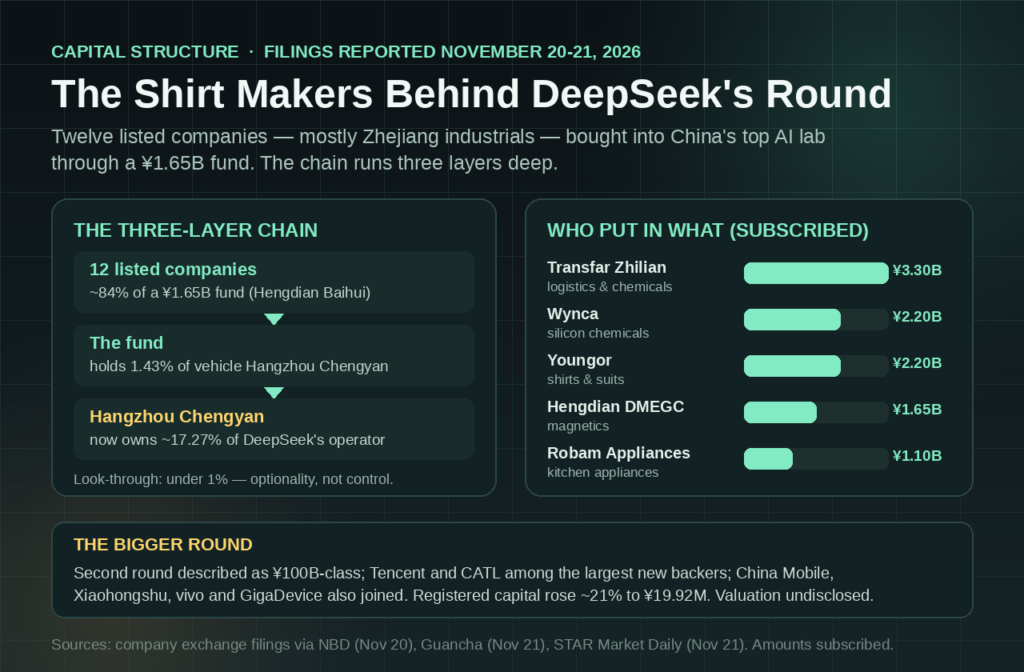
The leaderboard reads like a tour of the old economy. Transfar Zhilian — logistics and chemicals — put in 330 million yuan, a fifth of the fund. Wynca, a silicon-chemicals producer, and Youngor, which started with dress shirts, subscribed 220 million each. Hengdian DMEGC, a magnetics maker from the conglomerate behind the world’s largest film-studio lot, added 165 million. Robam Appliances, the kitchen-hood specialist, committed 110 million. Also in: a sock manufacturer, a lighting company, a futures broker. Their stated rationale, per the filings, blends industrial synergy with financial investment — logistics, chemicals and manufacturing owners want large-model capabilities inside their own transformation plans, and they want exposure to the asset appreciating fastest in China.
Zoom out and this fund is a rounding error in a round the market is calling “phenomenal.” The second financing is described in Chinese financial media as 100-billion-yuan-class and heavily oversubscribed, with Tencent and CATL among the largest new backers, joined by China Mobile, chipmaker GigaDevice, lifestyle platform Xiaohongshu and phone maker vivo. The valuation was not disclosed. Against that company, a shirt maker’s 220-million-yuan ticket is not a strategic bet — it is an option premium, paid to stay adjacent to whatever DeepSeek becomes.
The timing makes the contrast sharper. This capital came together in the same week public-market AI stocks suffered their worst selloff of the cycle, an SEC accounting probe was reported at Nvidia, and bond investors demanded high-yield spreads on investment-grade AI paper. Private investors in China are paying up for scarcity while public investors elsewhere are marking down abundance. Both are rational: DeepSeek’s open-weight models are, per this week’s People’s Daily report, part of an ecosystem with ten billion global downloads — and access to its equity has been almost impossible to buy at any price.
For business operators watching from outside China, two lessons travel. First, the fund-of-funds pathway — pooled industrial capital, professional GP, minority vehicle, look-through fractions — is how traditional companies everywhere will get AI exposure without pretending to become AI companies. A manufacturer doesn’t need 5% of a frontier lab; it needs a relationship, information rights and a call option. Second, watch what these LPs do next: if Youngor’s supply chain or Robam’s customer service starts running DeepSeek-powered workflows, the equity ticket will have bought something no vendor contract can — priority. The shirts-and-stoves coalition is not a quirky footnote to China’s AI story. It is the demand side, buying its way into the supply side, one subscribed yuan at a time.