Two earnings reports this month quietly answered the question the entertainment industry has been arguing about for two years: does AI-generated video actually make money? iQiyi and Tencent, reporting third-quarter results within days of each other, both said yes — from opposite ends of the business. One is using AI to collapse production costs. The other is using AI-made dramas to mint new advertising inventory inside WeChat. Together they sketch the first credible P&L for AI content.
Start with the cost side. On iQiyi’s November 16 earnings call, chief content officer Wang Xiaohui laid out a two-track strategy: AI-generated content for supply volume, and live-action-plus-AI hybrid production for prestige formats. The numbers are no longer hypothetical. In September, AIGC micro-dramas accounted for nearly 90% of the platform’s micro-drama content volume and nearly 80% of views. The quarter saw 21 AIGC mid-length dramas launched, with supply expected to double in 2027. Three AI-generated films in the Ferry Man franchise earned over 14 million yuan in revenue share — each recouping its production cost in week one. Some AI animations cut production costs 50–80% and cycles by up to 80%. And the frontier is moving upmarket: roughly 20 long-form drama projects are in production using hybrid live-action and AI, with the deepest integration slated for 2027.
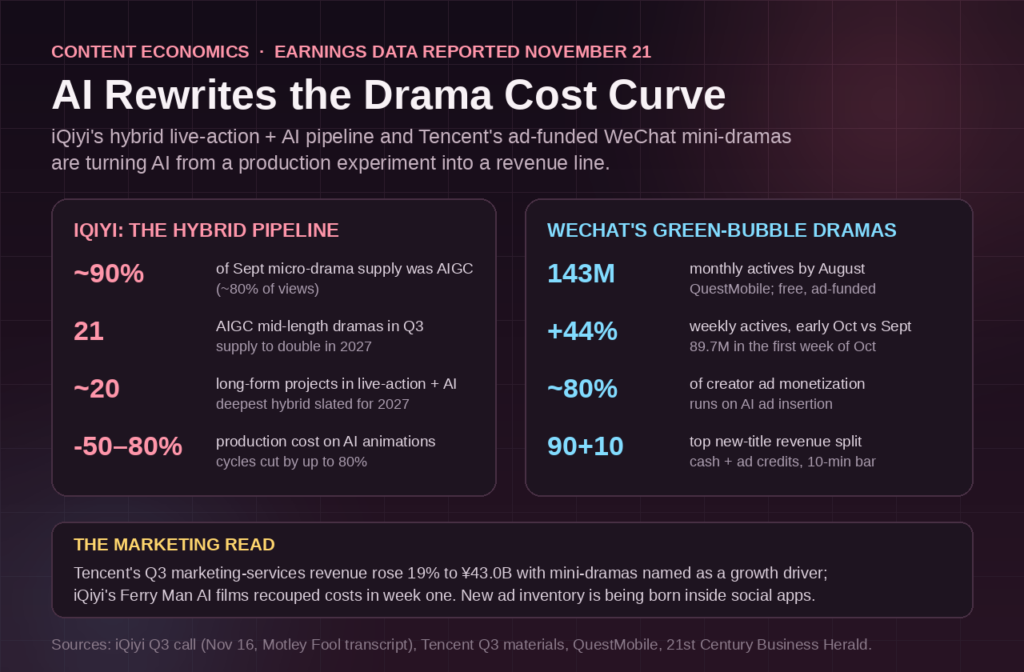
Tencent’s side of the ledger is about distribution. Green Bubble, WeChat’s official free mini-drama program, launched in its current form on October 14 with no standalone app: everything is free, ads between episodes pay the bills, and distribution runs on WeChat’s social graph — “friends are watching” recommendations, group shares, video-account clips that jump straight into full episodes. QuestMobile counted 143 million monthly active users by August; weekly actives hit 89.7 million in early October, up 44% from early September. Tencent’s own earnings materials name the drama entry as a driver of mini-program advertising growth within a marketing-services line that rose 19% to 43 billion yuan — and AI ad-insertion now supports roughly 80% of creators’ ad monetization. To pull content in, WeChat offers top new titles a split of 90% cash plus 10% ad credits, gated on viewers averaging at least ten minutes per session.
That ten-minute gate is the detail marketers should study. ByteDance’s Hongguo pays for clicks at scale; WeChat is explicitly paying for retention. It is a bet that social distribution can deliver engaged viewers without the buy-traffic arms race that consumes the bulk of Hongguo-ecosystem revenue — and a signal that the short-drama industry’s center of gravity is shifting from traffic arbitrage to content economics.
For brands, the actionable conclusion is that a new ad surface is being born inside the world’s largest super-app, stocked partly by algorithms at a fraction of traditional production cost. Placement inventory, AI-inserted ad formats and IP adaptations from China Literature’s novel library are all scaling now, while pricing is still in its land-grab phase. The studios that survive this transition may not employ camera crews. The media buyers who arrive early may not face 2027’s rate card.