Most brand mascots are finished products: drawn, trademarked, broadcast. The “Chinese Horse” that Chinese childrenswear giant Balabala sent galloping across X, YouTube, Instagram and Douyin this season is something stranger and smarter — an unfinished one. As Wenzhou Evening News reported on November 21, the brand deliberately released the horse not as a final asset but as an open co-creation medium, inviting families around the world to redraw it. The brand reports its heritage-style childrenswear line has now passed 100 million yuan — roughly $14 million — in sales.
The construction of the asset is worth unpacking because every layer does a job. The master design came from French artist Pierre Guignard, a long-time China resident who specializes in translating Chinese culture into visuals children everywhere can read; his horse carries ingots, auspicious clouds and Chinese knots in a deliberately playful register. The storytelling layer is a short drama, Flying Little Horse, co-made with Xu Xiaoxue, an inheritor of intangible-heritage knot-craft — giving the IP both a narrative and institutional cultural credibility. Then comes the inversion: instead of protecting the design, Balabala opened it. Thousands of family-made remixes now circulate on platforms spanning both the Chinese and global internet, each one unpaid distribution that no media budget could buy.
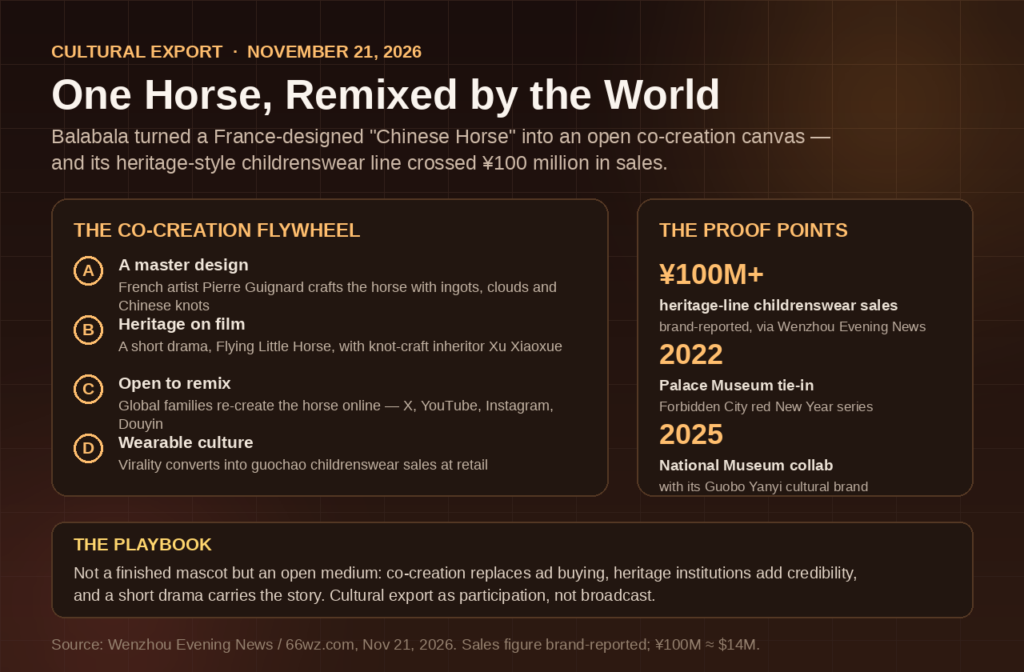
This is not a one-off viral accident but the output of a system Balabala calls the Oriental Treasure Program. In 2022 it worked with the Palace Museum’s Baoyunlou on a Forbidden City red New Year collection; in 2025 it partnered with the National Museum’s cultural brand Guobo Yanyi. The through-line, as Balabala business unit general manager Zhou Junwu told the paper, is using shared emotional narratives to dissolve cultural barriers and build perception of Chinese culture and Chinese brands among young overseas audiences. The horse sits inside a broader IP portfolio that also runs the conventional direction — licensed collaborations with My Little Pony, Ultraman, Sanrio and Warner Bros. Discovery properties — making Balabala a rare brand running cultural import and export simultaneously.
The timing sharpens the case. The Lunar Year of the Horse arrives in early 2027, which means the remixable horse is an asset appreciating toward its own holiday marketing moment — every family共创 between now and Spring Festival compounds the IP’s reach before the seasonal sales peak. And the report situates the campaign inside Wenzhou Ouhai’s digital-culture cluster, where animation studios are converting web-novel IP into short dramas for overseas platforms: cultural export is industrializing, with co-creation as one of its assembly lines.
For global marketers, the transferable mechanics are precise. Commission a master design from a credible cross-cultural artist rather than an in-house committee. Anchor it with a heritage partner whose authority you cannot fake. Carry the story in short-drama form, the format both audiences already watch. Then — the hard part for brand guardians — let go: open the asset to remixing and treat every derivative as earned media. The brand that reports nine-figure sales from a horse it doesn’t fully control has made the argument better than any case study could: in cultural marketing, ownership of the finish line matters less than ownership of the starting line.