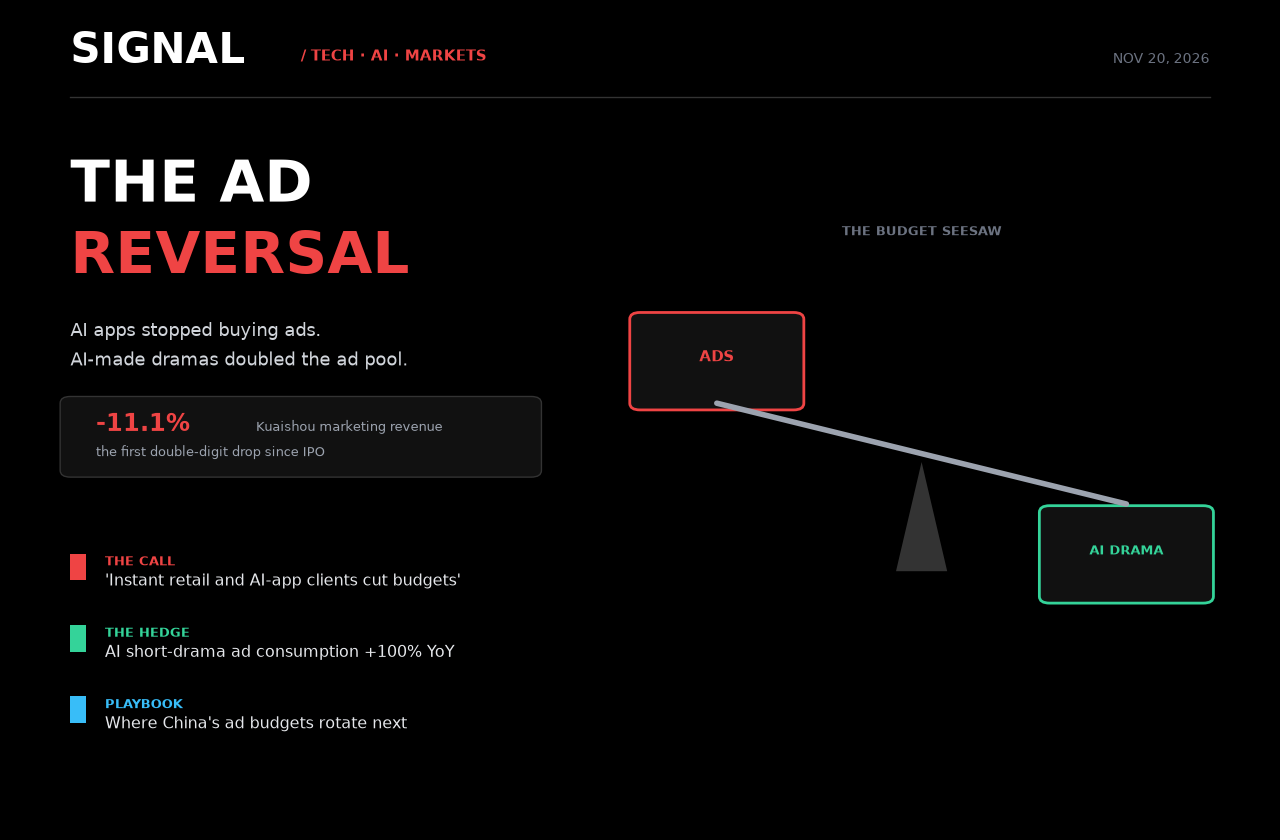
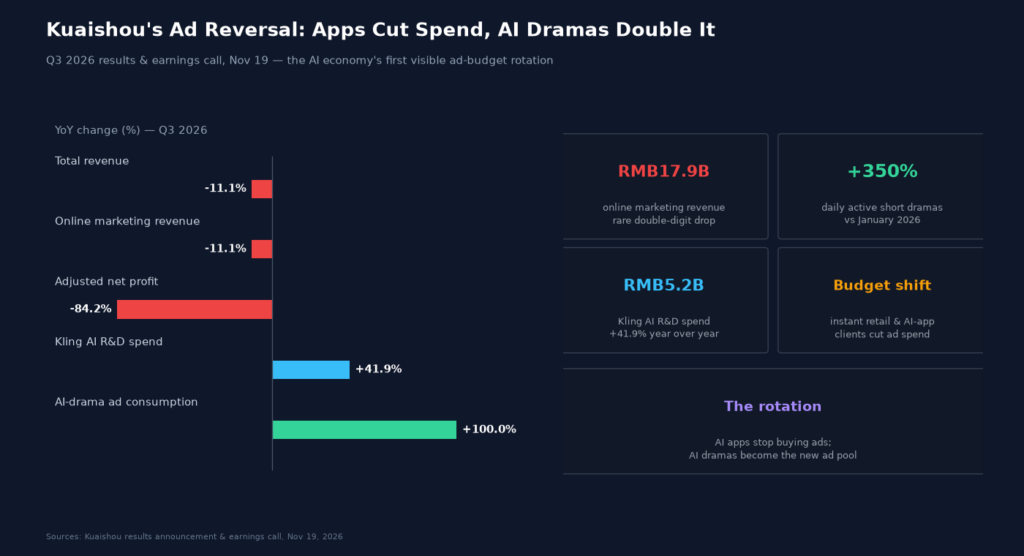
The most instructive advertising data point of the quarter came from a company most Western marketers rarely track. Kuaishou, China’s second-largest short-video platform, reported third-quarter results on November 19 that contained a rare and revealing combination: online marketing services revenue fell 11.1% year over year to RMB17.9 billion — the first double-digit advertising decline since its IPO — while total revenue also dropped 11.1% and adjusted net profit collapsed 84.2% to RMB790 million, with the company swinging to a RMB959 million net loss. The profit story is easy to tell: R&D for its Kling AI video models rose 41.9% to RMB5.2 billion, crushing domestic operating profit from RMB5.4 billion a year ago to RMB420 million. But the advertising story, detailed on the earnings call, is the one that should travel: management said marketing budgets from instant-retail and AI-application clients declined noticeably — the companies building the AI economy have started cutting their ad spend — while AI-generated short dramas doubled content-consumption ad spending year over year, with daily active short-drama users up 350% since January. The AI economy is eating its own customer acquisition budget and regurgitating it as AI content inventory. That rotation is a preview of what happens to ad markets everywhere as AI matures.
Why the AI apps stopped spending
The mechanism is worth understanding because it generalizes. China’s AI-application sector spent the past two years in a land-grab: consumer chatbots, AI companions, productivity tools and image generators bought installs at venture-subsidized prices, becoming a visible share of short-video platforms’ performance-ad revenue. Two forces ended the party simultaneously. DeepSeek’s free-tier throttling and the broader compute squeeze raised the cost of serving each acquired user, making marginal installs unprofitable; and the funding environment — the same hawkish rates and AI-skepticism documented in US fund-manager surveys — tightened the venture faucet that funded the spending. When your product’s unit economics deteriorate and your capital gets expensive, performance marketing is the first line cut, because it is the most discretionary. Kuaishou’s call is the first major-platform confirmation that this correction has arrived at scale. The parallel to watch: US AI apps have been among the fastest-growing mobile advertisers; if their Chinese peers are cutting, the same math is being run in Palo Alto boardrooms.
What replaced the budget: the AI content flywheel
The other half of the disclosure is more surprising. AI-generated short dramas — serialized vertical-video fiction produced substantially with generative tools — doubled the ad consumption they drive, and daily active drama users grew 350% in ten months. The economics form a closed loop: AI collapses production cost per episode, volume explodes, cheap content acquires cheap attention, and that attention is monetized through in-app advertising (the IAA model) whose buyers are… other apps, games, and e-commerce merchants seeking the cheapest converting inventory in the market. Kling’s own earnings-call updates reinforce the loop’s supply side: version 4.0 lifted revenue with user and ARPPU growth, director Lu Chuan publicly endorsed some outputs as reaching final-cut quality, and the company’s enterprise AI platform grew revenue 90% quarter over quarter. The platform is simultaneously the tool vendor, the content host, and the ad exchange for the AI content economy — a vertical integration that traditional studios and agencies cannot replicate.
The contrast with the rest of China’s ad market sharpens the lesson. The same week, Alibaba’s AI cloud grew 53% and Tencent’s marketing services grew 19% — AI monetization is booming in enterprise infrastructure and in closed-loop commerce, while open-ended app-install advertising contracts. Budgets are not disappearing; they are migrating from buying users to buying transactions and from human-made content costs to machine-made content volume. Kuaishou sits unhappily at the intersection: its legacy ad business depends on the spending category that is shrinking, while its AI bet consumes the profit that would cushion the transition.
A playbook for marketers watching this rotation
Three moves follow, whether or not you operate in China. First, if you sell AI applications, audit your own acquisition math against the Chinese correction: rising inference costs plus tightening capital means LTV assumptions built on 2025 serving costs are stale, and the platforms will feel your cuts before your users do. Second, if you buy media, the AI-drama IAA channel deserves a structured test — it is currently the cheapest attention with documented conversion behavior, but brand-safety review of machine-generated serialized content is non-negotiable, and the regulatory perimeter (China’s likeness-rights enforcement and virtual-persona advertising fines) is actively tightening around exactly this inventory. Third, if you make content, read Lu Chuan’s endorsement carefully: “some shots reach final-cut quality” is a professional saying the cost floor of acceptable video has moved, not that judgment is obsolete. The teams winning this rotation are those using AI volume for testing and human judgment for the final ten percent — the same conclusion the week’s other content stories reached from the opposite direction.
An ad platform’s earnings call is usually a lagging indicator. This one is a leading one: it documents, in numbers, the moment the AI economy’s first bubble — subsidized user acquisition — deflated into its second act, machine-made content monetizing machine-cheapened attention. Every ad market with an AI-app cohort and a short-video feed will run some version of this movie. China just showed the first reel.