Ask a room full of marketers to name a subscription business and you will hear the same three answers: Netflix, Spotify, and whatever SaaS tool their finance team complains about. The subscription economy, as the West tells it, is a story about recurring access to intangible things — shows, songs, software. So when analysts say China never really had a subscription moment, they are technically right about the wrong thing. China skipped the Netflix-shaped subscription. Then it quietly built one of the largest paid-membership machines on earth — inside a warehouse.
A Warehouse, Not a Stream
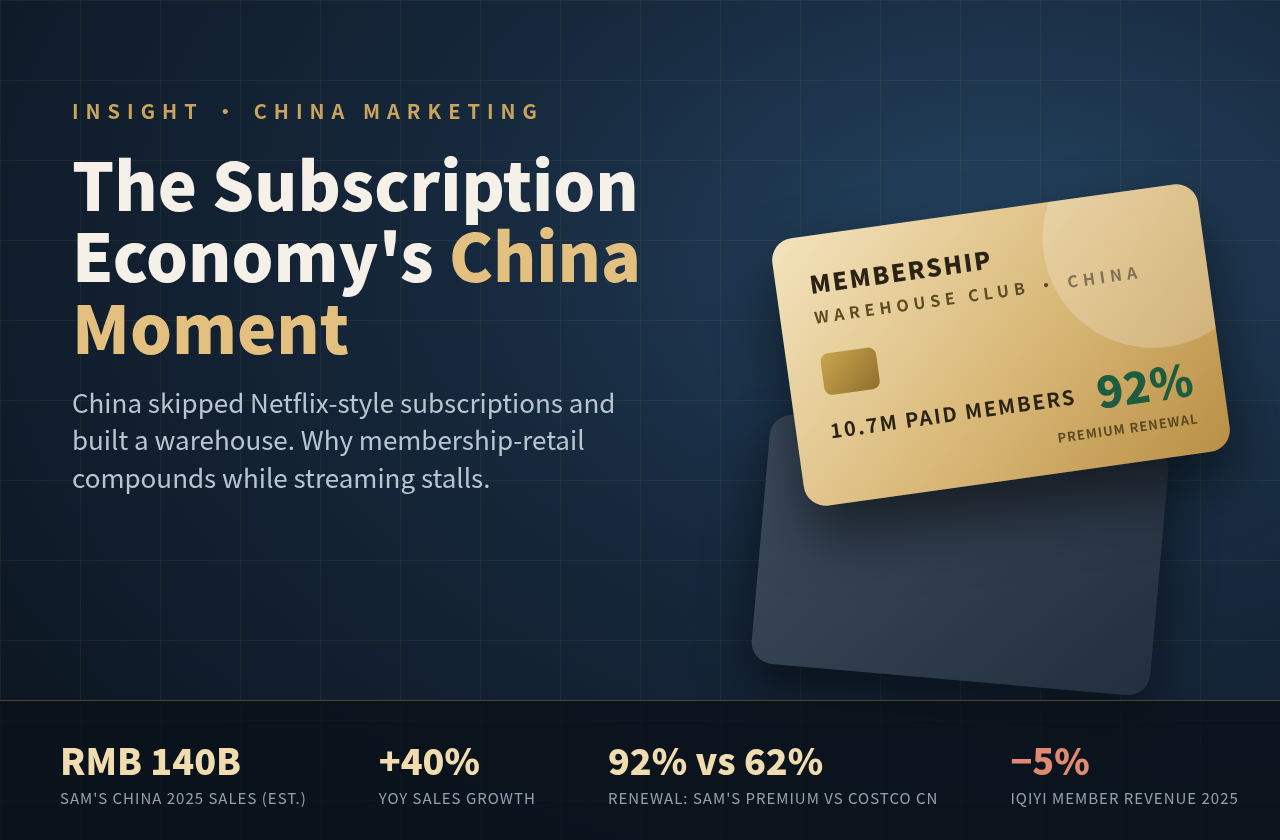
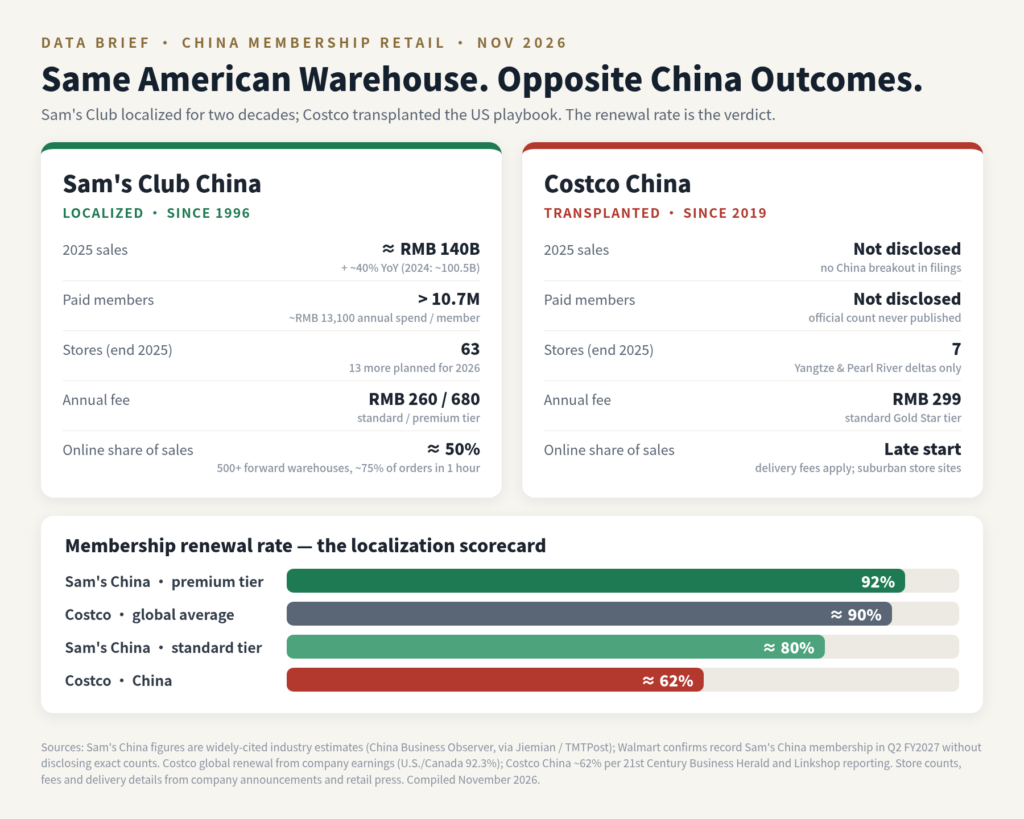
China’s subscription moment is not happening on a screen. It is happening at a checkout gate where you cannot even enter the store without a paid annual card. Sam’s Club China — Walmart’s warehouse-club chain — reportedly crossed RMB 140 billion in sales in 2025, up roughly 40 percent in a single year, on the back of more than 10.7 million paid members. Those are industry estimates rather than audited breakouts, but Walmart’s own earnings calls keep confirming the direction: in its Q2 fiscal 2027 report, released in August 2026, the company said Sam’s Club China membership hit an all-time high, with China net sales up 20.7 percent year over year.
Meanwhile, the subscription model Westerners actually recognize — streaming video — spent 2025 shrinking. Same country, same consumers, opposite trajectories. That gap is the story.
The Numbers Behind China’s Biggest Subscription
Start with the machine itself. Industry trackers, citing trade outlet China Business Observer and echoed across Jiemian and TMTPost, put Sam’s China at roughly RMB 140 billion in 2025 sales versus about RMB 100.5 billion in 2024 — nearly RMB 40 billion of net growth in twelve months. Paid membership passed 10.7 million by the end of 2025. Divide one by the other and the average member household spends around RMB 13,100 a year inside the club.
The renewal numbers are the interesting part. Premium-tier members — who pay RMB 680 a year versus RMB 260 for the standard card — renew at roughly 92 percent. Standard members renew at around 80 percent. Media estimates put annual fee income somewhere between RMB 2.8 billion and RMB 3 billion. The club ended 2025 with 63 stores and plans 13 more in 2026, and Walmart’s official filings show 11 new China clubs opened in the twelve months to July 2026.
The Costco Contrast: Same Flywheel, Different Verdict
Here is the control group in this natural experiment. Costco invented the modern warehouse-club flywheel, and globally it still runs beautifully: fiscal 2025 revenue of about US$275.2 billion, net income of US$8.1 billion, and membership fees of US$5.32 billion — roughly two-thirds of net profit. By fiscal 2026, fees reached about US$5.9 billion against US$11.7 billion of operating income. Worldwide renewal sits near 90 percent, and 92.3 percent in the US and Canada. Nobody doubts the model.
In China, the same model stalls. Costco opened its first mainland store in Shanghai in 2019 to famous opening-day crowds. Six years later it still operates only 7 stores, clustered in the Yangtze and Pearl River deltas. Chinese business press, including 21st Century Business Herald, reports China renewal at roughly 62 percent — a media-cited figure, since Costco discloses only global and North American rates in its filings. Whatever the precise number, the direction is unambiguous: the world’s best membership machine cannot get Chinese members to renew at anything like its home-market rate.
Same brand strength. Same categories. Same fee logic — Costco’s standard China card is RMB 299 a year. The variable that changed is not the model. It is the localization.
Mechanism 1: The Fee as a Trust Filter
Why does an upfront fee work at all in a market famous for price sensitivity? Because the fee is not a price. It is a filter, and a promise.
Pay RMB 260 before you have bought a single egg, and two things happen. The club selects for committed households — families who will actually shop enough to make the math work — and the club, in return, implicitly promises that everything inside the gate has been pre-vetted. Sam’s carries roughly 4,000 SKUs, a fraction of a traditional hypermarket’s tens of thousands, with one to three curated options per category. You are not paying for access to more choice. You are paying for the removal of choice — for someone else to have done the comparison shopping, the supplier audits, the quality rejection.
In a consumer culture where trust is built by verification rather than granted by branding, that promise has to be testable. And it is: you can see the marbling on the beef, taste the Swiss roll, weigh the nuts. The trust is edible. That matters more than it sounds.
Mechanism 2: Member Prices as Recurring Value
A subscription survives renewal only if the subscriber can do the arithmetic. Sam’s members can. The average household spends around RMB 13,100 a year at member prices on curated goods, against a RMB 260 fee — about 2 percent of spend. If curation and bulk pricing save even a few percentage points versus alternative channels, the card pays for itself several times over. Renewal stops being a loyalty decision and becomes a spreadsheet decision.
The premium tier sharpens this. At RMB 680, the top card adds a 2 percent rewards mechanism and monthly delivery vouchers, which is why its break-even sits somewhere around RMB 12,000 to RMB 21,000 of annual spend depending on delivery usage. Heavy households clear that bar easily — and they renew at 92 percent. Notice what the fee is not: it is not the business. Estimated fee income of RMB 2.8–3 billion is roughly 2 percent of Sam’s China sales. The fee funds trust and filters demand; the retail throughput is the business. That is a genuinely different structure from Costco’s global model, where fees effectively are the profit.
Mechanism 3: Localization as the Renewal Engine
Now back to the 92-versus-62 gap, because this is where the story earns its keep.
Sam’s did not arrive localized. Brokerage research from Northeast Securities notes that in the early years roughly 70 percent of Sam’s China SKUs were transplanted directly from the US assortment — and the format struggled for nearly two decades. The turnaround came from rewiring the supply chain around Chinese households: cutting SKUs to about 4,000, building regional products store by store — Shanghai-style braised ready meals, Wuhan hot dry noodle kits, hotpot bases and cured sausages for Sichuan-Chongqing clubs — and leaning into its private label, Member’s Mark, for differentiated staples.
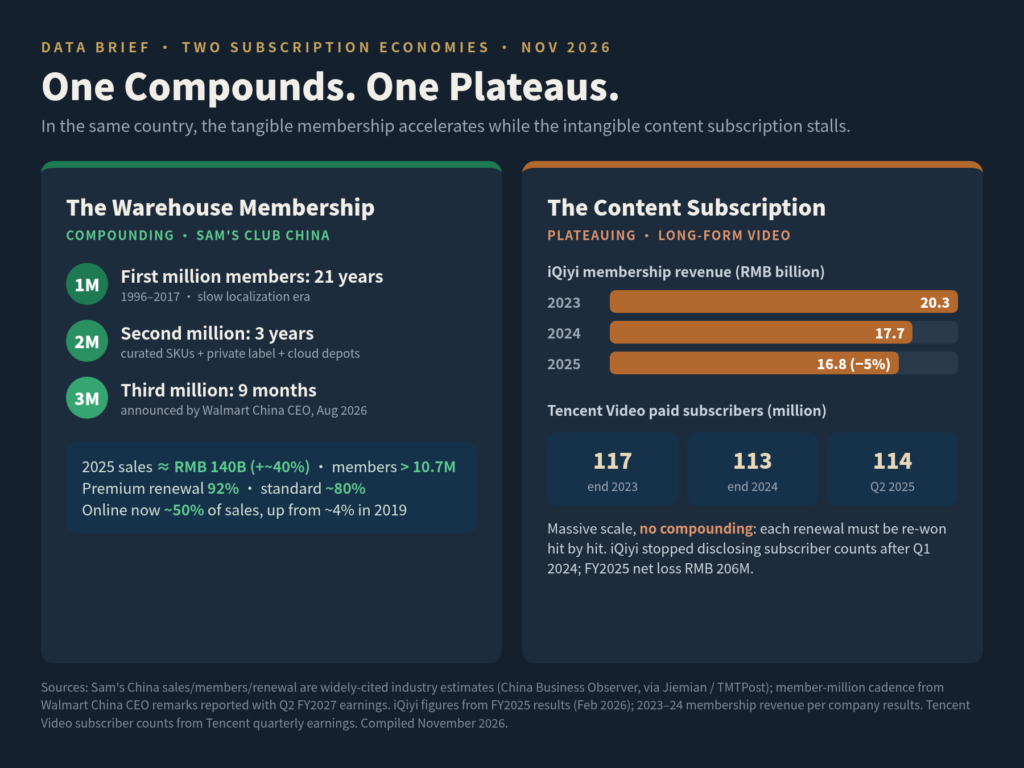
Then it rebuilt delivery around Chinese expectations. Sam’s now runs more than 500 forward warehouses — cloud depots stocked with about 1,000 high-frequency items — around its stores, with roughly three-quarters of online orders arriving within an hour. Online grew from about 4 percent of China sales in 2019 to roughly half today. In Walmart’s latest quarter, China e-commerce grew 26 percent and digital reached 55 percent of the market’s sales. Members can treat the club as a warehouse they visit monthly or an app that feeds them weekly. Both count as the same subscription.
Costco, by contrast, kept the American operating system: suburban sites that presume a car, a late and fee-bearing delivery offer, and an assortment adjusted at the margins rather than rebuilt at the core. Chinese coverage of its 62 percent renewal keeps landing on the same diagnosis — the flywheel needs density, delivery and local taste to spin, and a seven-store network cannot supply them yet. To be fair, Sam’s needed twenty years to earn its renewal rate; Costco has had six. But the lesson for operators stands: in China, localization is not a marketing layer. It is the renewal engine itself.
Mechanism 4: Belonging as the Identity Layer
There is a softer mechanism underneath the spreadsheet. In Chinese cities, the Sam’s card became a middle-class signifier — proof of a household that shops for quality in bulk, that owns a car or at least a big fridge, that has joined the club. The viral products do double duty: a Swiss roll is dessert, but posting it is a lifestyle claim.
Membership businesses everywhere sell belonging, but in China the warehouse makes belonging unusually concrete. The card gates a physical space; the products are shareable artifacts; the premium tier is a visible upgrade. Renewal, at that point, is not just economics — it is staying inside a group you have told people you belong to. Identity is the cheapest retention mechanism ever invented, and it compounds on top of the rational math rather than replacing it.
Meanwhile, the Streaming Subscription Plateaued
Now look at the subscription the West would recognize. iQiyi, often called China’s Netflix, reported 2025 total revenue of RMB 27.29 billion, down 7 percent, with membership revenue falling about 5 percent to RMB 16.81 billion — its second straight annual decline from a 2023 peak near RMB 20.3 billion — and a net loss of RMB 206 million. The company stopped disclosing subscriber counts after early 2024, a decision management framed as focusing analysts on revenue quality rather than headline users.
Tencent Video tells the plateau story with numbers still on the page: about 117 million paying subscribers at the end of 2023, 113 million at the end of 2024, 114 million at mid-2025. Enormous scale, zero compounding. Long-video subscription revenue growth in late 2025 was measured in single low digits. These are not dying businesses — they are mature, content-dependent annuities that re-earn their subscribers hit by hit, promotion by promotion.
Why Tangible Beats Intangible in a Verification Culture
Why does the warehouse subscription compound while the content subscription plateaus? The honest answer is structural, not moral.
A content subscription sells next month’s hits, which nobody can verify today. Its value is a forecast, and Chinese consumers — trained by two decades of e-commerce to check reviews, compare prices and demand proof — discount forecasts heavily. A membership-retail subscription sells last month’s proof: the beef you already ate, the prices you already compared, the delivery that already arrived in an hour. Every purchase is a renewal argument. The intangible sub must re-win trust with every content slate; the tangible sub banks trust with every grocery run.
Add switching economics and the gap widens. Canceling a streaming service costs nothing; walking away from a warehouse membership strands a household’s whole provisioning routine — the bulk sizes, the trusted staples, the one-hour depot. Verified value plus embedded habit is simply a stronger renewal machine than anticipated entertainment.
The Local Challenger That Folded
If the model were easy, local players would have copied it already. They tried. Alibaba’s Freshippo launched its Hema X membership stores in October 2020, peaked at about 10 locations, fought a public price war with Sam’s over signature cakes — and closed its last store, in Shanghai, on August 31, 2025. Yicai’s reporting, citing people close to the decision, points to the brutal capital math: warehouse clubs need heavy store and depot investment with payback periods of eight to ten years, and Freshippo chose faster-returning formats instead.
That exit is the moat made visible. The subscription is not the card — anyone can print a card. It is the two decades of localized supply chain, depot density and accumulated trust that make the card worth renewing.
Three Myths About China’s Subscription Economy
Myth one: China does not do subscriptions. It does — over 10.7 million households pay annually for the right to shop, at renewal rates a Western SaaS CFO would envy. The form is a warehouse, not a stream, so the Western-shaped narrative misses it.
Myth two: subscription equals content. In China the tangible subscription outperforms the intangible one on growth and commitment, because verifiable value suits a verification-trust culture better than promised value does.
Myth three: a globally winning model transplants. Costco’s 90 percent global renewal became roughly 62 percent in China. The model travels; the trust does not. Trust has to be rebuilt locally, purchase by purchase, year by year.
The Counterarguments, and Their Limits
Three objections deserve airtime. First, streaming subscriptions in China are huge — over a hundred million paying users on Tencent Video alone. True, and the argument is not that content subs failed; it is that they plateaued while membership-retail compounds. Scale and momentum are different metrics. Second, Sam’s is retail, not a subscription. But a recurring annual fee, gated access, tiered benefits and a renewal rate is precisely a subscription mechanic — the warehouse is just the delivery form. Third, Sam’s own cracks are showing: 2025 and 2026 brought quality-control complaints and grumbling that expansion is diluting the curation promise. Also true — and it proves the thesis rather than breaking it. The moment verifiable quality slips, the trust filter clogs, and renewal is exactly where the damage will appear. The metric to watch is not store count. It is the 92.
What Brands and Marketers Should Do
Four practical moves follow from the evidence. Design recurring offers around verifiable value — proof the customer can touch, taste or audit beats benefits they must take on faith. Treat localization as the renewal engine, not a translation layer: assortment, fulfillment and price architecture have to be rebuilt for the market, as Sam’s did and Costco has not yet done. Use the fee as a filter, not the business — price it to select committed customers and fund curation, then make money on the throughput it unlocks. And sell belonging on top of the math: tiers, shareable signature products and community signals turn a rational renewal into an identity decision.
The Takeaway
China never skipped the subscription economy. It skipped the Western shape of it. Where trust is earned by verification, the subscription people renew is the one they can taste — a curated warehouse with member prices, local products and one-hour delivery, not a content library they hope pays off next month. Sam’s Club China’s estimated RMB 140 billion, its 10.7 million members and its 92 percent premium renewal — against Costco’s reported 62 percent and streaming’s flat line — are the receipts. The membership is the subscription. The renewal rate is the verdict. And the verdict says: localize, verify, belong — or watch your flywheel stall at the gate.