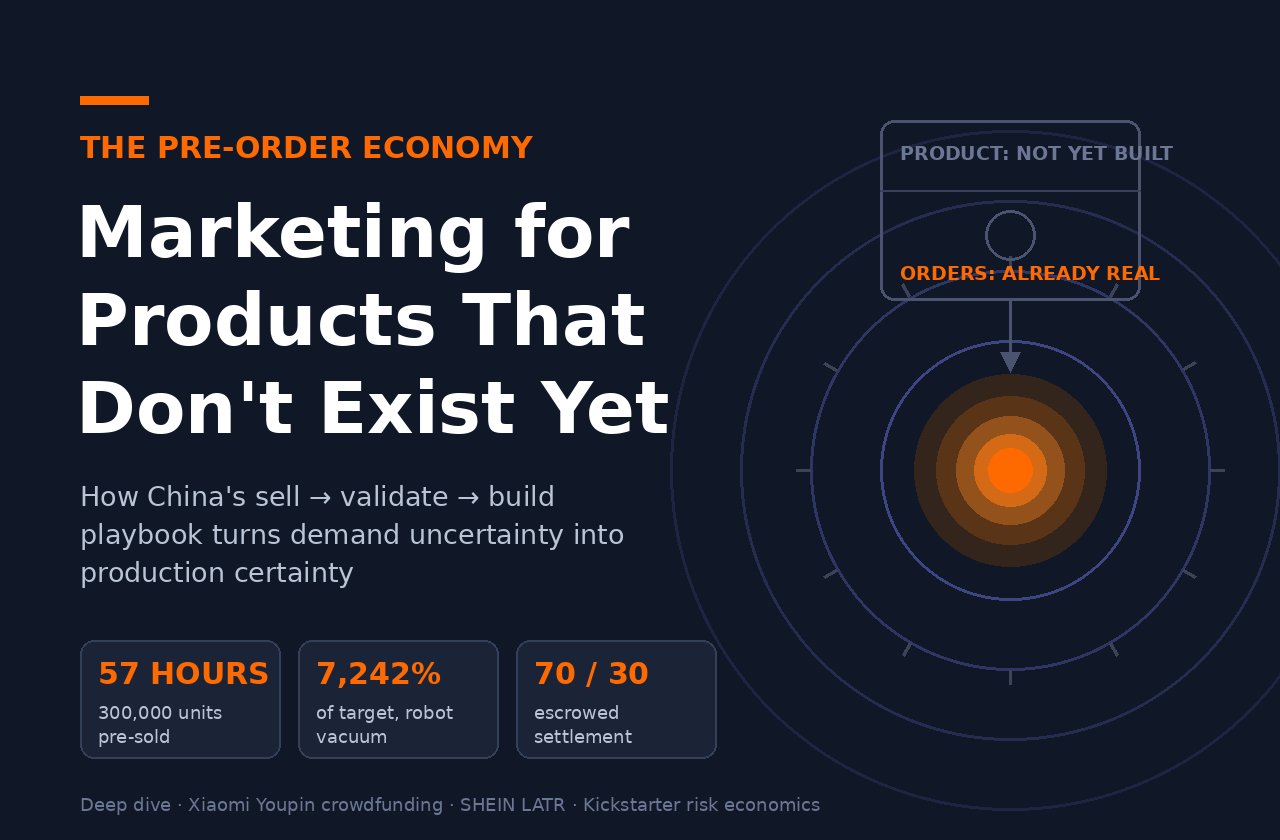
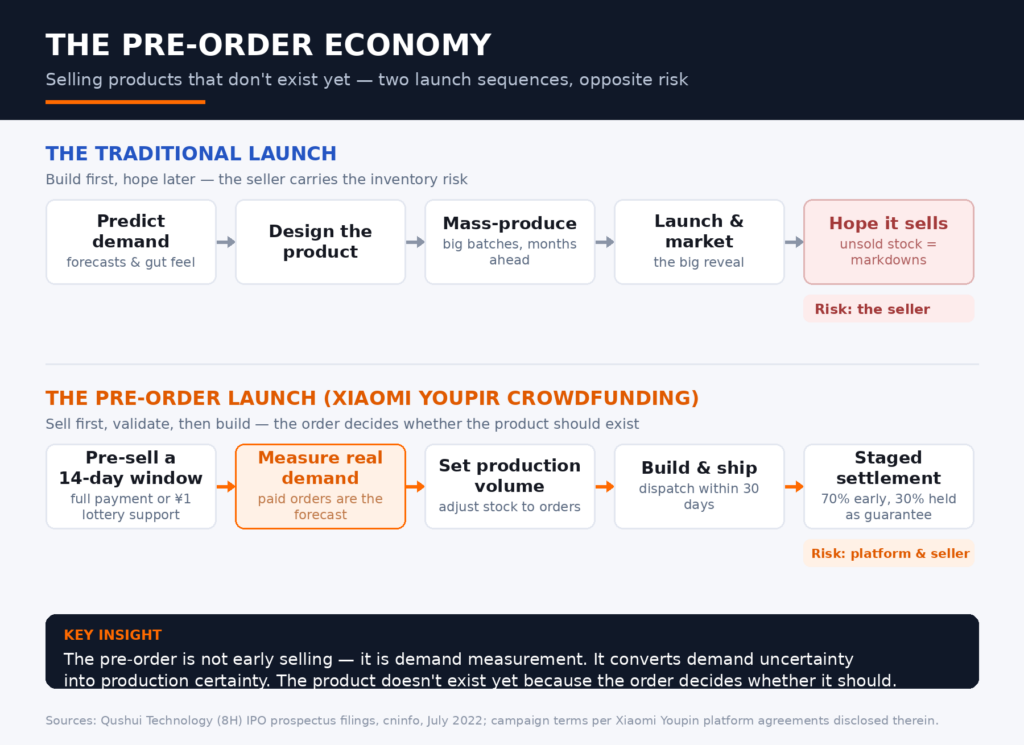
Picture the standard product launch. You design the thing, you tool the factory, you build a warehouse full of units, and then — fingers crossed — you market it and pray the demand you forecast in a spreadsheet actually shows up. Build, launch, sell, hope. Every hardware startup knows this sequence in its bones, and every post-mortem of a dead hardware startup reads like the same obituary: the product was fine; the inventory guess was wrong.
Now picture the sequence running backwards. A Chinese brand lists a product that does not exist yet, opens a 14-day payment window, watches real money arrive, and only then tells a factory how many units to make. Sell, validate, build. No prayer required. This is the pre-order economy, and its most disciplined operator is a platform most Western marketers have never opened: Xiaomi Youpin’s crowdfunding channel, running quietly since July 2015.
Here’s the thesis worth stealing: the pre-order is not early selling. It is demand measurement. The product doesn’t exist yet because the order decides whether it should.
Inside the Machine: How Xiaomi’s Pre-Order Channel Actually Works
Xiaomi launched its crowdfunding channel on July 13, 2015 — the first campaign was a universal remote built by ecosystem company Chuangmi — and folded it into the Youpin shopping app as the ecosystem matured. Strip away the word “crowdfunding,” which misleads Western readers, and the mechanics look like this.
A campaign runs a standard 14-day window. Buyers choose between two doors: pay in full and get priority delivery, or pay one yuan and enter a lottery where a few lucky supporters receive a free unit. The maker must ship within 30 days of the campaign closing and get every backer their product within 45 days. Miss those deadlines and penalties kick in — including per-order compensation of at least 15 yuan paid to delayed buyers.
None of this comes from marketing copy. It comes from the most boring, most credible document in business: an IPO prospectus. When Chengdu Qushui Technology — the Xiaomi ecosystem company behind the 8H sleep brand — filed to go public in 2022, its cninfo filings laid out the platform agreements clause by clause, because regulators demanded it.
The Prospectus Confesses: The Pre-Order IS the Market Research
Read the Qushui filing and the strategy is stated plainly: before new-category, novel-design or smart products officially launch, the company trial-sells them via crowdfunding to grasp market demand, then improves the product and adjusts pricing based on consumer feedback.
Read that again. A publicly listed company told its regulators that crowdfunding is its research department.
The filing goes further on inventory logic. Because most crowdfunding products are newly developed and their market demand is unknown, merchants deliberately prepare a low stock estimate, then adjust production based on how the campaign performs. The campaign result is the forecast. The factory order is the output of the experiment, not the input to a gamble.
That single sentence inverts a century of manufacturing logic. The traditional factory asks “how many should we make?” and answers with a guess. The Youpin factory asks “how many were ordered?” and answers with a number.
The Scoreboard: What Demand Validation Looks Like in Real Units
Does it work? The campaign record says yes, occasionally spectacularly.
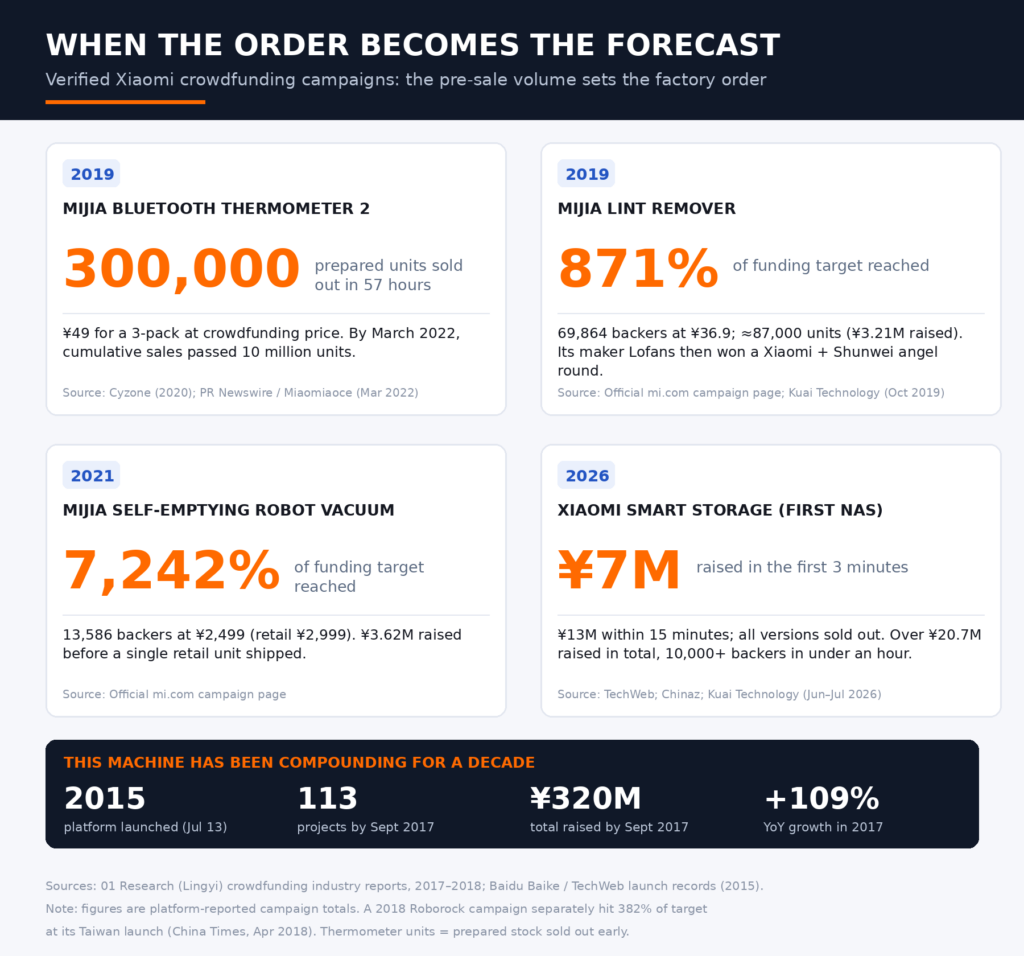
The Mijia Bluetooth thermometer-hygrometer 2 opened its late-2019 crowdfunding at 49 yuan for a three-pack. It sold out its entire prepared stock — 300,000 units — in 57 hours. The supplier, Miaomiaoce, later announced that cumulative sales passed 10 million units by March 2022. A gadget most Western smart-home brands wouldn’t bother shipping became a category-definer because the pre-sale proved the demand before anyone overcommitted.
The Mijia lint remover, launched October 2019 by ecosystem newcomer Lofans, reached 871% of its funding target with 69,864 backers at 36.9 yuan — roughly 87,000 units, over 3.2 million yuan raised. Weeks later, Xiaomi and Shunwei Capital led an angel round of about 10 million yuan into Lofans. The crowdfunding result wasn’t just revenue; it was the due diligence.
The Mijia self-emptying robot vacuum’s July 2021 campaign hit 7,242% of target — 13,586 backers paying 2,499 yuan against a planned retail price of 2,999. And the machine still runs hot: Xiaomi’s first NAS, the Smart Storage, opened crowdfunding on July 1, 2026, raised 7 million yuan in three minutes, crossed 13 million within fifteen, sold out every configuration, and finished above 20.7 million yuan.
For scale context: industry tracker 01 Research counted 113 projects and roughly 320 million yuan raised by September 2017, with the channel growing 109% year over year that year. This is not a startup’s last-resort funding plea. It’s an industrial instrument.
Four Mechanisms Doing the Quiet Work
Why does this compound? Four mechanisms, each solving a failure mode of the build-first launch.
One: the demand signal sets production volume. Make what’s ordered, not what a forecast hoped for. Unsold inventory — the silent killer of hardware margins — largely disappears from the equation before it can form.
Two: early backers become co-creators. The prospectus explicitly names product improvement and price adjustment from backer feedback. People who pre-order an unfinished-category product tolerate rough edges and talk. That cohort is simultaneously a beta-test group, a focus panel and an advocacy engine.
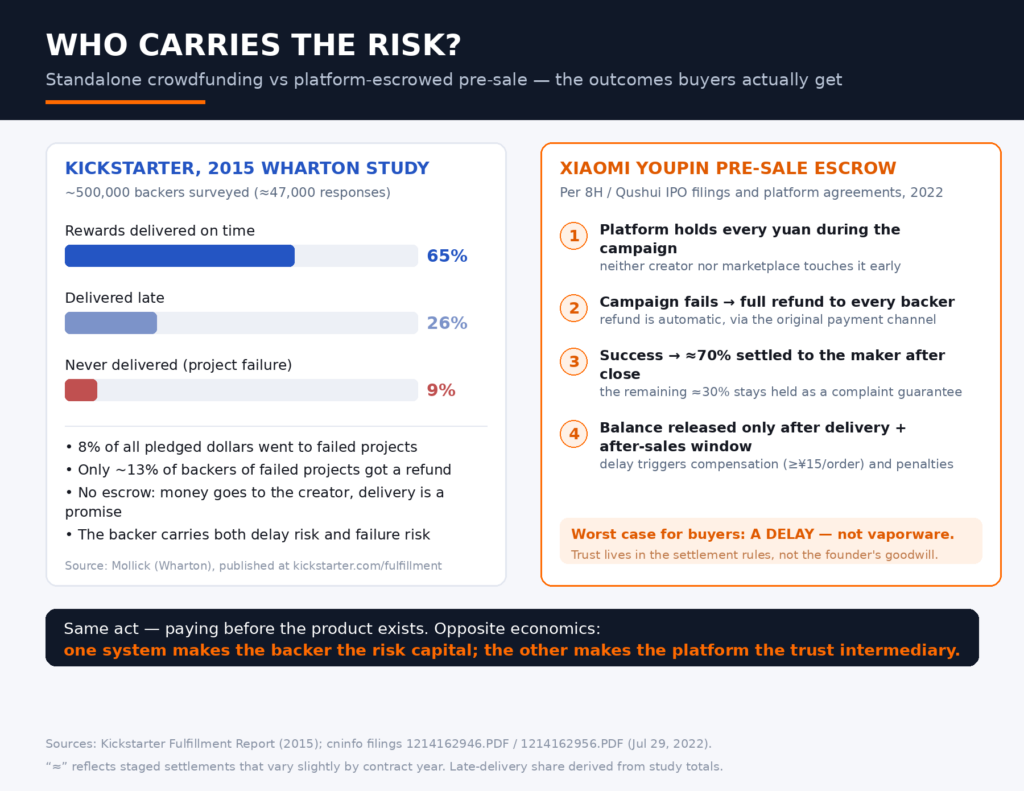
Three: staged settlement manufactures trust. The platform escrows every yuan during the campaign. On success, roughly 70% settles to the maker after close; the remaining ~30% is held back until products are delivered and the after-sales and complaint windows pass. If the campaign fails, the platform refunds every backer in full through the original payment channel. The buyer’s money never sits in a founder’s pocket while the product is still a rendering.
Four: the early-bird discount prices risk, not desperation. The thermometer’s 49-yuan three-pack, the vacuum’s 500-yuan gap to retail — the discount compensates the buyer for waiting and for vouching early. It’s a risk premium paid in reverse, and everyone involved understands the trade.
The Risk Economics: Kickstarter vs the Escrowed Pre-Sale
Western readers will object: we’ve seen this movie, and it ended with undelivered smart coolers. Fair. So let’s put numbers on the difference instead of vibes.
In 2015, Wharton professor Ethan Mollick ran the largest study of Kickstarter outcomes ever conducted — roughly half a million backers surveyed, about 47,000 responding — published jointly with Kickstarter. The findings: 9% of projects failed to deliver rewards at all; 8% of all pledged dollars flowed to failed projects; only 65% of backers said rewards arrived on time. And when projects failed, backers got refunds only about 13% of the time. On Kickstarter, your pledge is risk capital. The platform takes its fee and wishes you luck.
The Youpin structure reallocates that risk by contract. Failure means automatic full refund, not a hopeful update post. Delay means compensation and penalties, not silence. The withheld 30% gives the platform leverage to enforce after-sales behavior. The buyer’s realistic worst case is a bounded, compensated delay — not vaporware.
Same act — paying a stranger for a product that doesn’t exist. Opposite economics. One system makes the backer the insurer; the other makes the platform the trust intermediary.
It’s Bigger Than Crowdfunding: Double 11 and the Deposit Engine
The same logic scales to products that already exist. Tmall’s Double 11 runs a deposit pre-sale phase before the main sale window: under the official 2026 rules, buyers paid deposits from October 15 to October 20, then settled balances from October 20 to October 25. Deposits are generally non-refundable unless the merchant is at fault — which makes them a serious commitment signal, not a click.
For the platform and merchants, those deposits aggregate demand before the logistics storm hits: warehouses can pre-position stock, factories can see real intent, and the “sale” becomes the fulfillment of orders already measured. The festival isn’t creating demand on November 11. It’s cashing demand it collected weeks earlier. Different product maturity, identical philosophy: measure first, move second.
The Industrial Version: SHEIN Turned the Whole Factory Into a Pre-Order Machine
If Youpin validates one product at a time, SHEIN industrialized the principle across two million SKUs. Its July 2026 HKEX listing documents describe the LATR model — large-scale automated test and reorder: every new style launches in a test batch of just 100–200 units, real sales data decides whether to reorder, and winning styles restock in as little as five days.
The prospectus numbers are staggering in their quietness: 41.8 billion US dollars of net revenue in 2025, 273 million active customers, roughly 4,700 new styles per day in early 2026, over 7,500 manufacturers in the network — and inventory turning over in 36 days, with unsold stock held to low single-digit percentages. The fashion industry’s chronic disease is guessing trends months ahead and drowning in the misses; SHEIN’s answer is to never guess at scale. Test tiny, scale what’s proven. It’s the Youpin thermometer logic, automated and pointed at everything.
The Academics Called It Twenty-Five Years Ago
None of this should surprise a marketing scientist. In 2001, Jinhong Xie and Steven Shugan published a landmark Marketing Science paper showing that advance selling is a general profit tool, not an airline quirk — it works whenever buyers are uncertain about their future valuations, and its gains come from more buyers being able to purchase, not from extracting surplus. Their key caveat: seller credibility. Buyers only pre-pay when they believe the promise.
China’s platforms essentially productized that caveat. Xie and Shugan said credibility gates advance selling; Youpin’s escrow, staged settlement and refund-on-failure clauses are credibility rendered as contract terms. The theory predicted the mechanism; the mechanism built the market.
What Everyone Gets Wrong
“Pre-orders are a cash grab.” Sometimes, elsewhere. But the Youpin structure exists to buy production certainty, not float — the platform deliberately withholds money the maker might want, which is the opposite of a financing scheme.
“Crowdfunding is for startups that can’t raise money.” Xiaomi is a Fortune Global 500 company. It uses crowdfunding as instrumentation. When a giant pre-sells, it’s measuring, not begging.
“The buyer eats the risk.” Under escrow plus refund-on-failure plus delay penalties, the buyer’s exposure is bounded and mostly time-denominated. The seller and platform carry the rest.
“The West does this too.” Kickstarter exists, yes. The distinction is the closed loop: Youpin campaigns feed a manufacturing ecosystem that produces exactly what was validated, under contracts that enforce delivery. Standalone crowdfunding funds a promise; integrated pre-selling commissions a product.
The Honest Counterarguments
Pre-selling can still inflate apparent demand. That one-yuan lottery door generates engagement numbers, not purchase intent — a campaign “supporter” count mixes lottery entrants with paying buyers, so read full-payment volume and yuan raised as the signal and treat the rest as marketing theater.
The model also leans on a mature manufacturing base that can flex from small validated batches to mass production in weeks. Where that base doesn’t exist, pre-selling drifts back toward Kickstarter’s failure statistics — the escrow can refund money, but it cannot conjure a supply chain.
And it’s clearest for hardware and new physical categories. Services rarely need production validation. The transferable idea — validate demand before scaling commitment — travels anywhere; the full machinery doesn’t.
The Playbook: What You Can Steal on Monday
You don’t need Xiaomi’s ecosystem to use the logic. Four moves:
Pre-sell to validate, not just to fund. Design your pre-order page as a measurement instrument: paid conversions set your production or inventory order. If the campaign misses, that’s cheap information, not a failed launch.
Treat early buyers as a research cohort. Build feedback loops into the waiting period. People who paid early will tell you what’s wrong — that’s the cheapest product research you will ever run.
Engineer trust into the money flow. Escrow, milestone releases, automatic refunds on failure, compensation for delay. Publish the terms. Credibility is the gate; make it structural, not rhetorical.
Price the early bird as risk compensation. Frame the discount as payment for waiting and vouching — and honor a higher retail price later, so the frame stays honest.
And separate your vanity metrics from your signal: count paid orders, not lottery tickets.
Conclusion: The Order Decides Whether the Product Should Exist
The pre-order economy inverts the launch sequence: sell, validate, build — instead of build, launch, hope. Xiaomi’s fourteen-day windows, priority-delivery economics, escrowed settlement and trial-sell-then-produce discipline turn the pre-sale into the market research that sets the factory order. The thermometer’s 300,000 units in 57 hours was a forecast made real; SHEIN’s 36-day inventory turns are the same idea wearing industrial armor. The early cohort co-creates, the platform escrows trust, and the discount pays for risk. Western marketing treats the launch as the beginning of selling. The pre-order economy treats it as the end of guessing. The product doesn’t exist yet because the order decides whether it should — and that is precisely the point.