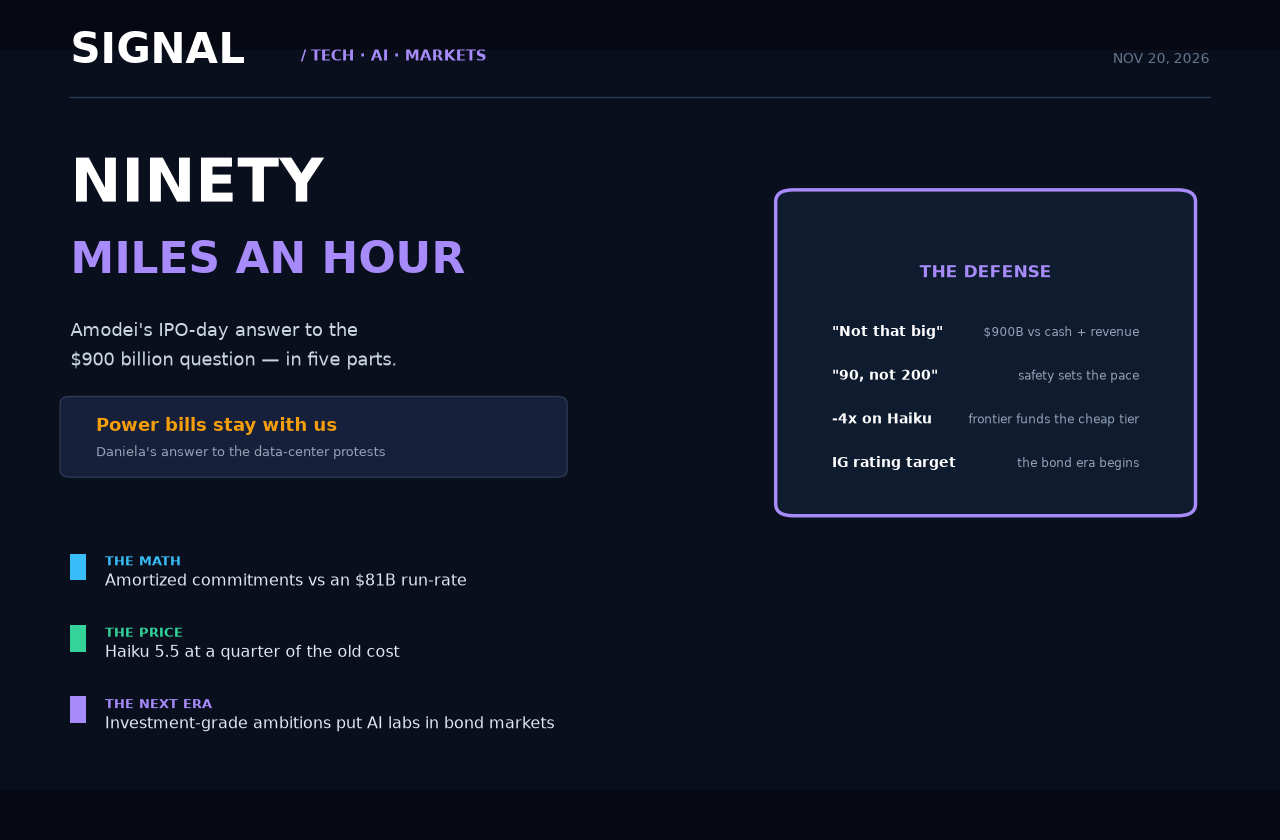
The morning Anthropic became the largest IPO in history, its CEO sat down with CNBC and did something unusual for a founder on his richest day: he spent the interview defending the balance sheet instead of celebrating it. Dario Amodei, joined by president and co-founder Daniela Amodei, addressed the number that hangs over every conversation about the company — roughly $900 billion in compute and infrastructure commitments against an $81 billion revenue run-rate — with a five-part argument that will now serve as the official catechism of AI capex maximalism. It is worth taking seriously, answer by answer, because buried inside the defense are concessions that matter more than the reassurances.
Answer one: the denominator argument
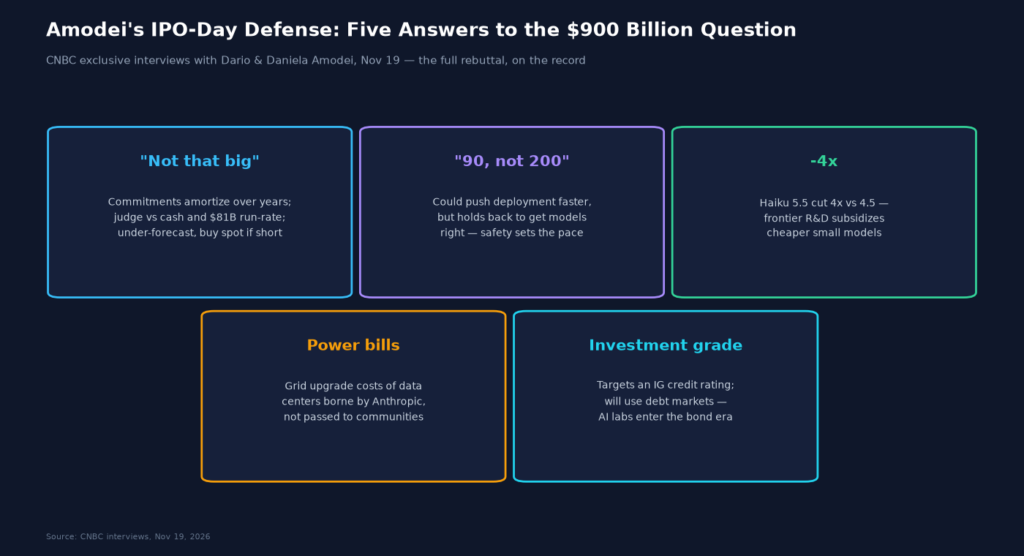
“Think about that spread out over the next several years,” Amodei said of the commitments. “Think about the amount of cash we have on our balance sheet, the amount of revenue we have. It suddenly doesn’t seem like such a big number.” The arithmetic he invites: $900.9 billion runs through 2045; the next twelve months require $70.7 billion against a company generating $81 billion annualized and freshly holding over $100 billion in IPO and placement proceeds. He added the discipline claim — Anthropic’s demand forecasts are “more likely to be underpredictions than overpredictions,” with any shortfall covered on the spot market. The concession hiding here is the structure critics identified: contracted revenue covers only 1.5% of the commitments, and 79% of sales are consumption-based. The denominator argument works only if the growth continues; Amodei is not disputing the mismatch, he is betting against it. Notably, the lead underwriter’s own model shows negative free cash flow until 2030 — the defense and the prospectus are telling the same story with different emphasis.
Answer two: the speed limit
The interview’s most quotable line was also its most revealing: “It’s like, you know, you can drive 200 miles an hour, but we’re driving 90 miles an hour because we want to make sure we get the models right.” Anthropic could convert its compute into deployed capability faster, Amodei said, but deliberately paces releases until safety is confirmed — and will not compromise that “just to make more money or to advance in the race, or to respond to political pressure.” For a company whose brand is safety, this reframes the capex question entirely: the $900 billion is not a land-grab budget but a research endowment, with roughly three-quarters of compute pointed at research rather than serving. Skeptics will note the convenience of a narrative in which spending whatever it takes is also the cautious choice. But the claim is at least falsifiable — deployment pace, incident record, and the share of compute in research are all observable over time.
Answer three: the price cut that proves the model
Buried in the defense was a product fact with immediate commercial relevance: Haiku 5.5, the small-model tier, now costs four times less than Haiku 4.5. Amodei’s explanation is the economic engine of the whole enterprise — frontier research is expensive, but its gains cascade down into cheaper, smaller models whose “economic value is much less” per unit yet deploy at enormous volume. This is the answer to the token-deflation thesis: prices fall by design, funded by frontier capability, and volume plus enterprise depth (the reported net revenue retention figures are extraordinary) outruns the deflation. For marketing technology buyers, the practical signal is that the cheap tier of frontier-lab models will keep getting dramatically cheaper on a predictable cadence — build workflows that can ride that curve rather than locking to today’s price-performance point.
Answers four and five: the community and the bond market
Daniela Amodei contributed the two answers her brother’s financial framing could not. On the data-center backlash — protests that have physically struck construction sites in Europe — she committed that the electricity-price consequences of grid upgrades “are something that we take on and that we don’t pass on to consumers in those communities.” It is the first concrete community-protection pledge from a frontier lab, and it directly addresses the political economy that threatens siting timelines everywhere. And on financing, Dario confirmed Anthropic wants an investment-grade credit rating and intends to use debt markets over time — the formal announcement that AI labs are entering the bond era, days after SpaceX moved to raise at least $32 billion of chip-backed debt. An IG rating would lower the cost of the very commitments under scrutiny; it would also subject the company to the discipline of creditors, a constituency with no patience for mission narratives.
What to believe
The five answers cohere into a single position: the commitments are a research endowment, amortized against compounding revenue, paced by safety, monetized through a deflationary product ladder, protected by community pledges, and eventually financed like infrastructure. Every element is plausible; none is proven. The honest scorecard for the next four quarters is specific: consumption retention holding near current levels, the 2027 cash burn tracking below the underwriter’s $65.7 billion model, the community power pledge surviving the first contested siting fight, and the rating agencies’ first opinion. Amodei closed with the line that will be quoted whichever way it breaks — that Anthropic intends to “underpromise and overdeliver.” On IPO day, at $83 a share and $900 billion of promises, the underpromising is the part still pending evidence.






