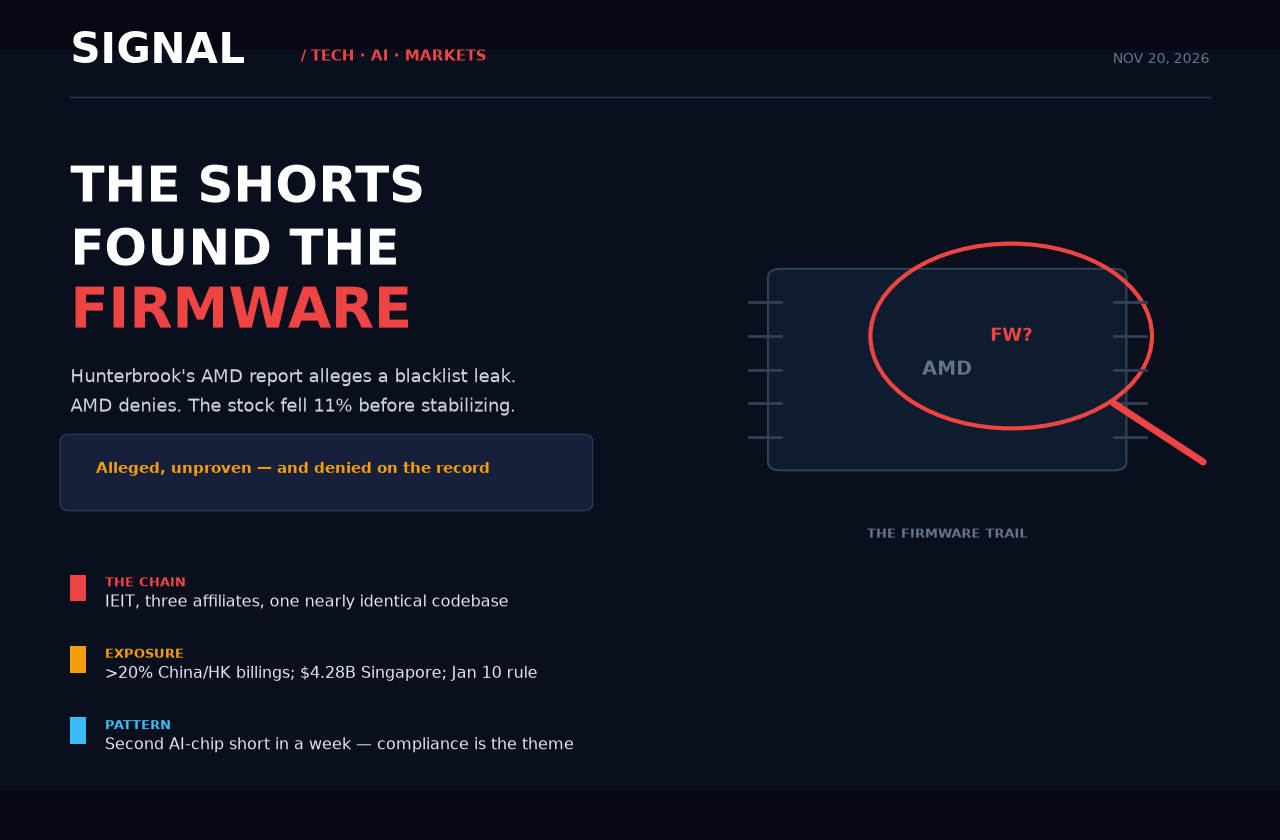
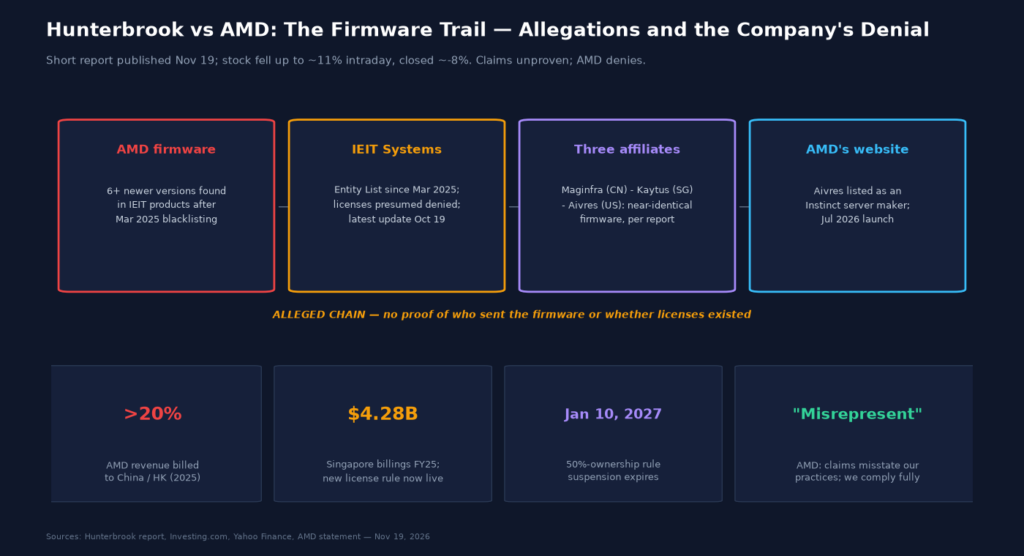
The second short attack on an AI chipmaker in seven days landed Thursday, and its weapon was not a spreadsheet of inflated revenues — it was a firmware version history. Hunterbrook Media, the research outlet whose affiliated fund disclosed a short position in AMD simultaneously with publication, reported that Chinese server maker IEIT Systems has continued incorporating newer AMD firmware into its products long after the US Commerce Department placed IEIT on the Entity List in March 2025 — at least six newer versions, the most recent dated October 19. Because Entity List exports require licenses that Commerce’s stated policy is to deny, the report implies a prohibited supply chain is still alive somewhere. AMD’s stock fell as much as 11% within the hour, briefly erasing roughly $96 billion of market value, before recovering to close down around 8%. AMD denied the claims on the record: “The claims misrepresent AMD’s business practices and relationships,” a spokesperson told Yahoo Finance, adding that the company complies with US export controls and maintains rigorous compliance processes.
What the report actually establishes — and what it doesn’t
Precision matters here, because the difference between allegation and proof is the whole story. Hunterbrook’s documented findings: IEIT products contain recent AMD firmware; three companies linked to IEIT — Maginfra in China, Kaytus in Singapore, and Aivres in California — distribute nearly identical firmware under their own brands; IEIT’s 2022 annual report listed Aivres (formerly Inspur Systems) as a subsidiary, and Kaytus’s audited accounts name IEIT as ultimate parent; AMD’s own website lists Aivres as a manufacturer of Instinct-based AI servers. What the report does not establish: who transmitted the firmware to IEIT, whether any license existed, or that AMD itself violated export law. Firmware can travel through distribution channels, OEM relationships and gray markets without the originator’s direct act. The report’s own framing concedes the gap; the market priced the ambiguity anyway. That is the signature of the current environment — after Muddy Waters’ governance-themed attack on Nvidia a week earlier, AI chip stocks are trading on compliance tail-risk, not just earnings.
The genuinely undisputed exposure is what makes the allegation plausible enough to move $96 billion. AMD bills more than 20% of revenue to China and Hong Kong addresses. Singapore accounted for $4.28 billion in fiscal 2025 — over 10% of sales — and a new interim rule effective this week requires licenses for chips shipped there and to four other countries. A suspension of the “50% ownership” rule, which would extend Entity List restrictions to foreign subsidiaries majority-owned by blacklisted firms, expires January 10, 2027 — potentially bringing entities like the affiliates in the report formally into scope. And AMD’s assembly, test and packaging runs substantially through two joint ventures 85%-owned by China’s Tongfu Microelectronics, with AMD holding 15% and a $100 million loan outstanding to one of them. None of that is illegal. All of it is exactly the kind of structure that becomes fragile when rules tighten on a calendar.
The short-seller’s real thesis is the rotation
The report’s sharpest line is aimed not at AMD’s past but at its present valuation. AMD shares had more than doubled this year, propelled partly by investors rotating out of Nvidia during its governance crisis — William Blair upgraded AMD citing precisely that dislocation. Hunterbrook’s closing argument: investors who fled Nvidia over China risk bought a more expensive company with its own China problem. Whatever the firmware trail proves, that observation stands on its own. The “second source” trade assumed AMD carried Nvidia’s demand upside without Nvidia’s geopolitical and governance baggage; this week’s report, plus the Singapore licensing rule, plus the January expiry, repriced that assumption in a single session. Bloomberg Intelligence’s read is the sober one: this is a compliance-risk event, not an earnings event — direct datacenter-GPU sales to China are already immaterial to AMD’s AI outlook, but indirect exposure through billing addresses is hard to bound, and uncertainty is what multiples hate.
What buyers and builders should take from this
For enterprises building on AI compute — including marketing organizations signing multi-year AI service commitments — three lessons generalize beyond AMD. First, compliance risk is now a priced input across the AI stack: your vendor’s chip supplier’s distributor network is, transitively, your operational risk. Vendor due diligence should ask about export-control exposure the way it asks about data residency. Second, watch the rule calendar, not just the headlines: January 10, 2027 and the Singapore licensing regime will do more to reshape supply than any short report; contracts spanning those dates deserve force-majeure and substitution clauses. Third, discount short-seller research appropriately in both directions — the affiliated fund profits from the decline, but the documented firmware trail and ownership records are verifiable facts that AMD’s blanket denial does not specifically rebut. The truth will emerge through filings, licenses and possibly enforcement, not through the initial price action. Until then, the honest position is the one this article has taken throughout: the exposure is real, the violation is alleged, and the market has decided that in AI chips, the question alone costs eight percent.






