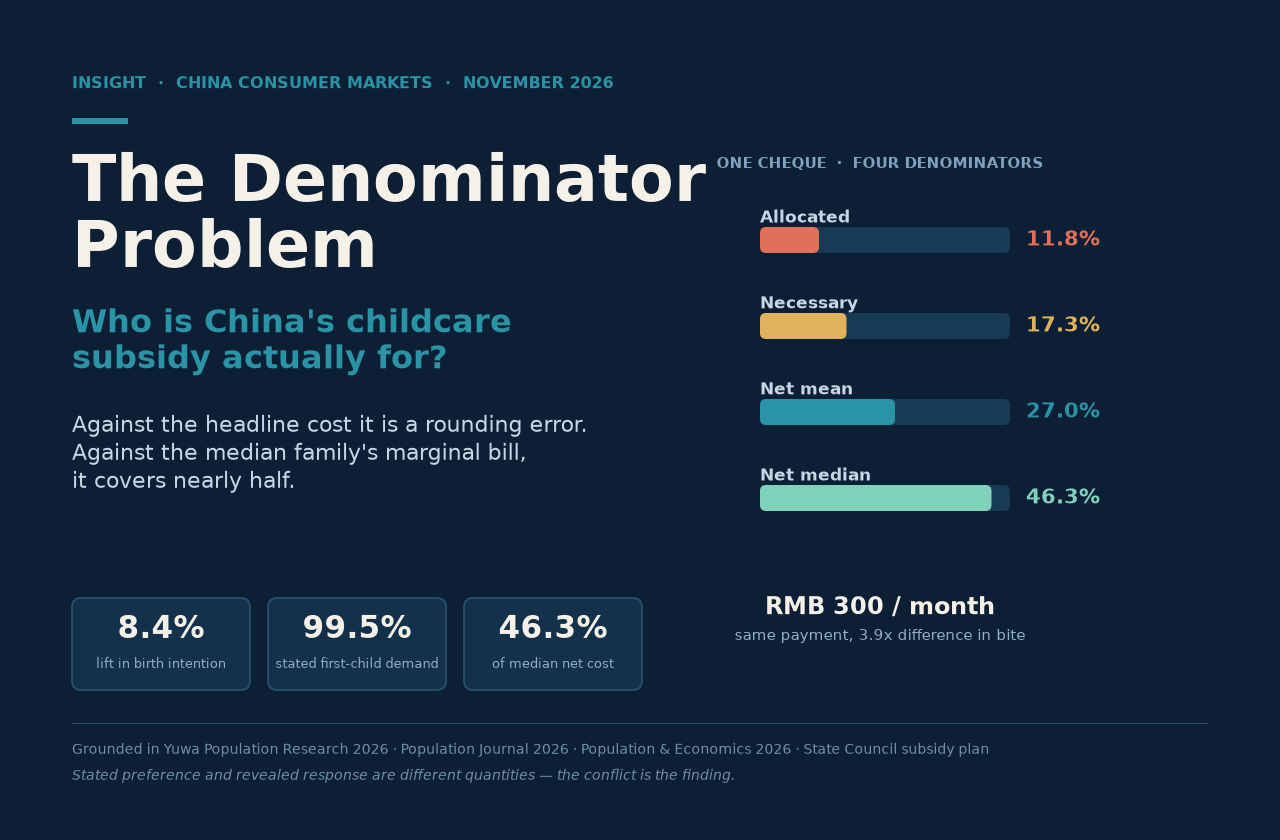
Everyone debates whether China’s childcare subsidy is “enough.” That debate is stuck because it argues about the numerator. RMB 3,600 a year — RMB 300 a month — is either generous or insulting depending entirely on what you divide it by. And China now has four defensible denominators, drawn from the same dataset, that differ by a factor of four.
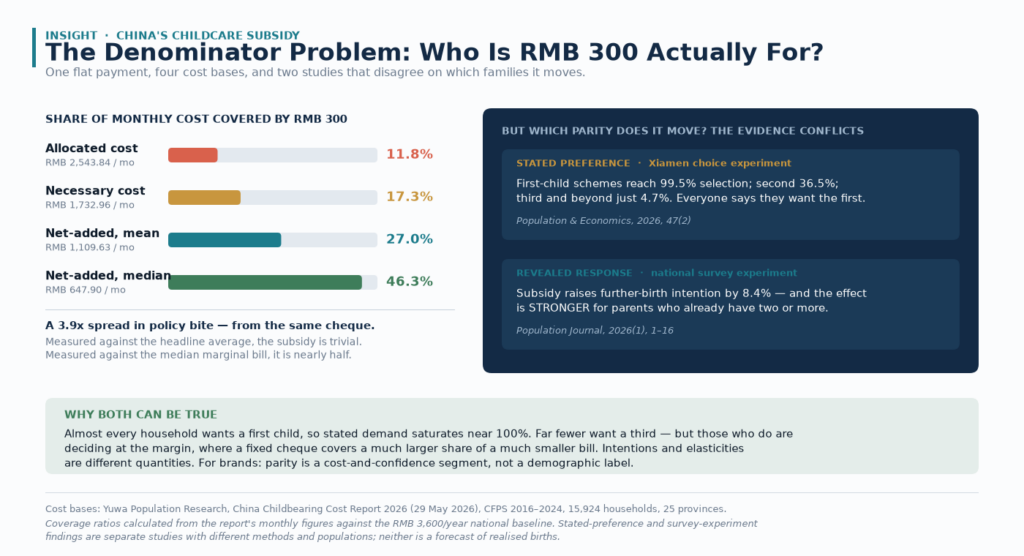
Divide by allocated cost, the headline RMB 2,543.84 a month, and the subsidy covers 11.8 percent. Divide by necessary cost, RMB 1,732.96, and it covers 17.3 percent. Divide by net-added cost — what one more child actually adds to a household that already has one — and the mean of RMB 1,109.63 gives you 27 percent. Divide by the median net-added cost of RMB 647.90, and the same cheque covers 46.3 percent.
Same money. A 3.9x spread in policy bite.
Why the Denominator Collapses
The mechanism is unglamorous and almost entirely physical. A first child requires a complete kit: cot, pram, feeding equipment, clothes, a household rearranged around a new person. Nothing is inherited because nothing exists to inherit. A second child arrives into a home where the fixed costs are already sunk. The pram is in the cupboard. The room is already a room.
Yuwa Population Research’s 2026 report quantifies this with unusual precision. Net-added cost averages just 43.13 percent of allocated cost. A second child runs at 71.50 percent of a first, a third at 60.95 percent, a fourth and beyond at 37.09 percent.
Then there is the skew. The median net-added figure sits 41.61 percent below the mean. That gap is not statistical noise — it is the signature of a small number of high-spending households dragging the average upward while most families operate on far less. The headline number describes a family that barely exists.
The Conflict Nobody Resolves
Here is where it gets genuinely interesting, and where I would have written something too clean if I had not checked.
Two peer-reviewed Chinese studies from 2026 point in opposite directions.
A discrete-choice experiment using Xiamen survey data, published in Population & Economics, found that stated preference for first-child subsidy schemes reaches a ceiling of 99.5 percent selection — against 36.5 percent for second-child schemes and just 4.7 percent for third and beyond. Everybody says they want the first.
A national survey experiment published in Population Journal found the subsidy raises further-birth intention by 8.4 percent — and that the effect is stronger among people who already have two or more children. Higher-parity intentions are more sensitive to money.
Both can be true, and the reconciliation is the actual insight. Almost every household wants a first child, so stated demand saturates near 100 percent and cannot rise much further. Very few want a third — but the ones who do are deciding at the margin, where a fixed cheque covers a far larger share of a far smaller bill. Stated preference measures how many people want something. Elasticity measures how many change behaviour per yuan. They are different quantities, and conflating them produces bad policy and worse marketing.
What This Means If You Sell Things
The commercial consequence is sharper than the demographic one.
If the subsidy bites hardest on second and third children, then the households most likely to change behaviour are the ones brands treat as an afterthought. Almost all parenting marketing is engineered for the first-time parent: maximum anxiety, maximum information need, maximum willingness to pay for certainty. That is a real segment. It is also the segment where RMB 300 barely registers.
The second-child household is a different customer entirely. Lower marginal cost, inherited equipment, accumulated experience, less social comparison pressure — and a state payment that covers a meaningful fraction of what they actually add. They are not anxious beginners. They are experienced operators making a calculated marginal decision.
Selling them the same fear-and-reassurance content designed for first-timers is a category error. They need bundle economics, durability, hand-me-down compatibility, and honest arithmetic. Not certainty theatre.
Parity, in other words, is not a demographic field in your CRM. It is a cost structure and a confidence level. The subsidy did not create that segmentation. It just made it impossible to keep ignoring.