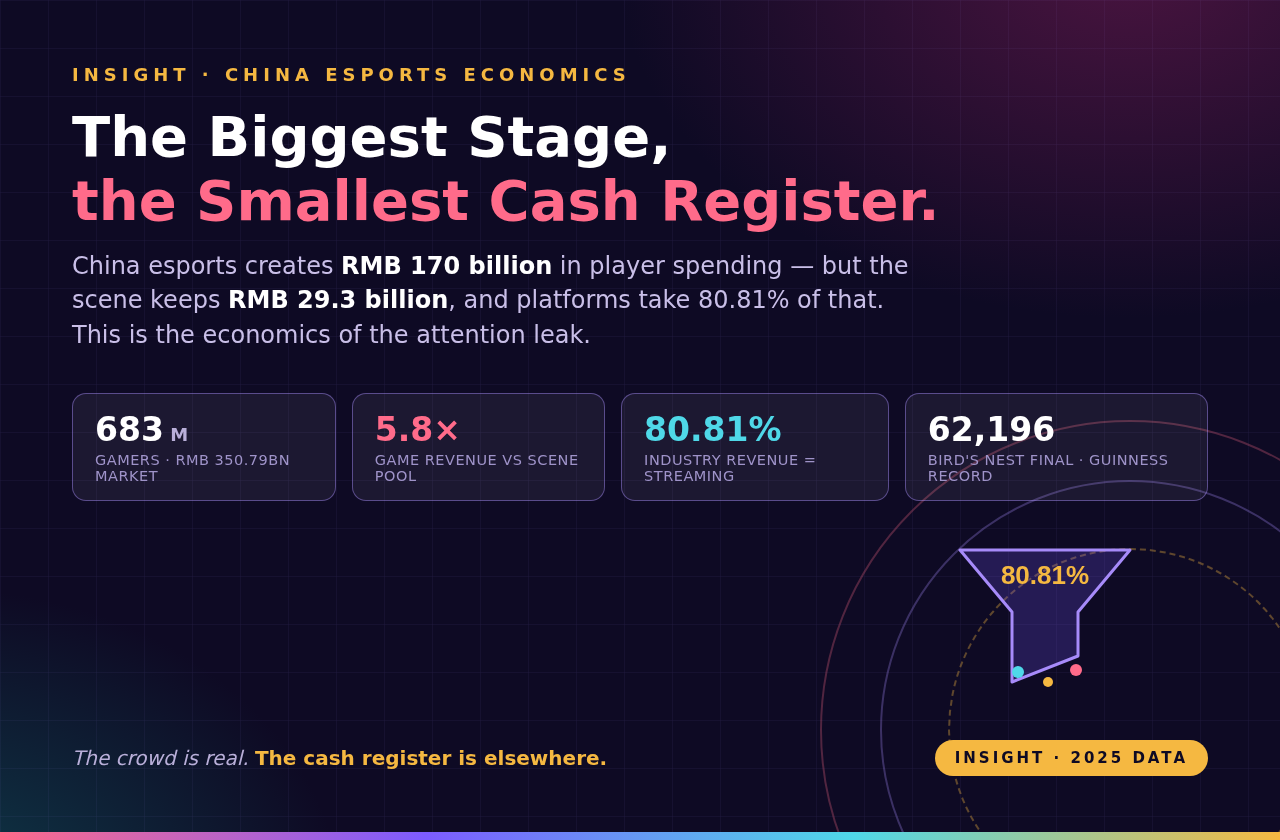
Something strange sits at the center of China’s esports economy. In 2025, players spent RMB 170.05 billion inside competitive games — up 18.96%, nearly half the country’s entire gaming market. The scene around those games — the leagues, clubs, arenas and broadcasts that make esports esports — earned RMB 29.33 billion. Same culture, same fans, same year. A 5.8× gap.
Most coverage treats this as a maturity problem: give it time, the industry will catch up. The economics say otherwise. The gap is structural, and it has a specific shape — an attention leak.
Where the money actually goes
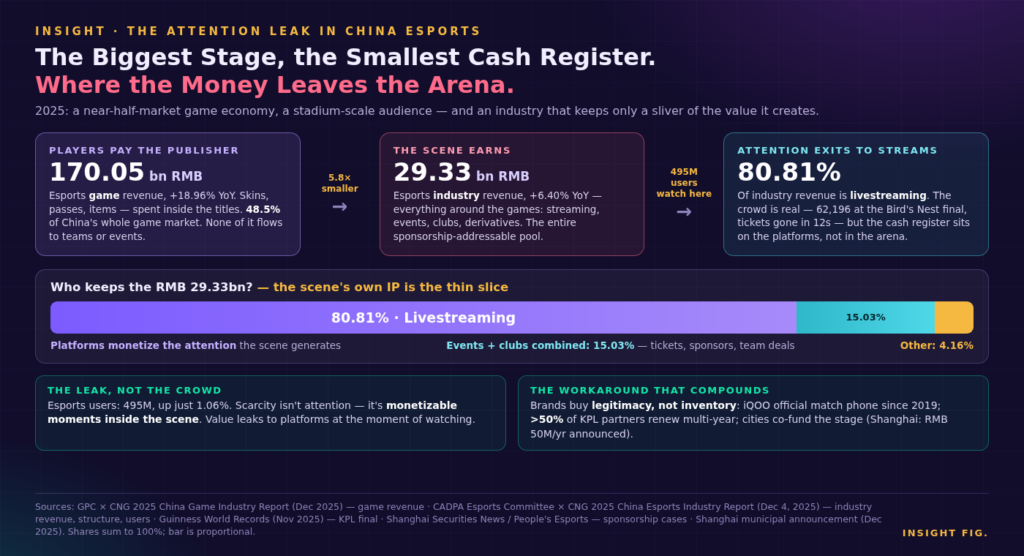
Start with the first number. That RMB 170 billion is skins, battle passes and items bought inside titles like Honor of Kings. It flows to publishers, full stop. A sold-out stadium does not move a yuan of it. The competitive scene is, financially speaking, a very expensive marketing department for the games themselves.
Now the second number. Of the RMB 29.33 billion the ecosystem earns, livestreaming platforms take 80.81%. Events and clubs — the entities that actually produce the drama — split 15.03%. Everything else is 4.16%. Here is the mechanism: esports manufactures attention at enormous cost, then hands it to platforms at the exact moment it becomes monetizable. The fan watches a club’s match on a streamer’s channel; the ad inventory, the gifts, the subscriptions belong to the platform. The scene pays to create the moment; someone else owns the cash register.
Why scarcity isn’t the problem
The audience keeps breaking records. The 2025 KPL Grand Final packed 62,196 fans into Beijing’s Bird’s Nest — a Guinness World Record — with tickets gone in 12 seconds and over 85% of attendees traveling from other cities. Yet esports user growth has flatlined: 495 million, up just 1.06%. Read those together: attention is abundant and nearly saturated; what’s scarce is monetizable moments owned by the scene. Clubs don’t lack fans. They lack the pipes that turn fandom into revenue — which is why CNG’s chief analyst publicly warns that sponsorship dependence leaves clubs fragile. One revenue stream, owned by someone else’s audience relationship, is not a business model. It’s a subsidy.
What smart brands already figured out
This is why the best integrations don’t buy inventory — they buy legitimacy. iQOO has been KPL’s official match phone since 2019 because equipment inside the competition compounds credibility that banners can’t. More than half of KPL’s brand partners sign multi-year deals: they’re underwriting the scene’s survival, and being remembered for it. Cities do the same math — Shanghai announced RMB 50 million a year in dedicated support in December 2025 — because the return is tourism, identity and youth gravity, not gate receipts.
The takeaway for marketers: in China esports, the crowd is real and the cash register is elsewhere. Price your sponsorship as patronage of a cultural institution, measure it in seasons of earned trust, and never — ever — pitch the RMB 170 billion as your addressable market. It was never on the table.






