China recorded 7.92 million births in 2025, the lowest since 1949. Yet the money, attention and anxiety flowing toward each individual child keep rising. That gap — fewer babies, more spent per baby — is the whole story of China’s parenting market in 2026, and most brands are still reading it backwards.
This deep dive rebuilds the category from verified primary data: the National Bureau of Statistics, the National Health Commission, the Ministry of Finance, the National Healthcare Security Administration, Yuwa Population Research, and platform research from RedNote and Ocean Engine. Along the way it corrects three numbers that circulate widely and wrongly, and replaces the famous “cost of a child” headline with a far more useful set of three ledgers.
The argument is simple. China’s parenting economy is no longer a products economy that happens to use content. It is a content economy that happens to ship products. The purchase is the last, least interesting step of a long verification process that begins months before the baby arrives. Brands that win are the ones that become the trusted source inside that process — not the ones with the best shelf position at the end of it.
The Number Everyone Quotes, and Why It Is Now Out of Date
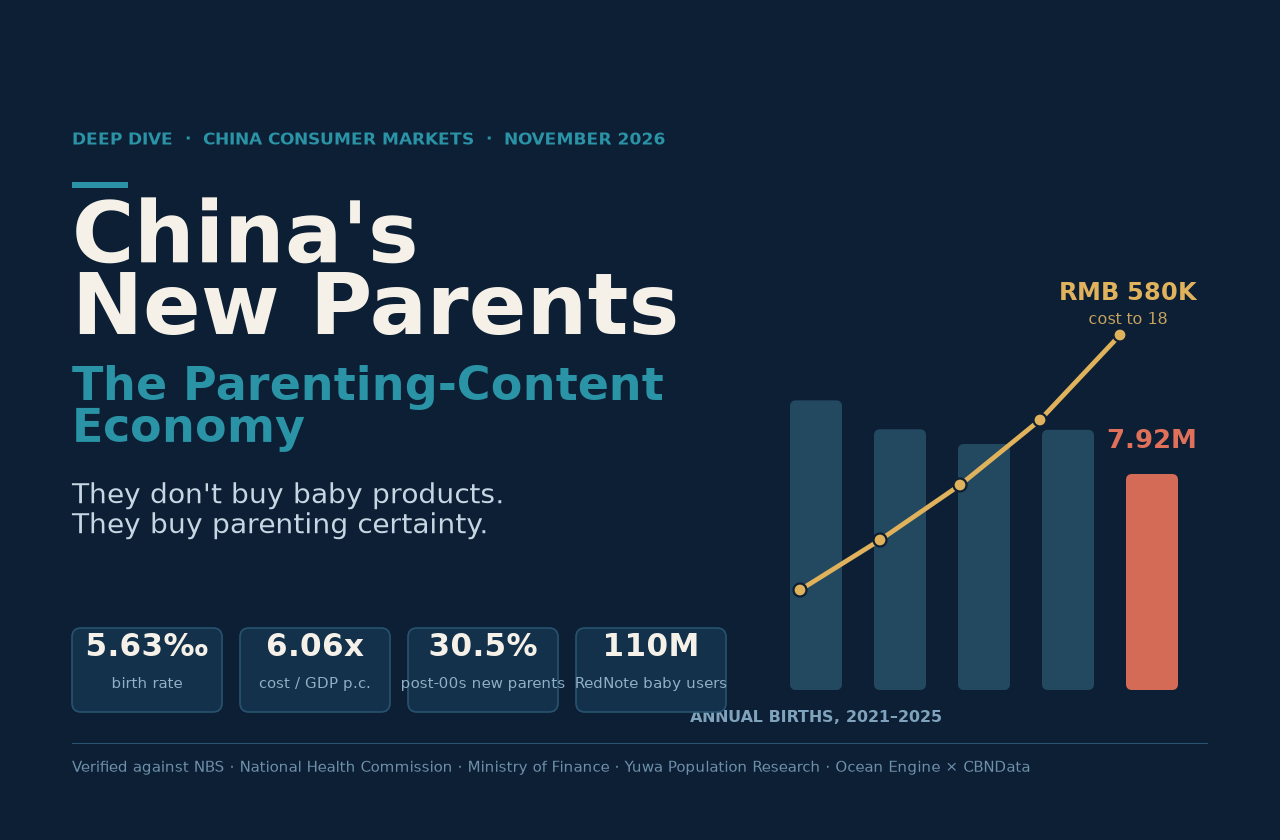
Start with the demographic floor. The National Bureau of Statistics reported 7.92 million births for 2025, a birth rate of 5.63 per thousand, and a total population decline of 3.39 million. That is 1.62 million fewer babies than 2024 — a drop of roughly 17 percent in a single year.
The five-year sequence tells you the 2024 uptick was noise, not recovery: 10.62 million in 2021, 9.56 million in 2022, 9.02 million in 2023, 9.54 million in 2024, then 7.92 million in 2025. The 2024 bump was a Dragon-year preference, a cultural one-off that borrowed demand from 2025 rather than creating it. Anyone who built a five-year plan on that uptick was reading a calendar, not a trend.
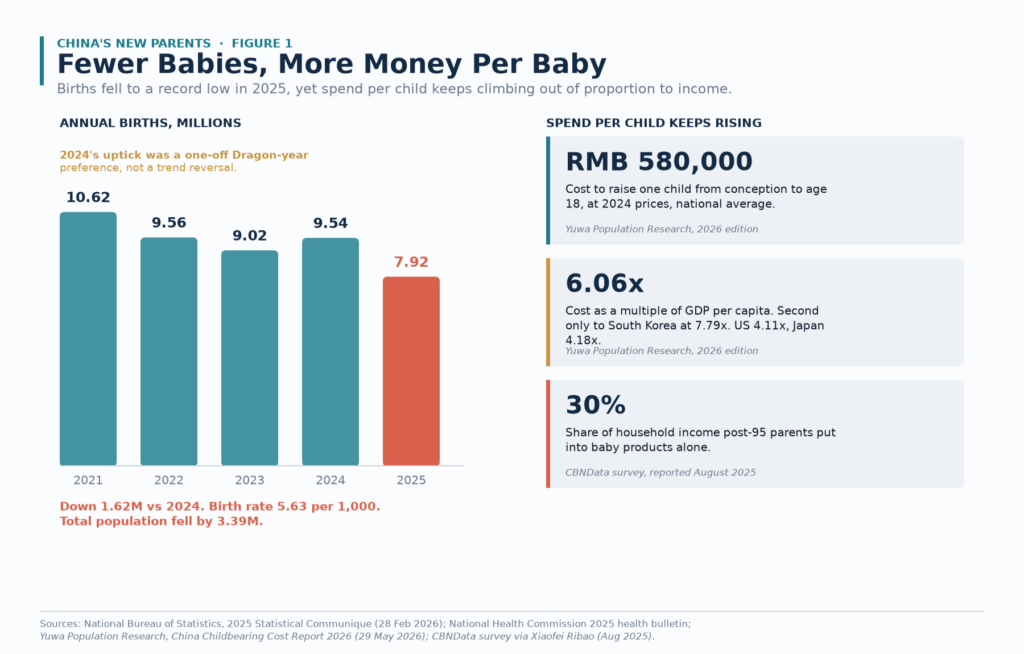
Now the number that needs correcting. You will see “RMB 538,000 to raise a child to 17” quoted everywhere. It is real, but it belongs to Yuwa Population Research’s 2024 edition. In May 2026, Yuwa published a new edition built on five rounds of the China Family Panel Studies covering 15,924 households across 25 provinces — about 94.5 percent of the population. Its headline is different, and better evidenced: RMB 580,000 from conception to age 18, at 2024 prices, or RMB 2,543.84 per month.
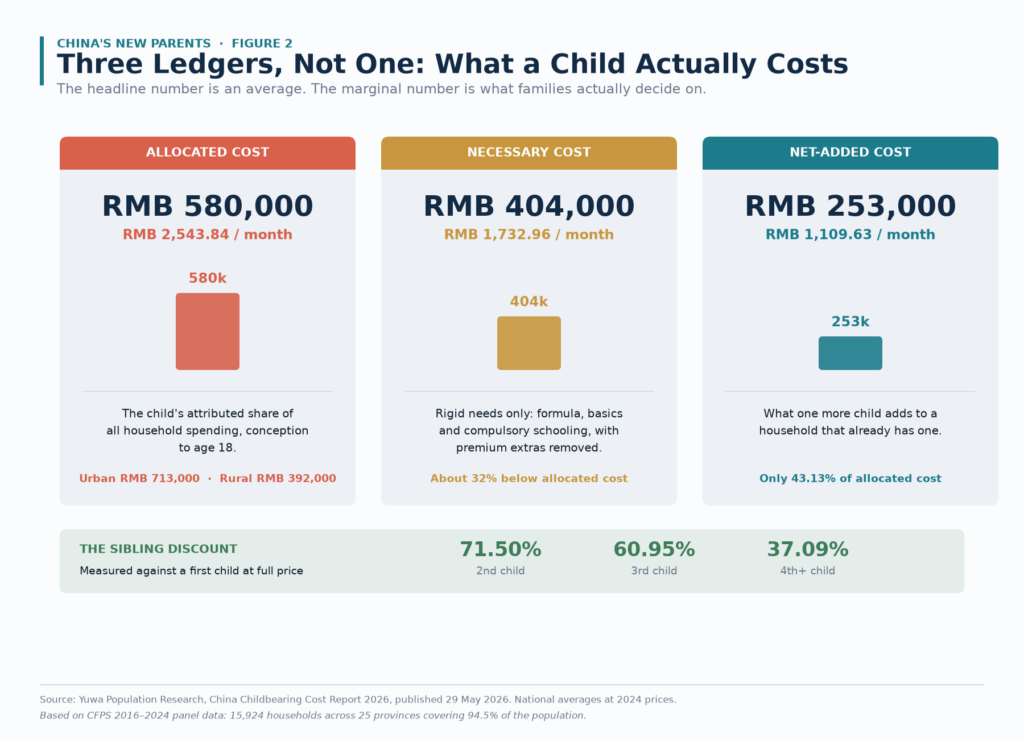
Urban households face RMB 713,000. Rural households, RMB 392,000. Shanghai runs RMB 4,751 a month against Tibet’s RMB 1,711 — a spread of nearly three times inside one country.
One more correction worth making, because it gets repeated in English-language coverage: China’s child-rearing cost is 6.06 times GDP per capita, which is second in the world, not first. South Korea sits at 7.79 times. The United States is at 4.11, Japan at 4.18. Calling China “the most expensive place on earth to raise a child” is a small exaggeration that costs you credibility with anyone who has read the report.
Three Ledgers, Not One: The Insight Most Coverage Misses
Here is where the 2026 report gets genuinely interesting, and where most commentary stops too early.
Yuwa separates three different questions that get lazily merged into one headline. Allocated cost — RMB 580,000 — is the child’s attributed share of everything the household spends. Necessary cost strips out early-learning classes, premium upgrades and discretionary spend, leaving rigid needs: RMB 1,732.96 a month, about RMB 404,000 in total, roughly a third below the allocated figure. And net-added cost asks the only question a family deciding on a second child actually faces: what does one more child add to a household that already has one?
The answer is RMB 1,109.63 a month, about RMB 253,000 — just 43.13 percent of allocated cost. The median is lower still, at RMB 647.90 a month, some 41.61 percent below the mean.
Read that again, because it changes the strategy. The scary average that dominates headlines substantially overstates the marginal burden most families experience. Clothes get handed down. Housing is shared. The family car already exists.
Yuwa quantifies the sibling discount with unusual precision: a second child costs 71.50 percent of a first, a third 60.95 percent, a fourth and beyond just 37.09 percent.
For marketers, this reframes the “anxious premium” thesis in a way the single-number version cannot. The premium is real, but it is concentrated in the first child and in the early years, where nothing can be inherited and every decision feels irreversible. A brand selling to first-time parents is selling into maximum uncertainty. A brand selling to second-time parents is selling into a household that has already learned what it can safely skip. Those are two different messages, two different price tolerances, and — crucially — two different content strategies. Treating them as one “mums and babies” audience wastes both.
What the State Actually Pays, and What It Cannot Buy
In July 2025, China’s central authorities published the Childcare Subsidy Implementation Plan: RMB 3,600 per child per year until age three, retroactive to 1 January 2025, regardless of whether the child is a first, second or third. This was the country’s first universal, nationwide cash transfer of its kind.
The fiscal scale is real. The Ministry of Finance released RMB 99.9 billion in central subsidy funds for 2026, up 10.6 percent year on year, with roughly RMB 110 billion expected across all levels of government. As of 21 July 2026, the National Health Commission reported 25.16 million recipients paid for the 2026 cycle, from 27.51 million applications.
Alongside the cash, medical coverage is expanding fast. As of 10 July 2026, the National Healthcare Security Administration reported 278 pooling areas across 28 provinces delivering zero out-of-pocket inpatient childbirth within policy scope, with nine provinces extending this to resident insurance holders. Note that number carefully — 278, not the 303 that has been circulating. And note the qualifier: “within policy scope” means catalogue-listed items at designated facilities. Premium rooms and out-of-catalogue consumables are still paid by the family.
So does RMB 3,600 change behaviour? Set it against RMB 580,000 and the honest answer is no. Three years of subsidy totals RMB 10,800 — under two percent of the full allocated cost. This is relief, not stimulus. It signals state priority and frees a little marginal spend; it does not manufacture babies. Japan and South Korea spent decades and vastly larger sums trying, and neither reversed the trend.
What the subsidy genuinely does change is the emotional register of the category. When the state formally declares childbearing a national priority, parenting shifts from private burden to publicly supported project. That is a permission structure for brands to talk about support rather than aspiration — and it is far more valuable than the cash itself.
The Uncomfortable Part: Price Creep Ate the Subsidy
Within weeks of the subsidy announcement, Xinhua’s Daily Telegraph ran an investigation that should be required reading for anyone pricing in this category.
Reporters documented shelf-price moves across cities. Jinlingguan Zhenhu went from RMB 200 to RMB 260 a can. Jinghu, RMB 145 to RMB 190. Aptamil stage three, RMB 157 to RMB 216. Huggies Gold diapers, roughly RMB 120 to RMB 180 a pack.
The arithmetic is brutal. An infant under one consumes seven to eight cans a month. At RMB 40 more per can, that is RMB 280 to RMB 320 extra monthly — against a subsidy worth RMB 300 a month. One line item absorbed the entire transfer.
The investigation also identified three quieter mechanisms: scan-code rebates shrinking from around RMB 20 to RMB 2, promotions quietly ending, and old SKUs discontinued in favour of “upgraded formula” at a higher price.
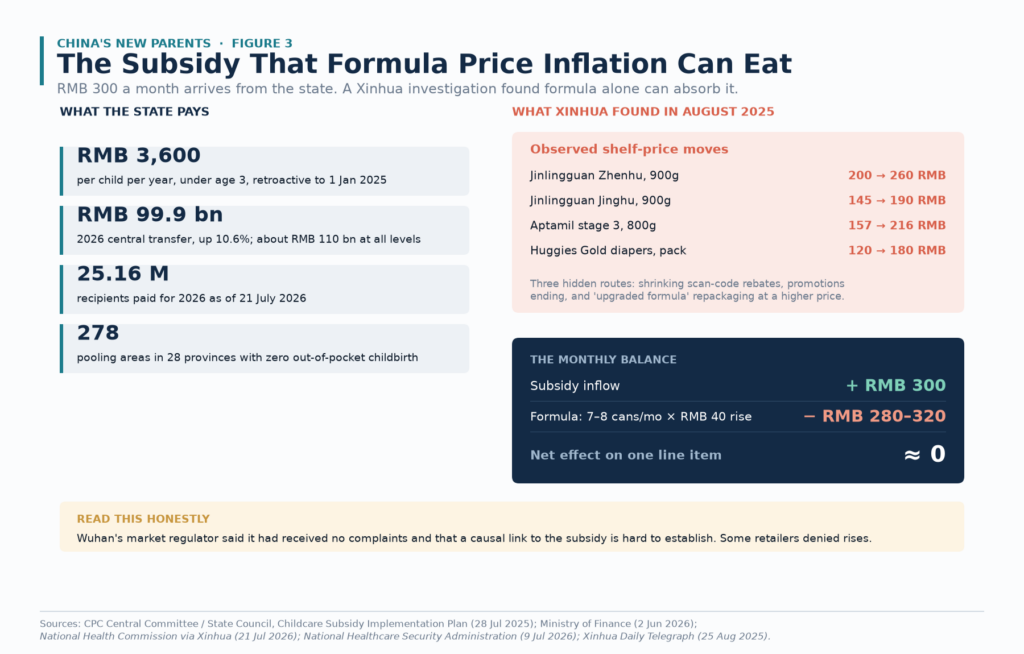
Be fair about the evidence, though. Wuhan’s market regulator told reporters it had received no complaints and noted that a causal link to the subsidy is difficult to establish — the cash goes into personal accounts, not a voucher system with traceable redemption. Several retailers denied rises outright. One industry executive framed it as price recovery after years of margin-crushing competition.
The strategic lesson holds either way. In a category where trust is the product, being perceived to harvest a state benefit is more damaging than the margin you gain. Parents in this market keep receipts and post them.
Why Content Became the Channel
Now the mechanism that makes this market different from a shrinking Western baby category.
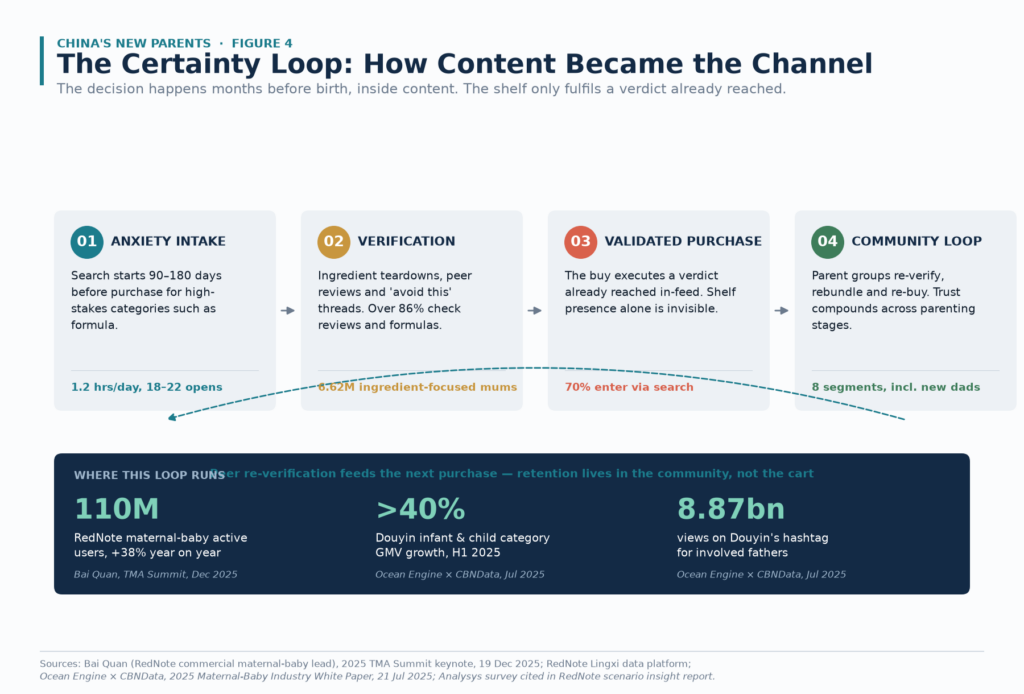
RedNote’s commercial maternal-baby lead, Bai Quan, disclosed at the December 2025 TMA Summit that the platform’s maternal-baby active users reached 110 million, up 38 percent year on year — against a falling birth rate. That divergence is the entire thesis in one data point. The audience for parenting content is growing while the population of babies shrinks, because the content serves anxiety, not just infants. It reaches expectant couples, grandparents, and parents of older children who never left.
The usage pattern explains why. These users spend 1.2 hours a day on the platform, opening it 18 to 22 times, and 70 percent enter directly through search. This is not browsing behaviour. It is lookup behaviour — the behaviour of someone trying to resolve a specific worry before they act.
The decision starts absurdly early. RedNote’s category data shows mothers beginning to research formula and nutrition 90 to 180 days before purchase, with a large share of first-trimester mothers already studying formula ingredients. The commercial decision is being made roughly nine months before the baby exists.
By the time a parent stands in a store or opens a shopping app, the verdict is already in. The shelf executes a decision made elsewhere. This is why shelf presence without content credibility is close to invisible — you are competing at the one moment when competition has already ended.
Verification is the substantive activity. Ingredient teardowns, peer reviews, “avoid this” threads. RedNote’s Lingxi data identifies 6.62 million “ingredient mothers” who research formulations in depth. Survey work cited across platform reports puts review-and-formula checking above 86 percent. These parents are not looking for reassurance; they are looking for evidence that will survive scrutiny from their parent group.
On the demand side, Ocean Engine and CBNData’s July 2025 white paper recorded Douyin’s infant and child category GMV growing over 40 percent in the first half of 2025 — again, against falling births.
Put the loop together: anxiety drives search, search produces verification, verification authorises purchase, and the parent community re-verifies afterward, feeding the next cycle. Retention lives in the community, not the cart.
The Household Buys, Not Just the Mother
Two structural shifts change who you need to convince.
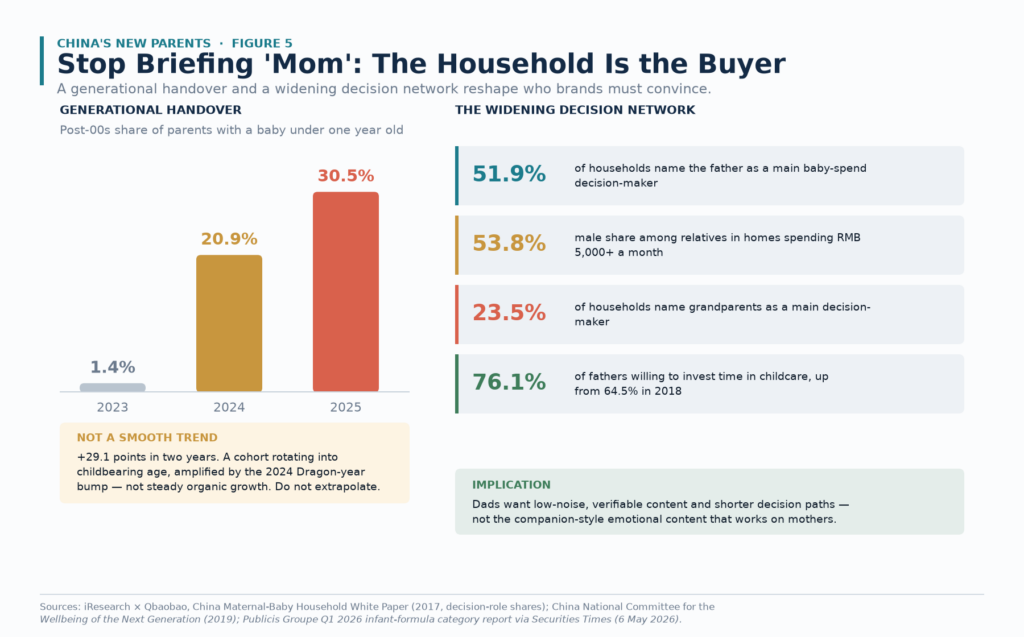
First, the generational handover. Publicis Groupe’s Q1 2026 category analysis found that among parents with a baby under one year old, the post-00s share went from 1.4 percent in 2023 to 20.9 percent in 2024 to 30.5 percent in 2025.
Be precise here, because this statistic is routinely overstated. It is not 30.5 percent of all parents. It is 30.5 percent of parents of infants — the leading edge. And a 29-point jump in two years is not organic growth; it is a cohort rotating into childbearing age, amplified by the Dragon-year bump. Do not extrapolate it forward in a straight line.
What matters is the character of that cohort. Publicis describes them as demanding “quality and price sensitivity simultaneously” — they are not premium-at-any-cost buyers. They are the most research-intensive, least brand-loyal generation to enter this category, and they grew up treating content as infrastructure.
Second, the decision network has widened. iResearch’s household white paper — dated 2017, so treat it as directional rather than current — found 51.9 percent of households naming the father as a main baby-spend decision-maker, rising to a 53.8 percent male share among relatives in households spending RMB 5,000 or more monthly. 23.5 percent named grandparents as main decision-makers. Separately, the China National Committee for the Wellbeing of the Next Generation recorded fathers’ willingness to invest time in childcare rising from 64.5 percent in 2018 to 76.1 percent in 2019.
The content signal is louder than the survey data. Douyin’s hashtag celebrating involved fathers accumulated 8.87 billion views. RedNote lists “new dads” among its eight core maternal-baby segments and flags it as one of the two fastest-growing.
Here is the practical insight most briefs miss: fathers do not want the same content as mothers. Platform analysis suggests dads respond to low-noise, verifiable, decision-shortening content — specs, comparisons, clear verdicts — rather than the companion-style emotional content that works with mothers. Running one creative across both is not efficiency. It is a mismatch.
Three Mistakes That Cost Real Money
Reading falling births as a falling market. Frost & Sullivan, cited in Kidswant’s late-2025 Hong Kong prospectus, values China’s maternal-child products and services market at RMB 3.995 trillion in 2024 by GMV, forecast to reach RMB 4.865 trillion by 2029 — a 4.1 percent compound annual rate. Note carefully: the widely circulated “RMB 4.9 trillion market” is a 2029 forecast, not today’s size. Anyone quoting it as current is four years early. The market grows slowly in aggregate while premiumising sharply per child. That is a mix-shift story, not a volume story.
Treating subsidy as demand stimulus. It is relief. Budget against value-per-child, not against a hoped-for baby boom that the policy is not designed to deliver.
Assuming the mother is the whole audience. She is often the lead researcher, but the household signs off. Brief the network.
What Actually Works
Become a verifiable source, not an advertiser. In a category where over 86 percent check reviews and formulations, your claims will be tested by strangers with no loyalty to you. Publish ingredient rationale, sourcing, test results and limitations. The brands that survive scrutiny earn a position no media budget can buy.
Sell evidence, not fear. The anxious premium converts on proof. It collapses on manufactured urgency — and in this category, parents talk to each other constantly. Anxiety marketing works once and then reprices your brand permanently.
Enter nine months early. If the formula decision is made in the first trimester, a campaign that starts at birth is arriving after the auction closed.
Segment by parity, not just demographics. First-child households face full allocated cost and maximum uncertainty. Second-child households face 71.5 percent of it and far more confidence. Different proof, different price framing, different content.
Build the community as retention infrastructure. The re-verification loop after purchase is where the next purchase is decided.
Risks Worth Stating Plainly
The birth decline is structural and no subsidy currently on the table reverses it. Headcount is a ceiling; value-per-child is the offset, not a rescue.
Trust is fragile in a way that is specific to this category. The 2008 melamine scandal pushed domestic formula share down to roughly 40 percent and drove years of import substitution. Domestic brands recovered to a 65–70 percent share across 2023–2025 — but 2025 also saw foreign premium brands rebound with double-digit growth while some domestic leaders declined. Anyone writing “domestic formula has won” is describing 2021, not 2026. One safety incident can reprice an entire category overnight.
And the ethical line is a commercial line. Marketing that amplifies parental anxiety to sell certainty is borrowing against a trust account it cannot refill.
The Takeaway
China’s new parents are fewer, richer per child, and more scrutinising than any generation before them. They begin deciding months before birth, inside content, and they buy what survives peer verification. The state has added a modest floor under them — RMB 3,600 a year, expanding childbirth coverage, a clear signal of national priority — but it has not changed the underlying economics.
The real story is not the falling birth count. It is that RMB 580,000 is an average that hides a RMB 253,000 marginal reality, that 110 million people consume parenting content while babies decline, and that the household — not the mother alone — now signs off.
Sell verified certainty. Enter early. Brief the whole household. And never sell fear to someone whose entire purchase is an attempt to escape it.