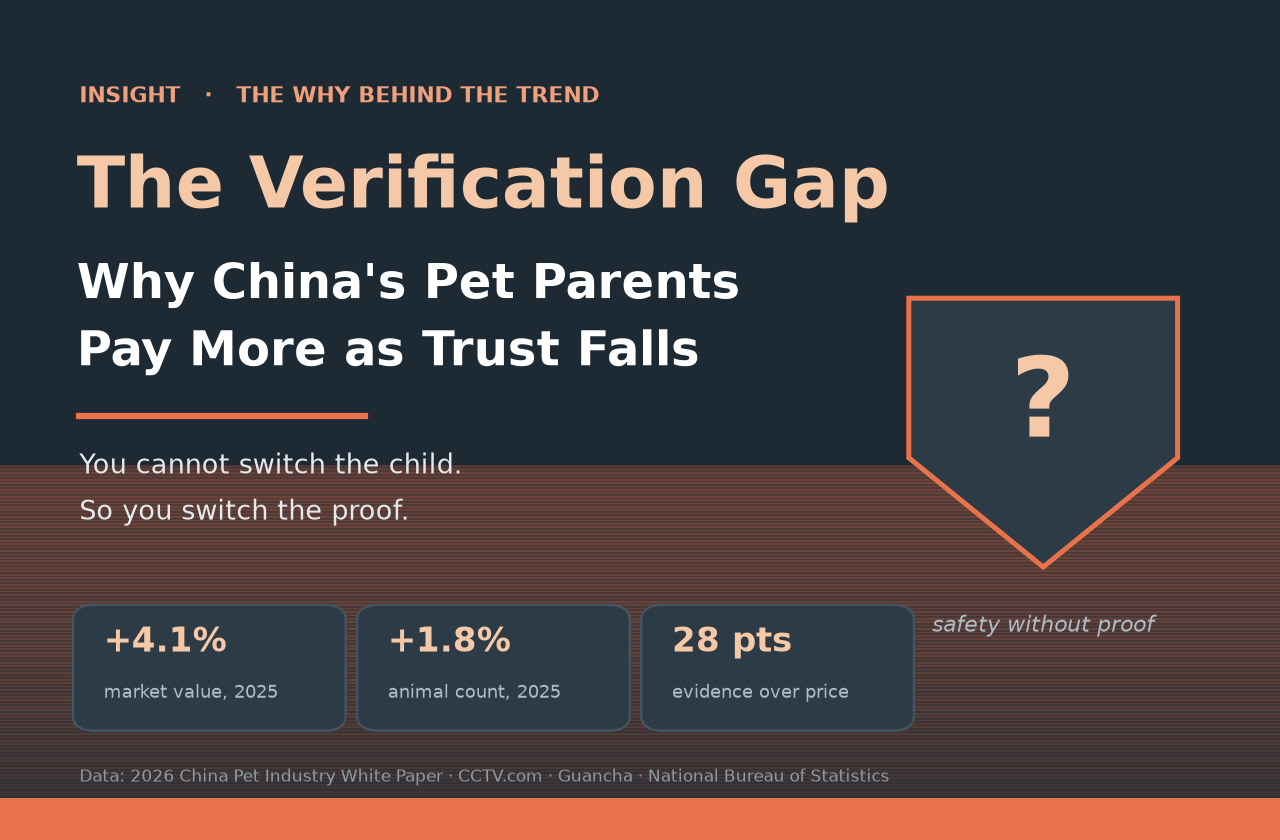
Here is a puzzle worth sitting with. In 2025 China’s urban pet market grew 4.1 percent while the animal population grew only 1.8 percent. Value is outrunning volume by more than two to one. In the same year, thousands of cat owners reported their animals developing hind-limb paralysis after eating certain domestic foods, and a leading brand’s passing lab results did nothing to calm them.
Spending up. Trust down. Both at once.
The lazy explanation is that fewer babies means more pets. It is also wrong, or at least incomplete. China’s marriage registrations actually rose 10.8 percent in 2025 to 6.763 million pairs, helped by a rule change that removed residency restrictions. Births fell to 7.92 million, a record low, but the household-formation story is not a straight line down. If substitution were the whole mechanism, the marriage rebound should have dented pet demand. It did not.
Something else is driving the premium. Look at what buyers actually check.
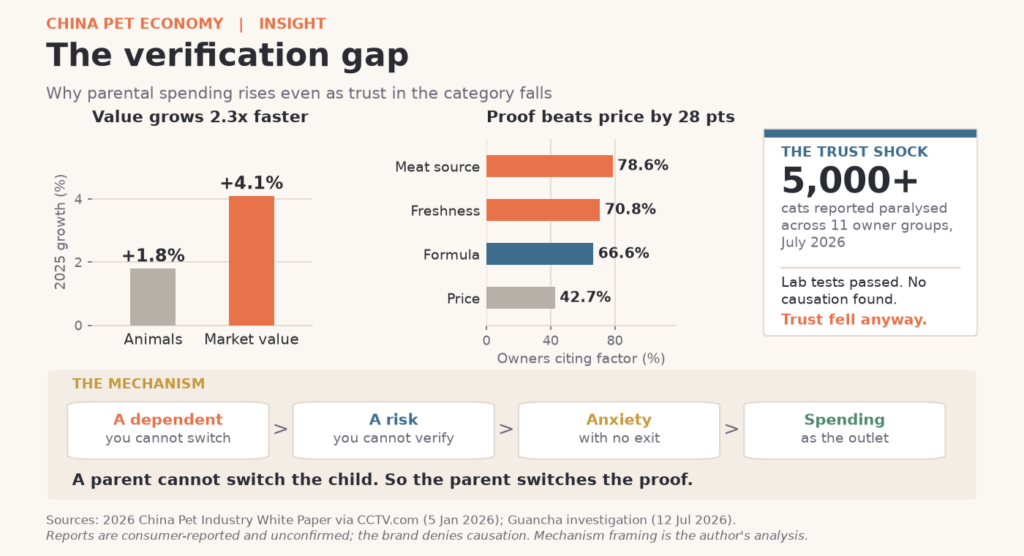
Among owners buying fresh food, 78.6 percent scrutinise meat source, 70.8 percent ingredient freshness and origin, 66.6 percent formulation science. Price sits at 42.7 percent — roughly 28 points below freshness. That is not a price-sensitive commodity buyer. That is a parent reading a formula tin.
Now add the constraint that makes this psychology expensive. A parent cannot switch the child. When you distrust a product, the normal exit is to stop buying it. But the dependent still has to eat tomorrow, and the dependent cannot tell you what went wrong. You are locked into the category while locked out of certainty.
That is the verification gap: an obligation you cannot exit, attached to a risk you cannot verify.
Anxiety with no exit does not dissipate. It converts. It converts into the one action available — buying more evidence. Traceable meat. Published batch tests. Clinical backing. A higher price is not a luxury signal here; it is the fee for a clearer answer to a question the animal cannot answer for itself.
This reframes the trust shock entirely. The paralysis reports did not weaken the premium logic. They strengthened it. Every unexplained case raises the value of proof, and the brands that can supply proof capture the spend that less transparent competitors lose. Trust falling and premiums rising are not contradictory. They are the same mechanism running in one direction.
Japan confirms the structural reading. Its pet population has actually shrunk — from about 17.12 million cats and dogs in 2013 to 15.67 million in 2025 — while children under 15 fell to 13.29 million. The famous “pets outnumber children” gap widened mostly because children disappeared, not because pets multiplied. Yet Unicharm’s pet care segment still grew 5.0 percent in FY2025 to JPY 156.1 billion, at a 15.4 percent core operating margin against 10.7 percent for personal care. Fewer animals, higher margin. Value per dependent, not dependent count, is the engine.
For marketers the implication is uncomfortable and useful. You are not competing on affection. Everyone in this category has affection. You are competing on resolvability — how quickly a worried parent can reach a defensible answer. Publish the batch report. Name the farm. Show the test. The brand that reduces the verification gap does not need to win the argument about whether pets are children. It only needs to be the one that answers.
The pet was never the customer. But the parent’s unanswered question is the product.