Here is a puzzle. The same carved lipstick, carrying the same cultural story, was read as proof of quality in Tokyo and proof of arrogance in Hangzhou. Nothing about the product changed. What changed was who got to verify the claim.
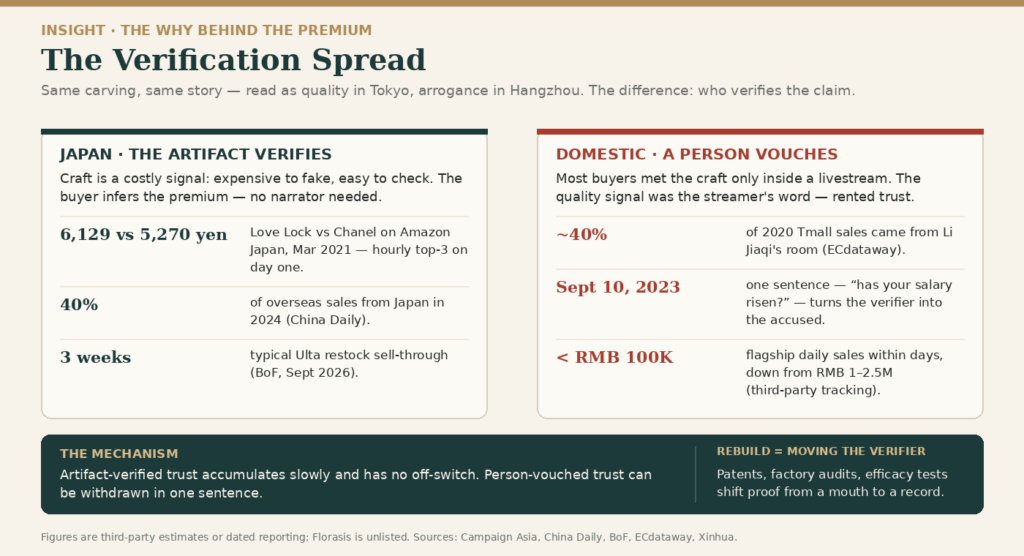
In Japan, the verifier was the object itself. A relief fine enough to survive a magnifying glass is a costly signal — expensive to fake, easy to check. Japan’s craft culture already treats manufacturing precision as a proxy for product substance, so the carving needed no narrator. It arrived pre-verified. That is why a four-year-old Chinese brand could list a lipstick at 6,129 yen on Amazon Japan in March 2021 — above Chanel’s 5,270 yen — and crack the hourly top three on day one. The premium was not asserted by the brand; it was inferred by the buyer.
Domestic Premium Ran on Borrowed Trust
At home, the chain looked different. The craft was still there, but most buyers met it only inside a livestream, where the quality signal was not the carving but the streamer’s word. By 2020, more than 80% of Florasis sales ran through Tmall, and roughly 40% of Tmall sales came from Li Jiaqi’s room. The brand had outsourced verification to a personality.
That works beautifully until the personality speaks. On September 10, 2023, defending a 79.9-yuan eyebrow pencil, Li asked a complaining viewer: “has your salary risen all these years? Have you been working hard?” In one sentence, the verifier became the accused. Because the premium had been vouched for rather than demonstrated, no artifact was left to defend it. The backlash ran straight through the streamer into the price. Per-gram calculations — wildly inconsistent across media, roughly 333 to 985 yuan — gave the anger a unit of measurement. The meme was not about grams. It was about who had the standing to call the price fair.
The Asymmetry: Slow Verification Abroad, Instant Betrayal at Home
Notice the time constants. Abroad, verification accumulated slowly and held: @cosme pop-ups and a Harajuku masterclass for around 150 beauty students in 2023, a Samaritaine counter in Paris in September 2024, the Ginza Six flagship in January 2025, Ulta’s marketplace in October 2025. Each rung added a verifier — retailers, professionals, mall curators — until the brand no longer needed to vouch for itself. Japan ended up at 40% of overseas sales in 2024; Ulta restocks reportedly sold out within three weeks.
At home, betrayal propagated in hours: flagship-store daily sales reportedly fell from the 1–2.5 million yuan range to under 100,000 within days. Trust built through one person can be withdrawn by that person in one sentence. Trust built through artifacts and institutions has no such off-switch.
What the Rebuild Is Really Buying
Read through this lens, the rebuild stops looking like contrition. The billion-yuan R&D pledge, the smart factory, the 150-plus patents, the skincare line — none of it is primarily about better product. It is about moving the verifier. Patents can be looked up. A factory can be audited. Efficacy can be tested. Each asset transfers the burden of proof from a mouth to a record.
The lesson generalizes beyond beauty. Cultural premium is not fragile because culture is fragile; it is fragile when the claim outruns the buyer’s ability to check it. Sell where the artifact speaks first. And if a personality must speak for you, remember: you have not built trust, you have rented it — and the landlord can raise the rent in one livestream.