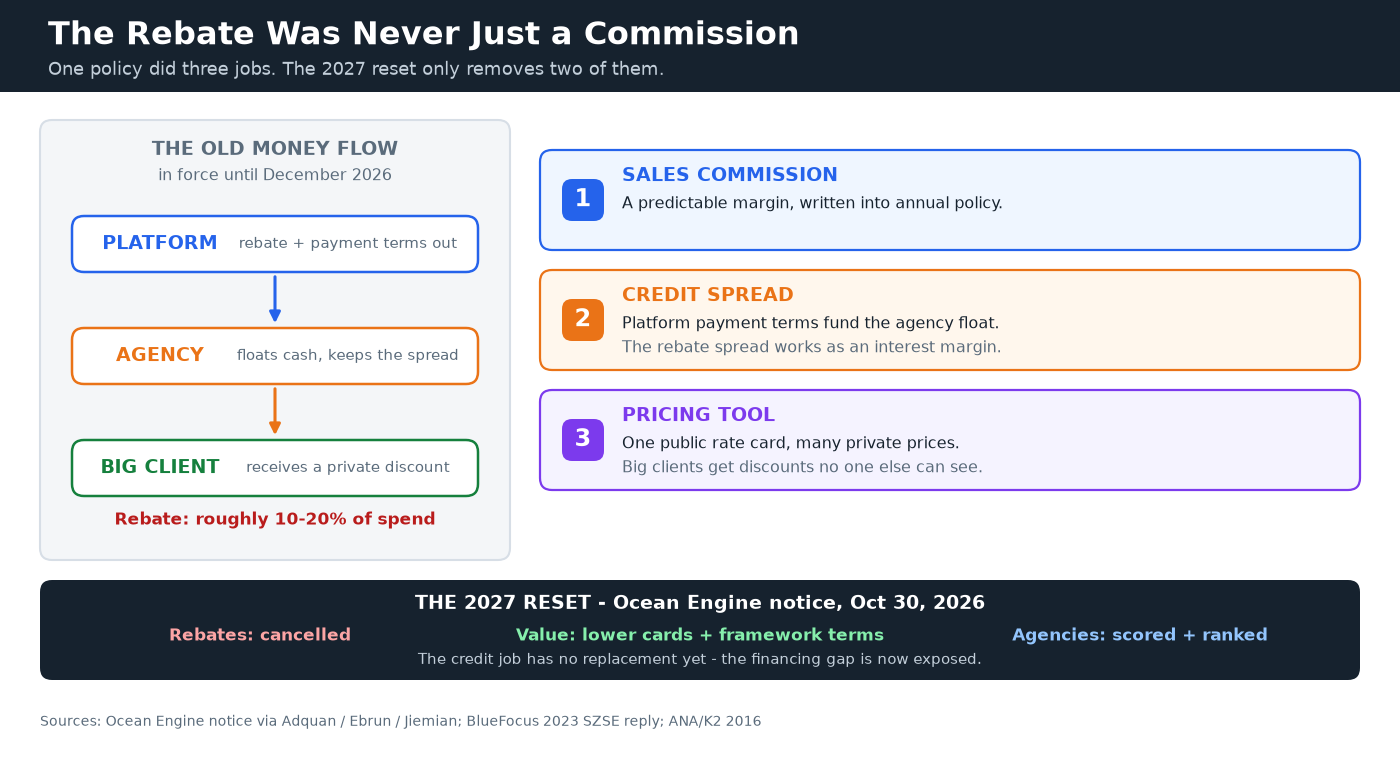
When Ocean Engine announced it would kill agency rebates from January 2027, the industry reaction looked disproportionate. A commission policy change, and thousands of agencies felt their business model dissolve overnight. That reaction is the clue. The rebate was never just a commission. It was a machine doing three jobs at once — and only one of them was sales compensation.
Job one is the obvious one: pay the channel. Rebates of roughly 10%–20% of spend, written into annual policy, gave agencies a predictable margin they could quote against, borrow against, and plan around. Standard channel economics.
Job two is where it gets interesting. Chinese agencies routinely floated cash for advertisers — paying platforms upfront while clients settled months later. Where did the working capital come from? Partly from the platforms themselves, in the form of payment terms. BlueFocus, one of China’s largest agency groups, acknowledged in a 2023 reply to a Shenzhen Stock Exchange inquiry that it had negotiated longer payables with media partners, trading away part of its rebate to lower financing costs. Read that structure plainly: the platform extends credit to the agency, the agency extends credit to the advertiser, and the rebate spread is the interest margin. A meaningful slice of China’s agency sector was, functionally, an ad-credit business wearing a media-buying costume.
Job three was price discrimination. Because agencies passed part of the rebate to big clients and kept the rest, platforms could charge different effective prices to different advertisers while publishing a single rate card. The broker was the pricing instrument — opacity as a feature, not a bug. This is why the R3 scissors gap exists: listed prices and paid prices live in different worlds by design.
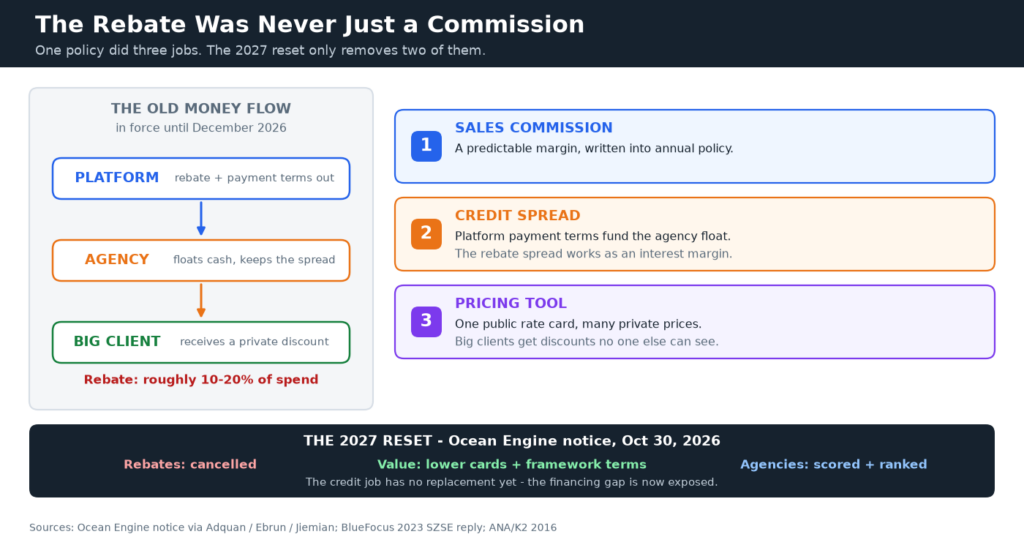
Now re-read the 2027 announcement through this lens. Cancelling rebates and replacing them with lower published rate cards plus framework discounts kills job three: price discrimination moves from the agency’s pocket into the contract, where clients can see it. Switching agencies to assessment-and-ranking incentives kills job one’s predictability: a contractual commission becomes a discretionary bonus. But job two — the credit function — has no announced replacement. Agencies still owe platforms cash on schedule; clients still pay late. The financing gap the rebate quietly covered is now exposed on thousands of balance sheets.
And before anyone files this under Chinese exceptionalism: the ANA’s 2016 K2 study found US media rebates running 1.67%–20% of spend, much of it undisclosed. The West ran the same machine through agencies; China ran it through platform policy. The 2027 reset is not the death of the relationship layer. It is the moment one of its hidden functions — cheap credit — stopped being free.