Here is a question most cross-border marketing guides never ask: why does the West draw a line between content and ads, while China draws a label on top of them?
The usual answer is culture. Western consumers value editorial independence; Chinese consumers are comfortable with commerce. It is a tidy story. It is also mostly wrong.
The real driver is simpler and less flattering: the boundary follows the profit model.
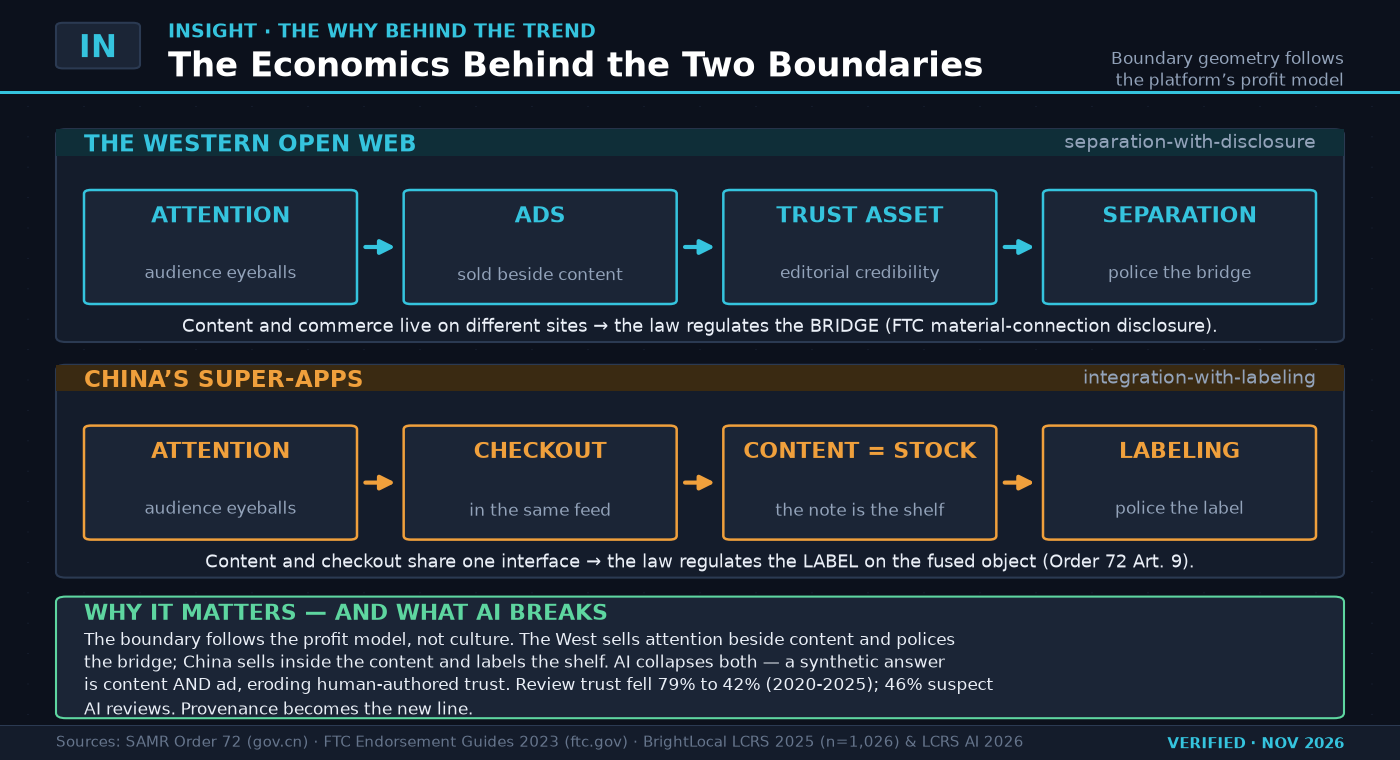
The West sells attention beside content
On the open web, a publisher earns by selling audience attention to advertisers. The content and the ad live in different places — an article here, a banner there, a sponsored post clearly tagged. The thing being sold is the audience’s trust in the content. Blur that trust and the inventory loses value.
So the law protects the asset. The FTC’s material-connection rule polices the bridge: disclose the tie, keep the modes separate, do not let the ad contaminate the editorial. Separation is not a moral preference. It is inventory protection.
China sells inside the content
China’s super-apps collapsed the distance. The product card sits in the note; the buy button sits in the stream. Attention converts to checkout in the same interface. Here the content is not beside the inventory — it is the inventory.
When content is the shelf, you do not separate it from commerce. You label the shelf. That is exactly what SAMR Order 72 Article 9 does: linked seeding content must carry the literal “Ad” mark. The boundary is drawn inside the object because the object was never two things.
Why this reframes the whole debate
Once you see the economics, the “China is lax” argument collapses. Order 72 is stricter on its face than #ad practice — it mandates a literal mark and a publisher-liability chain. The difference is geometry, not laxity, and the geometry tracks how each platform earns.
It also explains the consumer contract. Western audiences demand a mode-switching signal because their trust asset is editorial purity. Chinese audiences accept commercial content that delivers decision value because their trust asset is usefulness. Same goal — a consumer who knows what they are getting — different asset being protected.
What AI breaks
Both regimes protect human-authored trust. AI erodes exactly that. A synthetic answer can be the content and the ad at once, with no human author to disclose a connection or bear liability. The signals both systems rely on stop working.
The data shows the strain. BrightLocal found review trust fell from 79% in 2020 to 42% in 2025, and 46% of consumers now suspect a review is fake if they think AI wrote it. The boundary is shifting from who wrote it to where it came from — provenance, not authorship, becomes the new line. China’s AI-labeling mandate and the EU AI Act’s Article 50 are the first drafts of that rewrite.
The takeaway for brands: stop importing disclosure habits across borders as if they were universal. Match the geometry, protect the local trust asset, and start labeling provenance now — because the asset both regimes defend is the one AI is quietly dissolving.