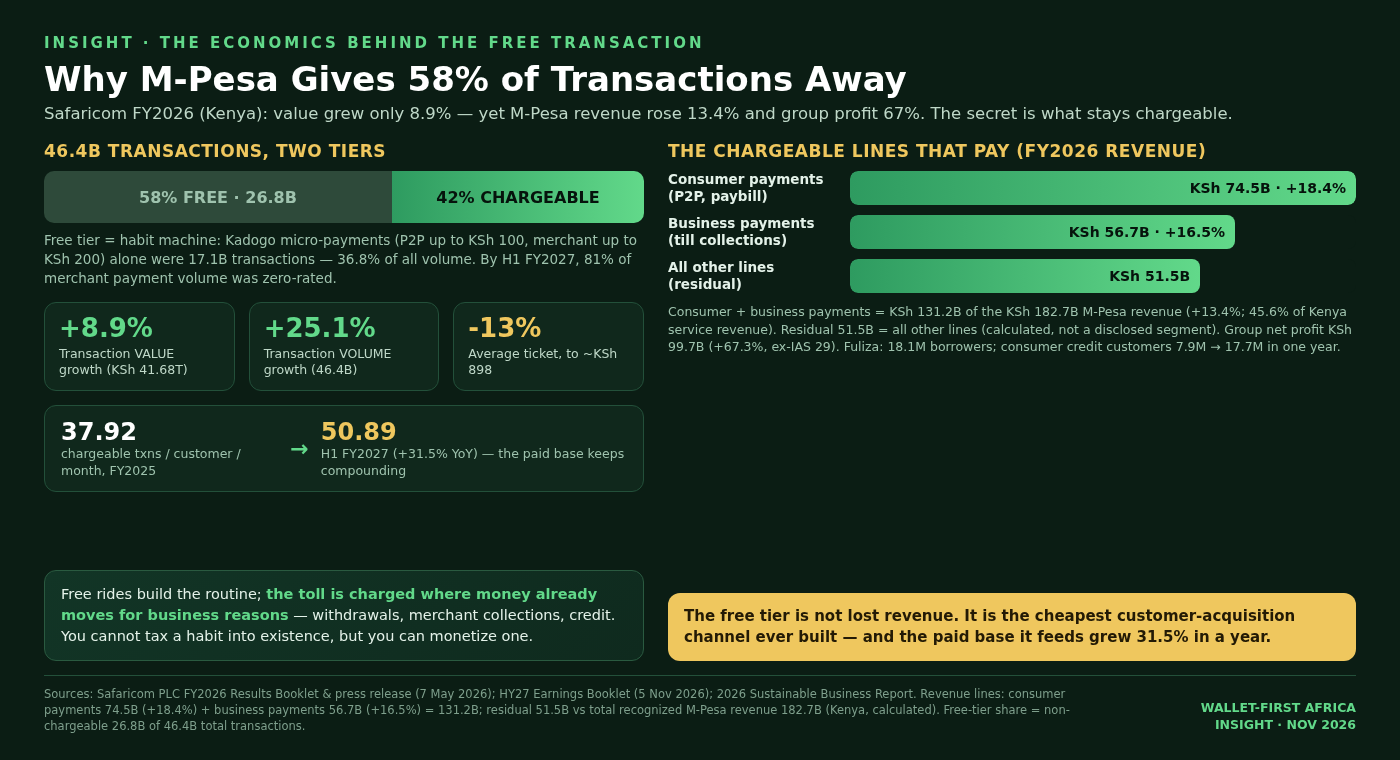
Look at Safaricom’s FY2026 numbers and you will find something that looks like a contradiction. Transaction value grew just 8.9%. Yet M-Pesa revenue rose 13.4%, and group net profit jumped 67.3%. How does a payment business make more money while its headline growth decelerates?
The answer is hiding in plain sight: 58% of M-Pesa’s 46.4 billion transactions were free. Not discounted. Free. And that is not a bug in the model. It is the model.
The Free Tier Is a Habit Machine
Under the Kadogo tariff, person-to-person transfers up to KSh 100 and merchant payments up to KSh 200 cost nothing. Those micro-transactions alone ran to 17.1 billion in FY2026 — 36.8% of all volume. By the first half of FY2027, after the free limits were raised, 81% of merchant payment volume was zero-rated.
Why would a company give away the majority of its product? Because every free kiosk payment, bus fare and airtime top-up is a repetition. Repetition is what turns a wallet into a reflex. You cannot tax a habit into existence — but once the habit exists, you can monetize the moments around it.
The Toll Booths Are Where Money Already Moves
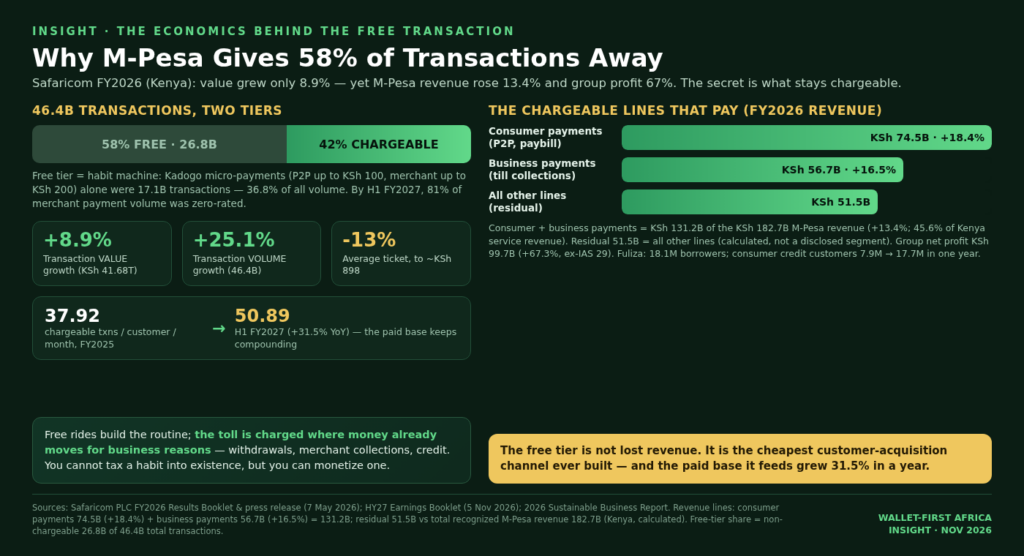
Here is the part most observers miss. M-Pesa does not charge for the habit. It charges where money moves for reasons that exist anyway: sending wages home, collecting till revenue, withdrawing cash, borrowing. Consumer payments revenue grew 18.4% to KSh 74.5 billion; business payments grew 16.5% to KSh 56.7 billion. Together they are the core of a KSh 182.7 billion revenue line — 45.6% of Safaricom Kenya’s service revenue.
And the paid base is compounding fast. Chargeable transactions per active customer per month went from 37.92 in FY2025 to 50.89 in H1 FY2027 — up 31.5% year on year. The free tier did not cannibalize the paid tier. It fed it.
Credit completes the loop. Fuliza now underwrites 18.1 million borrowers from transaction behavior alone, and consumer credit customers jumped from 7.9 million to 17.7 million in a single year. The wallet knows who can repay because it watches them transact fifty times a month. The free transactions are not lost revenue; they are underwriting data.
Why “Value Growth” Is the Wrong Scoreboard
This is why the 8.9% value growth is misleading. Average ticket size fell about 13% to roughly KSh 898 because the rail is absorbing smaller, more everyday payments — exactly the payments that used to be cash. Volume grew 25.1%. The economy is not stalling; it is digitizing at the bottom of the ticket distribution, where fees are deliberately zero.
The incentive structure explains everything. Safaricom is not paid to maximize transaction fees. It is paid to maximize chargeable events per customer — and the cheapest way to manufacture those events is to make the unchargeable ones free. Regulators see a fee cut; shareholders see an acquisition channel with negative cost.
What This Means for You
If you market to wallet-first consumers, stop reading value growth as market health. Read frequency. The brands that win will be the ones priced for the free tier’s rhythm — KSh 50 to 200 moments, fifty times a month — and positioned at the toll booths where the money actually moves: the till, the payday transfer, the overdraft top-up.
M-Pesa figured out something every platform business eventually learns: the transaction you give away is the one that sells the transaction you charge for. Africa just learned it first, at a scale of 46 billion transactions a year.