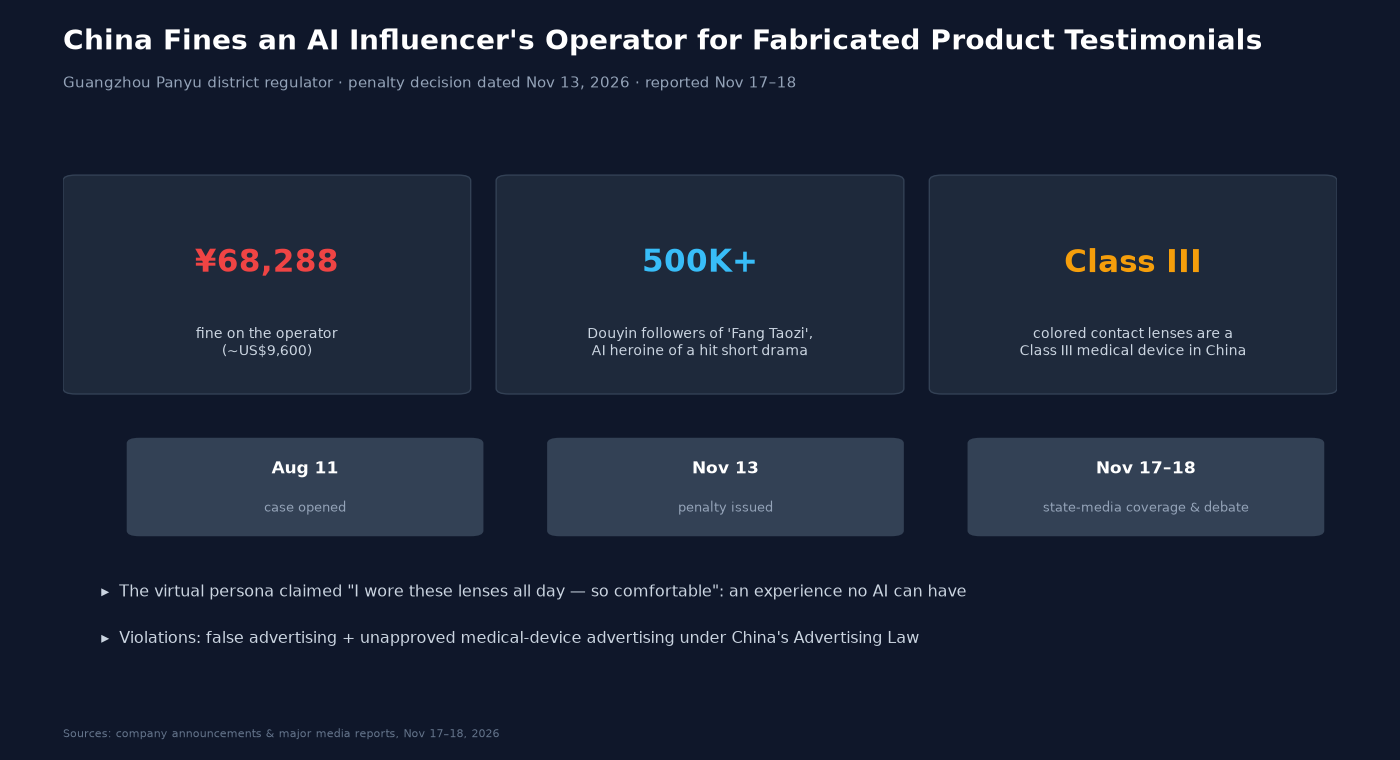
The virtual influencer known as Fang Taozi has more than 500,000 followers on Douyin and tens of millions of likes. She is the AI-generated heroine of a hit short drama, “The Girl Who Was Laid Off,” and this autumn she took her first brand deal: colored contact lenses from a brand called NUTNUTLOOK. In the ad, she spoke in the first person. “I wore these lenses all day — so comfortable,” she said, adding that a special design meant viewers could “blink with confidence.” Regulators in Guangzhou’s Panyu district had two problems with this. The lesser one: colored contact lenses are Class III medical devices in China, and the ad carried no medical-advertising approval. The greater one: Fang Taozi is not a person. She has never worn anything. The experience she testified to was fabricated by definition.
The district’s market regulator fined the operator, Guangzhou My Film & TV Culture Media Co., ¥68,288 — roughly $9,600 — under China’s Advertising Law provisions on false advertising and unapproved medical-device promotion, according to the penalty decision dated November 13 and reported by state media and outlets including Shanghai Daily’s Shine and 36Kr’s English service on November 17–18. The sum is trivial. The precedent is not. This is among the first enforcement actions anywhere to target the specific mechanics of AI-persona endorsement: not a deepfake of a real celebrity, not an undisclosed bot account, but a wholly synthetic character giving fabricated first-person product testimony.
Why the legal logic travels farther than the jurisdiction
Strip away the Chinese statutory references and the regulator’s reasoning reduces to a principle every advertising standards body already recognizes: a testimonial must reflect the genuine experience of a real user. The FTC’s endorsement guides say so in America; the UK’s ASA says so in Britain. What the Fang Taozi case adds is the demonstration that this principle bites on synthetic personas — that “the character said it, not the brand” is no defense, and that the operator who prompts, scripts, and publishes the persona owns the claim as surely as if a human spokesperson had read it.
Chinese commentary around the case, including a widely syndicated state-media editorial titled “AI endorsements are not beyond the law,” drew the line precisely: a virtual person may have no physical body, but may not fabricate product experiences or blur real and fake. Note what was not condemned. Virtual idols, AI short-drama stars, and digital brand ambassadors remain legal and popular; the enforcement targeted the testimonial, not the technology. That distinction is the whole compliance roadmap for the industry.
The context: China is regulating AI content from every angle at once
The fine landed in a week of coordinated signals. Xinhua published guidance clarifying how AI creators — short-drama makers, digital-human livestreamers, prompt-service sellers — should register and pay taxes on their income. The short-drama platform Hongguo disclosed it had intercepted or removed nearly 44,000 works suspected of likeness-rights violations, 99% caught by proactive screening. And courts have begun allocating liability when employees use AI at work. The pattern is unmistakable: China is not banning AI content; it is industrializing the compliance layer around it — identity, taxation, licensing, testimony — faster than any Western jurisdiction has attempted.
For global brands, the practical stakes are rising because AI-persona marketing is scaling everywhere. Virtual influencers front campaigns from Seoul to Los Angeles; AI-generated short dramas are a booming export format; agencies increasingly propose synthetic brand characters as cheaper, scandal-proof talent. The Fang Taozi case prices the scandal-proof claim: the persona cannot misbehave, but its operator can be fined for every invented experience it narrates.
A three-rule playbook for synthetic endorsement
First, separate depiction from testimony. An AI character can demonstrate a product visually, star in branded narrative, and embody a mascot. It cannot say “I used this and here’s how it felt” — no synthetic persona can hold a genuine experience, so any first-person efficacy or comfort claim is fabricated by construction. Script reviews should flag every “I” sentence attached to a product claim.
Second, map the claim to the category. The medical-device dimension doubled the operator’s exposure in this case. Health, beauty-with-efficacy, financial, and supplement claims carry pre-approval and substantiation regimes in most markets; running them through a virtual character adds risk without adding any exemption.
Third, contract for the liability. Brand-operator agreements for virtual talent should specify who scripts claims, who substantiates them, who holds advertising approvals, and who pays when a regulator disagrees. The Guangzhou operator learned that owning the account means owning the fine. Brands that assume the influencer’s corporate wrapper insulates them should read the decision twice.
The AI influencer industry’s founding promise was talent without human failure modes. Guangzhou’s regulator just clarified the fine print: the failure modes didn’t disappear. They moved to whoever writes the script.