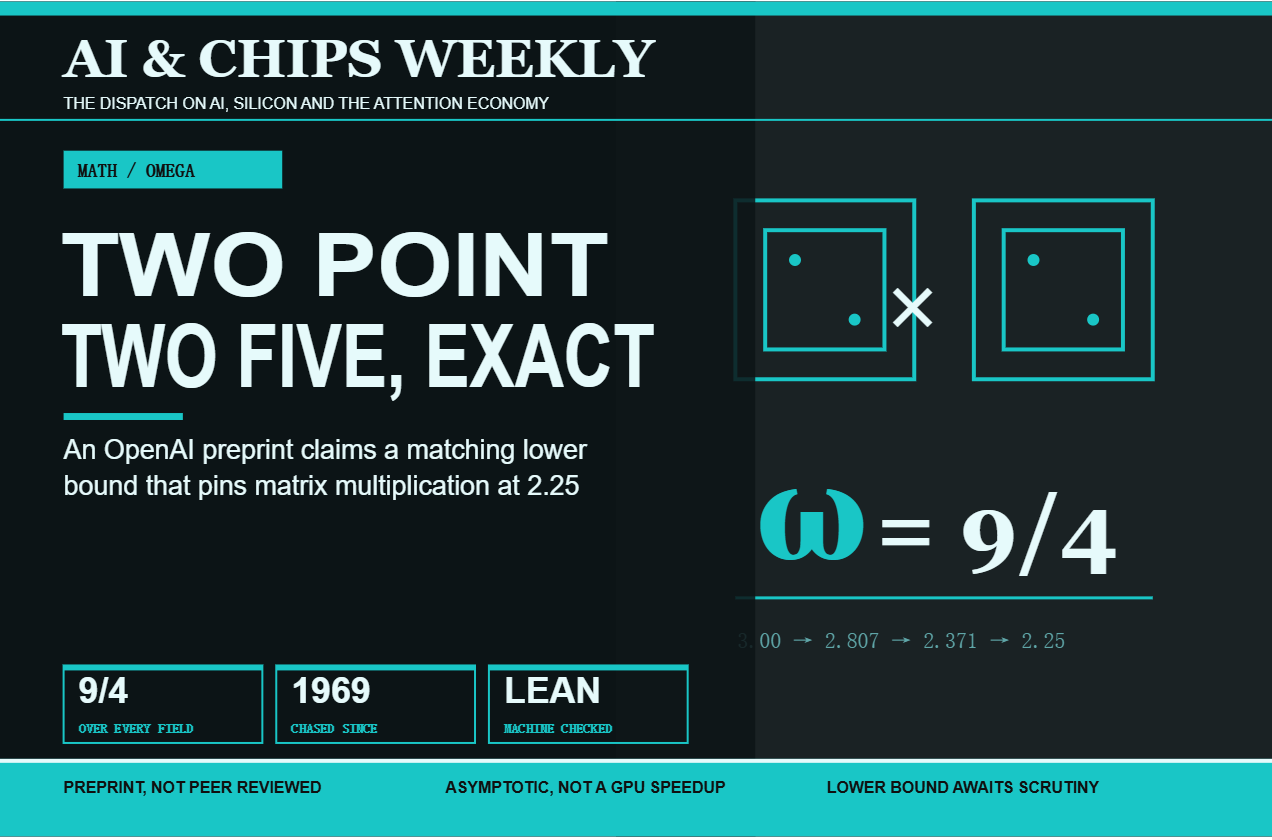
OpenAI posted a preprint on 24 November, titled The matrix multiplication exponent is nine fourths, claiming that the exponent known as omega is exactly 2.25 over every field. That number governs how the cost of multiplying two square matrices grows with their size, and it has been chased since Strassen showed in 1969 that seven products could beat the schoolbook eight. The story comes in two halves: an October paper gave an upper bound of 9/4 over the complex numbers, and this one adds the matching lower bound, arguing that formal arithmetic circuits need at least about half of n to the 9/4 in multiplication gates. If it holds, it closes a decades-old question and kills the cherished guess that omega might be 2. Independent support already exists on the upper side, with Rafael Pass at Cornell giving an elementary constructive proof. Keep the limits clear: this is a preprint, not peer reviewed, the lower bound still needs community scrutiny, and it describes asymptotic arithmetic, so no GPU suddenly multiplies faster tomorrow.