Open Snapchat’s global ad-reach dashboard and Saudi Arabia looks like a rounding error next to India or the United States. Open the app itself in Riyadh and you are standing in the country’s living room. That gap — between how the West categorizes Snapchat and how Saudis actually use it — is one of the most instructive misreadings in global marketing.
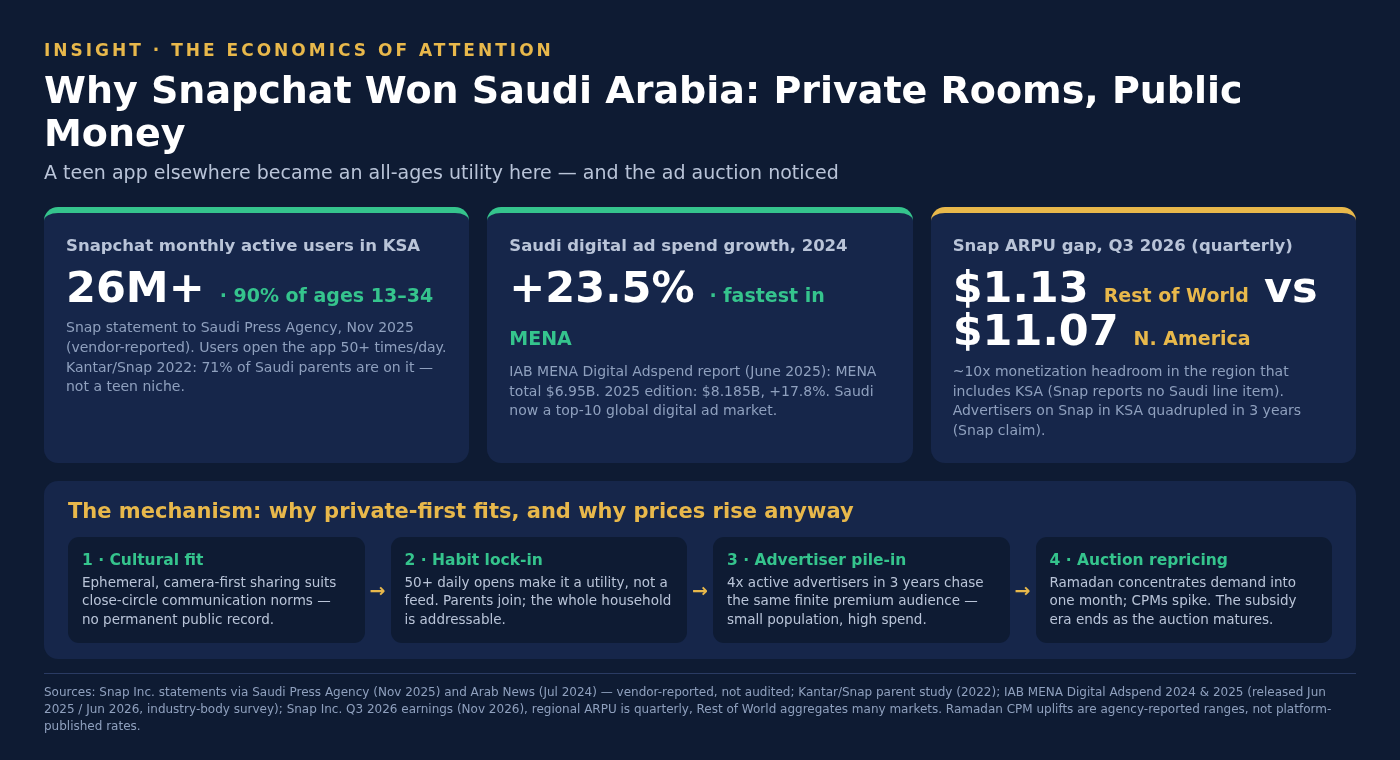
The numbers first. Snap’s Saudi communications head told the Saudi Press Agency in November 2025 that the Kingdom is one of the company’s most important markets worldwide, with more than 26 million monthly active users. Around 90% of Saudis aged 13–34 use the app, opening it more than 50 times a day. A Kantar study commissioned by Snap back in 2022 found 71% of Saudi parents were on it. Read those together: this is not a teen channel. It is household infrastructure. (All user figures here are Snap’s own statements to press — vendor-reported, not audited — but the trajectory has been consistent across four years of disclosures.)
Why did a disappearing-photo app become a national utility? Our reading: the product’s architecture happens to fit the culture’s communication norms. Saudi social life runs on close circles — family, friends, trusted groups — and Snapchat’s default is exactly that: ephemeral, camera-first sharing with people you actually know, no permanent public record, no pressure to perform for strangers. Snap’s own regional executives describe users showing their authentic selves there more than on other platforms. Where a public feed asks you to broadcast, Snap asks you to whisper. In a market where the private circle is the unit of trust, the whispering app won.
Then the habit compound kicks in. Fifty daily opens is not media consumption; it is a reflex, closer to checking the time. When parents join the same app as their kids, the addressable household collapses into one surface — and advertisers noticed. Snap says active advertisers in the Kingdom more than quadrupled in three years. IAB MENA’s industry ad-spend survey shows Saudi digital advertising grew 23.5% in 2024, the fastest in the region, pushing the Kingdom into the world’s top ten digital ad markets; the regional total hit $8.185 billion in 2025.
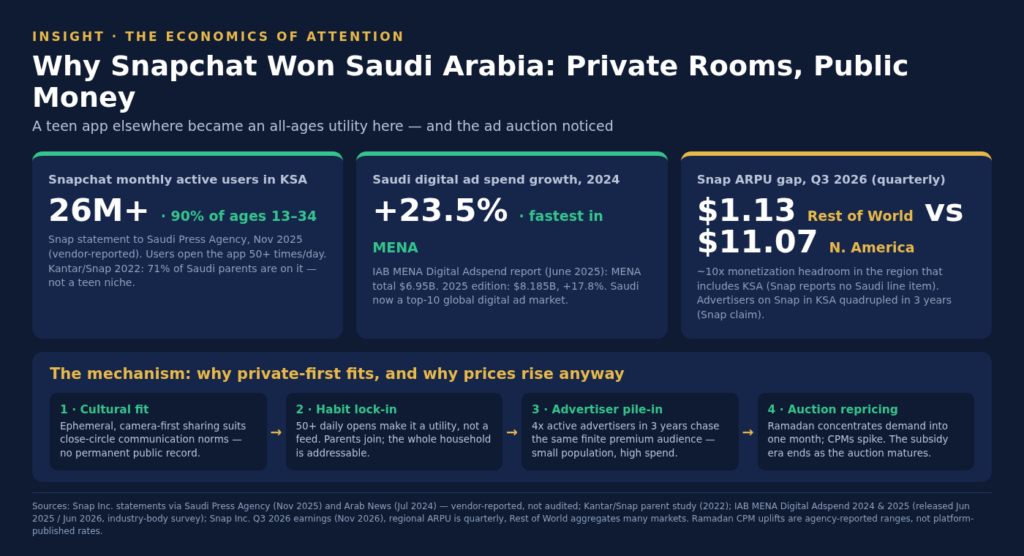
Here is the economics twist. Attention is abundant, but monetization is not — yet. Snap’s Q3 2026 earnings show Rest of World ARPU at $1.13 per quarter versus $11.07 in North America, a roughly tenfold gap (Snap reports no Saudi line item, so treat this as a regional proxy). That gap is the opportunity and the warning at once: more advertisers are chasing a finite, premium audience in a country of 35 million, and agencies report Ramadan CPMs spiking as the whole market bids at once. The cheap-attention window that state-built connectivity opened is closing the way all auctions close — from the demand side.
The lesson generalizes beyond Saudi: platform categories are local, not global. What a product is called in San Francisco matters less than what it does inside a specific culture’s trust structure. Find the app that matches how a society actually talks, and you have found its real mass medium — whatever the global dashboard says.





