Every profile of Mercado Libre opens the same way: “the Amazon of Latin America.” It’s a handy shortcut, and it’s wrong in the most interesting way possible. Amazon is a retailer that bolted on payments and advertising. Mercado Libre is something stranger and more valuable: a company that looked at a continent missing its banks, its credit bureaus and its reliable couriers — and decided to build all three itself. The marketplace was never the whole business. It was the customer-acquisition layer for the institutions underneath.
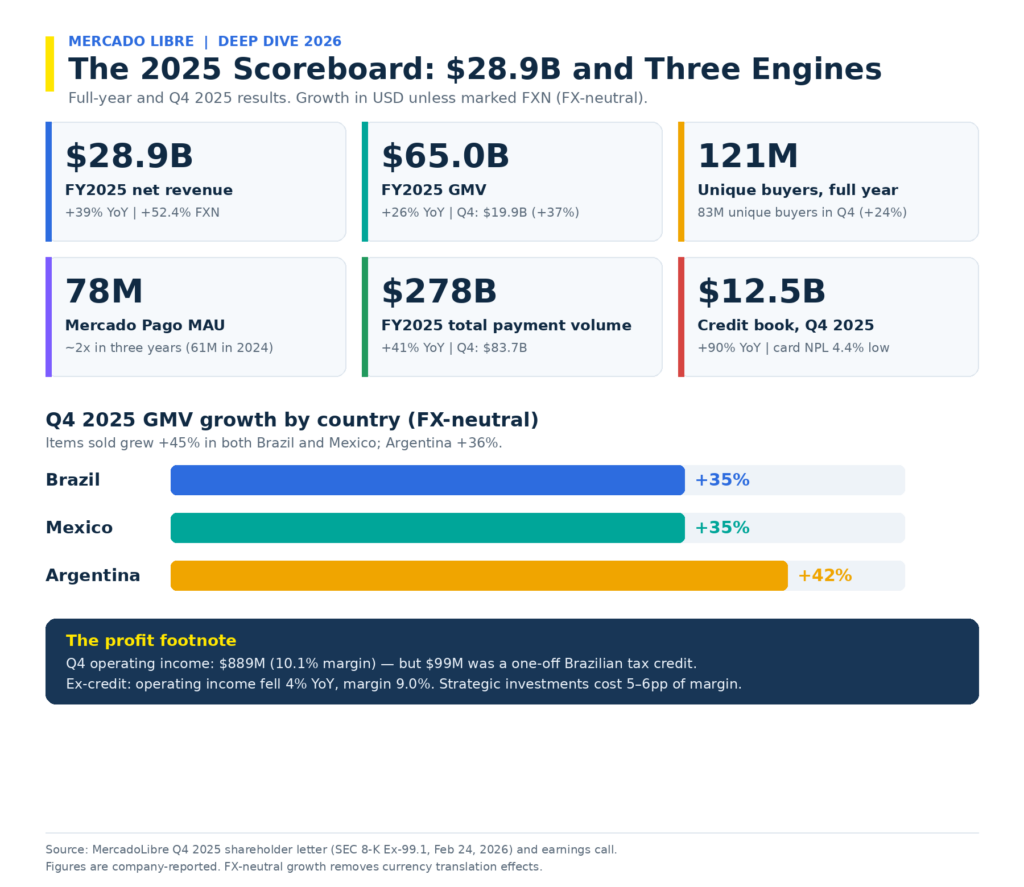
The 2025 numbers make the case. Full-year revenue hit $28.9 billion, up 39% in dollars and 52.4% on an FX-neutral basis, according to the Q4 shareholder letter filed with the SEC in February 2026. Mercado Pago, the fintech arm, ended the year with roughly 78 million monthly active users — more than double the 35 million it had three years earlier. Its credit book grew 90% to $12.5 billion, with early-stage credit-card delinquency at a historic low of 4.4%. Advertising grew 67% FX-neutral. This is not a store with a wallet attached. It’s a commerce-fintech-ads flywheel, and each turn makes the next one cheaper.
Here’s the thesis we’ll defend across this piece: the everything-app didn’t emerge from chat, the way WeChat did, or from search, the way Naver did. It emerged from solving a continent’s missing infrastructure. And in late 2026, we finally got the first real stress test of that model — which makes this a good moment to look at both the machine and its canaries.
A Continent-Shaped Problem
Start with the world Marcos Galperin was selling into. He founded the company in Buenos Aires in August 1999, fresh out of his Stanford MBA, and the barrier he identified wasn’t demand. Latin Americans wanted to buy things. The barrier was trust infrastructure: payments in economies where most adults had never held a bank account, logistics where the postal service was a lottery and addresses were suggestions, and credit where thin files meant punishing rates — if you could get credit at all.
The World Bank’s Global Findex 2025 database, which surveys financial inclusion using 2024 data, shows how deep that hole was and how fast it’s filling. Account ownership among adults in Latin America and the Caribbean (excluding high-income economies) stood at 39% in 2011, 54% in 2017, and 70% in 2024. Brazil leads at 86%, Chile at 85%. But credit-card ownership tells the sharper story: roughly 14% of adults in Mexico, 30% in Argentina, 43% in Brazil. Management’s own figures on the earnings call were consistent — card penetration below 20% in Mexico, around 40% in Argentina. An entire continent of consumers with purchasing power and no formal way to finance it.
That’s not a market gap. That’s an institutional vacuum. And vacuums are where the biggest companies get built.
Three Inventions, Not One
Mercado Libre’s history reads less like a product roadmap and more like a sequence of institution-building:
- 1999 — the marketplace. An eBay-style auction site, escrow-mediated because strangers didn’t trust each other.
- 2003 — Mercado Pago. Born as the escrow mechanism, it evolved into a full digital bank: wallet, yield accounts, cards, credit, insurance.
- 2013 — Mercado Envíos. The logistics network — fulfillment centers, an air fleet, last-mile coverage — built because you couldn’t rent reliable delivery at continental scale.
Each layer solved a missing institution instead of assuming it existed. The company went public on Nasdaq in 2007, and by 2025 it operated across 18 countries. On January 1, 2026, founder Galperin handed the CEO role to Ariel Szarfsztejn — the executive who had built the logistics network — and became executive chairman. The company reported record Net Promoter Scores in both commerce and fintech across its core markets in 2025. That’s the trust dividend, made visible: 121 million unique buyers over the full year, 83 million in Q4 alone.
The Flywheel: Five Engines, One Loop
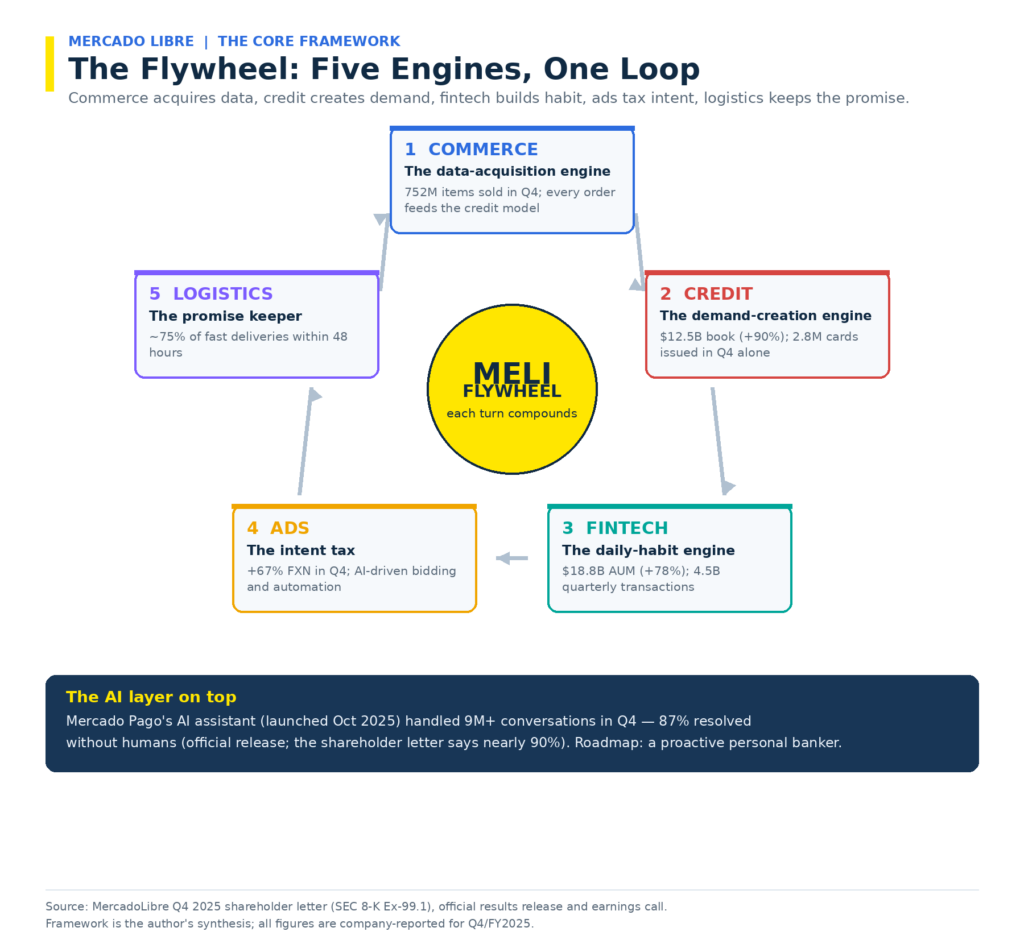
Here’s the framework that explains why the pieces compound. Five engines, each feeding the next:
Commerce is the data-acquisition engine. 752 million items sold in Q4 2025, up 43%. Every order, every repayment, every browsing session feeds behavioral underwriting. The shareholder letter explicitly credits marketplace-plus-fintech interaction data for the credit models that issued 2.8 million cards in Q4 alone. In a region with thin credit files, the marketplace is the credit bureau Latin America never had.
Credit is the demand-creation engine. A $12.5 billion book growing 90% doesn’t just earn interest — installments expand what buyers can afford, which grows GMV, which generates more underwriting data. Management is explicit that card expansion in Brazil, Mexico and Argentina is a deliberate margin trade today for lock-in tomorrow.
Fintech is the daily-habit engine. Assets under management reached $18.8 billion, up 78% — from roughly $2 billion three years earlier. Yield accounts pull salaries and savings into the app, making it daily between purchases. 4.5 billion payment transactions in Q4; $278 billion in total payment volume for the year, up 41%. The ambition management keeps repeating: become the principal bank, not the spare wallet.
Ads are the intent tax. Advertising revenue grew 67% FX-neutral in Q4, driven by AI-powered bidding and automation. This is the retail-media layer every marketplace eventually builds — and on MELI it’s still early enough that the auction isn’t fully priced.
Logistics is the promise keeper. Nearly 75% of fast deliveries arrived within 48 hours. When Brazil cut its free-shipping threshold from R$79 to R$19 in mid-2025, purchase frequency and conversion accelerated — items sold in Brazil rose 45% in Q4. Operations, it turns out, are marketing.
The Marketplace Is the Credit Bureau LatAm Never Had
This is the part the Amazon analogy can’t carry. Amazon underwrites merchants with transaction history; MELI underwrites consumers with behavioral history in economies where the formal bureau has almost nothing on file. The Q4 letter’s credit section reads like a proof: the card book more than doubled to $5.7 billion, early 15–90-day card delinquency fell to 4.4% — a historic low, down more than 300 basis points in three years — and the net interest margin after losses (NIMAL) for the whole portfolio, card included, held at 23.3%.
On the call, fintech president Osvaldo Giménez added the behavioral kicker: customers who get the card are two to three times more likely to become “ecosystemic” users — people who shop, pay, save and borrow inside the same app. The credit product isn’t a side business. It’s the loyalty program with an interest rate.
Brazil and Mexico Are the Story — Argentina Is the Option
Headlines fixate on Milei-era Argentina, and it’s true the country delivered 42% FX-neutral GMV growth in Q4. But read the volume tables: Brazil and Mexico each grew items sold 45% and GMV 35% FX-neutral, on vastly larger bases. Brazil’s Q4 items-per-buyer acceleration followed the shipping-threshold cut; Mexico’s merchant acquiring TPV grew 50% FX-neutral on the call. MELI is a Brazil-Mexico company with an Argentine option attached — high-beta upside when the macro cooperates, and FX translation noise when it doesn’t. Always read the FX-neutral column next to the reported one.
The Margin Dip Was a Decision, Not an Accident
Q4 operating income of $889 million looks like a 10.1% margin — until you notice $99 million of one-off Brazilian tax credits inside it. Strip those out and operating income fell 4% year over year, margin 9.0%. Management’s own estimate: the combined strategic investments — lower free-shipping threshold, credit-card expansion, first-party retail, cross-border trade — cost 5 to 6 percentage points of operating margin in the quarter.
That’s not deterioration. That’s a company spending today’s margin to buy tomorrow’s lock-in, and saying so out loud. The flywheel logic only works if you’re willing to look temporarily worse while the loop tightens. The market’s patience with that trade is itself a risk — more on that below.
The AI Layer: 87% of Conversations, Zero Humans
In October 2025 Mercado Pago launched an AI assistant. By Q4 it had handled more than 9 million conversations, with 87% resolved without human support — that’s the figure in the official results release; the shareholder letter’s prose rounds it to “nearly 90%.” Both numbers describe the same quarter, and we’ll use the conservative official one.
The roadmap matters more than the resolution rate. Management describes the assistant evolving from reactive support into a proactive personal banker — and, eventually, into product recommendation. Meanwhile the affiliate network has grown past 12 million people, with affiliate-channel orders up 240% in Q3 2026. And on the November 2026 call, CEO Szarfsztejn drew a hard line: MELI will not hand its inventory to external agentic platforms. Its own shopping agent is already live in small rollouts across the three core markets. The company that built the missing institutions intends to own the AI counter too.
What the Credit Panic Gets Right — and What It Misses
A book growing 90% a year sounds reckless. Here’s the honest two-sided read, updated through Q3 2026 (reported November 4, 2026):
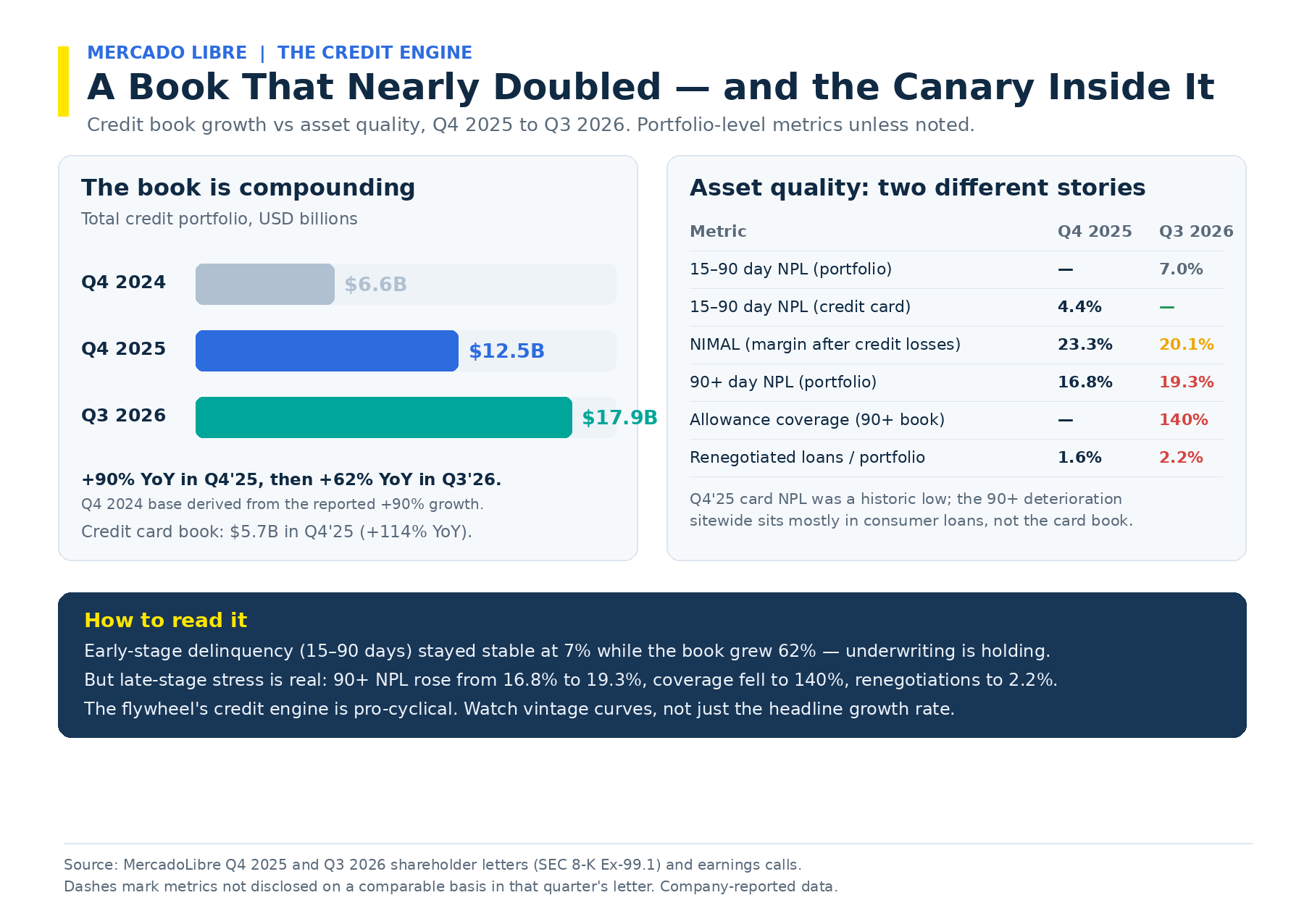
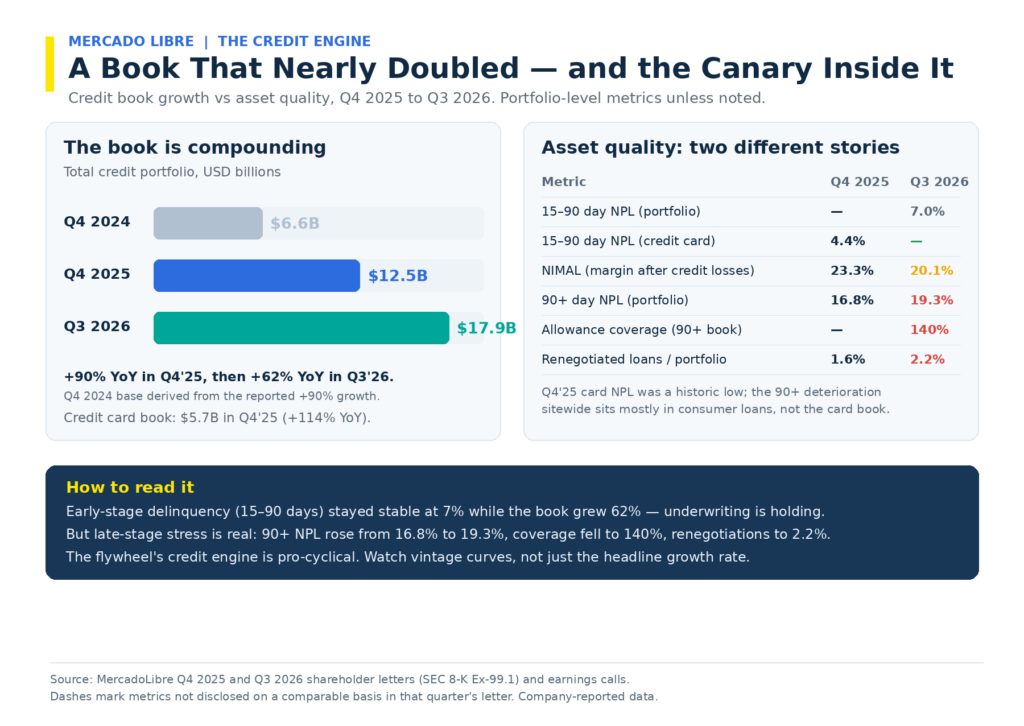
The reassuring side: the book reached $17.9 billion, up 62%, while early-stage 15–90-day delinquency for the portfolio held at 7.0%, stable quarter over quarter. Underwriting at the front of the funnel is holding even as issuance accelerates. The card book’s allowance ratio actually fell from 21.5% to 18.8% per the 10-Q product breakdown.
The uncomfortable side: late-stage stress is real and visible. Portfolio 90+ day delinquency rose from 16.8% in December 2025 to 19.3% in September 2026. Allowance coverage fell to 140%. Renegotiated loans climbed from 1.6% to 2.2% of the book. NIMAL compressed from 23.3% to 20.1%. And the deterioration sits mostly in consumer loans — whose allowance ratio jumped from 27.3% to 34.8% — not in the card product everyone watches.
So the canary the Q4 call hinted at has started singing. It doesn’t mean the model is broken; a young, fast-growing book in a volatile region will throw off late-stage noise, and management argues vintage curves matter more than headline NPLs. But “proprietary data makes credit safe” is a hypothesis under live testing, not a settled fact. The stock’s roughly 7–14% single-day drop after the Q3 print — and a year-to-date decline of about 25% — says the market is repricing exactly this uncertainty.
The Moat Is Being Probed From Every Angle
Competition is converging fast. Shopee is entrenched in Brazil. TikTok Shop opened seller onboarding in Mexico in January 2025 and launched the shopping mall in February — and, in a detail that says everything about MELI’s infrastructure position, integrated Mercado Pago as a payment option from day one. Brazil followed in May 2025. Amazon persists, and Temu and Shein press on price. MELI’s response is the flywheel itself: cross-border GMV grew 74% FX-neutral in Q4, first-party retail passed $4 billion for the year, and December 2025 saw the first China fulfillment center open, shipping to five markets. The moat isn’t selection scale — it’s that competitors keep having to rent pieces of MELI’s trust stack to compete with it.
What Brands and Marketers Should Actually Do
Four moves follow from the data:
- Price for financed affordability. In a continent where installments are the purchase decision, model the monthly payment, not the sticker. Credit expands category ceilings — that’s demand your pricing strategy should assume exists.
- Get into MELI ads early. A channel growing 67% FX-neutral (51% in Q3 2026) means the auction is still forming. Early retail-media discipline here compounds the way Amazon Ads did a decade ago.
- Treat fulfillment as a marketing decision. Envíos enrollment lifts the delivery promise, which lifts conversion, which lifts ranking. The Brazil threshold experiment proved operations move the funnel.
- Structure your catalog for the agent. With MELI building its own shopping agent and refusing external ones, clean structured product data is the next discovery surface in LatAm. GEO isn’t just a Google story.
Risks We Won’t Paper Over
Credit-cycle exposure is the big one: the engine is pro-cyclical, and the late-stage metrics above are the early tremors. FX translation flatters and deflates reported growth — Argentina especially. Chosen margin compression persists: Q3 2026 operating margin was 6.3%, down 350 basis points year over year, and management has explicitly prioritized long-term earnings power over a short-term margin target. The market must keep believing the flywheel narrative through the spend cycle — and November’s selloff shows that belief is not guaranteed.
The Takeaway: Build What Everyone Else Assumes Exists
Mercado Libre became Latin America’s everything-app by building what the continent lacked: escrow that became a bank, a courier network that became a promise, purchase data that became a credit bureau. The 2025 numbers show the loop compounding; the 2026 numbers show what happens when the credit engine meets a real cycle. Both belong in the story.
The lesson generalizes beyond LatAm. The everything-app doesn’t start from chat or search. It starts from the infrastructure everyone else assumes exists — and in most of the world, that assumption is still wrong. Whoever builds the missing layer owns the relationship. MELI just happened to do it first, on a continent where nothing could be assumed.