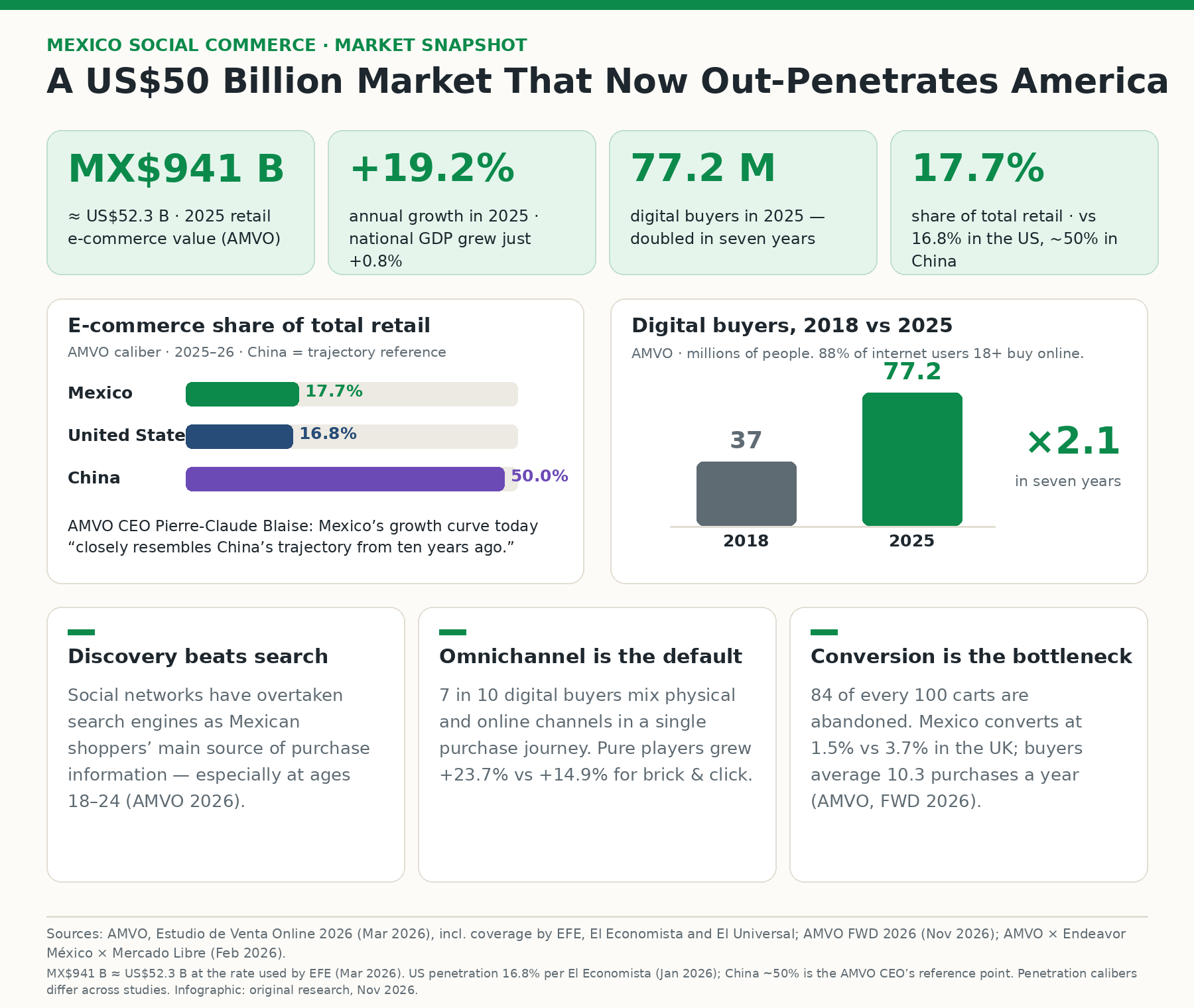
When US e-commerce turned into a tariff-and-CAC knife fight, sellers looked south — and found a market behaving like China ten years ago. That is not our metaphor; it is the comparison offered by Pierre-Claude Blaise, CEO of the Mexican Online Sales Association (AMVO). The numbers back him up: Mexican retail e-commerce hit MX$941 billion in 2025 (about US$52.3 billion), growing 19.2% while national GDP crawled forward 0.8%. Some 77.2 million Mexicans now buy online, and e-commerce takes 17.7% of total retail — ahead of the United States at roughly 16.8%.
TikTok Shop picked Mexico as its first Latin American market in February 2025, and the launch went vertical: daily sales multiplied 34-fold within eight months, and by September 2026 the platform reported 133x its launch-base daily GMV. The strategic unlock for American sellers arrived in April 2026: the US–MX program lets you sell to Mexican consumers straight from your US warehouse, with TikTok advancing import duties against your settlement balance. One inventory pool, two demand markets.
But the back door has a toll booth. Mexico’s 2026 revenue law makes platforms withhold up to 36 points of gross revenue (20% income tax plus the full 16% VAT) from sellers without a valid Mexican tax ID — and collects 100% of VAT from foreign sellers regardless. Mexico is the US’s back door and its proving ground: the market where American sellers learn whether their playbook survives Spanish-language content, fragile consumer loyalty, and a formalizing state.
The Market the US Underestimated
For years, Mexico sat in the “interesting, but later” folder of every US expansion plan. Then the folder caught fire.
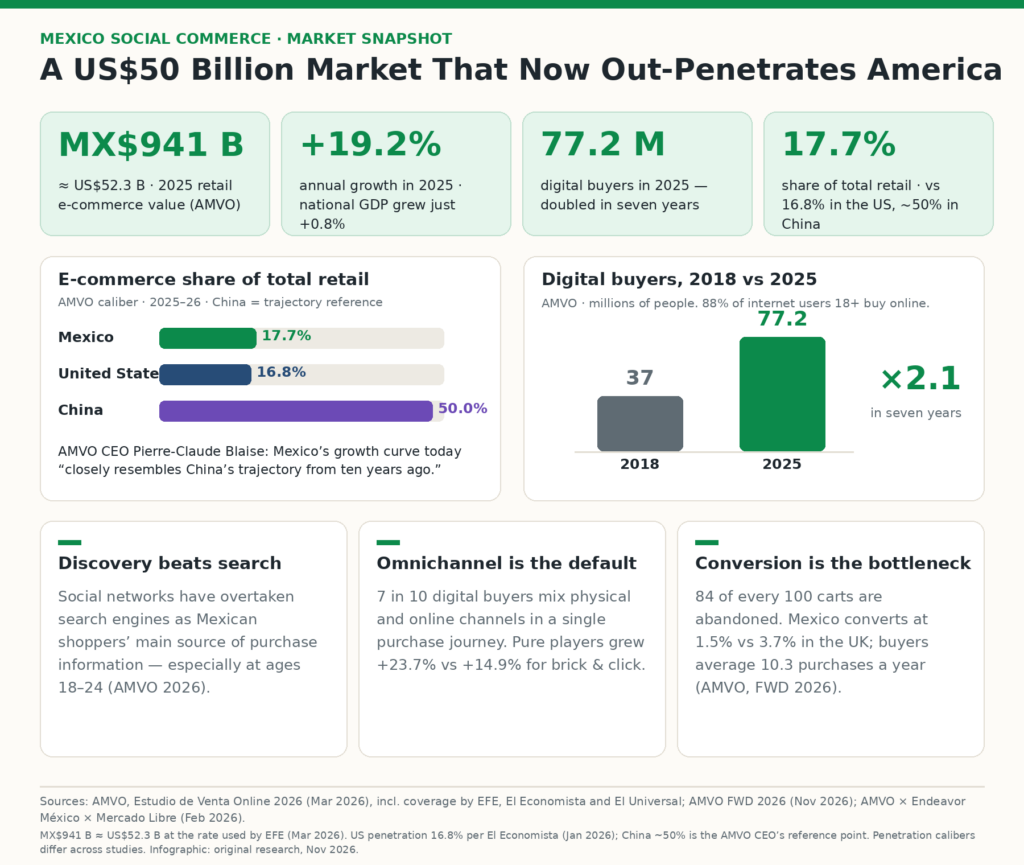
AMVO’s Online Sales Study 2026, released in March, put the market at MX$941 billion for 2025 — eighth-largest retail e-commerce market globally, and the fastest-growing major economy in the top ten. The buyer base doubled in seven years, from roughly 37 million in 2018 to 77.2 million in 2025. Nearly 88% of Mexican internet users over 18 now shop online. Penetration passed the US threshold this cycle: 17.7% of Mexican retail runs through e-commerce versus about 16.8% in the States.
And here is the frame that matters. China’s e-commerce penetration sits near 50% today. Blaise’s point at the AMVO–Endeavor México–Mercado Libre research presentation in February was that Mexico’s current curve resembles China’s from a decade ago — which means the growth story is closer to halftime than the final whistle.
Two structural details make the opening real. First, digital-native sellers grew 23.7% in 2025 versus 14.9% for traditional brick-and-click retailers — the channel rewards operators built for it. Second, AMVO found social networks have overtaken search engines as shoppers’ main source of purchase information, especially among 18-to-24-year-olds. Discovery moved. The shelf didn’t.
The Concentration Problem — and the Flank It Left Open
Mexico’s antitrust authority, Cofece, concluded its marketplace investigation in September 2025 with a striking finding: Amazon and Mercado Libre account for more than 85% of seller sales and transactions on Mexican retail e-commerce platforms. The regulator documented seller-side barriers — opaque selection of the featured offer (the Buy Box), and extra visibility for sellers who buy the platform’s own logistics — but could not muster the qualified majority to order remedies. The case closed with evidence, not consequences.
Read that as a market map. Two shelf giants own search-driven demand. What they do not own is creator-led discovery — the moment a shopper who was looking for nothing ends up buying something. That flank was open in early 2025. TikTok Shop walked through it.
The Ignition: TikTok Shop’s First LatAm Market
TikTok Shop launched in Mexico in February 2025 — before Brazil, before anywhere else in the region. Mexico was explicitly the laboratory for discovery commerce in Latin America.
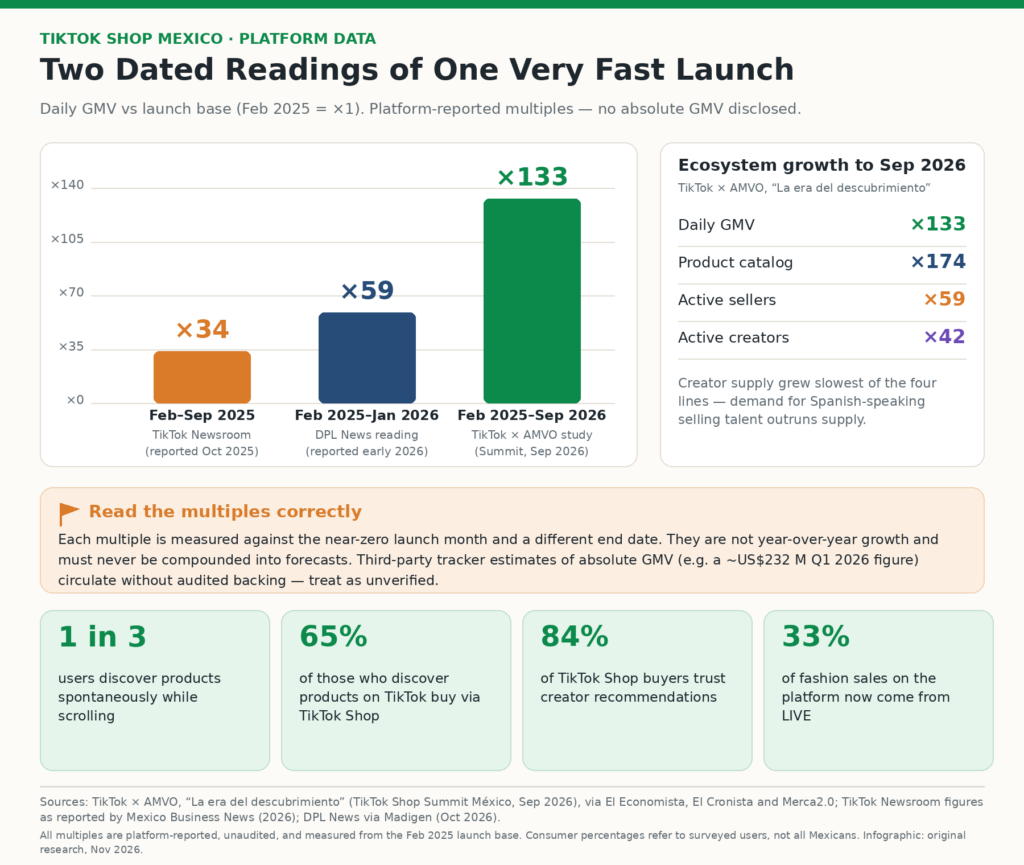
The lab results came fast. Per TikTok’s newsroom figures, average daily sales grew 34x between February and September 2025, the product catalog expanded 15x, and active sellers and creators grew 23x. A later reading through January 2026 put daily GMV at 59x the launch base. And at the TikTok Shop Summit México in September 2026, a joint TikTok–AMVO study called La era del descubrimiento reported daily GMV at 133x, catalog at 174x, active sellers at 59x, and active creators at 42x since launch.
Read the Multiples Like an Analyst, Not a Fan
A quick discipline note, because these numbers get abused everywhere. Each multiple is measured against the near-zero launch month, at a different cutoff date. The 34x, 59x, and 133x figures are not contradictions — they are three photographs of the same rocket at different altitudes. None of them tells you the absolute size of the market, and none should ever be compounded into a forecast. Third-party trackers estimate TikTok Shop Mexico sold north of US$497 million in its first eleven months (Charm.io data, cited by Mordor Intelligence), which is a useful order-of-magnitude anchor — but it is tracker arithmetic, not audited disclosure.
For market sizing with a defensible caliber, use AMVO’s audited-survey retail numbers, or Mordor’s broader forecast: Mexico’s total e-commerce (B2C plus B2B) at US$62.16 billion in 2026, heading to US$143.54 billion by 2031 at an 18.22% CAGR. Different scope, clearly labeled — never mix the two in one sentence.
What the Discovery Data Actually Says
The TikTok–AMVO study is platform research, so treat it as directional. But its internal logic is consistent with what AMVO independently found about social overtaking search:
- One in three users discovers products spontaneously while scrolling.
- 65% of people who discover products on TikTok go on to buy through TikTok Shop — note the denominator: discoverers, not all users.
- 84% of TikTok Shop buyers say they trust creator recommendations.
- Reviews capture 40% of reported content attention; tutorials 37%.
- 33% of fashion-category sales on the platform now come from livestreams.
That last number deserves a pause. Livestreaming was supposed to be the format that never travels outside Asia. In Mexican fashion, it is already a third of the channel.
The Proof Is in the Live Sessions
The case studies read like early-Shenzhen screenshots. Electronics retailer Steren reported a 370% sales increase during Hot Sale 2025. Wilson, the sports brand, reported monthly GMV up 4,000% after committing to high-engagement livestreams. Discount retailer Waldo’s grew sales 149% month-over-month after opening its shop.
During Buen Fin 2025, livestream GMV grew 3.2x versus the pre-campaign period across roughly 3,500 seller sessions; a perfume buyer-store, AMORA, ran a 19-hour continuous live with agency Opinión X and cleared more than 2,000 orders. By Hot Sale 2026, platform sales ran more than 8x the prior year, and sessions producing 500+ orders grew more than fivefold. In November 2026, creator Monserrat Meraz sold over MX$1 million — 4,100-plus units to 187,000 viewers — in a single ten-hour fashion stream, a national record for one session.
Platform-selected cases, yes. But the pattern across three shopping festivals is the tell: live commerce in Mexico grows faster than the channel around it, every single campaign.
Why the Back Door Works: Adjacency, Whitespace, Culture
Strip the hype and four structural advantages remain.
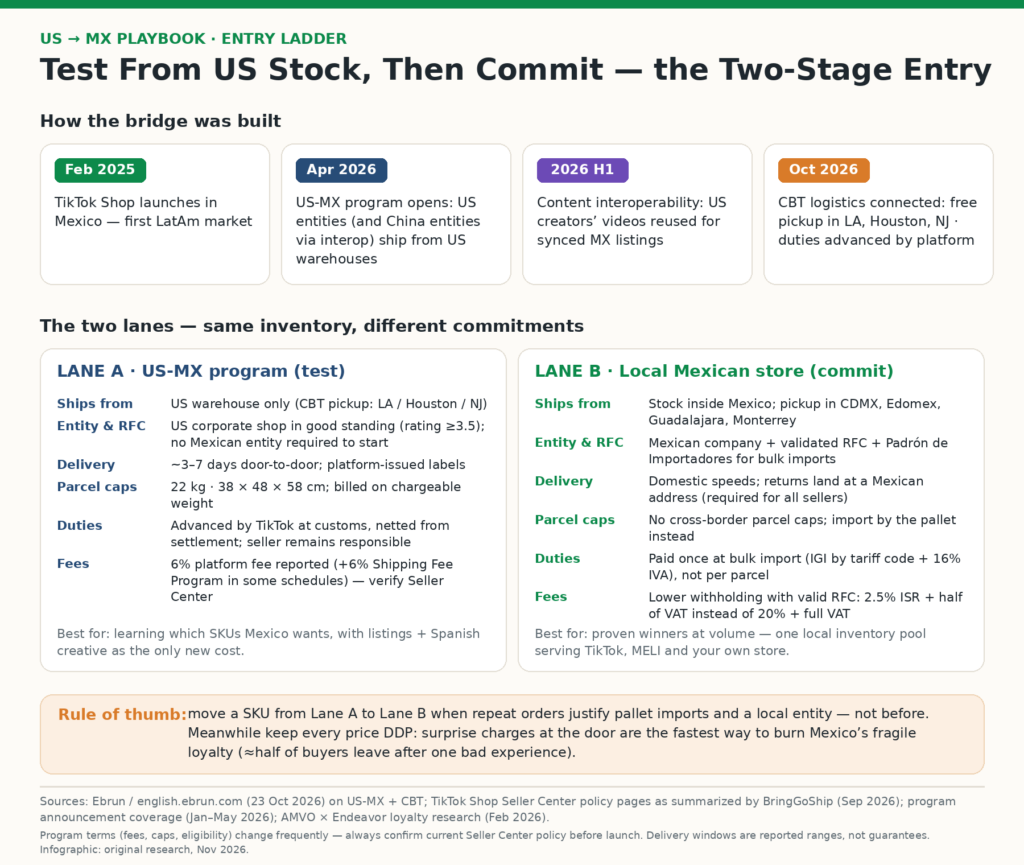
Inventory adjacency. The US–MX program, announced in January 2026 and live in April, lets eligible US-entity sellers (and China-entity sellers through an interoperability mode) serve Mexican demand from US warehouses. Listings sync from the US shop; pricing is set in pesos; delivery runs roughly three to seven days. In October 2026, TikTok connected its official CBT logistics service to US–MX shops — free seven-day pickup in Los Angeles, Houston, and New Jersey, with US and Mexico parcels handed to the same driver. TikTok advances import duties at customs and deducts them from your pending settlement. You do not pre-finance a bulk import to find out whether Mexico wants your product. Testing costs listings plus Spanish creative, not new inventory.
Content-commerce whitespace. The shelf duopoly owns search; nobody owns the feed yet. Creator partnerships still buy category positions at prices that look like early Southeast Asia. One revealing asymmetry from the Summit data: creators multiplied 42x while the catalog multiplied 174x. Products are arriving faster than people who can sell them on camera. If you can build a Spanish-speaking creator bench, you are buying the scarce side of that market.
Cultural commerce. Mexico’s calendar is a demand engine: Día de Muertos flows into Buen Fin, then Black Friday, then Christmas — TikTok Shop bundled the whole stretch into a single Mega Noviembre campaign for November 2026. Family-centered gifting, color-saturated aesthetics, Spanish-language trust. Localization here is demand engineering, not translation. A US-tested creative translated word-for-word is a US creative wearing a sombrero; the products that win are re-staged for Mexican contexts.
The loyalty premium. AMVO–Endeavor research found roughly half of Latin American shoppers would abandon a platform after a single bad experience, and more than half abandon carts when their preferred payment method is missing. Delayed deliveries affect more than half of consumers. Read that as an opportunity statement: in a market with fragile loyalty, boring excellence — accurate delivery promises, transparent all-in pricing, working payment options — is a differentiator, not a hygiene factor.
The Toll Booth: What the Back Door Actually Costs
Now the part the breathless threads skip. Mexico formalized its digital economy in 2026, and the bill arrives per transaction.
Gate 1: The Withholding Regime
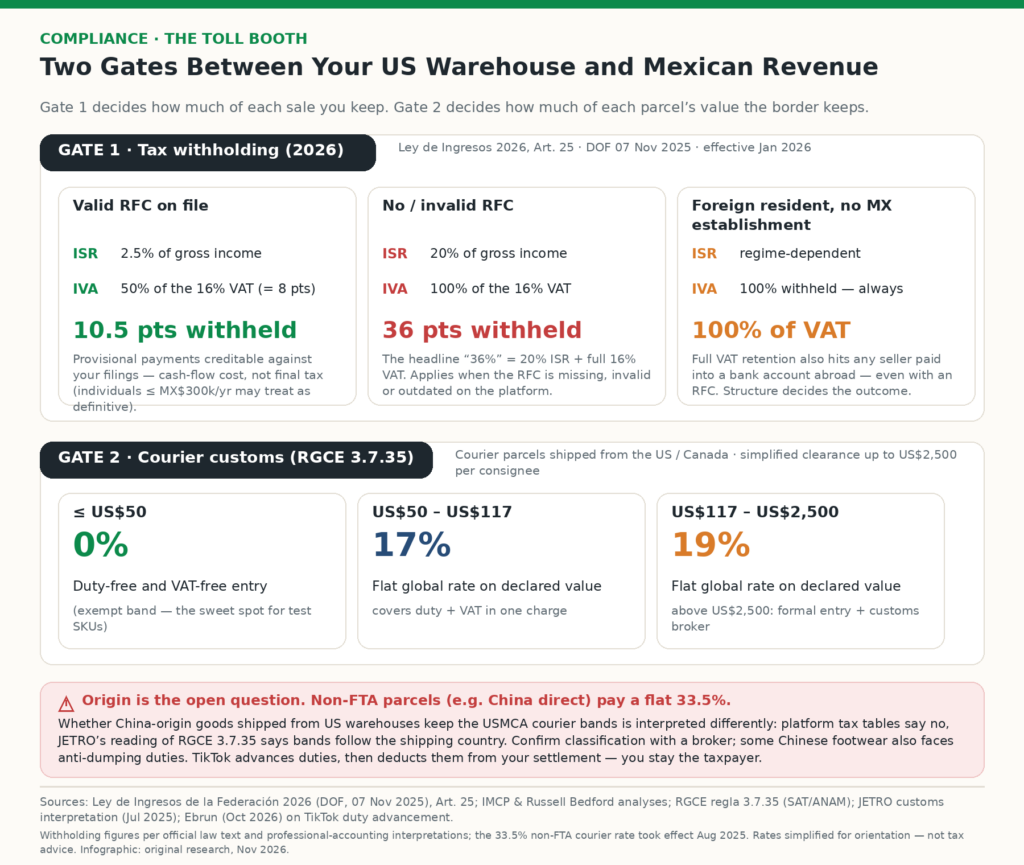
The 2026 Ley de Ingresos de la Federación, published in the official gazette (DOF) on November 7, 2025, rewired platform taxation effective January 1, 2026. Platforms now withhold income tax (ISR) and VAT (IVA) at the source:
- With a valid RFC (Mexican tax ID) registered on the platform: 2.5% ISR on gross income — up from 1% for individuals, and newly extended to companies — plus 50% of the 16% VAT, another 8 points. Call it 10.5 points withheld, creditable against your filings. It is a cash-flow cost, not necessarily a final tax.
- Without a valid RFC: 20% ISR plus 100% of the VAT. That is the famous 36% — 36 points of gross revenue, withheld before you see a peso.
- Foreign residents without a Mexican establishment: 100% VAT withholding applies regardless. The same full-VAT rule hits any seller whose proceeds land in a bank account abroad. Your corporate structure, not your sales skill, decides which column you sit in.
The law also gave SAT, the tax authority, real-time access to platform transaction data and the power to block non-compliant platforms. This is not a paperwork nudge; it is telemetry. RFC registration is the single biggest margin decision a foreign seller makes in Mexico — treat it as a pricing input, not an admin chore.
Gate 2: The Border
Courier parcels shipped from the US or Canada clear under a tiered regime (RGCE rule 3.7.35): declared value up to US$50 enters duty-free and VAT-free; US$50–117 pays a flat 17% global rate; US$117–2,500 pays 19%. Above that, formal entry and a customs broker. Parcels from countries without a trade agreement — China direct — pay a flat 33.5% from the first dollar, a rate in force since August 2025.
One honest complication: whether China-origin goods sitting in a US warehouse keep the preferential courier bands is genuinely disputed. Platform tax guidance says origin rules deny them; JETRO’s reading of the rule text ties the bands to the shipping country. Until customs practice settles it, classify your goods with a licensed broker before you price — and note that some Chinese footwear carries anti-dumping duties on top. The US warehouse is a logistics address, not an origin certificate.
Meanwhile, the door behind you narrowed too. The US suspended its US$800 de minimis exemption for all countries on August 29, 2025 — so shipping refused Mexican orders back into your US warehouse now triggers duties and entry formalities. Returns need a Mexican address and a Mexican plan; TikTok’s return policy requires one for every seller anyway.
Gate 3 (the quiet one): Trade Politics
On July 1, 2026, the US declined to extend the USMCA in its current form at the treaty’s first joint review. The agreement remains fully in force — preferences, origin rules, dispute mechanisms unchanged — but it now enters annual reviews through its 2036 term. Translation: the adjacency advantage that makes the back door cheap is politically contingent, repriced annually. Build the Mexico P&L so it survives a bad review year.
The Payments Myth You Need to Unlearn
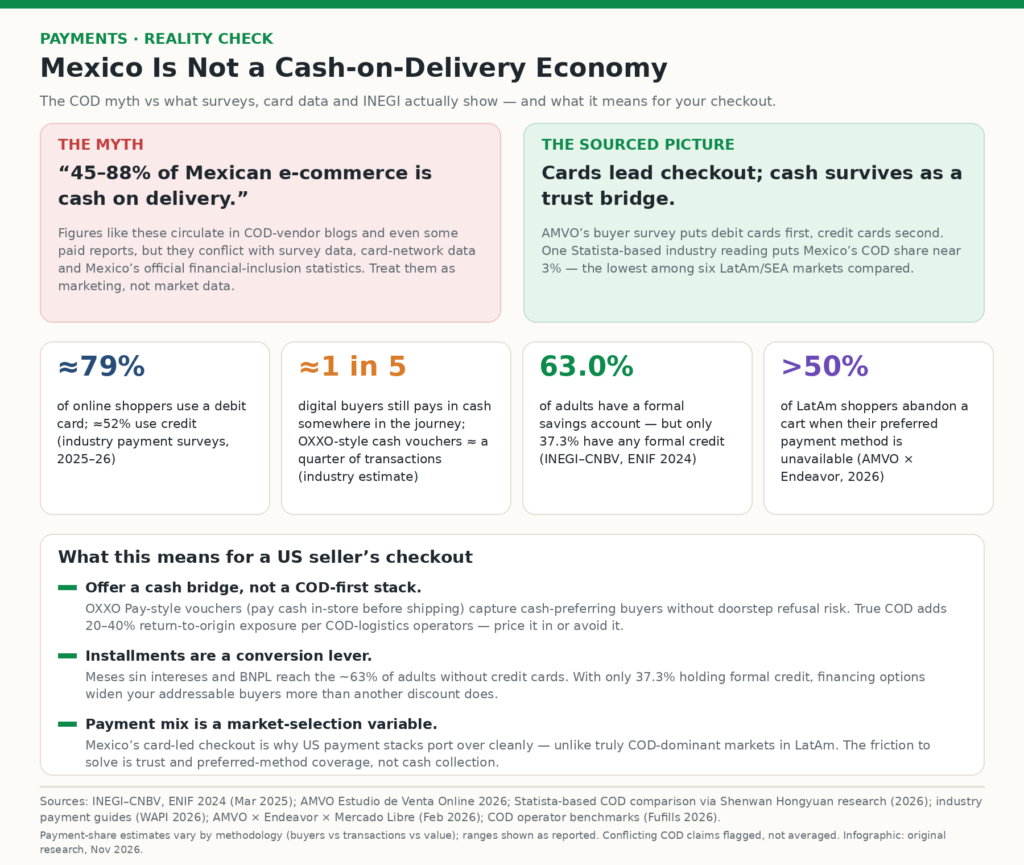
Here is where imported playbooks fail quietly. Sellers hear “Latin America” and brace for a cash-on-delivery economy. Vendor blogs claim 45%, 50%, even 88% of Mexican e-commerce is COD. The sourced picture says otherwise.
AMVO’s buyer survey puts debit cards first and credit cards second among online payment methods. A Statista-based comparison circulated by Shenwan Hongyuan research puts Mexico’s COD share near 3% — the lowest of six LatAm and Southeast Asian markets compared, against 68% in Vietnam and 17% in Brazil. Industry payment guides estimate roughly 79% of online shoppers use debit cards and about half use credit.
Cash has not vanished — it changed form. About one in five digital buyers still pays cash somewhere in the journey, and OXXO-style vouchers (order online, pay cash at a convenience store, then the merchant ships) account for a substantial share of transactions by industry estimates. That is a cash bridge, not COD: payment is verified before fulfillment, so the doorstep-refusal risk never exists. Actual COD, per operators who run it, carries 20–40% return-to-origin exposure. Price that in or route around it.
The deeper statistic is governmental: INEGI’s 2024 financial-inclusion survey (ENIF) found 63% of adults hold a formal savings account but only 37.3% have any formal credit. Mexicans can pay; many cannot finance. Installments (meses sin intereses) and BNPL therefore widen your addressable market more than another discount does. Your US card-first checkout ports over cleanly — add the cash bridge and financing options, and you have covered the market as it actually is.
The Entry Sequence That Survives the Toll Booth
Put the pieces together and the rational sequence writes itself.
Stage one — test from US stock. Open the US–MX shop, sync listings, write Spanish creative with native reviewers (not machine translation with a flag emoji), keep test SKUs under the US$50 duty-free band where the product allows, and price DDP so no customer ever meets a surprise charge at the door. Budget creators before ads: with catalog growth outrunning creator growth 4-to-1, affiliate partnerships are still the cheap side of the trade. Creator commissions in the market run roughly 5–30% depending on category and terms — model them as cost of goods, not marketing overhead.
Stage two — formalize what wins. When repeat orders justify it, form the Mexican entity, validate the RFC, join the importers’ registry, and move proven SKUs to Mexican stock imported by the pallet. You trade per-parcel duty friction for one bulk import, cut withholding from the punitive column to the creditable one, and unlock domestic delivery speeds. Your one local inventory pool can then serve TikTok Shop, Mercado Libre, Amazon and your own store — which matters, because the antitrust file says platform rules can change without asking you.
Throughout — compute the fully loaded P&L. Commission (6% platform fee reported for the program, plus shipping-program charges that vary by schedule), creator cuts, duty advancement, withholding drag, COD refusal exposure if you use it, and the cost of returns that cannot economically go back north. The sellers who get hurt in Mexico are the ones who compute margin before the toll booth and discover it afterward.
Risks and Honest Caveats
Multiple-mania. We said it once, we will say it again: 34x/59x/133x are launch-base artifacts at different dates. Anchor forecasts to AMVO’s survey-caliber market growth, not platform fireworks.
The window prices up. Active sellers multiplied 59x in nineteen months. Content costs and auction prices will industrialize on schedule. Early-mover margin is a window, not a moat — the durable assets are your creator bench, your localized SKU knowledge, and your compliance structure.
Policy volatility cuts both ways. Mexico’s formalization can tighten (SAT already has real-time telemetry); US trade politics can reprice the border annually. Neither risk is diversifiable within a single-channel strategy.
Platform dependence. One platform’s program terms — duty advancement, parcel caps, fee schedules — currently are your logistics strategy. Fees already moved in other markets (TikTok raised European commissions from 5% to 9% in January 2026). Assume Mexico’s promotional terms normalize, and build toward multi-channel before they do.
Conclusion: A Second Front, Not a Loophole
Mexico became the US’s back door because adjacency made it cheap to test and whitespace made it worth testing: one inventory pool under a still-functioning trade treaty, a content-commerce format whose creator side is still supply-constrained, and a market growing 19% with China-style headroom ahead. The toll booth is real — 36 points without an RFC, full VAT for foreign structures, a disputed origin rule, fragile loyalty, annual treaty reviews — but every line item is payable with structure. Test from US stock. Formalize locally. Localize culturally. Build the creator bench before the window prices up. The back door isn’t a loophole; it is a second front. And the sellers who treat it as a real market, not an arbitrage, are the ones still standing when the door becomes the main entrance.