It is 11:40 p.m. in Seoul. A parent realizes there is no milk for breakfast, taps an app three times, and goes to bed. By 7 a.m., the milk is outside the door. Nobody watched an ad to make that happen. Nobody read a slogan. The delivery itself was the message — and that, in one sentence, is how Coupang became the default way a nation shops.
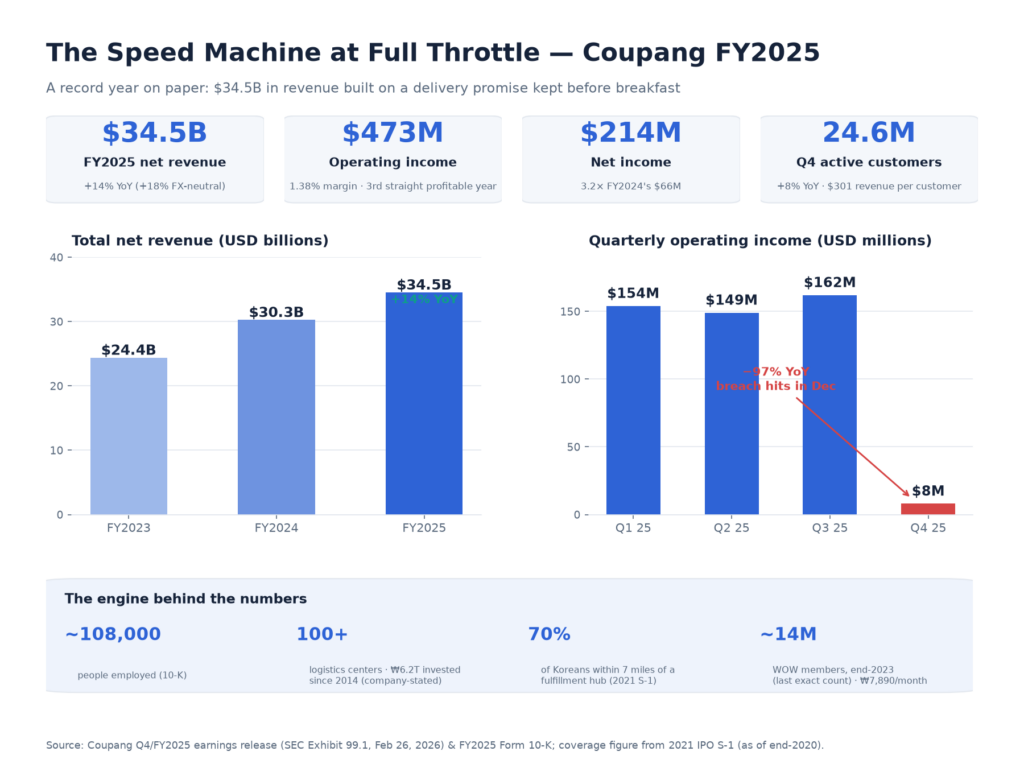
Most brands rent attention. Coupang built a machine that earns it every single morning. The results show up in SEC filings: $34.5 billion in revenue for 2025, up 14% year over year, a third consecutive profitable year, and 24.6 million quarterly active customers in a country of about 52 million people. Then came the plot twist no operations playbook prepares you for. In late 2025, a former employee walked out with the personal data of tens of millions of customers — and the same trust engine that compounded speed into habit reversed, hard. Quarterly operating profit fell 97%. A regulator eventually imposed the largest privacy fine in Korean history.
This case study is both the playbook and its warning label: what happens when logistics becomes the brand, and what it costs when the brand keeps its delivery promise but breaks its data promise.
The Market That Made Speed Possible
Korea is a logistics designer’s dream, and almost nobody markets it that way. The 2025 national census counted 51.8 million people, with 50.9% of them packed into the Seoul–Incheon–Gyeonggi capital region. Apartments house 54.5% of households. Translation: your customers live in vertical clusters, stacked on top of each other, within a short drive of a warehouse. A delivery route in Seoul serves hundreds of doors per stop-cluster. The same route in a sprawled American suburb serves dozens.
That density is the hidden subsidy behind every dawn-delivery promise. It is why an Amazon-style, own-everything model could reach national scale in Korea years faster than similar ambitions crawled across lower-density markets. Geography did not make Coupang’s execution easy — it made the economics possible.
The Founding Bet: Own the Box, Own the Clock
When Bom Kim founded Coupang in 2010, Korea’s e-commerce leaders — Gmarket, 11st — ran asset-light marketplaces. Sellers stocked; sellers shipped; platforms took a cut and blamed the courier when things went wrong. Kim looked at that model and bet the company on its opposite: buy the inventory, build the warehouses, employ the drivers, control every hour between checkout and doorstep.
On paper it was capital suicide. In practice it was brand strategy. Rocket Delivery launched in 2014 with a promise simple enough to fit on a box: order before midnight — even seconds before — and it arrives tomorrow. In 2019 the company extended the model into groceries with Rocket Fresh, whose dawn service had piloted in the Seoul area in October 2018. The WOW membership, launched in October 2018, bundled it all: free dawn delivery by 7 a.m., free returns, later Coupang Eats discounts and Coupang Play streaming. Each layer turned a logistics feature into a lifestyle subscription.
By its 2021 IPO filing, Coupang said 70% of the Korean population lived within seven miles of one of its fulfillment centers. The company’s own materials, reported in 2024, put cumulative logistics investment since 2014 at ₩6.2 trillion across more than 100 logistics centers. The FY2025 10-K counts roughly 108,000 employees, the bulk of them in logistics. Competitors could copy the advertising. They could not copy the concrete.
The Mechanism: Four Conversions That Turn Speed Into Marketing
Here is the part worth stealing. Coupang’s marketing engine is not a campaign; it is a loop with four conversions.
Promise → Habit
Every kept dawn delivery is a trust deposit. The 10-K describes the compounding plainly: through 2025, revenue per active customer grew 3–7% each quarter excluding currency effects, driven by engagement within and across more product categories, while active customers grew 8–10% per quarter. Reliability did not just retain people. It expanded what they trusted the app with.
Habit → Membership
WOW converts habit into a contract. The last exact membership count Coupang disclosed was roughly 14 million at the end of 2023; the price is ₩7,890 a month after a 58% increase in 2024. A household paying for dawn delivery, groceries, food-delivery discounts and a streaming service has pre-committed its commerce. Canceling is not switching apps — it is dismantling a morning routine.
Membership → Density → Speed
Member orders fill the same trucks on the same routes. Density drops unit cost; lower cost funds faster, cheaper promises; faster promises pull in more members. The moat is operational, not perceptual. You cannot advertise your way into someone else’s route economics.
Speed → Category Expansion
Fresh groceries are the wedge. Perishables are where speed matters most and where purchase frequency is highest — weekly, sometimes daily. Management said in the Q3 2026 call that Rocket Fresh volumes were growing more than twice as fast as the overall core commerce segment. Win the refrigerator, and you win the household’s default.
The Stress Test: When the Promise Broke Without a Single Late Package
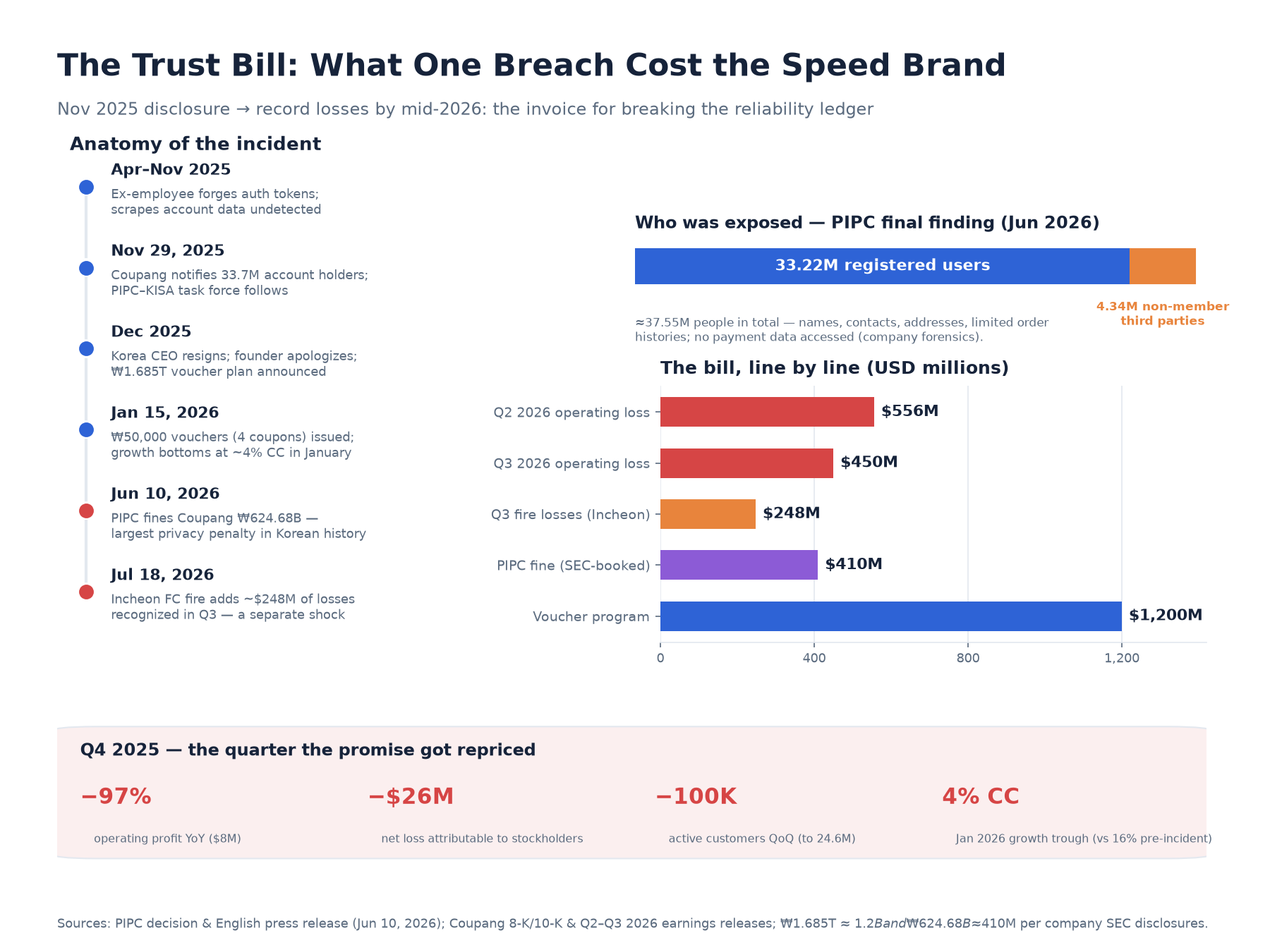
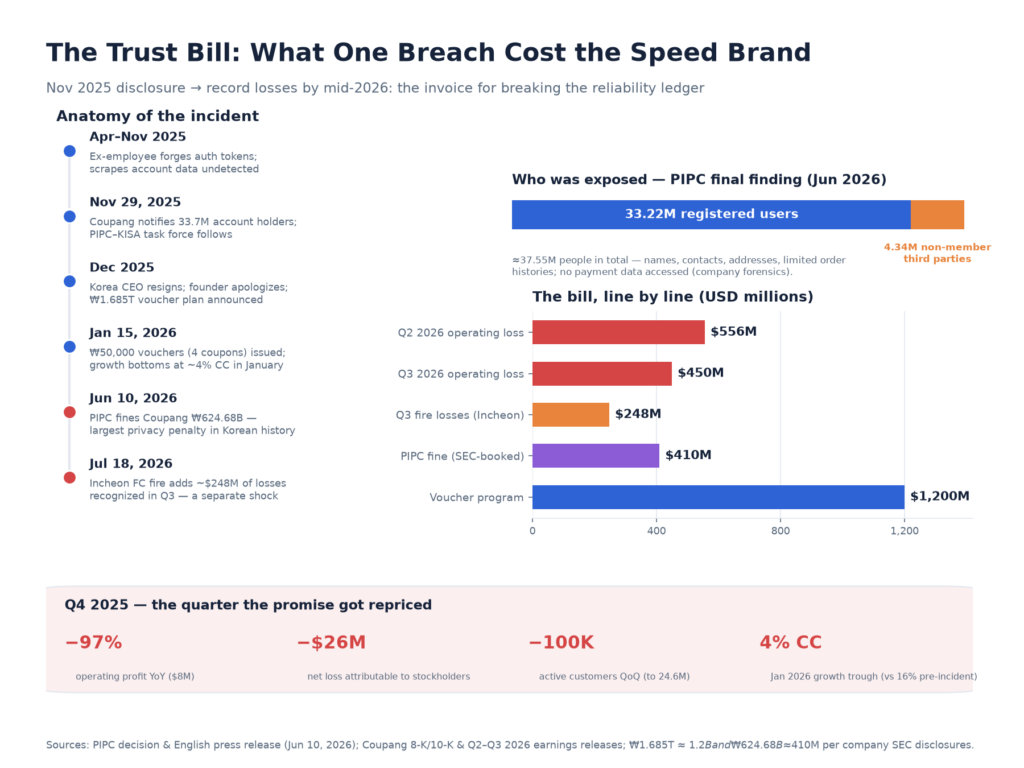
On November 18, 2025, Coupang detected unauthorized access to customer data. It notified the public on November 29: information from 33.7 million accounts — roughly 65% of the national population — had been exposed. The attacker was not a sophisticated crew. It was a former employee who had kept authentication signing keys, forged tokens, and scraped account pages from April to November while anomaly alarms went unanalyzed.
Coupang later claimed only about 3,000 accounts’ data was actually retained and subsequently deleted. Korea’s government rejected that downplay as a unilateral claim, and the Personal Information Protection Commission’s final findings in June 2026 were worse: 33.22 million registered users plus 4.34 million non-member third parties — family members and acquaintances whose names, phones and addresses sat in users’ delivery books — about 37.56 million people in total. The company’s forensics partners confirmed no payment card data or login credentials were taken. That distinction mattered legally. It did not matter emotionally.
The response was unprecedented in scale and revealing in design. Coupang announced a ₩1.685 trillion (about $1.2 billion) compensation program: ₩50,000 per affected customer, paid not in cash but in four single-use vouchers spread across its core store, Eats, travel and luxury services, distributed from January 15, 2026. Consumer groups called it a marketing tool disguised as an apology. They were half right — it was a retention mechanism, and it was exactly consistent with the habit-loop logic. To claim the apology, you had to come back and shop. Korea’s CEO resigned in December; the founder apologized publicly; an interim chief executive took the parliamentary hearings.
Then the invoice arrived. Q4 2025 operating profit collapsed 97% to $8 million; the quarter posted a $26 million net loss attributable to stockholders. Active customers slipped by 100,000 sequentially to 24.6 million, WOW membership declined year over year with a spike in cancellations, and the CFO later traced the growth trajectory: core commerce had been growing 16% in constant currency in the three months before the incident; by January 2026 that rate had bottomed near 4%, adjusted for holiday timing. In June, the PIPC fined Coupang ₩624.68 billion — about $410 million as booked in the company’s SEC disclosure — the largest privacy penalty in Korean history, covering both the breach and a separate unauthorized ad-data collection practice.
The lesson sits in the lag. Not one package was late. The brand’s equity had been stored in reliability expectation — and a data breach attacks the same ledger as a missed delivery, just invisibly. If your marketing promise is operational, your security budget is a marketing budget. Coupang learned that at roughly $35 per affected customer in vouchers — plus a fine nearly ten times the size of its entire 2025 operating profit.
The Recovery Arc: Customers Came Back Faster Than Margins
What happened next is the most instructive part of the case, because it tests whether a habit loop can survive a trust shock.
Q1 2026 was ugly: revenue growth slowed to a single digit for the first time since the IPO, and the company posted a $242 million operating loss — its first red quarter in seven — as vouchers were deducted from revenue and warehouses sat half-empty against a demand curve built for a different world. But underneath, the loop was already re-closing. By the end of April, the chairman said roughly 80% of the post-breach WOW membership decline had been recovered, and churn and sign-up rates were back to historical norms.
Q2 2026 brought the record loss — $556 million operating, $570 million net attributable — but only because the fine landed in the quarter; excluding it, the operating loss was $146 million. The customer metrics told the opposite story: active customers returned to 24.7 million, the pre-incident level, and total WOW membership passed its pre-incident peak to hit an all-time high. Management disclosed that customers excluding the small cohort that never returned were growing spend around 16% year over year — essentially the pre-incident engine. The oldest cohorts, acquired about fifteen years ago, now spend nearly ten times what they spent in their first year.
Q3 2026, reported on November 3, confirmed the arc: revenue of $9.96 billion, up 11% in constant currency and ahead of guidance; active customers at a record 25.2 million; Korean WOW membership at another all-time high. A July fire at an Incheon fulfillment center added $248 million of costs — a genuinely separate shock, and a reminder that owning the network means owning every risk inside it. Stripping the fire out, the operating loss narrowed to $202 million. Management guided Q4 constant-currency growth of 13–14% and said core margins should return to roughly pre-incident levels by mid-2027.
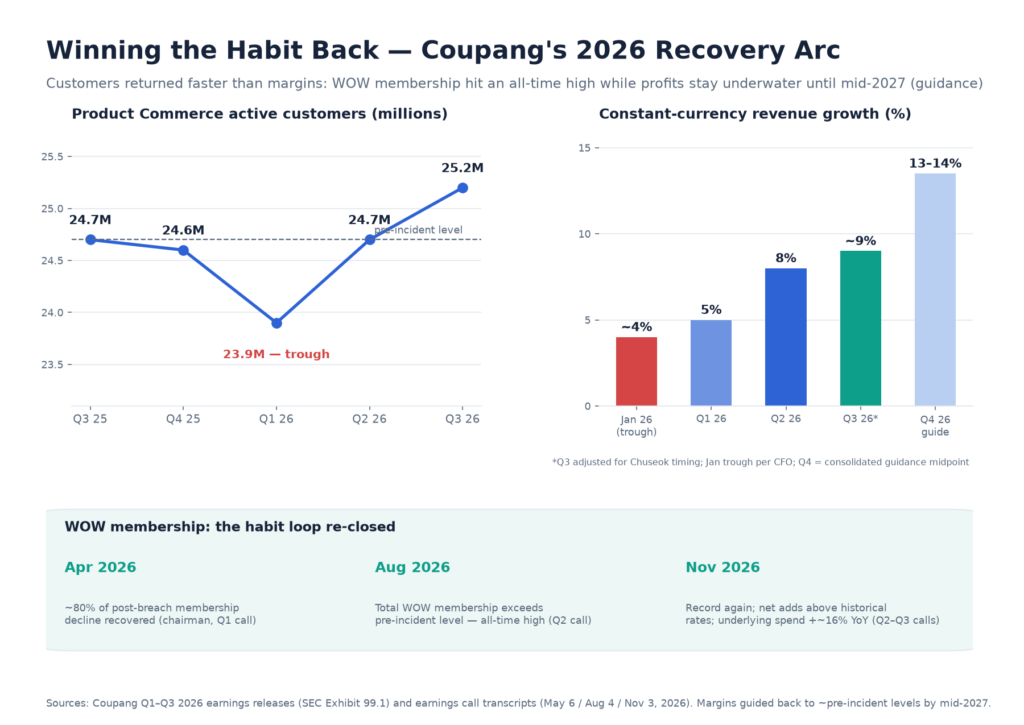
Read those two timelines together and you get the case’s deepest finding: the habit was more durable than the P&L. People forgave the company faster than the cost structure could heal. That is what a genuine operational moat looks like under stress — and also why thin-margin operators cannot afford many such tests.
The Reusable Methodology: What Operators Should Actually Copy
Strip away the Korean specifics and four transferable moves remain.
Make the operational promise the marketing promise. Pick one measurable service truth — dawn delivery — and let every kept instance do the advertising. Consistency beats creative. A slogan claims; a kept promise proves.
Buy density before reach. Coupang concentrated the Seoul metropolitan area first and let route economics fund expansion. Geographic focus looks like a growth constraint; it is actually a cost strategy. The same discipline is now visible in Taiwan, where the company says its own last-mile network covers the vast majority of volume and it launched dawn delivery in about one year — versus four in Korea.
Bundle the habit, not the discount. WOW’s lock-in is multi-service routine, not price. Subscription moats survive price wars; coupon dependence does not. Even the crisis response followed this logic: vouchers, not cash, because vouchers rebuild the loop.
Defend the data ledger like the delivery ledger. For an operational brand, security investment is brand investment. Budget it accordingly, audit signing-key hygiene, and never let a departed employee’s credentials outlive their employment. The breach cost more than a decade of security spending ever would.
Risks and Honest Caveats
The model’s margins are thin and its promises are thick. An operating margin of 1.38% in FY2025 tolerates almost no execution error, and 2026 demonstrated how fast operating leverage runs in reverse when demand dips below the capacity plan.
The growth portfolio is expensive. Developing Offerings — Farfetch, Eats, Play, Taiwan, fintech — lost $995 million in adjusted EBITDA in FY2025, wider than the prior year’s $631 million, and management raised the top end of its 2026 loss guidance to fund faster Taiwan expansion. The core business is funding bets whose speed moats do not automatically transfer; Farfetch is a different business entirely. There are encouraging signs — management says Eats and quick-commerce Rocket Now are now sustainable on a combined basis, a qualitative claim, not an audited one — but the portfolio remains a drag, and trailing free cash flow turned negative in 2026.
The owned model concentrates liability. Logistics labor conditions and platform-fairness probes are recurring Korean flashpoints; the regulator’s findings on privacy governance were scathing; a single warehouse fire moved the quarterly P&L by a quarter of a billion dollars. And the density dependence is real: the economics that work in Seoul’s apartment canyons do not lift-and-shift into sprawled markets. Naive export is the honest limit of this playbook.
Trends and What to Watch Through 2027
Three signals will tell you whether the story re-compounds. First, the margin bridge: management has pinned core-commerce margins to roughly pre-incident levels by mid-2027, with Q3 2026 as the likely trough — watch whether the guided Q4 improvement of 50–150 basis points actually lands. Second, the non-returned cohort: the company keeps chipping away at the minority of customers who left and stayed away; once 2026’s damaged quarters lap in 2027, reported growth should converge toward the underlying ~16% spend engine — or expose that it will not. Third, the export test: Taiwan’s WOW membership more than doubled year over year in Q3 2026, and the company is deploying AI across its logistics network, including an Nvidia collaboration announced in 2026, to bend the cost curve while it rebuilds. Speed is being pushed inward — minutes-scale delivery via Eats — at the same time it is being pushed outward.
Conclusion
Coupang proved that in dense, connected markets, operations can be the brand: a dawn-delivery promise, kept millions of times, compounded into $34.5 billion of annual revenue and default-choice status no campaign could buy. The breach added the missing chapter — speed-as-brand stores its equity in trust, and trust can be broken digitally even when every package arrives on time. The recovery added the hopeful one: habits built on real service are stubborn, and most customers came back. The methodology travels with its warning label attached. Make the promise operational. Buy density before reach. Bundle the habit. And defend the data ledger as fiercely as the delivery one — because your customers keep both on the same balance sheet, even if your org chart does not.