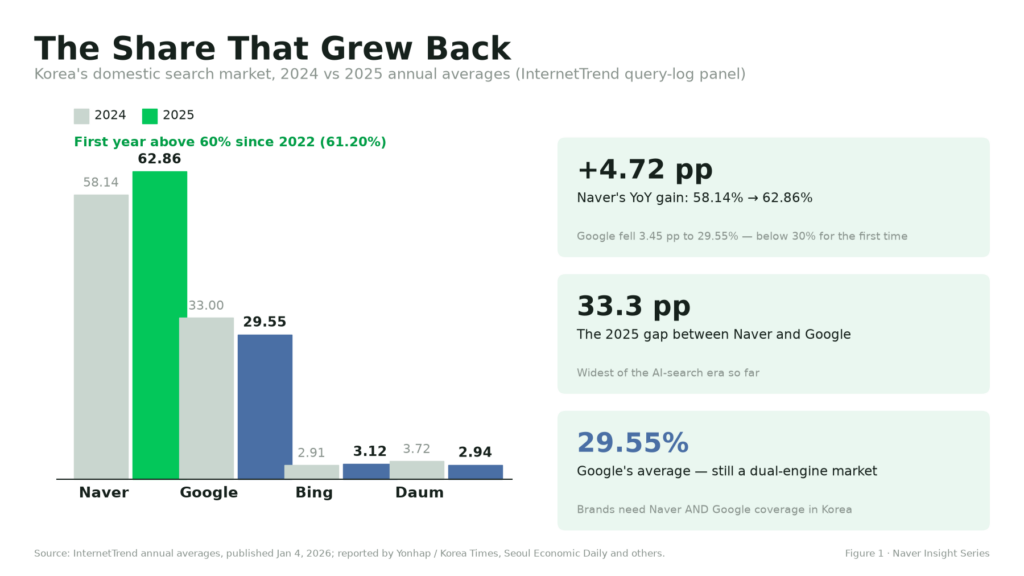
If you learned search marketing anywhere outside Korea, you learned a story with a fixed ending: Google arrives, the local portal dies. Ask the local portals Google steamrolled in market after market. So here is the number that breaks the story. In 2025, Naver’s average share of Korea’s domestic search market was 62.86% — up from 58.14% the year before, according to InternetTrend, the Korean research firm whose query-log panel local media treat as the reference measure. Google fell 3.45 points to 29.55%, dipping below 30% for the first time. It was Naver’s first year above 60% since 2022.
Read that again. In the age of ChatGPT, the local search engine didn’t just survive. It grew.
And the explanation is not patriotism. Korean consumers are ruthless switchers; they abandon an app the moment something better appears. What keeps them — and what keeps local brands winning inside Naver while global brands struggle — is architecture. Naver spent twenty years building a Korean-language content garden, then wired the checkout counter directly into the search box, then trained its new AI layer to cite the garden’s most trusted sources. This piece walks through how that machine works, what it costs sellers, where the walls really are (spoiler: not where most foreign observers think), and what a global brand should actually do about it.
First, an Honest Word About Measurement
Before we build on that 62.86%, you deserve the caveat. StatCounter, the international analytics firm, tells a different story: on its referral-based measure — which counts clicks arriving at tracked websites — Google leads Korea, and by September 2026 the split was roughly 48% to 43% in Google’s favor. Both numbers are real. They count different things. InternetTrend’s panel captures searches that begin and end inside Korean platforms: the blog post read on Naver, the café thread, the shopping comparison that never leaves the app. StatCounter mostly sees the traffic that exits to the open web. Naver wins the first race; Google wins the second. A Korea strategy built on just one of these dashboards is flying with one instrument. We’ll use InternetTrend for query share because that’s the arena where brands meet buyers — but keep both gauges in view.
The Phenomenon: AI Made the Garden Stronger, Not Weaker
The conventional wisdom said generative AI would kill the portal. Naver ran the opposite play. It launched AI Briefing in March 2025 — generative summaries sitting directly under the search box — and by December 11, 2025 the company said the feature covered about 20% of integrated-search queries. Note the caliber: that’s one in five queries receiving an AI summary, not AI stealing a fifth of traffic. More than 30 million people were using it at least once a month by spring 2026, and Naver has publicly targeted roughly 40% coverage during 2026.
The design choice matters more than the percentage. For health queries, AI Briefing draws on tertiary hospitals and medical societies. For finance, on securities filings and brokerage research. For public information, on government and institutional sources. In other words, the AI was trained to trust the Korean establishment — the same corpus Naver’s own blogs, cafés and Knowledge iN Q&A have been cultivating for two decades. The company reported that results carrying AI Briefing saw click-through rates about eight points higher and dwell time up 20%, and that its vector indexing of content grew more than 300% in 2025. Treat those as vendor-reported figures — Naver is grading its own homework — but the direction is corroborated by the share data.
Then, on April 30, 2026, Naver quietly retired related-search terms, the suggested-keyword strip it had run since 2007 — about nineteen years. Person-name suggestions had already been removed back in 2020 after abuse scandals. The replacement is AI-native: follow-up questions generated by the briefing itself. A nineteen-year-old navigation habit was deleted because the machine now does the navigating.
Wall One — The Corpus Nobody Else Can Crawl
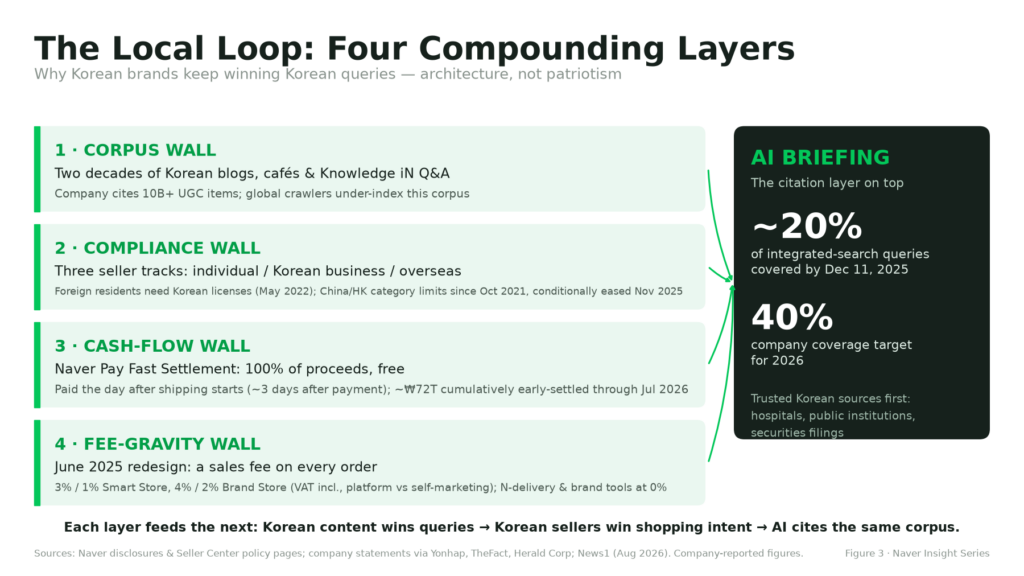
Google indexes the open web. Naver’s strength is the web that isn’t open: twenty years of Korean-language blogs, fan cafés, and the crowdsourced answers of Knowledge iN. Naver itself cites a database of more than 10 billion user-generated items feeding its shopping AI, alongside product data from roughly 600,000 Smart Store sellers. That seller count is company-cited and media-repeated; the last hard figure Naver published in its D-Commerce report was 550,000 stores at the end of 2022, so treat 600,000 as a well-sourced estimate, not an audited census.
Why does this matter for brands? Because when a Korean consumer searches “is this serum worth it,” the ranking assets are Korean reviews, Korean expert posts, Korean community threads. A translated product page is a visitor in this garden, not a resident. And now the AI layer cites the garden’s most authoritative plants — which means the corpus wall didn’t crumble when AI arrived. It got reinforced concrete.
Wall Two — Compliance, Not a Ban (the Myth Worth Killing)
Here’s where most English-language coverage gets Korea wrong. You’ll read that foreign companies “cannot register” on Smart Store. That’s false. Naver’s official Seller Center runs three seller tracks: individuals (phone verification, no business license, capped sales), Korean businesses (business registration, mail-order declaration, local settlement account), and an overseas-business track where a foreign company registers with its home-country license and passport, settles in USD, JPY, HKD, EUR, GBP, AUD or NZD to an overseas account, and passes anti-money-laundering screening. We checked the official help pages directly. The door exists.
What’s real is friction, and it’s deliberately shaped. Since May 4, 2022, foreign residents in Korea can sell only if they hold a Korean business license — the individual-foreigner shortcut was closed after counterfeit problems. China and HK-based sellers have faced restrictions since October 2021, with product registration blocked outright in four sensitive categories: fashion accessories and apparel, cosmetics and beauty, childcare, and sports-leisure. From November 24, 2025, Naver conditionally eased those category bans — sellers who can prove sales history on other platforms and hold real inventory may enter, while some childcare and cosmetics subcategories remain closed, and risk sellers can be rejected without notice.
So the wall isn’t “Koreans only.” It’s a compliance gradient: local entities glide through, foreign entities clear slower identity checks, settle in foreign currency, and — as we’ll see — pay the highest payment-fee tier. The practical effect still tilts the field toward local operators. But if you’re planning market entry, budget for structure and paperwork, not for a closed border. Precision here is the difference between a workable plan and a fantasy.
Wall Three — Cash Flow as a Weapon
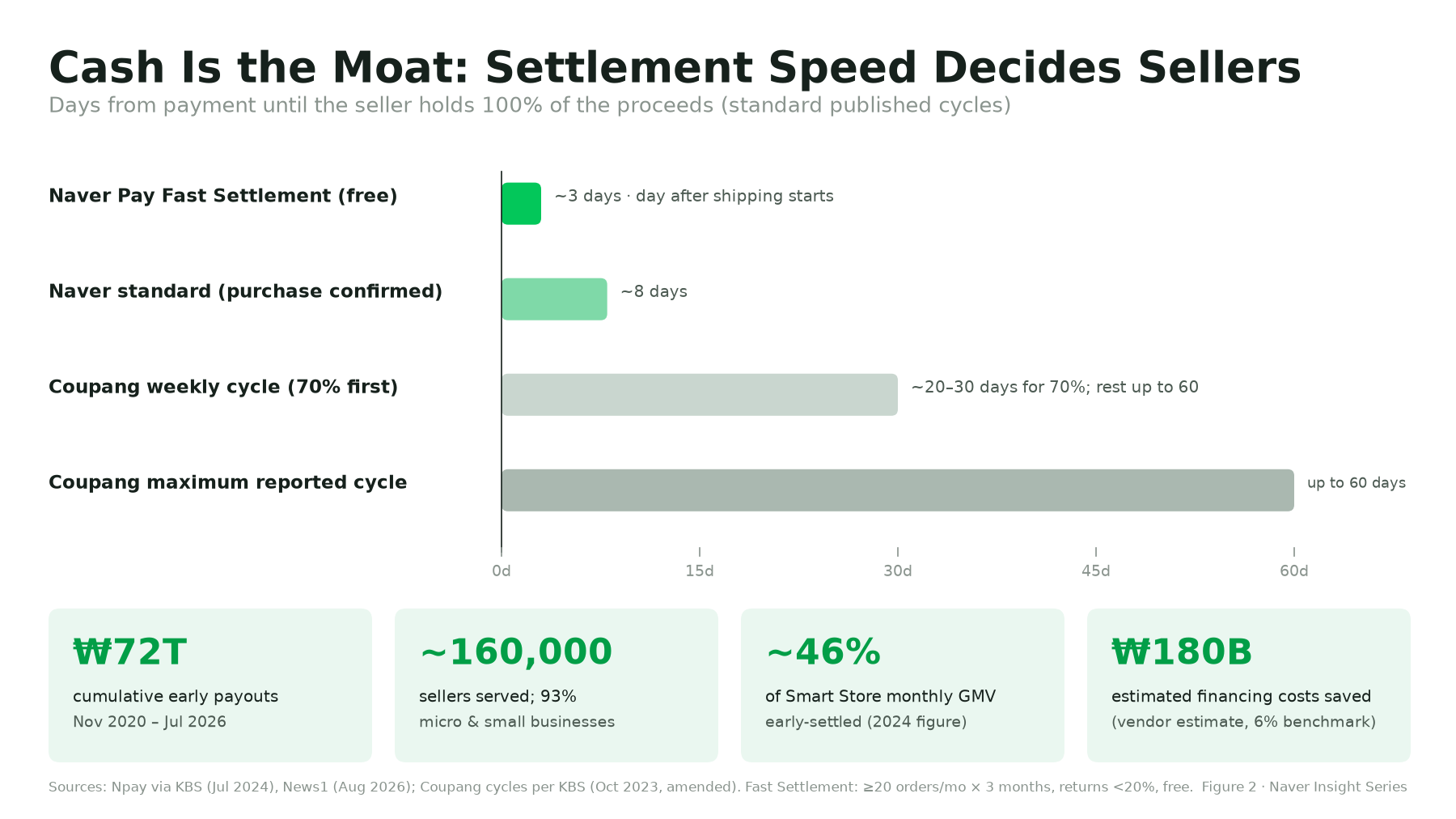
Ask any Korean online seller what hurts most and they won’t say traffic. They’ll say settlement — waiting weeks for money they’ve already earned. Naver turned that pain into a moat. Its Fast Settlement service pays sellers 100% of proceeds, free, the day after shipping starts — roughly three days after payment — versus the standard cycle of about eight days (the day after purchase confirmation). Sellers qualify with at least twenty orders a month for three consecutive months and a return rate under 20%, screened by Naver’s fraud-detection system.
The scale is startling. By July 2026, cumulative early payouts reached about ₩72 trillion since the service began in November 2020, serving roughly 160,000 sellers — 93% of them micro and small businesses, per Npay’s own disclosures carried by News1. Back in 2024 the company said nearly half of Smart Store’s monthly transaction value was being early-settled. Korea’s Financial Supervisory Service even named Naver Financial an outstanding shared-growth finance institution in January 2024 — the only e-finance firm honored. Npay estimates sellers saved around ₩180 billion in financing costs — a vendor estimate built on a 6% loan-rate benchmark, so treat it as directional.
The contrast makes the weapon visible. KBS reporting in October 2023 (later amended on a sourcing detail) described Coupang marketplace sellers waiting twenty to thirty days for 70% of proceeds, with the rest up to sixty days — some borrowing against receivables to buy next month’s stock. When Tmon and WeMakePrice collapsed in July 2024 over unpaid settlements, the whole industry learned why cash timing is existential. A local seller on Naver gets inventory money five days faster than the standard cycle and weeks faster than the marketplace norm. That’s not a perk. That’s compounding working capital, and it’s very hard for a foreign payment stack to match.
Wall Four — Fees That Pull You Deeper In
On June 2, 2025, Naver rewired its fee engine. The old acquisition fee — roughly 2%, charged only when Naver Shopping referred the buyer — was abolished. In its place: a sales fee on every order. Smart Store now charges 3% on platform-driven sales and 1% when the seller brings the customer through their own marketing links or Naver ad tools; Brand Store charges 4% and 2%. Those are VAT-inclusive roundings of the official 2.73/0.91 and 3.64/1.82 rates.
Two details most summaries miss. First, the payment layer survives: Npay’s order-management fee still applies on top, tiered by revenue from about 1.98% to 3.63% VAT-inclusive (small tiers were trimmed another 0.02–0.03 points in October 2025). Overseas sellers pay the general tier. So a micro seller driving their own traffic pays roughly 3% all-in, while a general-tier seller riding platform traffic pays closer to 6.6%. Second, the carrots: commissions on N-delivery logistics and the Brand Solution package were cut to zero. Daishin Securities estimated the redesign lifts the average take rate from about 2% to 2.8% — a sell-side estimate, not company guidance — and the logic is transparent. Bring your own customers and Naver rewards you with cheap fees; lean on Naver’s traffic, data and logistics and you pay more but get the machine. Either way, you’re inside the machine. That’s fee design as ecosystem gravity.
The Two-Engine Market: Coupang Fulfills, Naver Discovers
Western coverage loves a death match: Coupang versus Naver, winner takes all. Korean reality is a division of labor. Coupang owns fulfillment — rocket delivery, the Wow membership, the logistics fleet. Naver owns discovery — the search-intent traffic Coupang simply doesn’t have. The numbers show coexistence, not cannibalization. Naver’s FY2025 results, announced February 6, 2026, put group revenue at ₩12.035 trillion, up 12.1%, with commerce revenue of ₩3.6884 trillion, up 26.2% — crossing 30% of group revenue (30.6%) for the first time, versus 27.2% in 2024. Fourth-quarter commerce grew 36%, and Q4 payment volume hit ₩23 trillion. Meanwhile the Naver Plus Store app — launched March 12, 2025 as an AI-recommendation shopping app — reached 8.75 million MAU by May 2026 per IGAWorks MobileIndex, passing 11st to become Korea’s number-two standalone shopping app behind Coupang’s ~34.9 million, with monthly new installs running about 1.7 times Coupang’s that month. The company-reported detail: AI-recommended items accounted for over half the app’s transaction value by May 2026, and cumulative downloads passed 17.5 million.
And where Naver’s own logistics are weak — fresh food, dawn delivery — it rents a friend’s fleet instead of building one. The Kurly alliance, announced April 18, 2025, put Kurly N Mart inside Naver Plus Store on September 4, 2025, with Kurly’s Nextmile arm joining Naver’s fulfillment alliance that September: order by 11pm, groceries at your door by morning. The equity timeline is worth getting right, because it’s widely garbled: Naver bought about ₩43 billion of Kurly secondary shares in September 2025 for a 5.08% stake, then took a ₩33 billion third-party share allotment in May 2026 — at a roughly ₩2.8 trillion valuation — lifting its holding to 6.2% and making it Kurly’s largest shareholder, ahead of founder Kim Seul-ah. Discovery plus rented fulfillment: the anti-Coupang coalition, without the fleet bill.
The Real Threat Isn’t Google — It’s the Answer Box
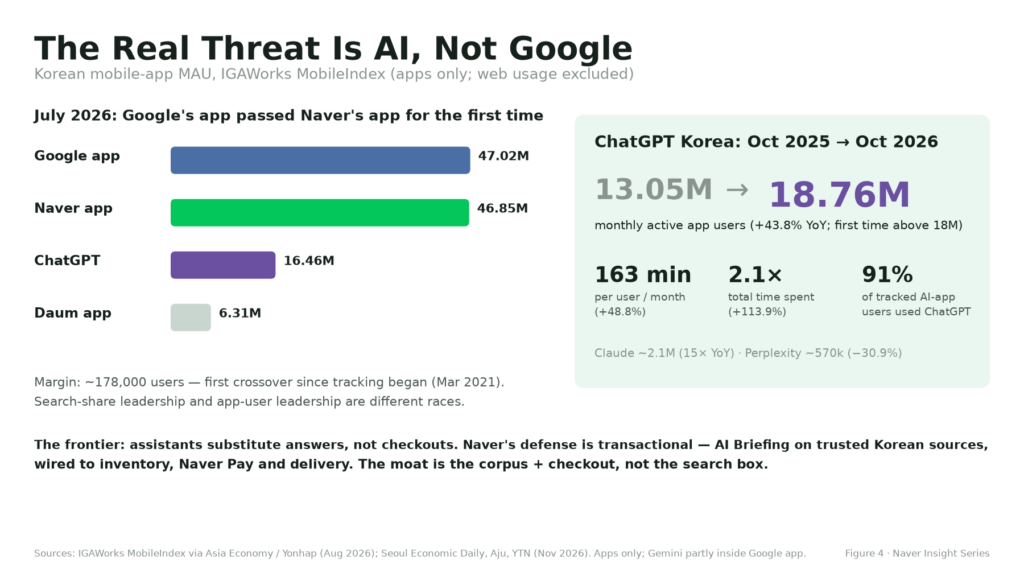
If you’re worried about Naver’s garden, don’t watch Google. Watch the assistants. In July 2026, IGAWorks MobileIndex recorded something that had never happened since tracking began in March 2021: the Google app passed the Naver app in Korean monthly active users, 47.02 million to 46.85 million — a margin of about 178,000, driven largely by Gemini living inside the Google app. And ChatGPT? Its Korean app MAU hit 18.76 million in October 2026, up 43.8% year over year, with users spending 163 minutes a month in the app — up 48.8% — and total time more than doubling. Claude grew fifteenfold to about 2.1 million. These are mobile-app numbers only; web usage is excluded, and a separate WiseApp panel put work-related ChatGPT users even higher. The appetite for global AI is not a myth.
But here’s the limit, and it’s the whole reason the garden still stands. An assistant can replace an answer. It cannot yet replace a checkout wired to Korean inventory, Korean reviews, Naver Pay and dawn delivery. Naver’s defense is explicitly transactional: AI Briefing on trusted Korean sources, an AI shopping agent launched in February 2026, and a commerce layer where the answer and the buy button share a screen. The frontier is contested — informational queries are leaking to assistants — but the transactional core, where brands make money, remains defended. For marketers the implication is sharp: GEO in Korea means being citation-worthy inside Naver’s trusted corpus, not just visible on the open web.
The Regulator Came for the Walls — and Bounced
Every walled garden invites the antitrust gardener. Korea’s Fair Trade Commission fined Naver ₩26.6 billion in January 2021 for tilting its shopping algorithm toward Smart Store products over rival open markets from 2012 to 2020. The Seoul High Court upheld it in December 2022. Then, on October 16, 2025, the Supreme Court reversed and remanded — in Korea’s first self-preferencing case against a platform. The reasoning matters: dominance alone creates no legal duty of equal treatment; the regulator must prove specific anti-competitive effects, and algorithm design is business discretion absent that proof. It’s a remand, not a final acquittal — the case isn’t over — and the ruling party is pushing an Online Platform Act that could legislate what the court wouldn’t presume. But note the asymmetry: even if regulation someday prunes the entity and fee walls, the corpus wall — twenty years of Korean content and the AI trained on it — survives any court order. You can legislate open access. You can’t legislate a corpus into existence.
What Global Brands Should Actually Do
Four moves, in order of commitment. First, budget for structure: a Korean entity or a serious local partner unlocks the business-seller track, local settlement, the lower fee tiers and the Fast Settlement cash cycle — the overseas track works, but you pay general-tier fees and wait longer for money. Structure is strategy, not paperwork. Second, run dual-engine SEO: Naver for the Korean corpus (blog, café, reviews, shopping ads, Brand Store) and Google for the 29.55% — plus AI Briefing citation-worthiness, which means authoritative Korean sources and structured facts, not translated brochures. Third, localize the corpus, not just the copy: Korean-language reviews and expert content are the ranking assets; translation-only strategies fail the garden’s authority tests. Fourth, put settlement speed into your channel P&L: three-day cash versus thirty-day cash changes inventory turns, and it should change how you compare Naver against Coupang and your own D2C site.
The Takeaway
Naver keeps local brands local because it built the Korean internet’s corpus, checkout and citation layer as one system — then trained its AI on exactly that system. The 62.86% isn’t nostalgia; it’s architecture. Entity friction, settlement speed, fee gravity and trusted-source AI compound together, and the 2025–2026 data says the compounding is accelerating, not decaying. For global brands, Korea punishes translation-level localization and rewards structural commitment. And the broader lesson travels far beyond Seoul: in the AI-search era, whoever owns the trusted corpus owns the answers. Korea just happens to be the place where a national garden proved it can out-defend the global web — with the receipts to show for it.