Ask a Western CMO what their loyalty program is worth and you’ll get a redemption rate. Ask Rakuten and you’ll get ¥11 trillion — a number it publishes every quarter, next to revenue, with a formula attached.
That difference isn’t cultural modesty versus Japanese precision. It’s an accounting choice, and it explains why Rakuten’s moat compounds while most loyalty programs quietly decay into coupon pipes.
The formula nobody else publishes
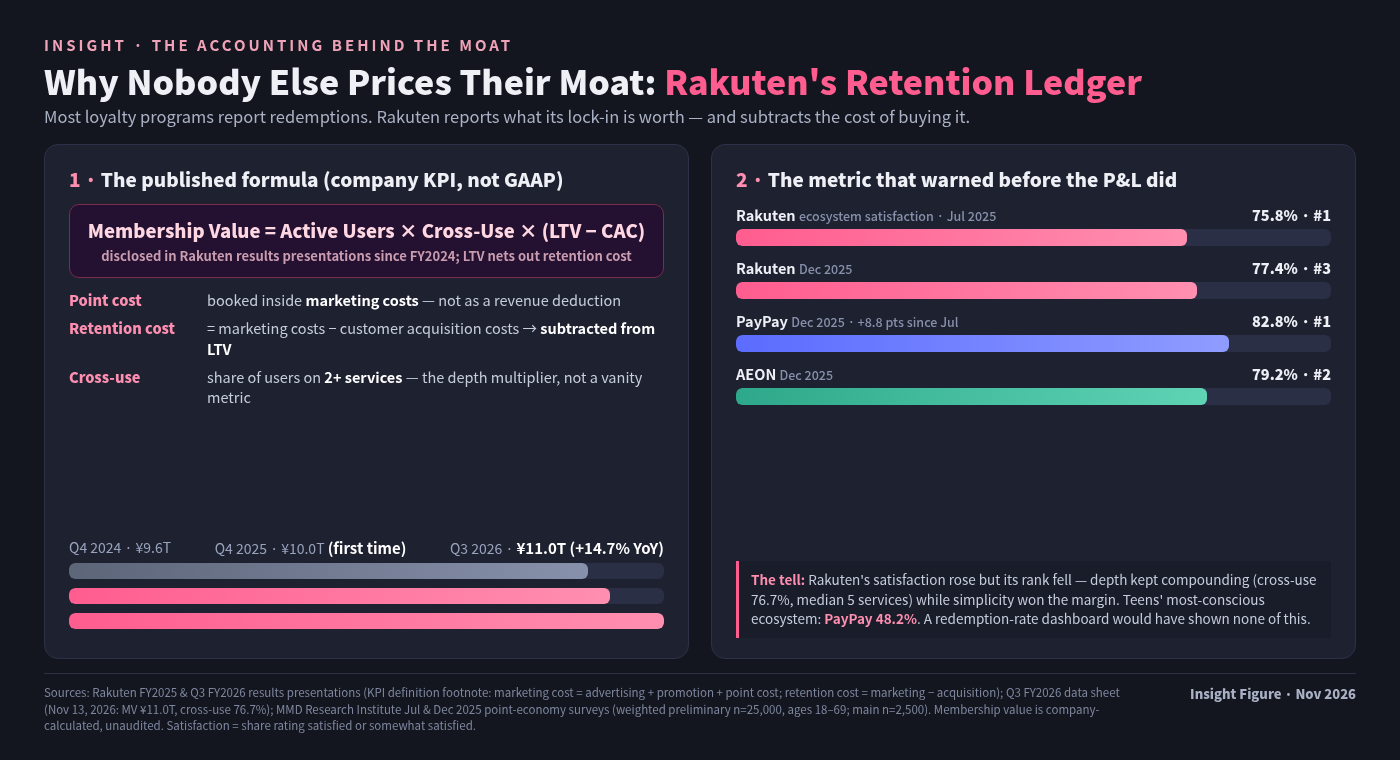
Buried in the footnotes of Rakuten’s results presentations is a definition most companies would treat as a trade secret: membership value equals active users × cross-use × (LTV − CAC). The footnote goes further. Marketing cost is defined as advertising plus promotion plus point cost. Retention cost is marketing cost minus acquisition cost. And retention cost is subtracted from lifetime value before the multiplication happens.
Read that chain slowly, because it inverts the industry’s default instinct. Most programs book points as a revenue deduction — a discount, a cost of sale, something to minimize. Rakuten books points as retention spending — an investment whose payoff is measured, net of its own cost, in the same KPI the board watches. You cannot optimize what you’ve classified as leakage. You can optimize what you’ve classified as an asset with a yield.
This is why the company can spend ¥650 billion worth of points a year (2024 issuance) without flinching, and why its membership value climbed from ¥9.6 trillion in Q4 2024 to ¥11.0 trillion in Q3 2026. The spend and the score sit on the same ledger. (Fair caveat: it’s a company-calculated estimate, not an audited line — a compass, not a valuation.)
Why the metric matters more than the money
Here’s the part that should worry every loyalty operator: Rakuten’s own framework flagged the crack before any financial statement did.
In MMD Research Institute’s December 2025 surveys (25,000 screened adults, weighted; 2,500 ecosystem users), Rakuten’s satisfaction actually rose — 75.8% to 77.4% — yet its rank fell from first to third. PayPay jumped 8.8 points to 82.8%. Among teenagers, PayPay is now the most-conscious ecosystem at 48.2%. Meanwhile Rakuten’s depth kept compounding: 76.7% cross-use, a median user running five services.
A redemption dashboard shows none of this. Redemptions were probably fine everywhere. What changed was the emotional price of complexity — and only a depth-and-value framework makes that trade visible. Rakuten’s moat is real precisely because it’s priced; its vulnerability is visible for the same reason.
What you can steal on Monday
You don’t need a bank to copy this. Three moves: reclassify point costs from discount to retention spend; define your own cross-use multiplier (share of customers using two or more products or channels); and report one net number — depth-adjusted lifetime value minus what you paid to buy it — to whoever funds your program. If that number scares you, good. That’s the point of pricing a moat: you find out what it’s worth before your customers do it for you.