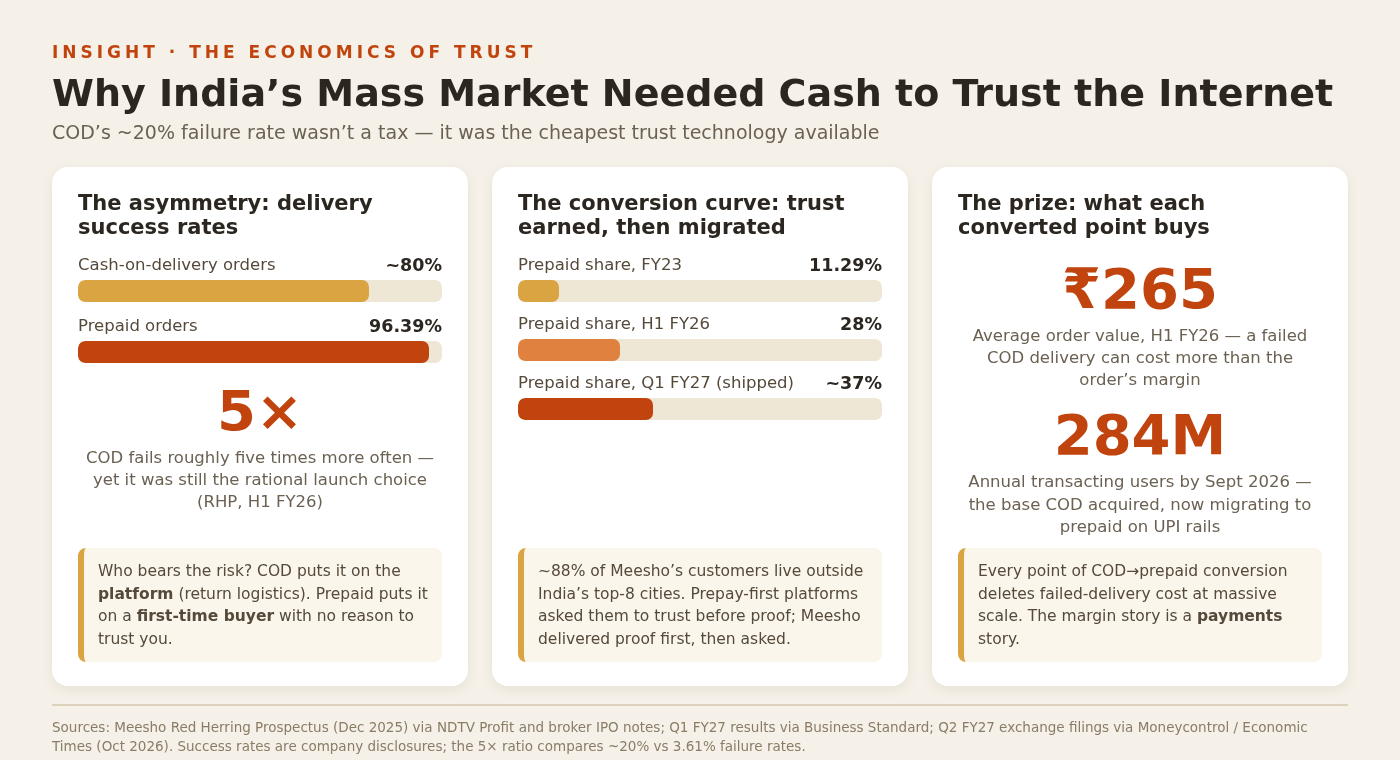
Look at Meesho’s prospectus the way a Western analyst does and one number screams inefficiency: 72% of orders paid in cash, with roughly one in five cash deliveries failing and coming back. Prepaid orders succeed 96.39% of the time. Cash-on-delivery fails about five times more often. Why would any rational company choose the worse rail?
Because the analyst is measuring the wrong cost. The failed-delivery rate is a logistics metric. The real question is a trust metric — and on that ledger, COD was the cheapest technology available.
Here’s the asymmetry nobody prices correctly. In a prepaid transaction, the buyer bears the risk: money leaves their account before a stranger’s parcel arrives. For a first-time internet shopper in a tier-3 town — the ~88% of Meesho’s customers who live outside India’s top eight cities — that stranger has no brand equity, no storefront, no recourse. Asking them to prepay isn’t a checkout preference. It’s asking them to extend unsecured credit to an app they met last week.
COD flips the risk onto the platform. Yes, Meesho eats the return logistics on that ~20% failure rate, on orders averaging ₹265. But compare that against the alternative customer-acquisition cost: prepaid-first platforms spent billions in marketing trying to convert the same population and largely failed, because no ad budget can manufacture trust that hasn’t been earned. A returned parcel is expensive. An unreachable customer is infinite.
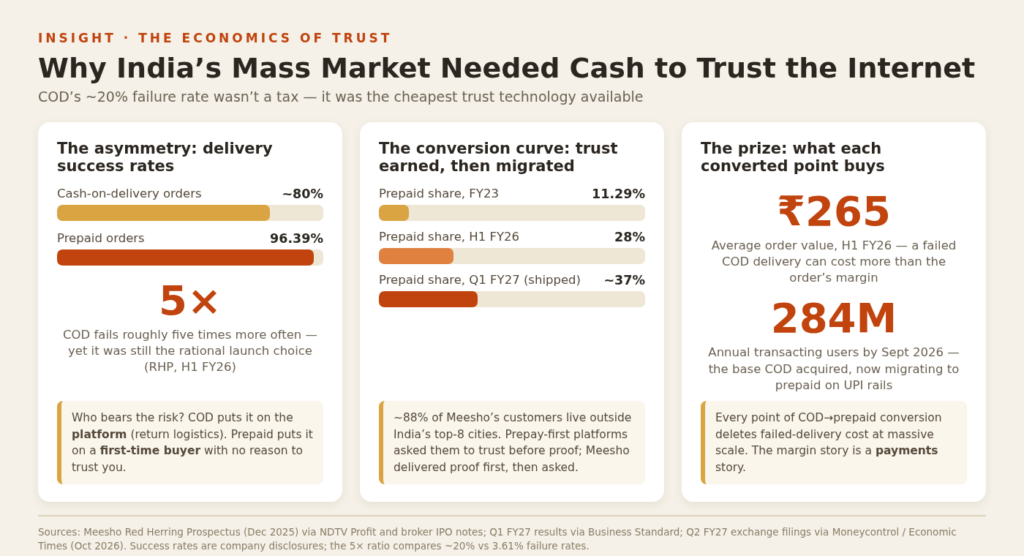
The conversion curve proves this was sequencing, not stubbornness. Prepaid share climbed from 11.29% in FY23 to 28% in H1 FY26 to roughly 37% of shipped orders by the June 2026 quarter. Meesho didn’t fight cash — it used cash to deliver proof, repeatedly, until the buyer had a personal history of parcels actually arriving. Then it asked for prepayment, and the buyer said yes, because the trust account was finally funded. UPI’s penetration greased the migration, but the deposits were made one delivered COD parcel at a time.
The generalizable mechanism: in low-trust markets, the party with the balance sheet must warehouse the risk until the relationship can carry it. China’s wallets pre-funded that trust account nationally before Pinduoduo scaled, so PDD never had to. India had no such endowment, so Meesho built the account privately, order by order — and now harvests it as margin, since every point of prepaid conversion deletes failed-delivery cost across 284 million annual buyers.
That’s why the profitability story is a payments story in disguise. The loss line bends not when logistics get clever, but when trust graduates from cash.





