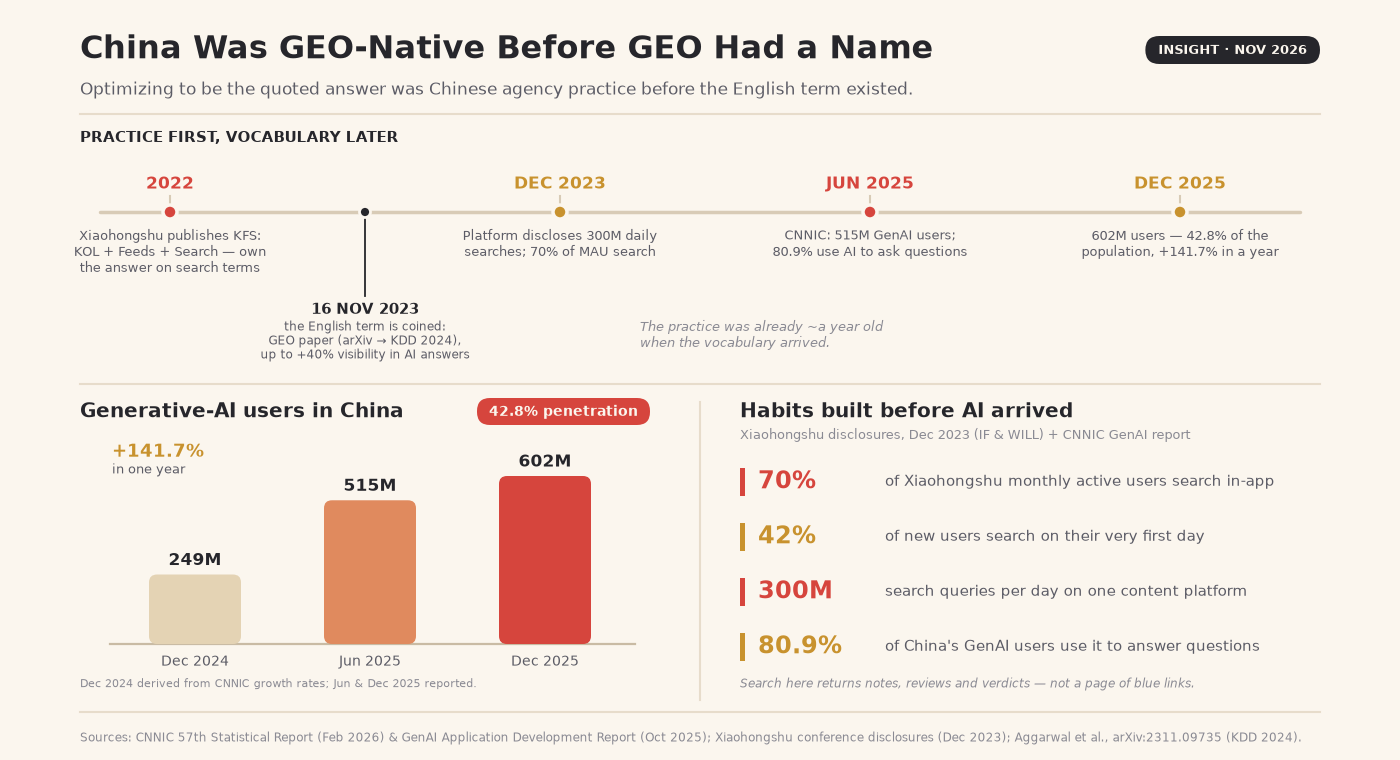
The acronym has a birthday: November 16, 2023, when researchers posted “GEO: Generative Engine Optimization” to arXiv — later published at KDD 2024 — showing that structured, evidence-rich content could lift visibility inside AI answers by up to 40%. The practice has no birthday. In China, it already had budgets, job titles and playbooks.
Start with where search happens. On Xiaohongshu, Douyin and WeChat, queries return notes, reviews and verdicts — not ten blue links. By December 2023, Xiaohongshu disclosed 300 million daily searches, with 70% of monthly active users searching and 42% of new users searching on day one. Users weren’t hunting pages. They were asking for answers, and getting a wall of human verdicts.
So agencies optimized for exactly that. Xiaohongshu’s official KFS playbook, published in 2022, bundles KOL content, Feeds amplification and Search positioning — the S literally means owning your keywords so your notes are the answer users find. That is the GEO objective, a year before GEO had a name.
The content was pre-adapted too. A high-performing seeding note runs problem → experience → verdict, carries photos, prices and comparisons, and front-loads the conclusion. The GEO paper found precisely these features — statistics, citations, clear structure — make content quotable by machines. A 2025 CSCW study by University of Michigan researchers Yi and Xian documented how thoroughly this style was industrialized: nine months of ethnography showing KOC advertorial labor deliberately disguised as spontaneous user posts.
Then the engine upgrade landed on prepared ground. CNNIC counted 515 million generative-AI users by June 2025, 80.9% of them using it to answer questions. By December 2025: 602 million — 42.8% of the population, up 141.7% in a year. Nobody had to be taught what an answer engine was for. The answer-first habit was already national.
Here’s the reframe. In the West, GEO is a migration project: retrain teams raised on link rankings. In China, it was a continuity project — same work, smarter engine. Fair caveat: in-app search wasn’t literally generative, and calling it GEO retroactively stretches the definition. But the skills transferred with almost no retraining, which is the claim that matters. And early doesn’t mean clean — the same machinery industrialized fake consensus, now an AI-poisoning risk on both sides of the Pacific.
For global marketers, the move is obvious: import the operating discipline — quotable structure, real-evidence consensus, answer-share monitoring — and pair it with Western measurement rigor. Vocabulary travels west to east. Reps travel east to west.



