Most marketers file AI search under traffic acquisition: a new referral line to watch in the sources report. That framing misses the story by an order of magnitude. AI search doesn’t just change where clicks come from. It changes how choices get made.
The Fingerprint of a Pre-Made Decision
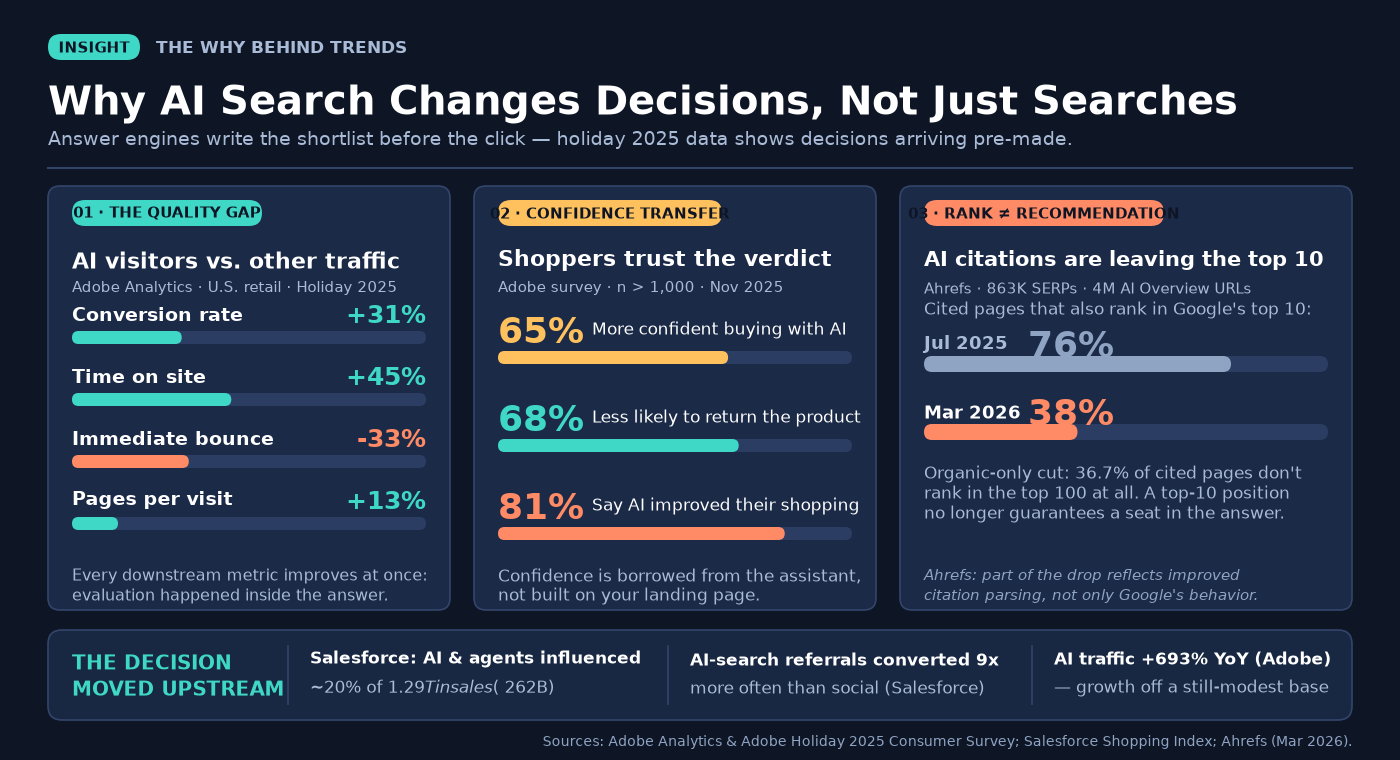
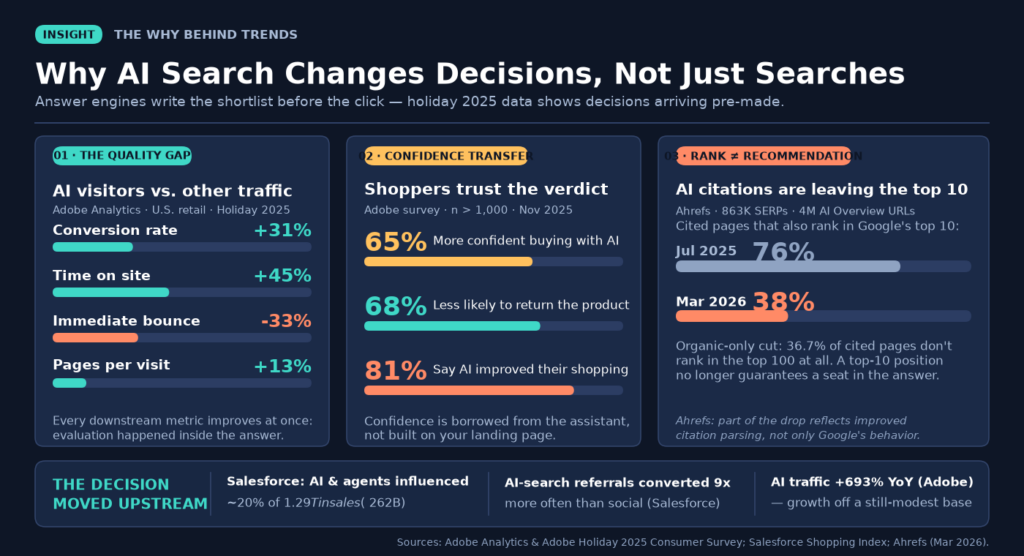
Adobe Analytics, tracking more than a trillion visits to U.S. retail sites, found that AI-referred shoppers in the 2025 holiday season converted 31% better than other traffic, spent 45% longer on site, and were 33% less likely to bounce immediately. Revenue per visit ran 32% above non-AI traffic — a reversal from 2024, when AI visitors were worth 51% less. In Adobe’s consumer survey, 65% said AI made them more confident in their purchase, and 68% said they were less likely to return it.
Read those numbers together and a pattern emerges: this is not better traffic. It is a decision that has already happened, arriving at your door for confirmation.
Why the Shift Happens: Four Mechanisms
A classic search engine hands you ten blue links and leaves the choosing to you. An answer engine does the choosing first.
- Choice-set compression. The engine names two or three recommendations. Not being named isn’t a lost ranking; it’s exclusion from consideration.
- Evaluation outsourcing. Specs, prices and reviews get compared inside the chat. Your persuasion surface is now whatever the model can read.
- Confidence transfer. The assistant vouches, and its authority rubs off on the pick — hence the confidence and lower-return signals.
- Verdicts that travel. Salesforce estimates AI and agents influenced roughly 20% of the $1.29 trillion in global holiday online sales — about $262 billion — while AI-search referrals converted nine times more often than social referrals.
The transaction layer is still being negotiated: OpenAI launched Instant Checkout in September 2025, then pulled back in March 2026 to focus on product discovery, leaving checkout to merchants. The durable shift sits upstream, in the verdict — not in the cart.
The Honest Caveats
Two limits deserve airtime. First, selection bias: early AI shoppers are high-intent buyers, so part of the 31% gap reflects who uses AI, not what AI does. And the +693% traffic growth rises off a modest base. Second, SEO isn’t dead — it’s the supply layer. But Ahrefs’ March 2026 study of 863,000 search results found only 38% of AI Overview citations came from top-10 pages, down from 76% in mid-2025 (part of that drop reflects improved measurement). Rankings feed the corpus; the corpus feeds the verdict. Being cited is not being recommended.
What Marketers Should Do Now
Compete for the verdict, not the visit. Audit what assistants say about your category across a fixed prompt set; track recommendation share, not just referral sessions. Feed the evaluation with quotable, consistent evidence — structured specs, verified reviews, third-party benchmarks — because the corpus now persuades the machine that persuades the buyer. And re-baseline your dashboards: fewer sessions with higher conversion can mean rising revenue, not decline.
The brands that treat AI search as a channel will optimize yesterday’s game. The brands that treat it as the decision layer will compete where choice actually happens now — inside the answer.