Every growth team inherits a scripture. In China’s internet boom it was scale-first: grab the GMV, grab the users, monetize later — the land-grab logic of subsidy wars. In the West after 2022 it was margin-first: unit economics, CAC payback, profitable growth or nothing. Each camp quotes its prophets. Each camp has its martyrs.
Here’s the uncomfortable part. Both scriptures are half-truths dressed as laws. And the 2025–26 earnings season just handed us the receipts.
The Thesis in One Paragraph
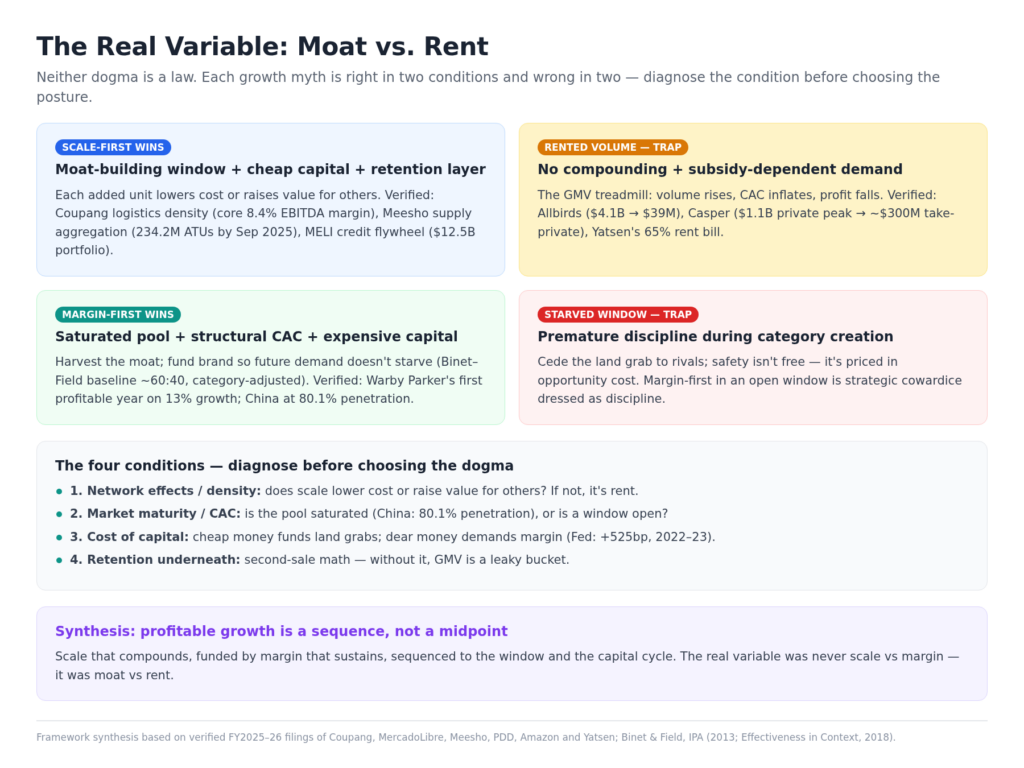
Scale-first works when scale compounds into a moat — logistics density, network effects, supply aggregation — and fails when scale is just rented volume that evaporates the moment subsidies stop. Margin-first works when the market is saturated and customer acquisition costs are structural, and fails when it starves a land-grab window that will never reopen. The real variable was never scale versus margin. It’s whether your growth builds a moat or pays rent.
Myth One: Own the Pool, Monetize Later
The scale-first era had a simple theology: whoever owns the pool owns the future. Pinduoduo’s ten-billion-yuan subsidy program, Meesho’s zero-commission supply grab, the community group-buy wars, Douyin’s GMV sprint — all bets that market position precedes profit.
The believers weren’t wrong about everything. Meesho closed FY2025 with 198.8 million annual transacting users, 1.8 billion orders and net merchandise value of ₹29,988 crore, up 29%. By September 2025 its user base had reached 234.2 million. When it listed on December 10, 2025, the IPO was subscribed roughly 79 times and the stock opened 46% above its issue price. The market still pays for a credible land grab.
But read the fine print. Meesho’s FY2025 net loss was ₹3,942 crore — almost entirely one-time taxes from flipping its domicile from Delaware back to India. Strip those out and the pre-tax loss was about ₹108 crore. Free cash flow turned positive at ₹1,032 crore, though that figure includes interest income; excluding it, ₹591 crore. This is not a company bleeding to death. It’s a company that finished buying its pool and started charging for water.
Myth Two: Profit First, Grow Second
The Western counter-scripture arrived with the rate hikes. Between March 2022 and July 2023 the Federal Reserve raised rates eleven times — 525 basis points, from near zero to 5.25–5.50%. Cheap money had funded growth-at-all-costs; expensive money demanded unit economics. The DTC cohort, raised on venture capital and podcast ads, was first against the wall.
Casper pioneered the bed-in-a-box category, hit a $1.1 billion private valuation in 2019, then went public in February 2020 at $12 a share — roughly half a billion dollars, less than half its private peak. It lost money every quarter it was public. In November 2021 it agreed to be taken private at $6.90 a share, about $300 million all-in; a foam manufacturer bought it in 2024. The category it created had no moat: anyone with capital could ship a similar mattress in a similar box, and a product bought once a decade never repays a customer acquired at auction prices.
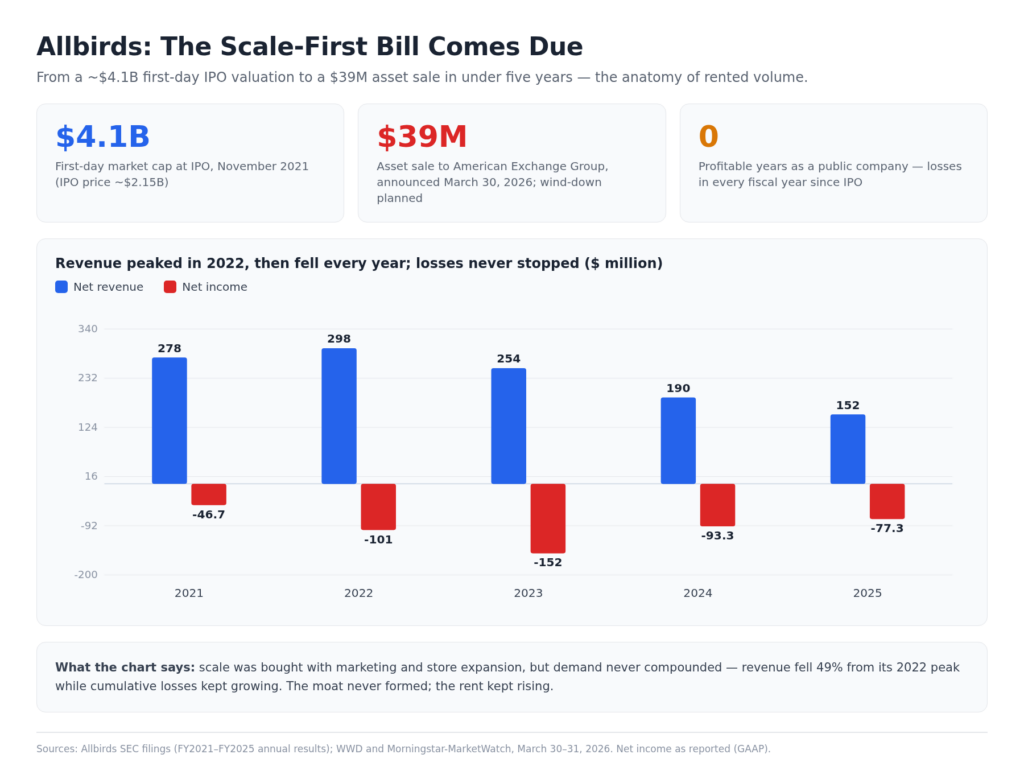
Allbirds tells the same story in sneakers. Revenue peaked at $297.8 million in 2022 and fell every year after — to $152.5 million in 2025, with a $77.3 million loss. It never had a profitable year as a public company. In March 2026 it agreed to sell its assets for $39 million and wind down. The first-day market cap at its 2021 IPO was about $4.1 billion. Do that math slowly.
The Reckoning Is Not a Cultural Event
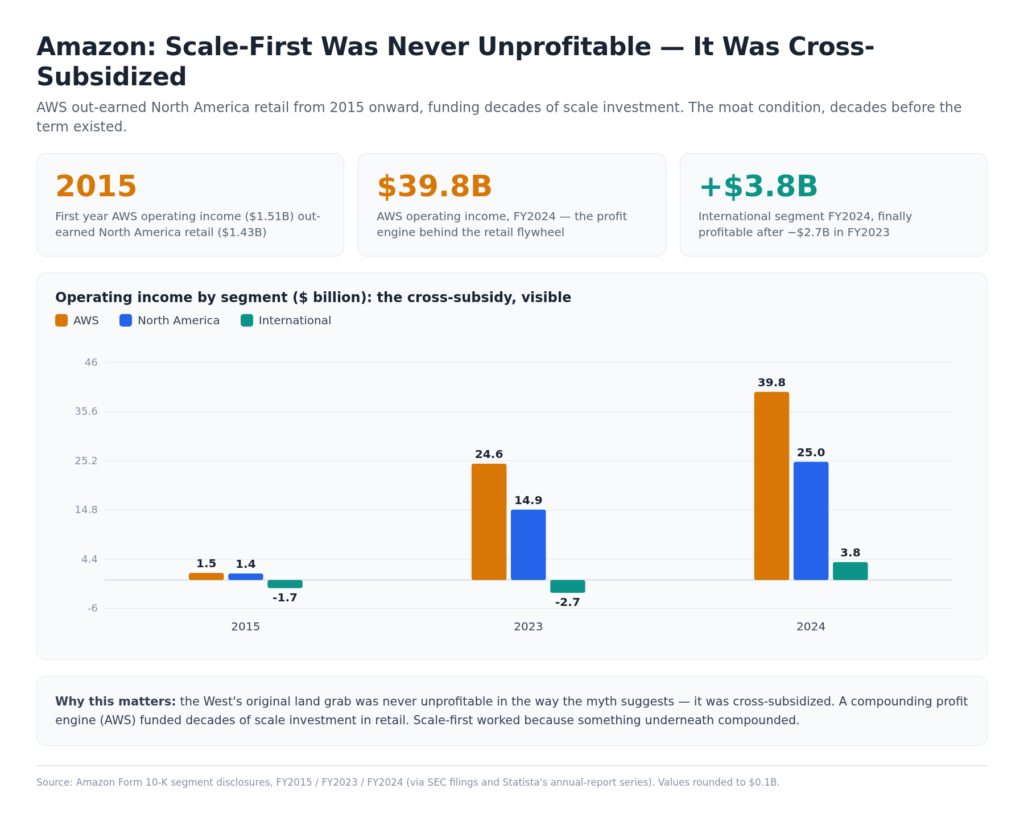
It’s tempting to frame this as China versus the West. Don’t. Amazon — the West’s original land-grab artist — ran scale-first for two decades, and it was never unprofitable in the way the myth suggests. It was cross-subsidized. AWS operating income first out-earned North America retail in 2015 ($1.51B versus $1.43B). By FY2024 AWS earned $39.8 billion, North America $25.0 billion, and International finally turned profitable at $3.8 billion after losing $2.7 billion in 2023. The retail flywheel was funded by a profit engine the market rarely priced correctly.
And China is now preaching margin. The policy chain is explicit: the July 2024 Politburo meeting first warned against involution-style vicious competition; the 2025 Government Work Report ordered comprehensive rectification; the revised Anti-Unfair Competition Law passed in June 2025 bars platforms from forcing below-cost sales; and the Central Financial and Economic Affairs Commission’s July 2025 meeting demanded governance of low-price disorderly competition. The state itself retired the scale-first scripture. The dogmas are artifacts of era and condition — not of culture.
Condition One: Does Scale Compound?
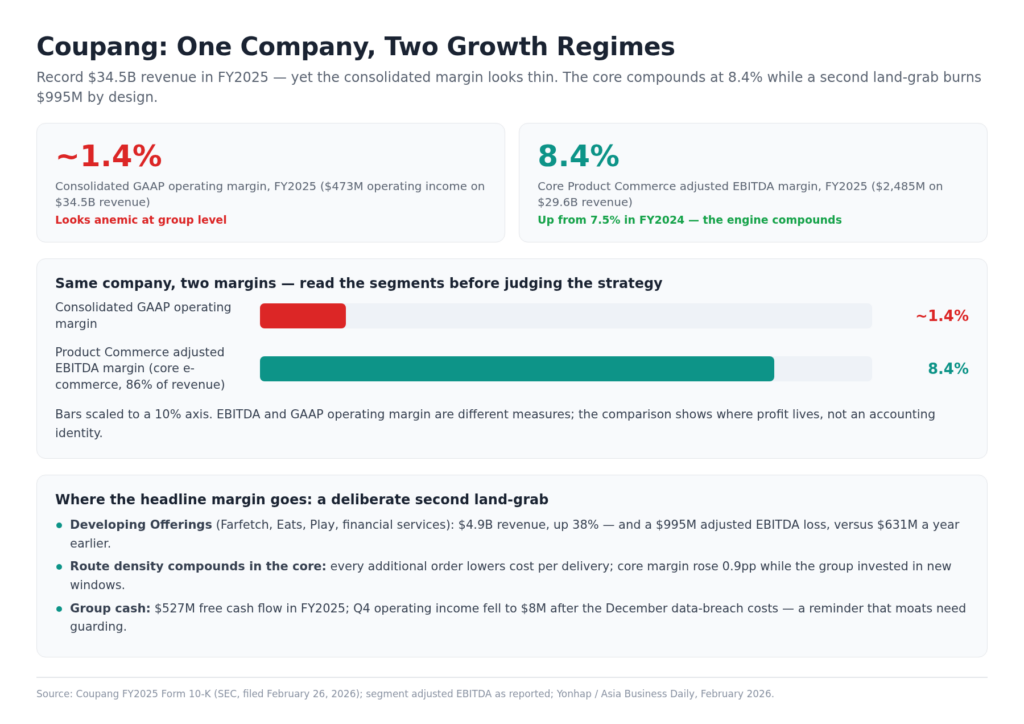
This is the filter that separates the giants from the graveyards. Coupang looks anemic at group level: FY2025 revenue of $34.5 billion, operating income of $473 million, a consolidated margin of about 1.4%. A margin-first purist would call it a failure.
Open the segments. The core Product Commerce business — 86% of revenue — earned $2,485 million in adjusted EBITDA at an 8.4% margin, up from 7.5% a year earlier. Route density compounds: every additional order lowers the cost per delivery. The headline margin is thin because Coupang is deliberately running a second land grab — Developing Offerings (Farfetch, Eats, Play, financial services) lost $995 million in adjusted EBITDA on $4.9 billion of revenue. One company, two growth regimes, one consolidated number that tells you almost nothing.
Meesho’s supply aggregation is the same logic in a different costume: zero commission attracts sellers, sellers attract buyers, density lowers fulfillment cost. Scale compounds — or it doesn’t. There is no third option.
Condition Two: Is the Pool Saturated?
Margin-first is true when the pool is full. China’s internet penetration reached 80.1% in December 2025 — 1.125 billion users, per CNNIC’s 57th report. When nearly everyone is already online, buying growth means bidding against yourself for the same customers. Acquisition cost becomes structural, and every incremental user bought at auction prices destroys value.
But in an open window — a new category, a new geography, a newly digitized population — margin-first is strategic cowardice dressed as discipline. MercadoLibre operates in exactly such a window, and it has the receipts to prove it knows.
Condition Three: The Dogma Follows the Discount Rate
Here’s the part nobody puts in the pitch deck: both scriptures are financing-condition artifacts. Scale-first thrived on 2015–21 cheap capital; margin-first thrived on post-2022 expensive capital. When the Fed moved 525 basis points in sixteen months, the growth playbook changed because the discount rate changed — not because anyone discovered a new law of physics.
Read the capital cycle before you choose your posture. A team that ran scale-first into 2022 and kept burning was not a visionary; it was a financing mismatch. A team that turns margin-first the moment a category-creation window opens is not disciplined; it’s late.
Condition Four: Retention Underneath, Brand Above
Scale-first only works with retention underneath. Without a second sale, GMV is a leaky bucket — you are renting volume from the ad auction, and the landlord raises the rent every quarter.
Margin-first only works without starving future demand. Binet and Field’s analysis of the IPA Effectiveness Awards databank — over a thousand cases across roughly 700 brands — found that long-term brand building and short-term sales activation work on different timescales, with a baseline budget split near 60:40 in favor of brand. Their 2018 follow-up refined it to roughly 62:38 with category-level adjustments. Treat it as a baseline, not a constant: the point is that harvesting today’s demand while cutting tomorrow’s is how margin-first companies quietly liquidate themselves.
Each myth needs the other’s discipline to be true.
The Rented-Volume Trap: A Chinese Receipt
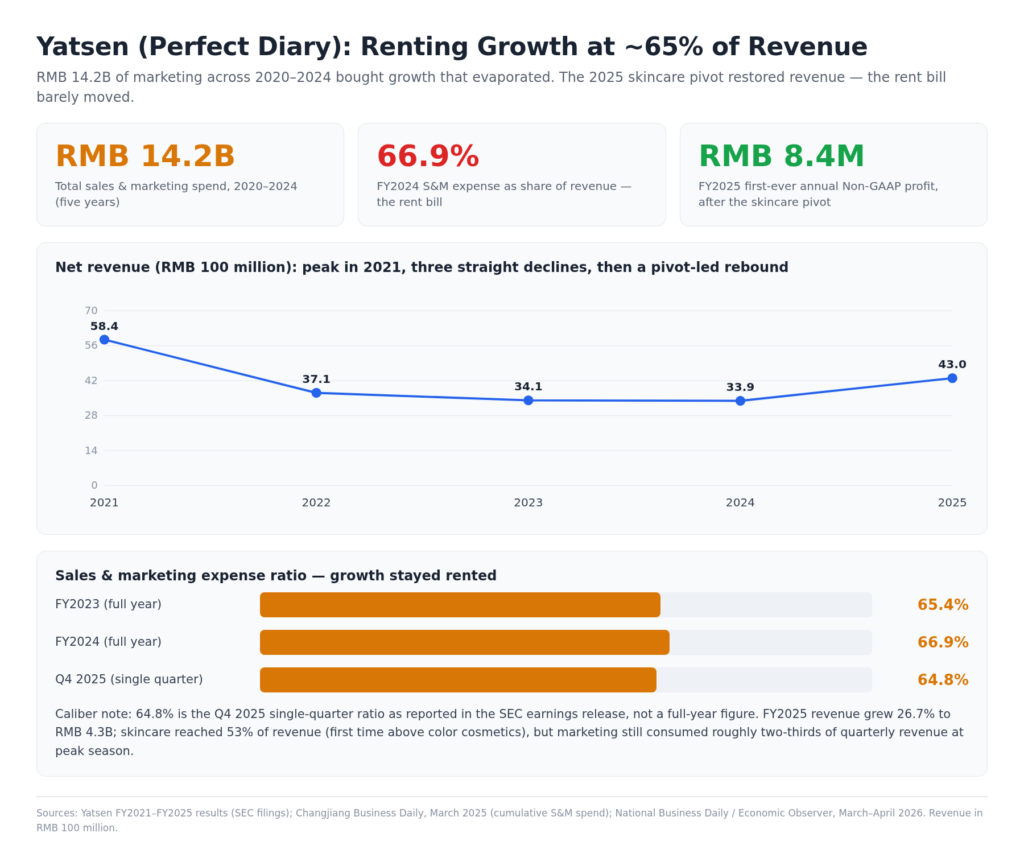
Yatsen, the parent of Perfect Diary, is the cleanest case study of rented volume anywhere. At its 2021 peak it was worth more than $16 billion. Then the bill arrived. Revenue fell from RMB 5.84 billion in 2021 to 3.71, 3.42 and 3.39 billion over the next three years. Across 2020–2024 the company spent roughly RMB 14.2 billion on sales and marketing; in FY2024 alone, S&M expense was 66.9% of revenue. The growth was real. It was also rented — every quarter, at auction.
The 2025 pivot is instructive. Skincare — a repeat-purchase category with actual retention — grew 63.5% and passed color cosmetics to reach 53% of revenue. Group revenue grew 26.7% to RMB 4.3 billion, and Yatsen posted its first-ever annual non-GAAP profit: RMB 8.4 million. GAAP loss narrowed to RMB 92 million. The market cap, meanwhile, sits around 98% below its peak. The lesson isn’t that marketing is bad. It’s that marketing without a compounding asset underneath is rent — and rent doesn’t build equity value.
The Counter-Receipt: When Margin-First Wins
Warby Parker is the DTC brand that survived the reckoning, and it did so by becoming the thing the dogma demands. FY2025 was its first full year of GAAP net income profitability — $1.6 million, against a $20.4 million loss in 2024 — on 13% revenue growth, with adjusted EBITDA up 30% to $95 million and $44 million of free cash flow. Eyewear repeats: prescriptions change, lenses wear out, customers come back. Average revenue per customer rose 5.7% to $324. Retention underneath, discipline above. The margin-first scripture is true — in its conditions.
The Synthesis: Profitable Growth Is a Sequence
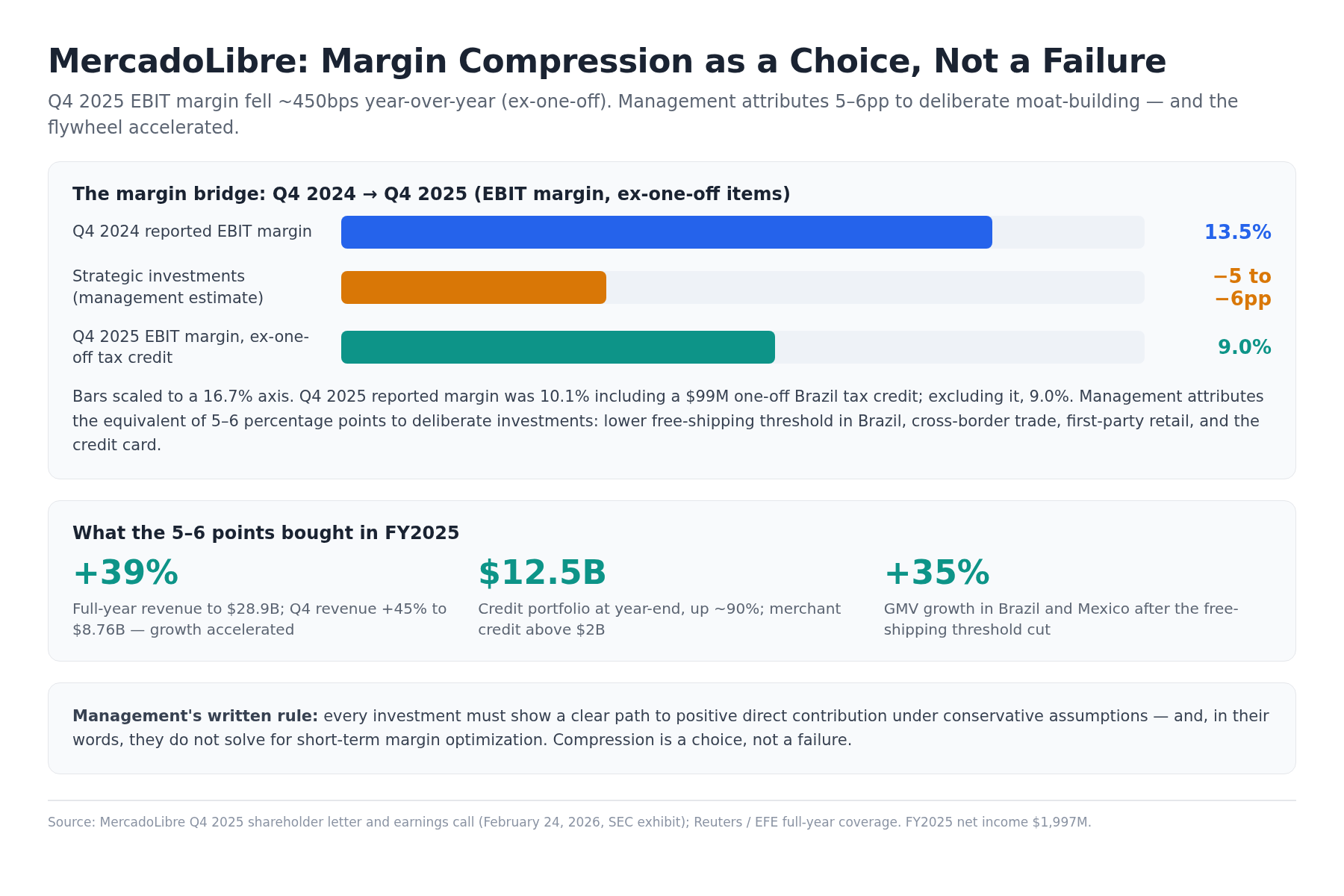
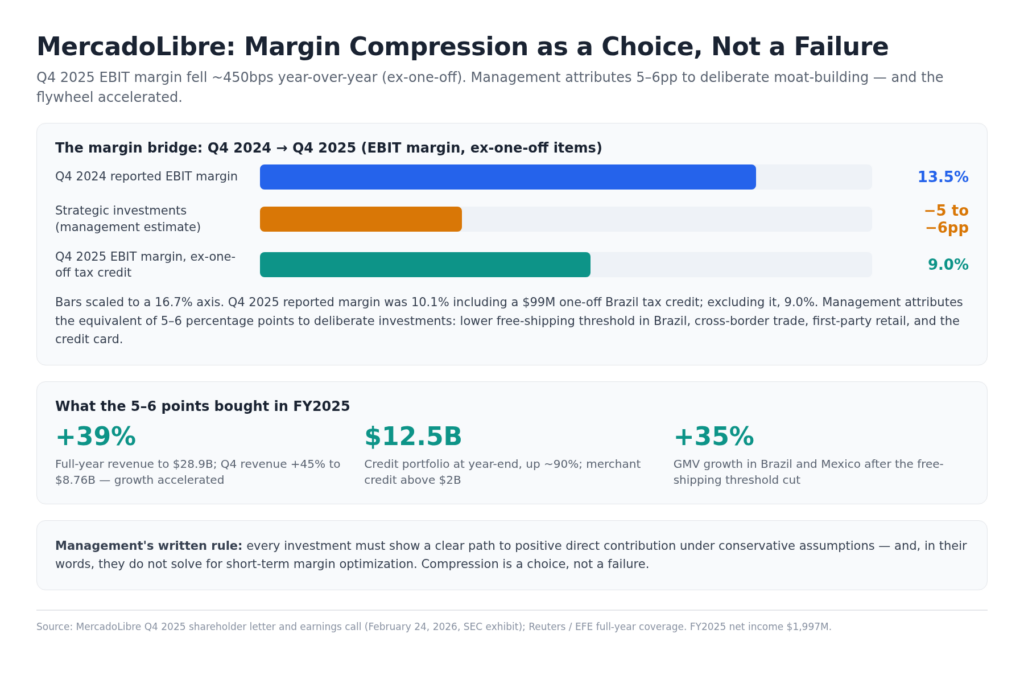
MercadoLibre shows what the synthesis looks like in the wild. In Q4 2025 it grew revenue 45% to $8.76 billion — and told shareholders, in writing, that its strategic investments (a lower free-shipping threshold in Brazil, cross-border trade, first-party retail, the credit card) cost the equivalent of 5–6 percentage points of operating margin. Excluding a one-off tax credit, the quarter’s EBIT margin was 9.0%, down from 13.5% a year earlier.
What did the 5–6 points buy? Full-year revenue up 39% to $28.9 billion. A credit portfolio that nearly doubled to $12.5 billion. Merchant credit above $2 billion. Management’s stated rule: every investment must show a clear path to positive direct contribution under conservative assumptions — and, in their words, they do not solve for short-term margin optimization.
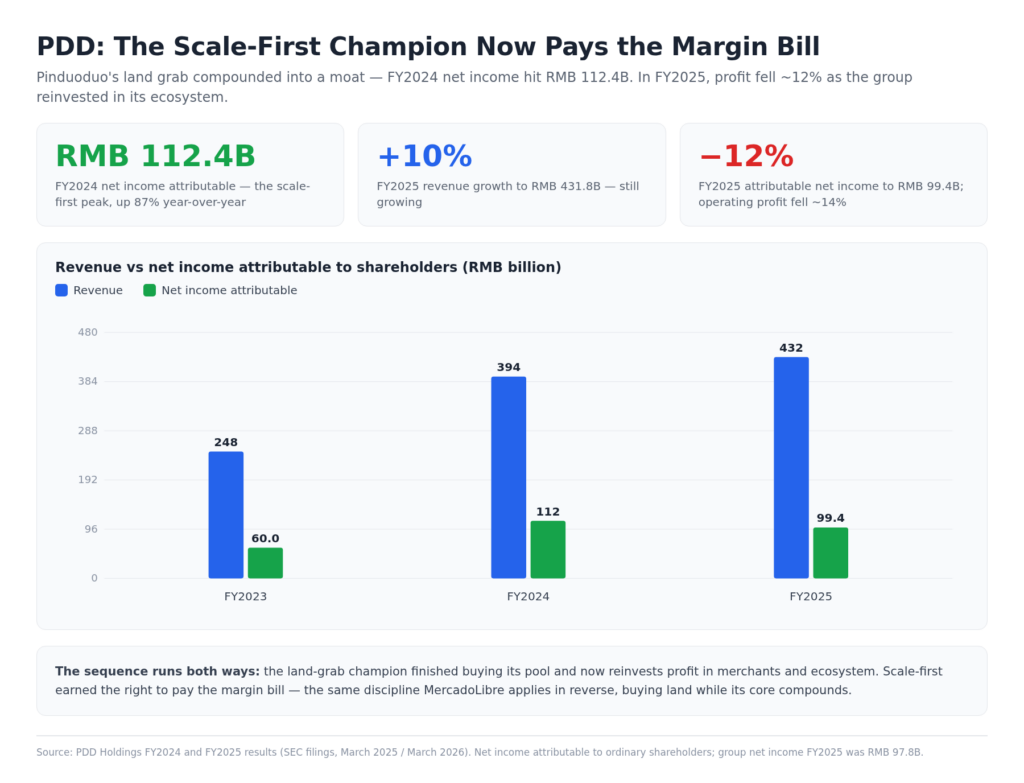
This is not splitting the difference between the two myths. It is scale that compounds, funded by margin that sustains, sequenced to the window. And the sequence runs both ways: PDD, the scale-first champion whose FY2024 net income hit RMB 112.4 billion (up 87%), saw FY2025 revenue grow 10% while attributable net income fell about 12% and operating profit fell about 14% — profit deliberately reinvested in merchants and ecosystem. The land-grab king now pays the margin bill; the margin king still buys land when the window is open.
What To Do Monday Morning
Four moves, in order:
- Diagnose the condition before choosing the dogma. Moat-building window plus cheap capital plus a retention layer → scale-first. Saturated pool plus structural CAC plus expensive capital → margin-first. The condition decides, not the culture.
- Test whether scale compounds. Measure marginal cost and value per added user — density economics, network effects, cross-use. If the next unit doesn’t make the previous ones cheaper or more valuable, you’re renting. Stop buying it.
- Sequence, don’t average. Land-grab the window with investment funded by a credible path to margin; harvest with discipline that doesn’t starve brand and future demand. Profitable growth is a sequence, not a midpoint.
- Read the capital cycle. Adjust posture to financing conditions, not to a fixed ideology. The discount rate is the quiet author of both scriptures.
The Counterargument — and Its Limit
Scale-first built Amazon and Pinduoduo, so why not worship it? Because of survivorship bias. For every giant whose scale compounded into logistics density or network effects, dozens of scale-first burnouts rented volume and died — Casper and Allbirds are the tombstones we can name. The moat condition is the filter; the dogma is not.
And margin-first is safer only in mature markets. In a category-creation window, premature discipline cedes the category to whoever is willing to invest. Safety isn’t free; it’s priced in opportunity cost. The synthesis sounds like common sense because it is — operationally, it’s the hardest thing on this page.