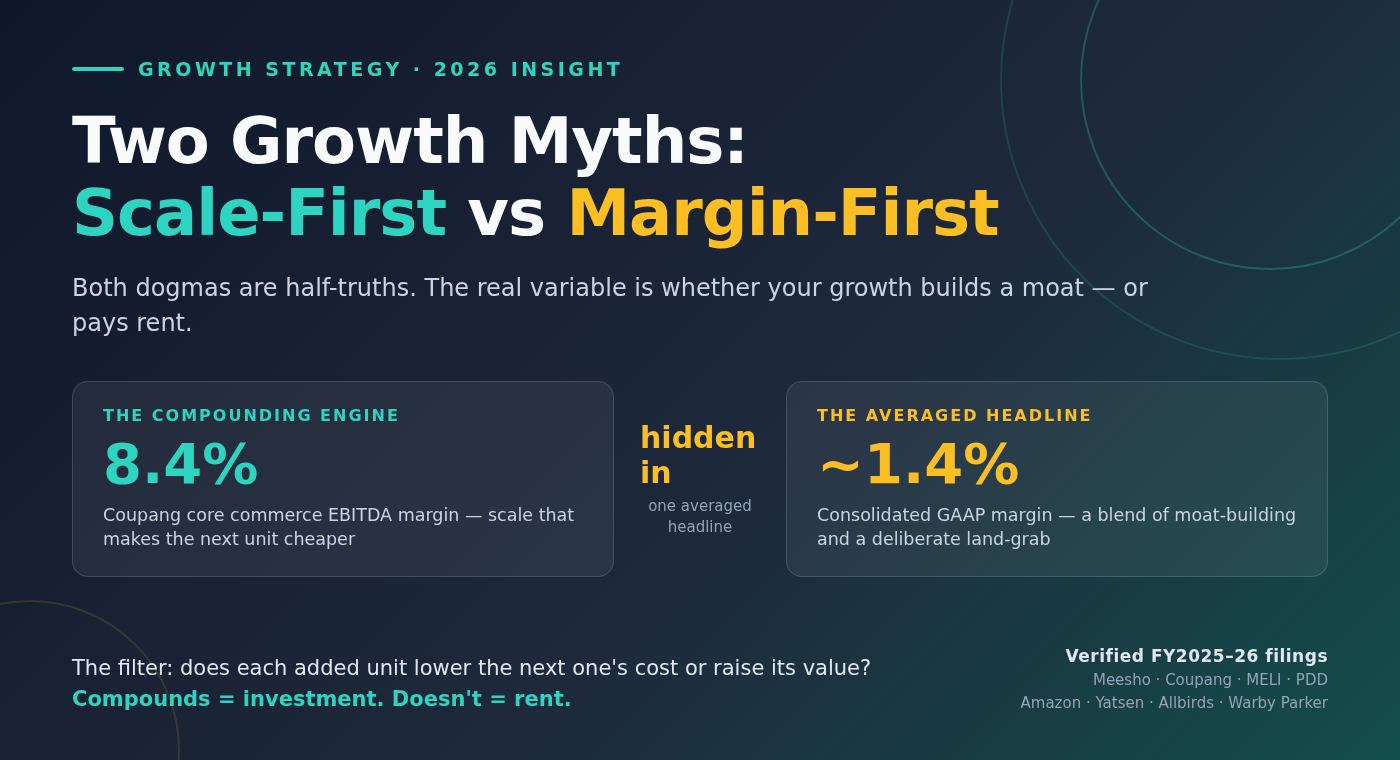
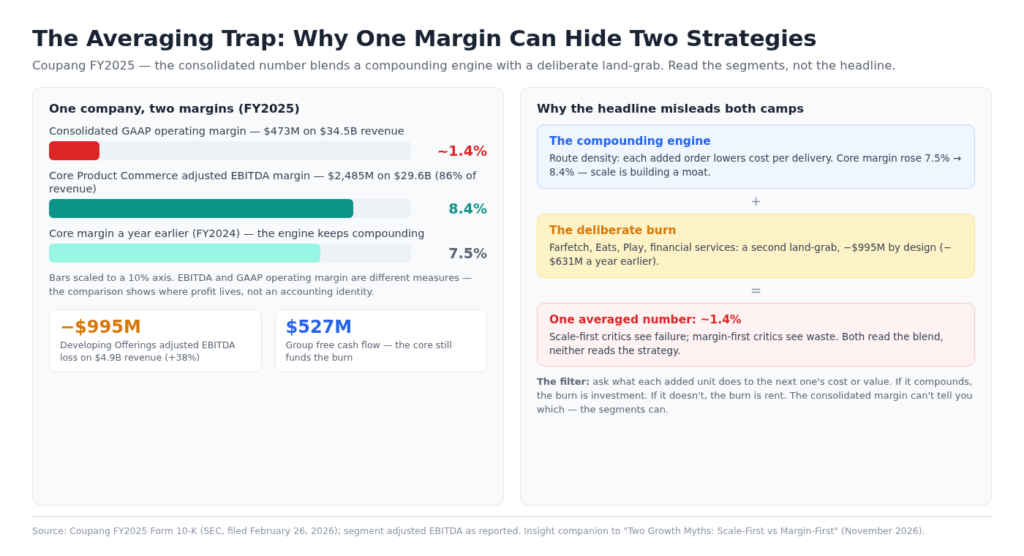
Here is a number that launches a thousand bad takes: Coupang earned $473 million of operating income on $34.5 billion of revenue in FY2025. A consolidated margin of about 1.4%. The scale-first camp calls it proof that land grabs never pay. The margin-first camp calls it proof that discipline slipped. Both camps are reading the same number — and both are wrong, because that number is a blend, not a strategy.
Open the segments and the blend separates. The core Product Commerce business — 86% of revenue — earned $2,485 million in adjusted EBITDA at an 8.4% margin, up from 7.5% a year earlier. That is a compounding engine: route density means every additional order lowers the cost per delivery, so scale literally makes the next unit cheaper. Meanwhile Developing Offerings — Farfetch, Eats, Play, financial services — lost $995 million in adjusted EBITDA on $4.9 billion of revenue, a burn that widened from $631 million the year before. That is a second land-grab, run on purpose, funded by the first business’s cash. The group still generated $527 million of free cash flow.
Why the Blend Fooled Everyone
The mechanism is arithmetic, not deceit. Consolidated margin is a weighted average, and averages destroy exactly the information a strategy debate needs: the marginal economics of each added unit. When one business compounds and another burns by design, the average can look like failure while both components are executing their intended roles. The 1.4% headline is not a verdict on Coupang’s strategy. It is a verdict on your reading method.
This is why both growth myths keep finding evidence. Scale-first believers point at the revenue record; margin-first believers point at the thin headline. Each selects the half of the blend that flatters its dogma. The same trap runs in reverse at MercadoLibre, where management told shareholders in writing that deliberate investments cost 5–6 percentage points of margin — compression as a choice, invisible unless you read the letter. And it runs destructively at companies like Yatsen, where a 65%-of-revenue marketing bill averaged into “growth” hid the fact that nothing underneath compounded.
The Filter That Actually Works
Stop asking whether margin is high or low. Ask what each added unit does to the next one’s cost or value. If it compounds — density, network effects, repeat purchase — the burn is investment and the averaged margin is noise. If it doesn’t, the burn is rent, and no headline growth will save you. The consolidated number can’t tell you which. The segments can. That is the whole insight: the moat-versus-rent question lives one level below the number everyone quotes.






