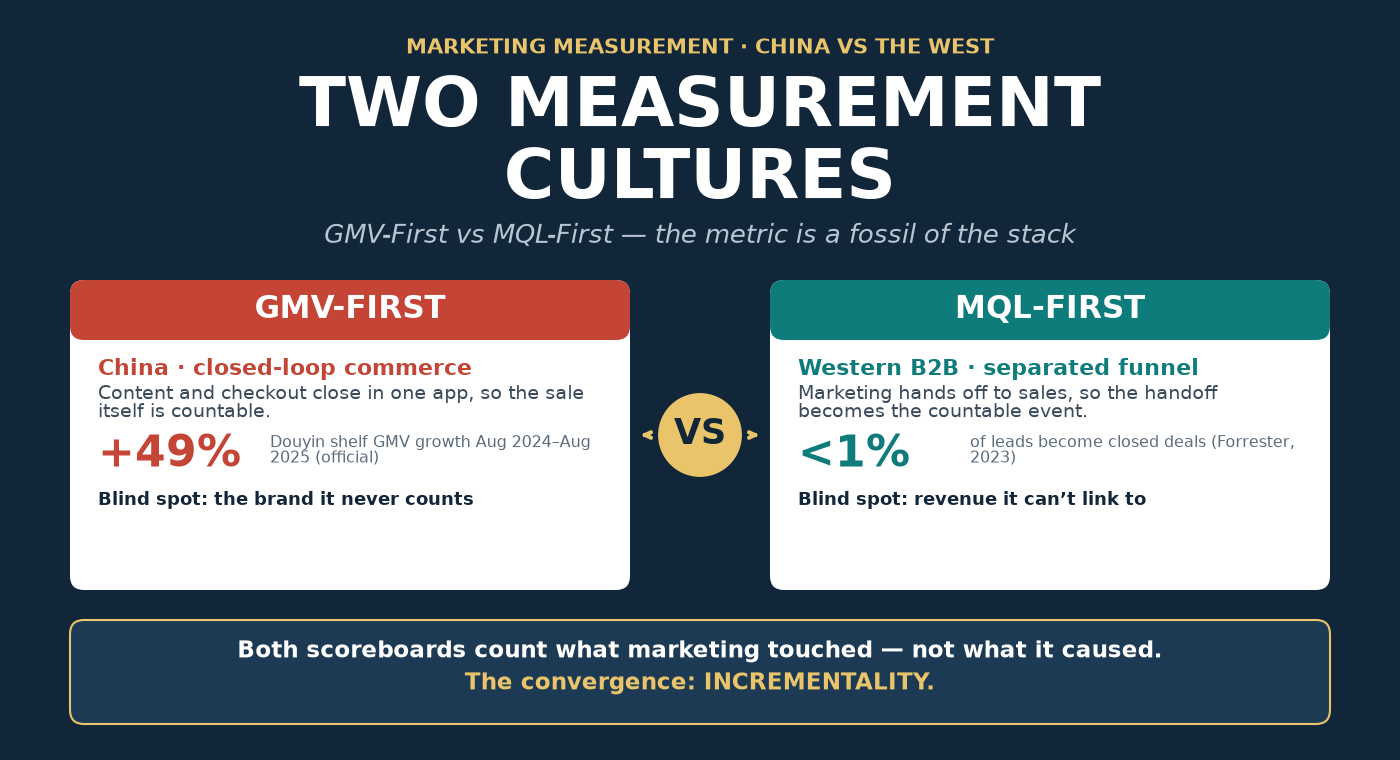
Here is a puzzle nobody in marketing likes to say out loud: both measurement cultures know their scoreboard is broken, and both keep counting anyway. Chinese teams net out returns in private while reporting gross GMV in public. Western teams complain about lead quality in every quarterly review while hitting MQL quotas to the decimal. This isn’t hypocrisy. It’s economics.
The Countability Gradient
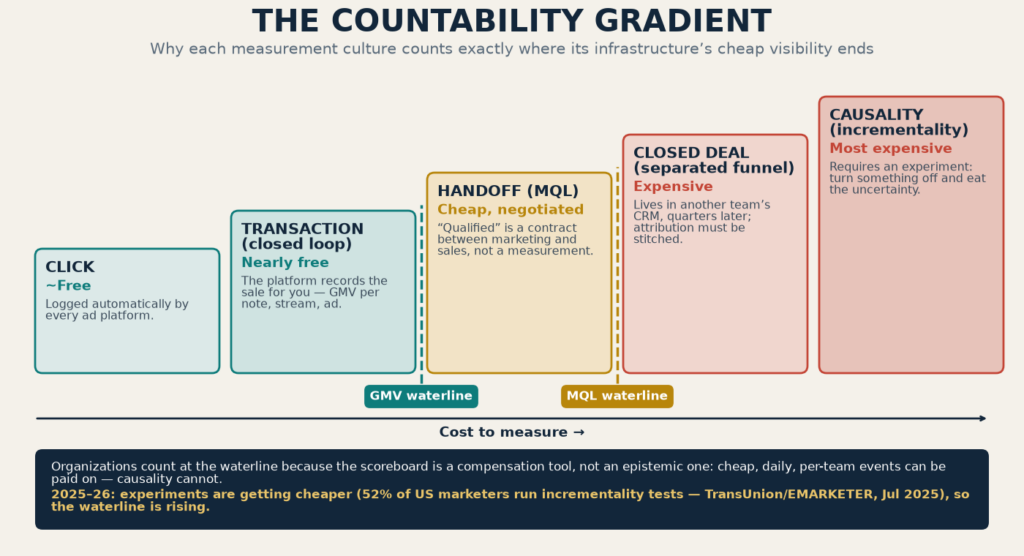
Every step from a marketing touch to actual revenue costs more to measure than the last. A click is free to count. A transaction inside a closed loop is nearly free — the platform logs it for you. A handoff is cheap but negotiated: someone has to define what “qualified” means, and that definition is a contract between departments. A closed deal in a separated funnel is expensive — it lives in another team’s CRM, quarters later. And causality — what would have happened without the ad — is the most expensive event of all, because it requires an experiment: turning something off and eating the uncertainty.
Notice the shape of that gradient. The cheapest event to count sits at the edge of what your infrastructure can see. And organizations, being rational cost-minimizers, count exactly there. GMV is where China’s closed loop ends its free visibility. The MQL is where the Western funnel’s cheap visibility ends, right before the sales org takes over. The metric isn’t chosen. It’s the waterline.
Why Knowing Better Changes Nothing
The evidence that proxies mislead is not new or hidden. eBay’s field experiments, published in Econometrica in 2015, showed 99.5% of brand-ad traffic arriving organically anyway — the ads were billing for demand they didn’t create. Forrester’s own research puts lead-to-close conversion under 1%, and the firm has been publicly saying goodbye to MQLs since 2023. CMI’s 2025 benchmark found only 29% of B2B marketers call their content strategy very or extremely effective. Everyone has read these numbers. The scoreboards didn’t move.
They didn’t move because the scoreboard is not an epistemic tool. It’s a compensation tool. A metric that can be counted cheaply, daily, per team, is a metric you can pay people on. Causality can’t be payroll: you can’t run a geo-holdout on every campaign and settle every bonus with a p-value. So the proxy survives every exposé — not because nobody knows, but because knowing doesn’t change what’s cheap to count.
The Waterline Is Moving
What’s interesting about 2025–2026 is that the cost gradient itself is shifting. Experiments are getting cheaper: 52% of US marketers already run incrementality tests, per the July 2025 TransUnion–EMARKETER survey. Chinese platforms are doing the math from their side — Ocean Engine’s official guidance concedes that same-month conversions capture only 60–70% of a touch’s eventual conversions, which means even GMV-undercounting is now measurable. When the price of counting causality falls, the waterline rises. Neither culture is converting out of virtue. They’re repricing.
The insight for operators: stop asking why your team clings to a bad metric. Ask what your infrastructure makes cheap to count — then make the next event cheaper. That’s the whole game.