A single rice brand was valued at ¥71.36 billion in 2025. In the same year, a bunch of grapes grown from the same variety, in the same country, sold for as little as ¥3 a kilogram — until someone stuck a Japanese label on it, and the price tripled. Welcome to Chinese agriculture marketing, a field that has spent a decade building the world’s largest system for naming, certifying and promoting place-based food, and is only now discovering that a name is not the same thing as a brand.
The scale is almost absurd. By the end of 2025, China counted 9,606 geographical-indication (GI) farm products, plus 1,041 regional image brands and close to 10,000 category brands. Livestreaming has rewritten the route from field to fridge. And yet the premium — the extra money a consumer will actually pay — remains stubbornly thin in most places. China’s farm brands solved designation and distribution before they solved differentiation. That is the story, and the opportunity, below.
A Rice Brand Worth ¥71.3 Billion — and a Grape Problem
Start with the headline number, because it is the one everyone quotes. In China’s 2025 brand-value evaluation, Wuchang rice came in at ¥71.36 billion, the top GI rice brand for a decade running. Then there is the other number you will see: ¥38.276 billion. Both are Wuchang rice. Both are “official.” They come from two different valuation systems — the China Brand Value Evaluation on one hand, and the HUST-led Green Gold Report census of public brands on the other. One is a brand-value estimate; the other is a public-brand assessment value. They are not the same measure, and anyone who adds them together or swaps them freely is not reading carefully. Brand valuations are not transaction receipts.
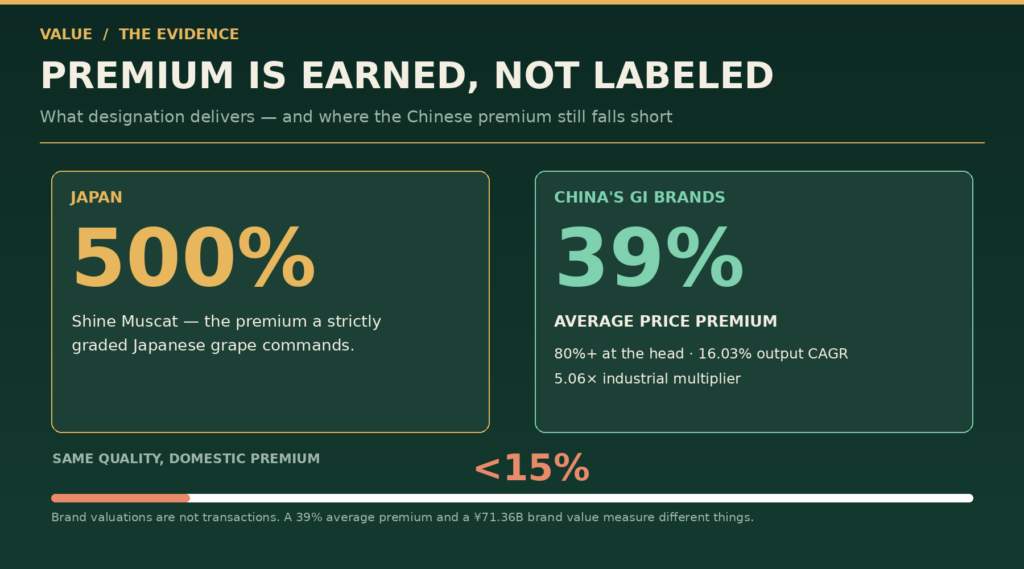
Now the grape. In late 2025, The Beijing News went shopping and found “Shine Muscat” grapes everywhere — in Japanese-styled boxes, in Korean-styled boxes, in boxes marked “Peru.” Every one of them was domestic. China’s customs list permits only apples and pears from Japan; no Japanese grapes enter the country at all. Shine Muscat is a real Japanese trademark, registered by the agricultural cooperative in Okayama in 2011, but the fruit in those boxes was home-grown yangguang meigui. The industry’s own market monitoring puts the price premium of a genuine Japanese premium grape at up to 500%, while equally good Chinese premium produce captures under 15%. Consumers were paying for a story, not a strawberry — sorry, a grape. And the story was imported.
That gap — between what a place can grow and what a place can charge — is the whole ballgame.
The Designation Machine: 9,606 Products, One Census
In June 2026, a joint research team at Huazhong University of Science and Technology released the Green Gold Report, the first nationwide census of GI agricultural public brands. The team spent a year on a full-coverage, standardized, non-commercial survey, valuing 3,221 public brands with one yardstick. As of December 2025, the count stood at 9,606 GI farm products — covering certification trademarks, collective trademarks, protected GI products and registered geographical indications, excluding alcohol, soy sauce and vinegar. The breakdown tells you where the energy is: 2,013 fruit products, 2,001 grain and oil, 1,796 vegetables, 1,189 livestock, 871 medicinal herbs, 849 aquatic products and 601 tea.
Read that carefully: these are not the same as the 5,066 GI products recognized by the national IP authority, which counts all categories, or the roughly 4,700 GI regional public brands tracked in earlier academic work. Three counting systems, three different things. Passing them off as one number is the fastest way to lose credibility with a Chinese audience.
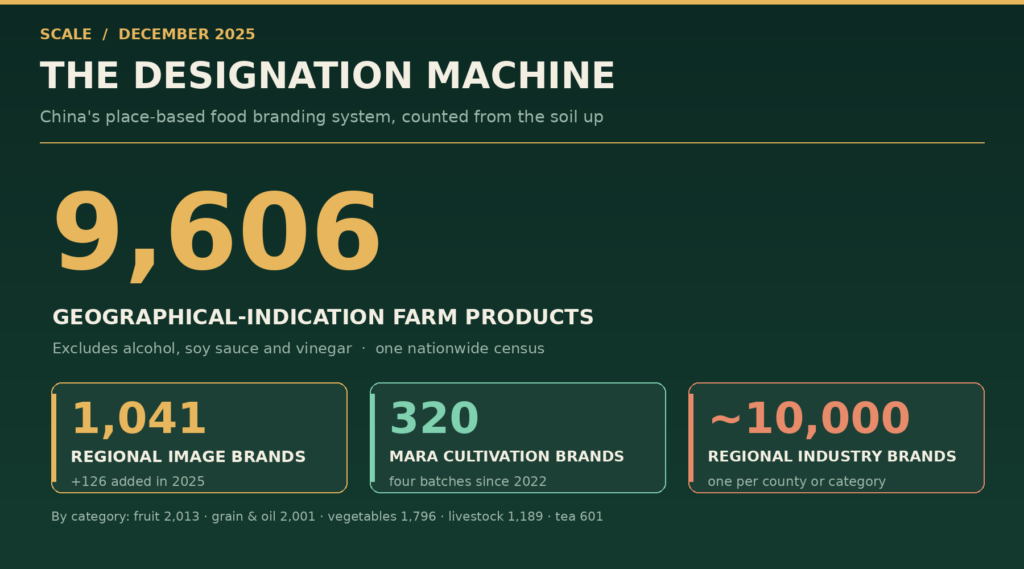
The policy scaffolding is real. The Ministry of Agriculture and Rural Affairs (MARA) has run an agricultural brand cultivation program since 2022; its fourth batch added 94 regional public brands in 2025, bringing the total to 320. Add 123 national GI protection zones, and you have a system that turns a county’s soil, climate and craft into a defensible legal asset. It is less a marketing department than a land registry for flavor.
What Each Label Actually Protects
A GI certification mark says the product’s quality and reputation are tied to a place and can be certified by a governing body. A collective mark is owned by an association and licensed to its members — useful for a whole county of growers. A protected GI product designation is an administrative registration with quality and origin rules attached. For a marketer, the distinction matters because it determines who can use the name, who polices it, and what happens when a neighboring county tries to free-ride. Get the governance wrong and you have handed your competitors a trademark with your money behind it.
The Two-Layer Brand System
Here is a structural quirk that confuses almost every newcomer. Chinese agricultural branding runs on two layers that rarely meet.
On top sit the regional image brands: Gansu’s “Ganwei,” Shandong’s “Haopin Shandong,” Zhejiang’s “Lishui Shangeng,” Jiangxi’s “Jinggangshan.” These are umbrellas — a promise about a whole province or city. Below them sit the category brands: Wuchang rice, Pu’er tea, Yantai apple, Yangcheng Lake hairy crab. These are the names consumers actually recall.
The 2025 China Regional Agricultural Brand Development Report captured the mismatch with a simple survey: ask people to name a regional agricultural brand and they list products, almost never umbrellas. The umbrella is a credibility endorsement; the product is the thing in the cart. Smart operators use the first to lend authority to the second. Lishui Shangeng, for instance, built a mother-and-child structure — a city-wide collective trademark with a state-owned operator, product standards, third-party certification and full traceability — and reported ¥6.505 billion in 2025 sales across more than a thousand licensed products. Six times it has topped the prefecture-level ranking for regional image brand influence. That is what an endorsement is worth when somebody actually runs it.
What the Premium Evidence Actually Says
Does any of this paperwork pay? The Green Gold Report says yes — unevenly. GI public brands command an average price premium of 39%. Top brands such as Wuchang rice and Xihu Longjing clear more than 80%. The output value of leading brands has grown at a 16.03% compound annual rate, and the associated industrial value added is 5.06 times primary agriculture alone. Tea is the standout multiplier. China Agricultural University measured the 320 cultivation-program brands at an average e-commerce premium of 33%.
Those are real numbers from credible teams. But notice the shape of them: an average of 39%, a ceiling above 80%, and thousands of brands in between that never reach either. The system lifts the head and leaves the tail. The national IP authority reports GI products generating over ¥969 billion in direct annual output value, with a target of ¥1.1 trillion by 2030. Plenty of value is being created. The question is who captures it.
The Channel Revolution
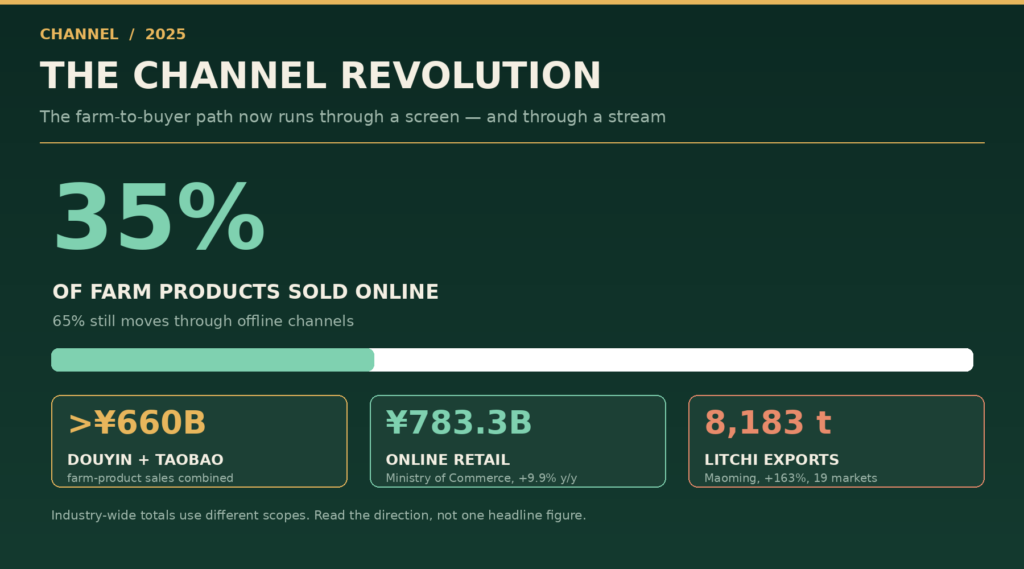
Forget the old three-step distribution chain. In 2025, 35% of farm products sold online, according to the regional brand report released in Beijing, and livestream sales of farm goods reportedly topped ¥3.1 trillion, up 28%, with Douyin and Taobao together moving more than ¥660 billion. That ¥3.1 trillion figure deserves a warning label: it is an industry-wide, loosely defined number from a report stage, and the identical “3.1 trillion, +28%” pair appears in other sources as first-half total livestream GMV. The Ministry of Commerce’s narrower dataset puts farm-product online retail at ¥783.3 billion, up 9.9%, while official think-tank research puts all 2025 livestream commerce above ¥5 trillion. The scopes do not line up. Use the directional conclusion, not the headline: content channels are absorbing farm sales faster than shelf e-commerce, and two platforms alone are moving hundreds of billions of yuan of produce.
The Trust Format: Live from the Field
Why does this work for agriculture? Because a tomato on a shelf is a non-standard product. You cannot tell its sweetness by looking. A streamer in the field can cut it open, show the soil, name the grower and answer questions in real time. Taobao alone organized more than 150 origin-traceability events in 2025; Xiangshan seafood gift boxes rose 20%, Xinjiang camel milk 85%, and Guangfeng pomelo online sales jumped 200%. “Village broadcasters” and new-farmer IPs do something a packaging label cannot: they put a face and a voice behind the provenance. Live commerce didn’t just move product. It manufactured trust at scale.
Standardization Is the Brand
You cannot build a premium on a product that changes every batch. That sounds obvious, and yet “heavy on application, light on management” is the exact phrase academics use for Chinese GI brands — nearly half gradually weaken after certification. The successful cases start with discipline, not storytelling.
Take Wuchang rice. A national standard issued at the end of 2024 introduced a “sensory plus physicochemical” double-track evaluation, turning the abstract idea of “tasty” into measurable indicators. A digital监管 platform — the outline of an IoT, blockchain and big-data traceability system — follows the grain from field to table. The “six unifications” model standardizes seed supply, inputs, planting, technique, aerial spraying and purchasing across growers. Zunyi chili, meanwhile, built its brand on more than two million mu (about 133,000 hectares) of standardized planting and over ¥21 billion in comprehensive output value. In Xishui county, 99.4% of egg production is scaled farming, sensors and robotics are standard, and a local price index influences roughly 70% of the national egg market. None of this is glamorous. All of it is the brand.
Traceability: From “Trust Me” to “Scan Me”
China’s GI “15th Five-Year Plan” now explicitly calls for origin tracing so that “the source can be checked, the destination tracked and responsibility assigned.” QR codes, one-item-one-code systems, IoT sensors and cold-chain monitoring are becoming table stakes. The strategic shift is subtle but enormous: a claim printed on a box asks the buyer to believe you; a scan result hands them the evidence. In a market where counterfeit “Shine Muscat” boxes are a cottage industry, evidence is the only defensible moat. Enforcement is tightening too — in 2024 authorities handled 1,407 GI infringement cases — but the brand that shows its own receipts will always be ahead of the one waiting for the inspector.
The Differentiation Gap
So why, with 9,606 certified products, is the premium still under 15% for most equivalent-quality goods? Because designation is not differentiation. A GI tag tells a consumer where something came from; it does not tell them why this one is worth more than the one next to it.
Japan’s Shine Muscat shows the alternative. Berry size, sugar content and bunch shape are graded to strict thresholds, and only fruit meeting the standard may carry the name. Sunkist and Zespri do the same in their categories: a brand is a promise enforced by rejection. In China, by contrast, “five hundred years of history” tends to substitute for a specification, and a whole county is licensed to tell the same story. When everyone can say “authentic,” nobody can charge for it.
Story, Culture and the Experience Layer
None of this means terroir narratives are useless. They are the experience layer that sits on top of standardization. Jinggangshan built agri-tourism and cultural IP around its regional brand; Lishui Shangeng tied product to ecological identity and a city-wide store network. Anxi turned Tieguanyin tea into 41 tea-themed estates, drawing over ten million visitors in 2025. Maoming litchi turned a 2,000-year history into a permanent industry convention, a national germplasm repository and a cultural carnival, then sold the story alongside the fruit. In each case the story worked because the product underneath had already been made consistent. Culture is the amplifier, not the engine.
Channel Strategy: Matching Product to Occasion
A premium needs an occasion. That is why the strongest operators segment by channel rather than dumping one SKU everywhere. Gift boxes and solar-term timing turn rice, tea and litchi into ceremonial purchases with far higher tolerance for price. Ready-to-eat and processed formats extend shelf life and move produce beyond the seasonal window. Community group-buying and supermarket chains reach families that never watch a stream. Cross-border is the newest frontier: Maoming exported 8,183 tonnes of fresh litchi in 2025, up 163%, to 19 markets, while its whole-chain output passed ¥12 billion and e-commerce sales rose 224%. The fruit did not change. The route, the packaging and the promise did.
The Government-Enterprise Model — and Its Tragedy of the Commons
Almost every successful Chinese place brand runs on the same arrangement: government sets standards and provides backing, an association owns the mark, a state-linked company operates it, and qualified enterprises use it. It is a sensible division of labor in a fragmented smallholder landscape — until incentives drift.
The risks are textbook. When a brand is “public,” individual growers have every reason to use it and little reason to maintain it. Standards are hard to enforce across thousands of scattered plots; free-riders dilute quality; homogeneous packaging and interchangeable stories flatten the category. Academics call it the tragedy of the commons; marketers should call it the day the premium disappears. Maoming’s answer was to keep the core message fixed — “Maoming litchi, world famous litchi” — while constantly renewing the tactics underneath. Brand assets compound through consistency; campaigns expire.
Global Mirrors
It is tempting to read China’s GI scale as a uniquely Chinese phenomenon. It isn’t. The EU has spent decades on PDO and PGI designations; Japan has Shine Muscat and Wagyu; New Zealand built Zespri into a category owner. The difference is discipline. Europe rejects producers who miss the spec. Japanese cooperatives police their trademark at the retail shelf. Zespri limits who may plant and who may export. China has the larger library of names and the faster channels. What it still needs is the habit of saying no — to bad batches, to opportunistic licensees, to the easy extra yuan that quietly retires a premium.
The Six-Move Playbook
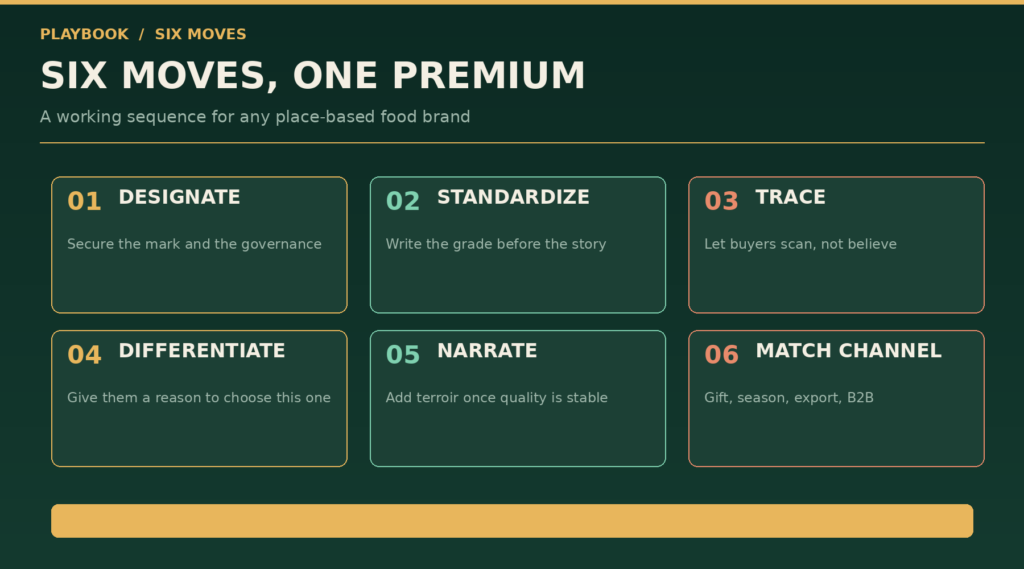
If you are building a place-based food brand, the sequence is short and non-negotiable. Designate — secure the mark and the governance. Standardize — write the grade before you write the story. Trace — let the buyer scan, not believe. Differentiate — give them a reason to choose this one. Narrate — add terroir and culture once quality is stable. Match the channel — gift, season, export, B2B ingredient packs, each with its own promise. Skip a step and the premium leaks out somewhere else.
Bottom Line
China has built the most ambitious agricultural branding apparatus on earth: thousands of protected names, a national cultivation program, a traceability mandate and a livestream channel that moves produce by the hundred billion. The premium evidence says it works — 39% on average, over 80% at the head, a 5.06× industrial multiplier. It also says the work is unfinished, because a designation can be granted in an afternoon while a brand has to be earned in every harvest. The next winners will not be the counties with the most certificates. They will be the ones willing to reject the fruit that doesn’t make the grade — and then tell the world why.