Most platform wars end with a funeral. Uber and Didi in China. Amazon and everyone in American retail. So when analysts watch noon and Amazon trade blows across the Gulf for nine straight years without a knockout, they assume somebody is losing slowly. That assumption imports the wrong economics. The Gulf duopoly is not a slow-motion knockout. It is a stable equilibrium, and the incentives make it one.
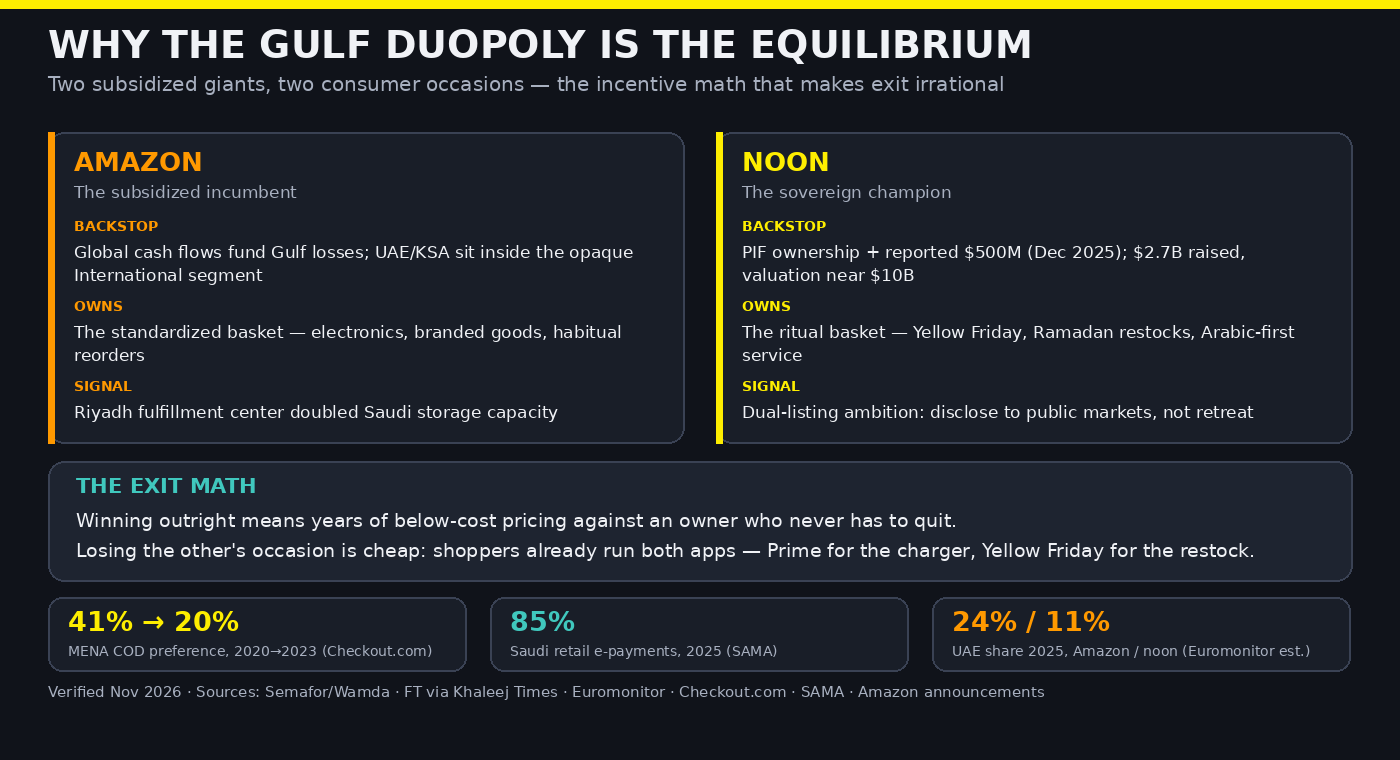
Start with the money behind each fighter. Noon is half-owned by Saudi Arabia’s Public Investment Fund, which reportedly put in more money in December 2025 — a $500 million round alongside founder Mohamed Alabbar — pushing total funding to roughly $2.7 billion. Alabbar told the Financial Times in September 2025 the company was almost profitable, valued near $10 billion, and heading toward a dual UAE-Saudi listing. Amazon, meanwhile, buries its Gulf numbers inside the International segment and funds regional expansion from a global profit engine. Neither owner needs this market to pay for itself this year. When both sides can price below economics indefinitely, price war stops being a weapon that ends wars. It becomes weather.
Now look at what each side actually owns. Amazon owns the standardized basket: the branded phone, the predictable delivery, the habitual reorder. Noon owns the ritual basket: the Yellow Friday haul, the Ramadan kitchen restock, the Arabic-first service that feels native. These are different occasions, not different versions of the same occasion — and Gulf shoppers happily run both apps. Euromonitor’s 2025 UAE estimates (Amazon around 24%, noon around 11%) describe overlapping loyalty, not a battlefield where one flag replaces another.
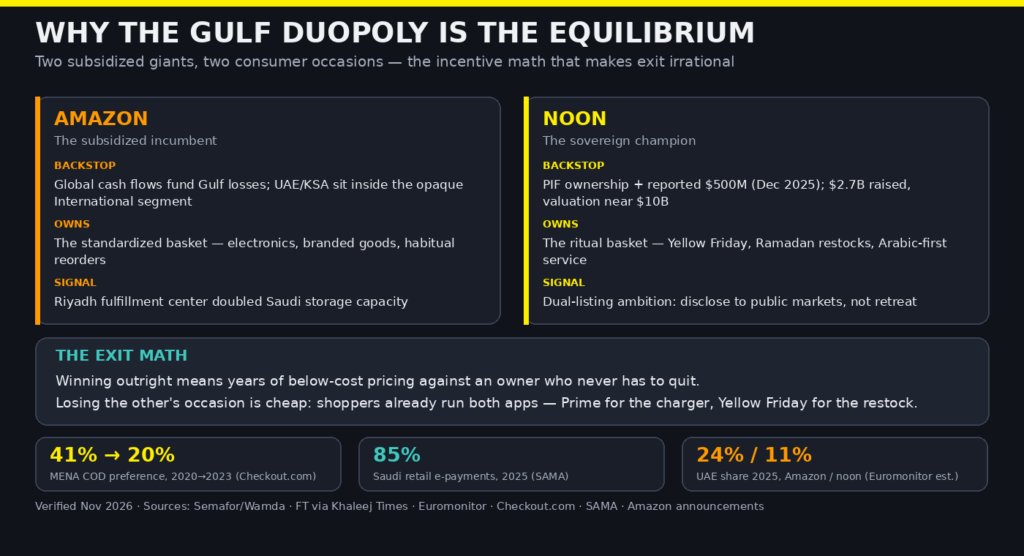
That is the exit math nobody prices in. To win outright, either player would have to conquer the other’s occasion — out-ritual the native champion or out-standardize the global machine — through years of subsidized pricing against an opponent who never has to quit. The cost of total victory is enormous. The cost of tolerating the rival is nearly zero, because the rival’s customers were your customers anyway, on a different day of the calendar. When victory is expensive and coexistence is free, rational capital coexists.
The checkout data confirms the equilibrium is comfortable, not fragile. Cash-on-delivery preference across MENA halved from 41% to 20% between 2020 and 2023, and Saudi central bank figures show 85% of retail payments were electronic by 2025. Both platforms are surfing the same prepaid transition, harvesting trust dividends instead of fighting over cash-first stragglers. Rising tides make duopolies polite.
For sellers, the implication is liberating: stop waiting for a winner who is not coming. The subsidies are structural, the occasions are split, and the compliance wave protects whoever commits. Build for both calendars. The duopoly is not the intermission — it is the incentive structure expressing itself.