Two companies have spent nearly a decade fighting over the same shopping carts between Dubai and Riyadh. Neither will tell you how much they actually sell. That single fact should change how you read every headline about the Gulf’s e-commerce war. Amazon folds its UAE and Saudi numbers into one opaque International segment. Noon has never published an official GMV figure at all. So when a blog confidently announces who is “winning,” it is quoting an estimate — often an estimate of an estimate.
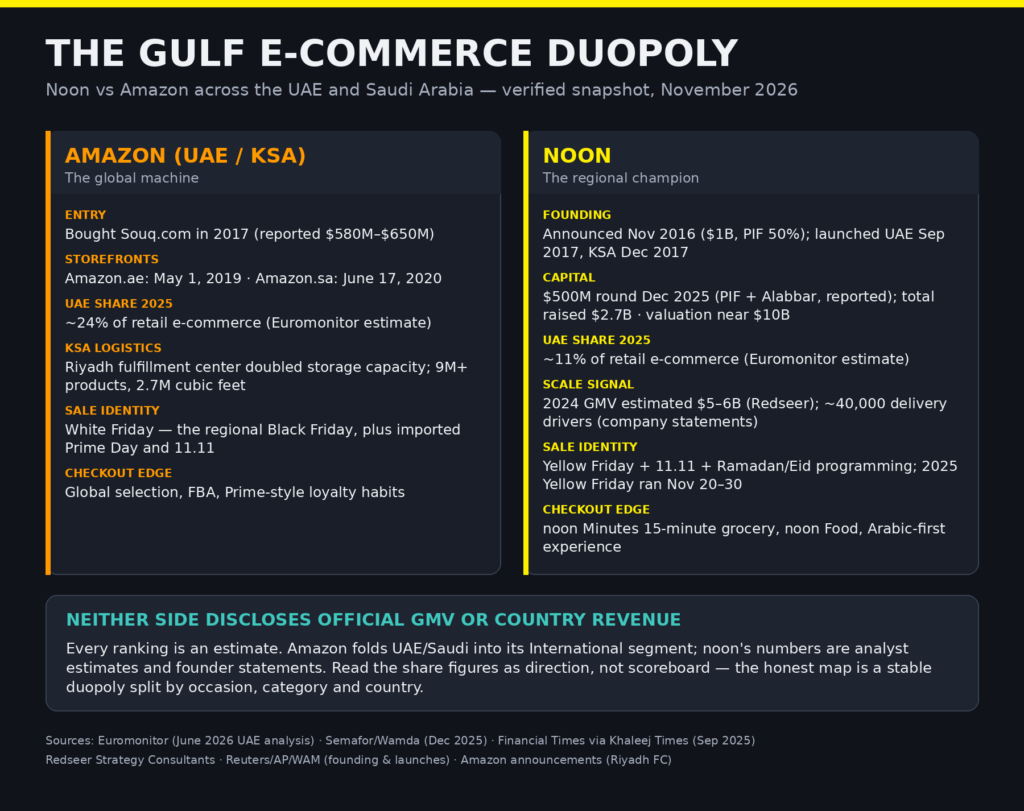
Here is what the verified record does show. Amazon bought its way in through Souq.com in 2017, a deal whose price was never officially disclosed but was reported in the $580–650 million range at the time. Noon was announced in November 2016 as a $1 billion regional-champion project, half-owned by Saudi Arabia’s Public Investment Fund, and went live in the UAE in September 2017 and Saudi Arabia that December. In December 2025, noon reportedly raised another $500 million from backers including PIF and founder Mohamed Alabbar, bringing total funding to roughly $2.7 billion at a valuation Alabbar had put near $10 billion in a September 2025 Financial Times interview — with a dual UAE-Saudi listing targeted within two years.
This is not a war that ends next quarter. It is funded on both sides for years. And the interesting part is that the two companies are not really fighting over the same basket.
Two Foundings, Two Theories of the Market
Amazon’s theory was transplant. Buy the region’s pioneer marketplace, rename it — Amazon.ae launched on May 1, 2019, Amazon.sa on June 17, 2020 — and plug the Gulf into a global machine: Fulfillment by Amazon, international selection, Prime-style loyalty habits. The bet: Gulf shoppers want what shoppers everywhere want, delivered to a global standard.
Noon’s theory was identity. Build an Arabic-first platform with its own logistics (Fulfilled by noon), its own payments, its own grocery service and its own sale rituals. Alabbar told the Financial Times in September 2025 that the company was “almost” profitable, with 2024 GMV estimated by Redseer Strategy Consultants at $5–6 billion and around 40,000 delivery drivers on the road. Those are founder statements and analyst estimates, not audited disclosures — but they sketch a company at genuine scale, not a subsidy-fueled pretender.
Both theories are working. That is precisely why nobody has won.
The $500 Million Signal: Why Sovereign Money Changed the Clock
Read the December 2025 round as a market statement, not just a financing event. A sovereign fund that already owned half the company put in fresh capital alongside the founder — that is the opposite of a bailout. It says the owner believes the regional-champion thesis is compounding and wants a bigger position before public markets price it.
The reported terms matter less than the direction. Noon has raised about $2.7 billion across its life, and Alabbar’s dual-listing ambition — UAE and Saudi exchanges within two years — would make it one of the region’s first genuine platform IPOs. A listed noon would face quarterly disclosure for the first time, which paradoxically could end the data opacity this entire rivalry hides behind.
Amazon’s counter-signal is concrete rather than financial: warehouses, delivery stations, assortment. One company is preparing for the public market; the other is preparing for the next decade of Saudi demand. Neither posture suggests anyone is looking for an exit.
The Numbers You Can Actually Trust
Let’s separate evidence from folklore, because this topic drowns in folklore.
Euromonitor’s retail e-commerce analysis of the UAE (June 2026 edition) puts Amazon at roughly 24% of the market in 2025 and noon at roughly 11%. Treat those as directional estimates from a major research house — other monitoring outfits produce wider ranges, and neither company confirms anything.
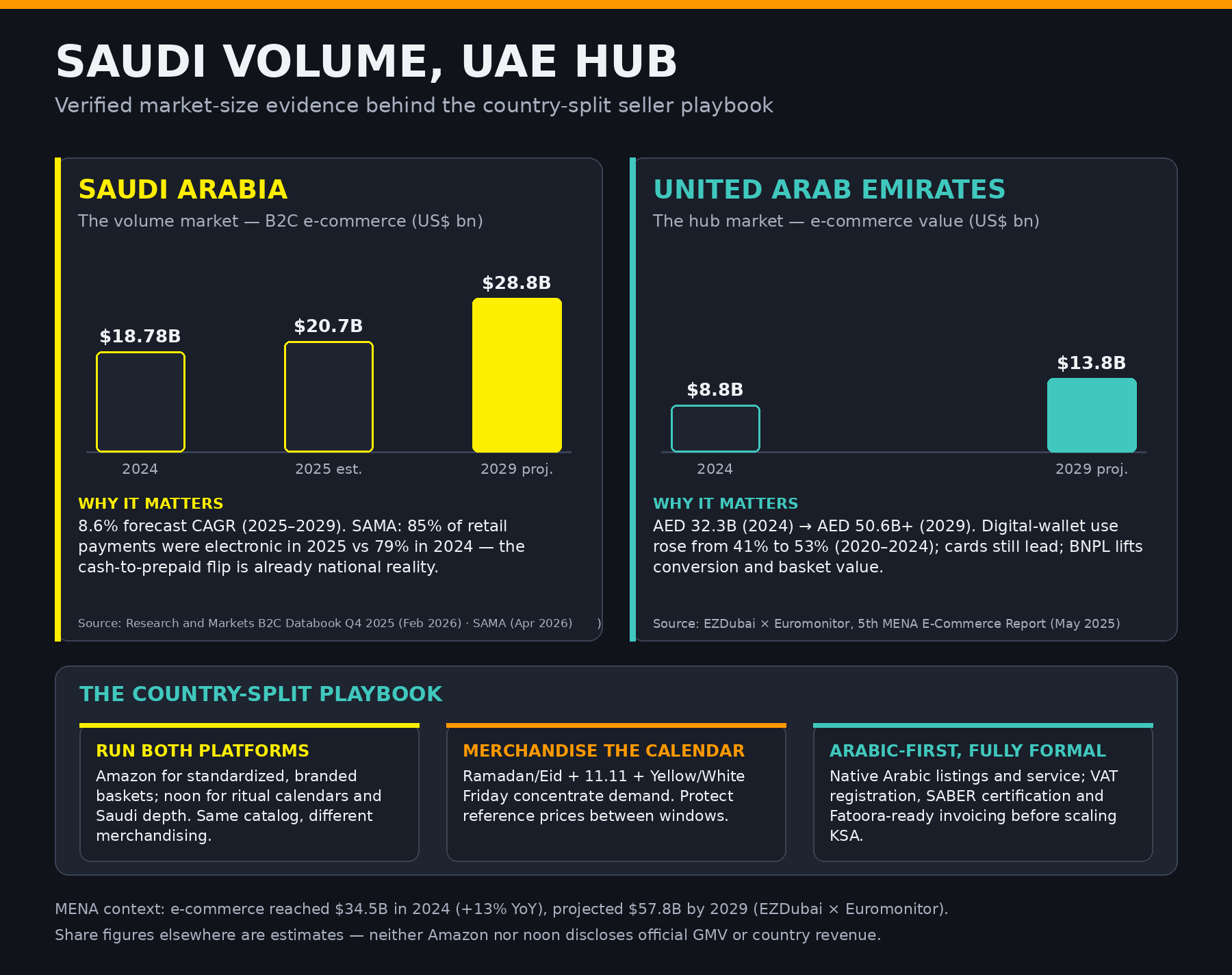
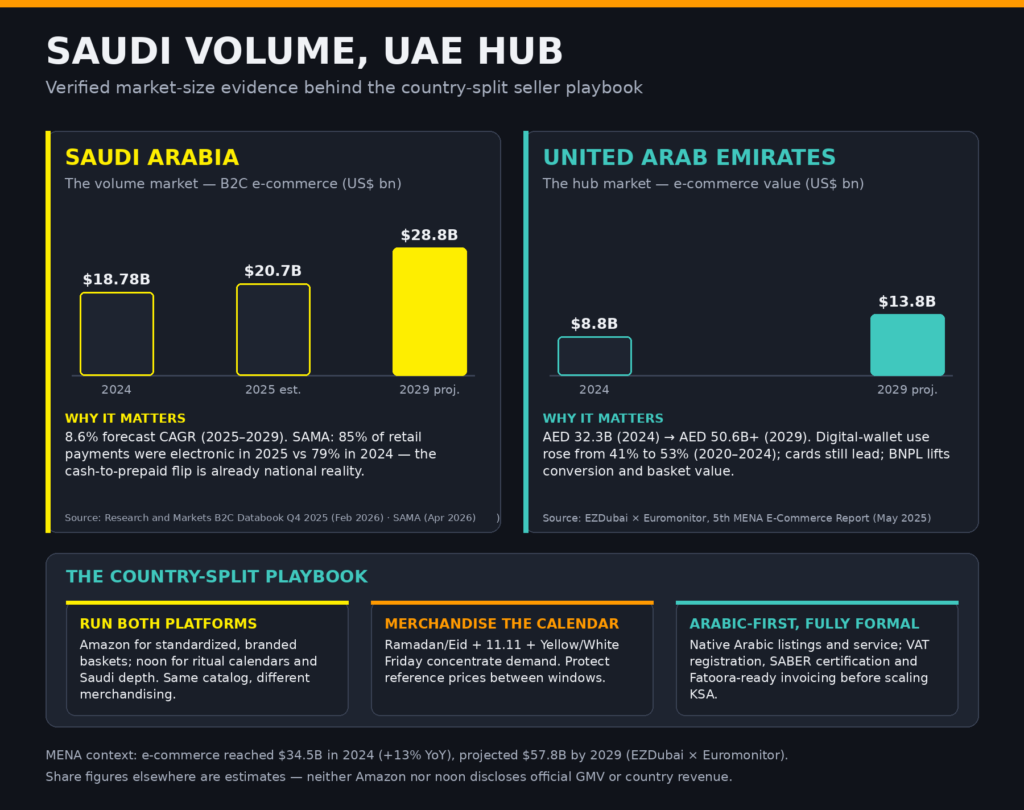
Market size is firmer. Research and Markets’ Q4 2025 databook values Saudi B2C e-commerce at $18.78 billion in 2024, about $20.7 billion in 2025, and projects $28.8 billion by 2029 — an 8.6% compound annual growth rate. The fifth EZDubai–Euromonitor MENA report puts UAE e-commerce at AED 32.3 billion (about $8.8 billion) in 2024, heading past AED 50.6 billion ($13.8 billion) by 2029. The wider MENA market hit $34.5 billion in 2024 and is projected to reach $57.8 billion by 2029.
Notice what these numbers say together: Saudi Arabia is roughly twice the UAE’s size and growing on a younger, digitizing population. The UAE is the richer per-capita market and the logistics gateway. Anyone selling “the GCC” as one blended territory is averaging away the strategy.
One more honesty note before we go further: figures circulating in seller blogs — a 17% Saudi VAT rate, fixed average-order values, precise dark-store counts, double-digit Ramadan category spikes — failed verification against official or primary research sources and are excluded from this analysis. The 17% VAT figure in particular is simply wrong; the standard rate has been 15% since July 2020.
Front One: The Calendar War
Western coverage frames this rivalry as Prime versus everything else. Walk through a Gulf November and you see something different: two retail calendars running in parallel.
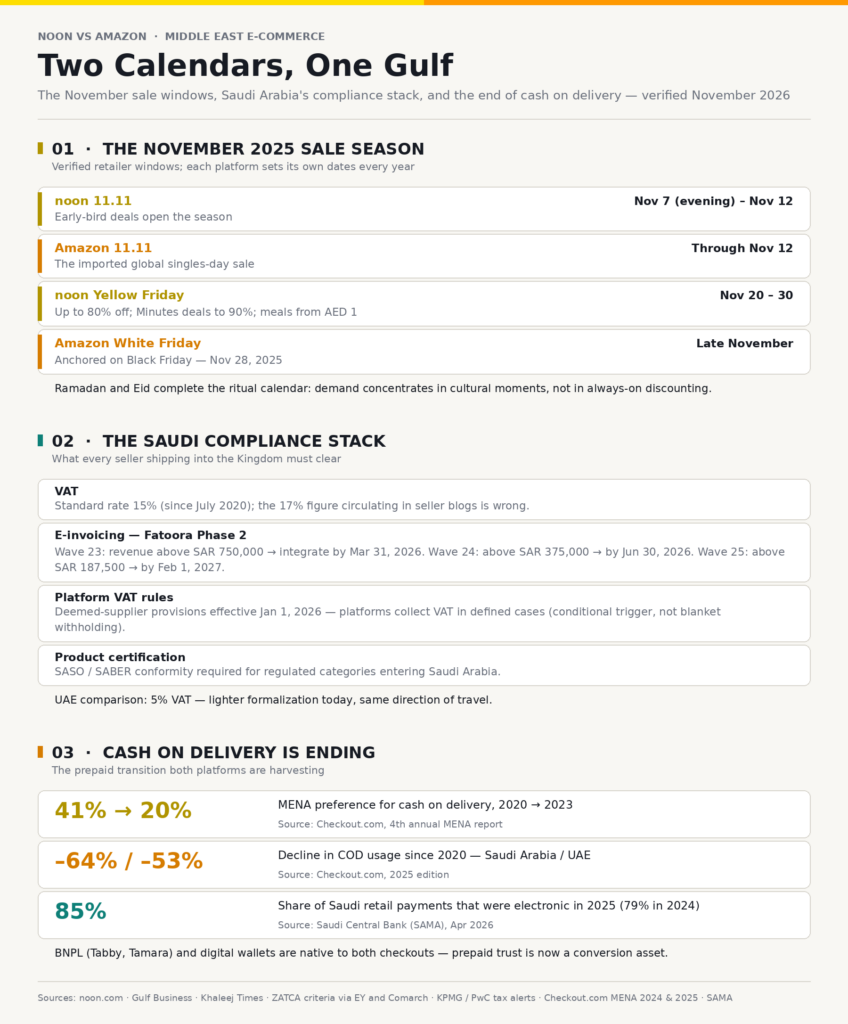
In 2025, noon’s 11.11 sale opened on the evening of November 7 and ran to November 12, with Amazon’s version ending the same day. Then came the main event. Noon’s Yellow Friday ran November 20–30 with headline discounts up to 80%, noon Minutes deals to 90% and meals from AED 1. Amazon’s White Friday — the regional renaming of Black Friday that Souq itself pioneered years before Amazon arrived — anchored on the late-November window around Black Friday, November 28.
Ramadan and Eid complete the ritual calendar. Demand in the Gulf concentrates in cultural moments: the pre-fasting stock-up, the Eid gifting surge, the family-visit home refresh. Noon merchandises these moments as a native operator; Amazon imports its global promotional machinery and adapts the labels. Neither approach is wrong. But they capture different occasions, and a shopper can be loyal to both — Prime for the phone charger, Yellow Friday for the abaya and the kitchen restock.
This is the manufactured-ritual playbook we have documented in China’s brand-day economy, running on the Hijri calendar. The lesson transfers: calendar engineering beats always-on discounting, because the reference price survives between windows.
Front Two: Logistics — Global Consistency vs Local Density
Amazon’s logistics story in the Gulf is about institutional weight. Its Riyadh fulfillment center — 390,000 square feet across five floors, 2.7 million cubic feet of storage for more than 9 million products — doubled its Saudi storage capacity when it opened, and the company keeps extending delivery coverage across the Kingdom ahead of peak season. FBA gives brand sellers a globally standardized operating system.
Noon’s story is density and speed. Noon Minutes promises grocery delivery in about 15 minutes from a network of dark stores in UAE cities — the official promise is 15, not the 12 that circulates in secondary posts — and in late 2025 the company began testing autonomous drone deliveries completing in under 15 minutes. Quick commerce is a cash-burn game, and the Gulf now hosts Meituan’s Keeta and Saudi startup Ninja alongside it. Watch unit economics before betting your category strategy on anyone’s delivery-time marketing.
Front Three: Categories — A Democratic Split
The category map refuses to crown a winner. Amazon’s global supply chain gives it structural strength in electronics, branded goods and general merchandise. Noon’s merchandising roots and Arabic-first experience give it depth in fashion, beauty and home, and its Saudi penetration is the pillar of its volume story. Research houses covering the GCC describe category leadership as genuinely split — different leaders in different aisles.
For a seller, that means the question is never “which platform is better.” It is “which platform owns my category’s occasion in this country.”
Front Four: The Checkout Revolution Nobody Priced In
Here is the most underreported shift in Gulf e-commerce: the cash-on-delivery era is ending, and it changes the margin math.
Checkout.com’s fourth annual MENA report found regional COD preference halved from 41% in 2020 to 20% in 2023, falling to about 10% in the mature digital economies of Saudi Arabia, the UAE and Kuwait. Its 2025 edition shows COD usage down 64% in Saudi and 53% in the UAE since 2020. The Saudi Central Bank’s own series tells the same story from the top down: electronic payments accounted for 85% of retail transactions in 2025, up from 79% in 2024.
Wallets are filling the gap — EZDubai’s report tracks UAE wallet usage rising from 41% to 53% between 2020 and 2024 — and buy-now-pay-later is native to both platforms’ checkouts, with Tabby and Tamara processing a growing share of baskets. Checkout.com found 46% of MENA consumers had used BNPL in the past year, and nearly a third would abandon a purchase if their preferred payment method was missing.
Why does this matter for the duopoly? Because COD was the great equalizer of distrust — it let any platform serve a cash-first consumer. Prepaid trust, once established, compounds into return-rate advantages, faster refunds, richer data and cleaner margins. The payment transition quietly rewards whoever owns the habit.
Front Five: Compliance — The Moat That Rises for Everyone
Saudi Arabia is formalizing fast, and the compliance floor is climbing under every seller.
The standard VAT rate is 15%. ZATCA’s Fatoora e-invoicing integration phase keeps descending the revenue ladder: Wave 23 captures businesses above SAR 750,000 with a March 31, 2026 deadline; Wave 24 goes down to SAR 375,000 by June 30, 2026; Wave 25 reaches SAR 187,500 by February 1, 2027. And from January 1, 2026, deemed-supplier provisions make e-commerce platforms responsible for VAT in defined cases — a conditional trigger, not a blanket withholding, but a clear signal of where enforcement is heading. Add SASO/SABER product certification for regulated categories, and the casual cross-border seller’s window is closing.
The UAE’s 5% VAT keeps it lighter, but the direction of travel is identical. Formalization punishes the uncommitted and protects the professional. If you have read our Mexico and Vietnam playbooks, you know this movie — the Gulf edition just has better logistics.
What Everyone Misunderstands
The GMV scoreboard. There isn’t one. Every share figure is an estimate; the honest read is a qualitative duopoly backed by funding signals, not fake precision.
The winner-take-all assumption. Western and Chinese platform wars trained us to expect one survivor. The Gulf’s split occasions, sovereign backing and category democracy point to stable duopoly as the equilibrium — two subsidized giants, neither willing or able to finish the other.
The UAE-centric lens. The Emirates are the hub and the showcase; Saudi is the volume engine. Country-split inventory and campaign logic beats regional averaging every time.
The TikTok panic. As of November 2026, TikTok Shop has not launched in the UAE or Saudi Arabia — no local seller center, no in-app checkout. Industry chatter points to a possible 2027 opening, but nothing is official. The region’s extraordinary social-commerce appetite currently feeds links into both incumbents’ checkouts. The flank is watched, not breached.
The Seller Playbook: What To Do Monday Morning
Run both platforms with one catalog and two merchandising brains: Amazon for standardized branded baskets, noon for ritual calendars and Saudi depth. Split inventory logic by country — Saudi for volume, UAE for margin and regional reach. Build your campaign calendar on Hijri windows and November’s twin Fridays, and defend your reference price between them. Go Arabic-first in listings, service and creator content — bilingual is table stakes, native is an edge worth testing. And formalize before you scale: VAT registration, SABER certification, Fatoora-ready invoicing. The compliance wave is not a cost center. It is the moat you get to keep.
Risks Worth Watching
Sovereign capital distorts pricing: PIF lets noon run below economics, and Amazon cross-subsidizes from elsewhere — seller margins live between two giants who do not need this quarter’s profit. Quick commerce burns cash faster than it earns loyalty. Regional geopolitics can break fulfillment while demand rises, so resilience is a marketing variable, not just an ops concern. And data opacity is structural: build your strategy on the qualitative fronts and the funding signals, because the scoreboard may never arrive.
Conclusion: The Duopoly Is the Equilibrium
The Gulf never crowned one winner because it is fighting two battles at once. Amazon wins the standardized occasion — the global product, the predictable delivery, the habitual reorder. Noon wins the ritual occasion — the Yellow Friday haul, the Ramadan restock, the Arabic-first experience backed by a sovereign fund with a decade-long horizon. Saudi brings the volume, the UAE brings the margin, and a rising compliance floor protects whoever commits. For brands, the winning posture is not choosing a side. It is running both calendars, in Arabic, fully formalized — and understanding that in culturally distinct markets, the duopoly is not the intermission. It is the show.