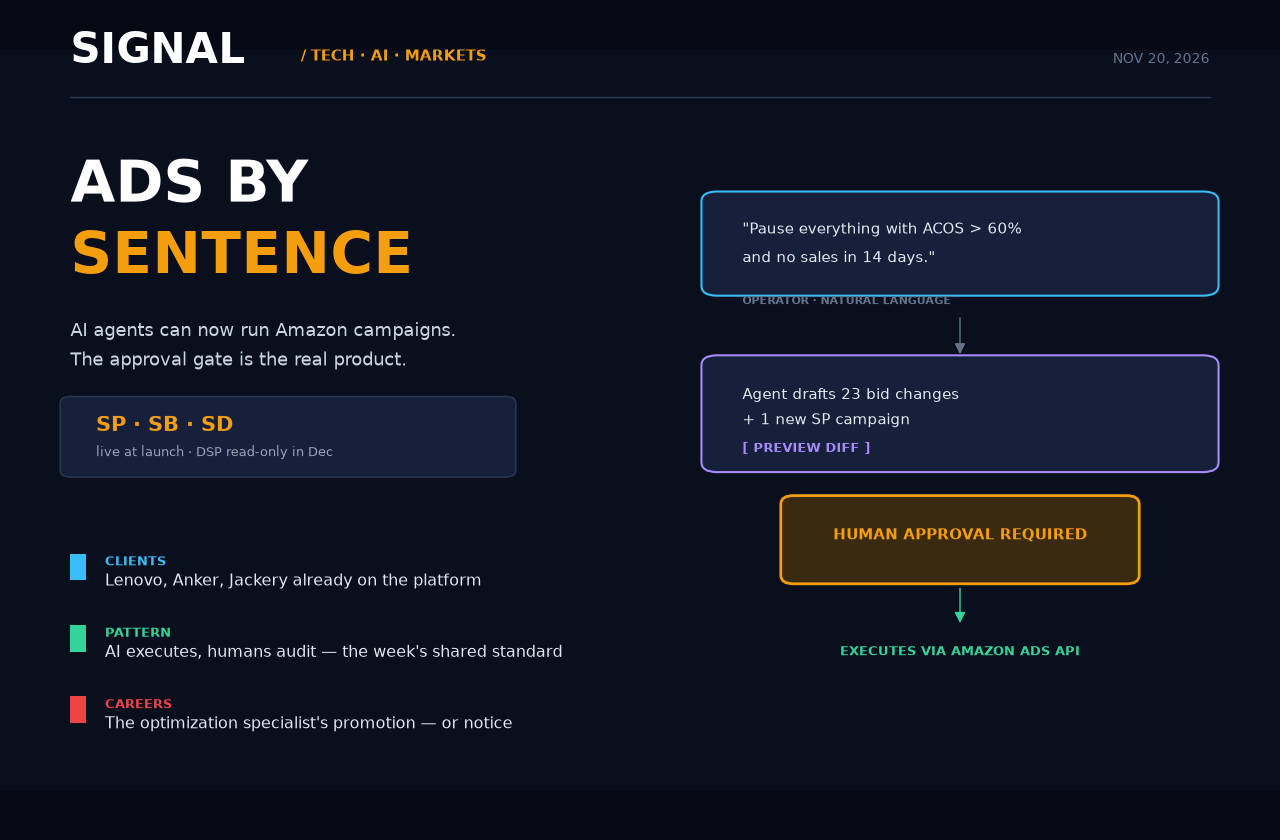
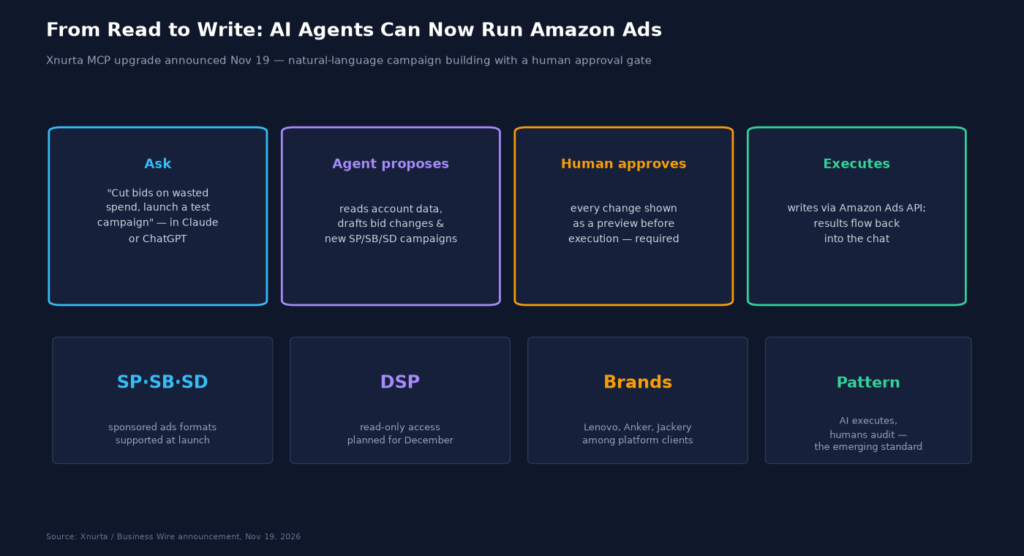
For two years, “AI in advertising” has mostly meant AI making suggestions and humans clicking buttons. On November 19, retail-media platform Xnurta announced an upgrade that crosses the line: its Model Context Protocol integration now supports write operations, meaning an AI agent inside Claude or ChatGPT can create campaigns, adjust bids in bulk, and restructure Amazon advertising accounts — executed through natural language, with every change surfaced as a preview that a human must approve before it touches spend. The company, whose client roster includes Lenovo, Anker and Jackery, supports Sponsored Products, Sponsored Brands and Sponsored Display at launch, with read-only DSP access planned for December. It is a small protocol update with a large implication: the daily operating surface of retail media — the clicks, bids and budget toggles that employ thousands of optimization specialists — just became a conversation.
Why the approval gate is the real product
Read-only MCP integrations arrived quietly over the past year: chat with your dashboards, ask why ACOS moved, get a summary. Useful, but inert. Write access is where trust becomes the binding constraint — an agent that can move bids can lose money at machine speed, and a hallucinated campaign structure can torch a launch week. Xnurta’s design answer is to make the human confirmation step non-optional: the agent proposes, the preview shows exactly what will change, and nothing executes without explicit approval. That pattern — AI executes, humans audit — is rapidly becoming the governance standard for agentic operations, echoing the same week’s enterprise moves: Microsoft’s transparency initiative built around observable, verifiable, controllable agents, and Salesforce’s Copilotforce requiring confirmation before CRM writebacks. The industry is converging on a shared architecture without anyone coordinating it, because the alternative — autonomous spend authority — is unsellable to any CFO who has read an incident report.
What changes for Amazon sellers and agencies
The practical shift is in the economics of account management. A mid-size Amazon advertiser’s week is dominated by micro-decisions: harvest search terms into exact-match campaigns, negate bleeders, shift budget toward converting placements, rebuild structures after a catalog change. Each task is simple; the volume is the cost. Natural-language execution collapses the per-task cost toward zero while keeping judgment human: “pause everything with ACOS above 60% and no sales in 14 days, but keep the brand-defense terms” becomes one sentence and one approval instead of an hour of filtering. For cross-border sellers — particularly Chinese brands operating US and EU accounts across time zones — the interface layer matters doubly: instructions in the operator’s language, execution on dollar accounts, audit trail in between. Agencies should read this as a margin-structure event: retainers priced on optimization hours will reprice toward strategy, creative testing and measurement design, and the firms that cling to click-work pricing will be undercut by those that productize the agent layer.
The December DSP read-only step hints at the roadmap’s ambition: programmatic display and streaming-TV inventory is where retail media’s next growth sits, and even read access puts DSP performance into the same conversational surface. Write access to DSP — with its larger budgets and brand-safety stakes — will be the harder governance problem, and the approval-gate pattern will be tested at a different order of magnitude.
The risks worth naming
Three failure modes deserve attention before teams hand over the keys. First, approval fatigue: when every change requires a click, humans start rubber-stamping previews — the gate degrades into theater unless the interface makes diffs genuinely legible and batch-approvals bounded. Ask vendors how they prevent it. Second, prompt-level ambiguity: “cut wasted spend” is a business judgment, not a query; agents will operationalize it differently depending on context, so teams need written definitions of waste, guardrail thresholds and protected campaigns before conversational management begins. Third, accountability: when an approved agent change loses money, the audit trail decides whether it was a bad proposal or a bad approval — insist on exportable logs of every proposal, preview and confirmation, and align them with the same evidence standards enterprise AI governance is adopting elsewhere.
Step back and the week’s pattern is unmistakable: OpenAI shipped a sales workspace, Microsoft and Salesforce embedded agents in the enterprise suite, and now a retail-media platform let agents touch live ad spend. The agentic layer is arriving function by function, always with a human gate, always faster than job descriptions update. The optimization specialist’s role isn’t disappearing — it’s moving up the stack, from executing changes to defining what “good” means and auditing whether the machine delivered it. That is a promotion, if you prepare for it. It is a redundancy notice, if you don’t.