Your best marketer just resigned. Two weeks later, the team is stuck on a campaign she used to run in her sleep. Nobody forgot the password. The judgment walked out the door with her: which audience to lead with, which approval mattered, which number to watch. It lived in her head, and now it is gone.
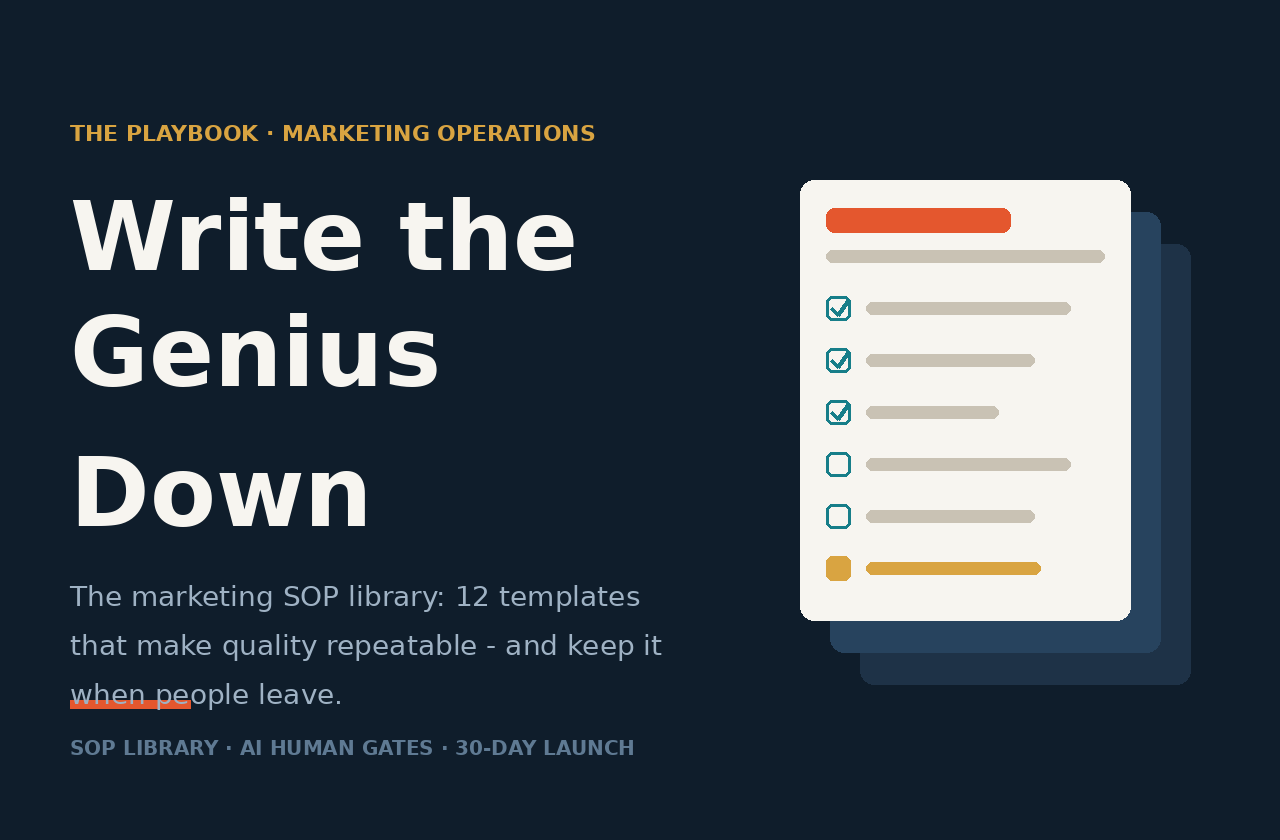
Here is the uncomfortable part. That knowledge was never secret. It was just never written down. And the fix is not hiring another genius. It is building a library of standard operating procedures, or SOPs: short, owned, versioned templates that turn one person’s hard-won judgment into everybody’s baseline. This playbook gives you the full system: the 12-template core library, the anatomy every template needs, the AI-era format with human gates, and a 30-day launch path that will not turn your team into a paperwork factory.
Why Your Team’s Quality Is a Single Point of Failure
Run the bus-factor test right now. If your best operator left tomorrow, what would survive? Campaign history lives in a tool. Assets live in a drive. But the decisions, the sequence, the “never skip this check” instincts? Those live in a person.
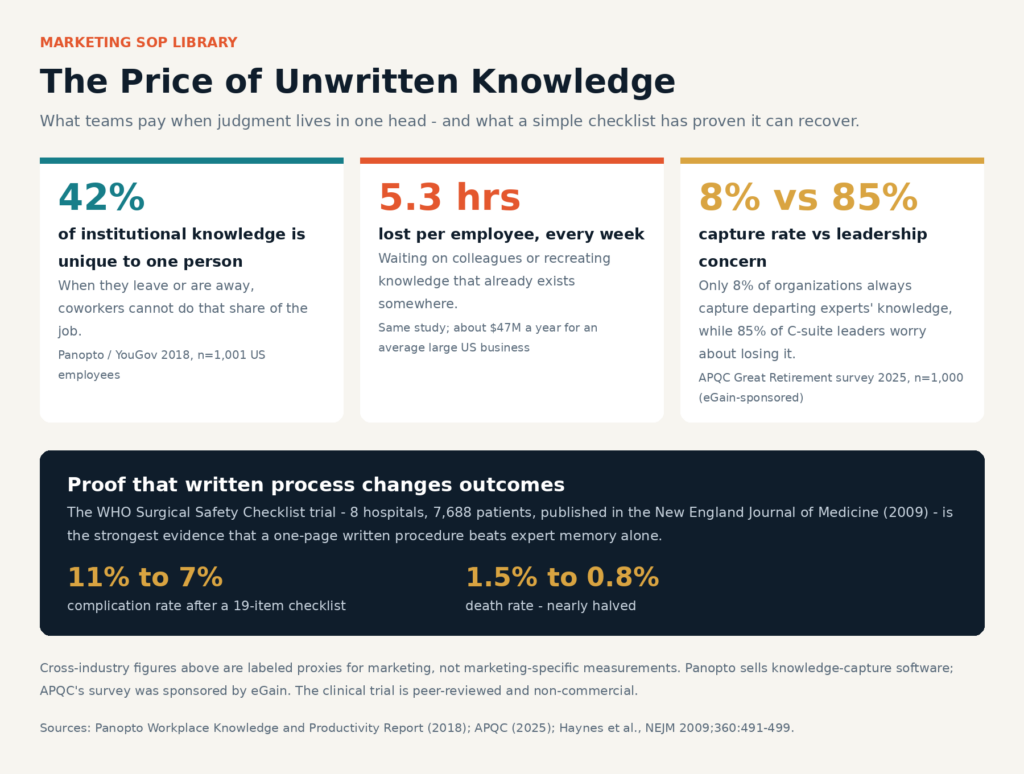
The research puts a number on it. Panopto’s Workplace Knowledge and Productivity Report, a 2018 survey of 1,001 U.S. employees run with YouGov, found that 42% of institutional knowledge is unique to the individual: acquired for their role, shared with no one. When that person is unavailable, colleagues simply cannot do that share of the job. The same study found employees lose 5.3 hours every week waiting on colleagues or recreating knowledge that already exists. Panopto, a knowledge-capture software vendor, so weigh the framing accordingly, pegged the annual cost for an average large U.S. business at roughly $47 million. These are cross-industry figures, not marketing-specific measurements, but if you have ever watched a teammate rebuild last year’s launch checklist from scratch, you know the tax is real.
And when the hero leaves, you pay twice. Gallup estimates replacement costs one-half to two times annual salary, a deliberately conservative range, before counting the months the replacement spends re-learning what the hero knew by heart. An SOP library is knowledge-retention infrastructure. It is the only asset on your team that gets more valuable when people rotate.
The Checklist That Cut Deaths Nearly in Half
If “write it down” sounds too humble to matter, borrow evidence from a field where the stakes are life and death. In 2009, the New England Journal of Medicine published the WHO Surgical Safety Checklist trial: eight hospitals on five continents, 7,688 patients, one 19-item checklist. Complication rates fell from 11% to 7%. Deaths fell from 1.5% to 0.8%, nearly halved. The surgeons did not get smarter. The system stopped relying on one expert remembering every critical step under pressure.
Marketing is not surgery, and nobody dies from a mis-tagged UTM link. But the mechanism transfers: a written procedure does not replace expertise, it guarantees the expertise gets applied every time, by everyone, even on the worst day. That is what a template does for a launch. The checklist is the floor under your quality.
SOPs Are Decision Shortcuts, Not Compliance Forms
Let’s kill the objection early. A bad SOP records activity. A good SOP forces decisions. The difference is in the fields. A brief that asks for “goals” produces “raise awareness.” A brief that demands one business goal with a number, one primary audience, one offer, and one named approver produces a campaign that ships without three meetings. The template embeds your best decisions into a document the next person cannot skip.
It is a decision shortcut: the last campaign already learned which audience converts, which claim needs legal review, which channel wastes budget. The template carries those answers forward, so the next campaign starts where the last one finished, not at zero.
The 12-Template Core Library
You do not need a hundred templates. You need a minimum-viable set that covers the decisions your team re-makes on a loop. Here is the inventory, grouped by when the work happens.
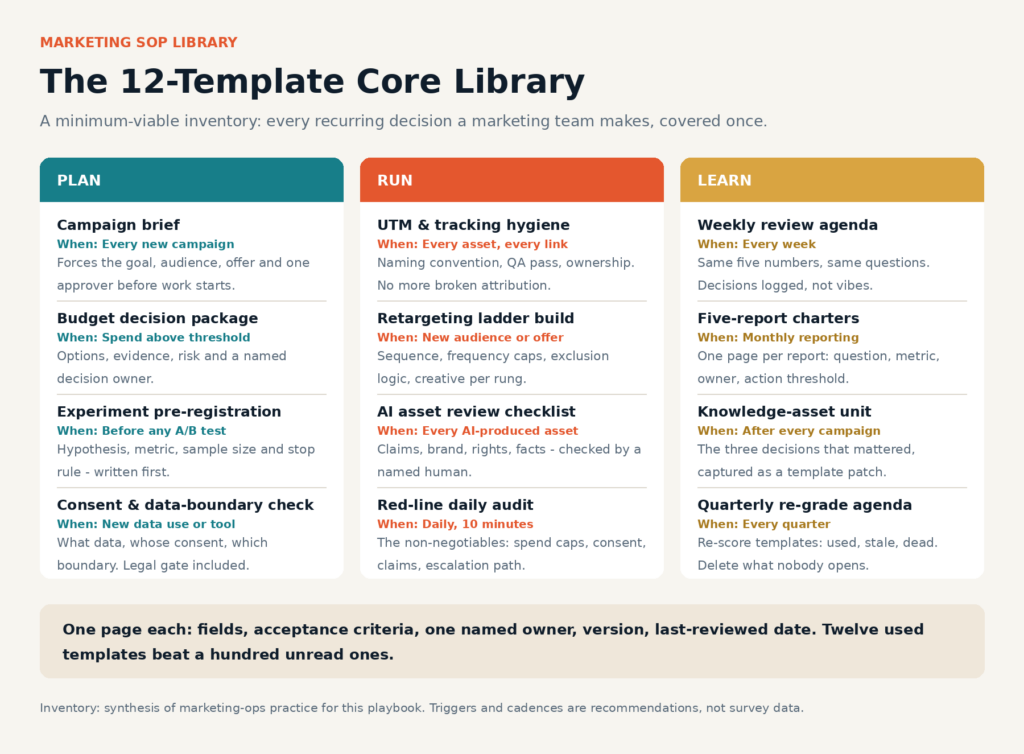
Plan. The campaign brief, opened for every new campaign. The budget decision package for spend above your threshold: options, evidence, risk, one decision owner. The experiment pre-registration, filled before any A/B test: hypothesis, metric, sample size, stop rule. The consent and data-boundary check for every new data use or tool, legal gate included.
Run. UTM and tracking hygiene for every asset and link, because broken attribution poisons every report downstream. The retargeting ladder build: sequence, frequency caps, exclusions, creative per rung. The AI asset review checklist: claims, brand, rights, facts, checked by a named human. The red-line daily audit, ten minutes on the non-negotiables: spend caps, consent, claims, escalation paths.
Learn. The weekly review agenda: same five numbers, same questions, decisions logged. The five-report charters, one page per recurring report: the question it answers, the metric, the owner, the action threshold. The knowledge-asset unit, captured after every campaign. The quarterly re-grade agenda, where you re-score the library itself: used, stale, dead.
Twelve templates. One page each. Every recurring decision covered once.
The Anatomy: What Every Template Contains
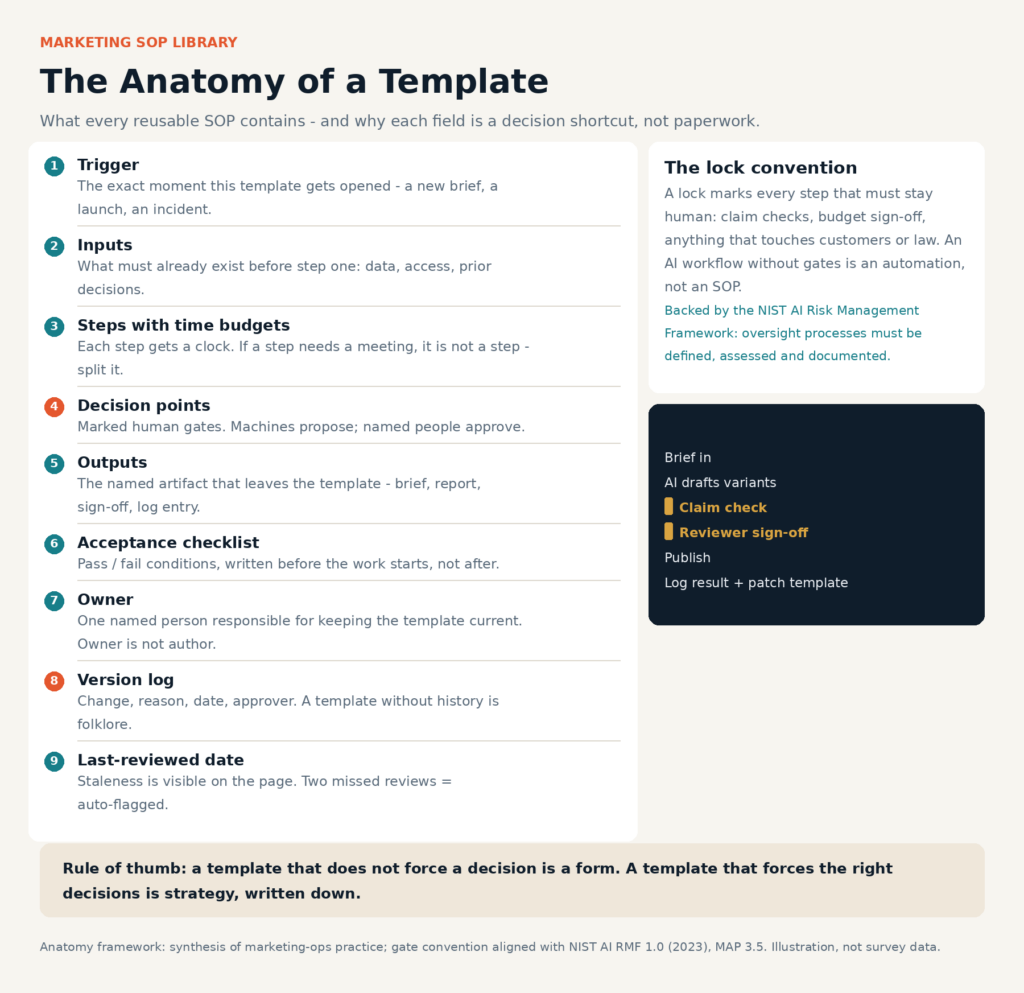
A template is reusable only if it carries its own operating instructions. Nine fields make that happen.
The trigger names the exact moment the template gets opened. Inputs list what must already exist before step one. Steps come with time budgets, because a step that needs a meeting is not a step, it is a project; split it. Decision points are marked as human gates, which matters more than ever, and we will get to that. Outputs name the artifact that leaves the template: a brief, a report, a sign-off, a log entry. The acceptance checklist states pass and fail conditions written before the work starts, not after. Every template has one named owner, and owner does not mean author; the owner keeps it current. A version log records change, reason, date, approver, because a template without history is folklore. And the last-reviewed date makes staleness visible on the page: two missed reviews and the template gets auto-flagged.
Notice what is missing: no field says “describe the process in paragraph form.” Prose is where SOPs go to die. Fields force decisions; paragraphs let everyone nod and improvise.
The 2026 Upgrade: AI-SOPs With Human Gates
Here is where most process libraries become obsolete, and yours becomes a weapon. McKinsey’s State of AI in 2026 survey, 1,719 respondents across 97 nations, found 89% of organizations now use AI regularly in at least one function, yet only 37% report any impact on operating profit. The gap is not the technology; it is the process around it. Nearly three-quarters of McKinsey’s AI high performers, roughly 6% of respondents attributing at least 5% of EBIT to AI, have fundamentally redesigned their workflows, versus about one-quarter of everyone else. They are also twice as likely to have defined processes for measuring AI’s impact. Read that as a mandate: the winners write the workflow down.
An AI-SOP interleaves machine-executable steps, prompt chains, tool calls, generation passes, with locked human gates. Picture the AI asset production SOP: brief in, AI drafts variants, locked gate for the claim check, locked gate for reviewer sign-off, publish, log the result, patch the template. The claim library is referenced, not re-invented; every asset checks against the same approved facts.
This is the emerging standard, not paranoia. The U.S. National Institute of Standards and Technology, in its AI Risk Management Framework, calls for human oversight processes to be defined, assessed, and documented, and human roles in human-AI configurations to be clearly differentiated. The framework is voluntary and under revision, but the direction is unmistakable: documented gates are becoming the price of admission for serious AI use. So tattoo this on the library wall: an AI workflow without gates is an automation, not an SOP. Automations scale your mistakes at machine speed. SOPs scale your judgment.
A vendor-flavored footnote: Adobe’s May 2025 study of 348 U.S. marketers, released alongside its GenStudio product, so read it as vendor research, found AI users save an average of 114 minutes a week on content creation. Yet only 40% could name who oversees AI systems at their workplace. Faster output, unclear ownership: precisely the failure mode a gated SOP prevents.
Capture: Write SOPs Without a Documentation Project
The fastest way to kill this initiative is announcing a “process quarter” and vanishing into document-writing. Capture must ride on work you already do.
Use the retro-capture rule: after every campaign or incident, extract the three decisions that mattered and patch the relevant template. Ten minutes at the retro, not a week in a wiki. Use the second-time rule: first time, do it; second time, write it; third time, template it. Only genuinely recurring work reaches the third repetition, so the cadence filters for you.
Capture from winners, not theory. Document your best recent campaign as it actually happened; you are bottling a proven process, not designing an ideal one. APQC’s 2025 Great Retirement survey of 1,000 professionals, sponsored by knowledge-software vendor eGain, found the top barriers to capturing departing experts’ knowledge are lack of time (52%) and insufficient resources (45%). Retro-capture dodges both: no new budget line, no new meeting.
Version, Review, and the Kill Rule
A library is a living system or a landfill. Every change gets a version-log entry: what, why, when, who approved. Every template gets a quarterly review tied to your existing planning cadence, not a special ceremony. Miss two reviews and the template is auto-flagged as stale, publicly.
Then the part nobody wants to hear: the kill rule. SOPs nobody uses get deleted, not archived forever. A template with zero opens in two quarters is noise that makes the twelve good ones harder to find. The quarterly re-grade makes deletion a scheduled act, not a political fight.
Adoption: Make the Template the Fastest Path
People do not resist templates. They resist slow templates. If filling the brief takes longer than improvising, rational people improvise. Let the data indict the template, not the people.
Three mechanics make adoption stick. First, onboarding: new hires run the library before touching live accounts. Panopto found the average new hire gets about 2.5 months of formal training but can take up to six months to ramp fully, with up to 3.5 months spent hunting for information and redoing existing work. The library is the difference between contributing in weeks and spinning for a quarter. Second, the shortcut incentive: measure time-to-launch with and without the template, publish the gap, and make sure the template wins. Third, treat shadow processes as diagnostics: when people bypass a template, it is too slow, too vague, or missing a real decision. Fix the document; do not police the humans.
One wiring trick: gate what people care about. Launches require a filled brief; spend above threshold requires the decision package. When the template is the default path to the outcome, usage stops being a compliance question.
Measuring Library Health
You cannot defend a library you cannot measure. Track five dials: share of campaigns launched from templates, rework-rate trend, time-to-launch, gate-compliance rate (human sign-offs actually happening), and stale-SOP count.
The payoff evidence encourages. APQC, the benchmarking nonprofit, reports knowledge programs that measure rigorously can return $2 or more for every $1 spent per participating employee. In its 2025 benchmarks, programs explicitly measuring outcomes like innovation speed or time-to-market were far likelier to report enormous or a lot of business value: 67%, versus 43% that did not track it. The lesson is not “documentation pays” but “measured documentation pays.” Give the saving a receipt, and the library keeps its funding.
Failure Modes and the Boundary of Templates
Three failure modes kill libraries. Template sprawl: a hundred SOPs nobody reads; the kill rule cures it. Compliance theater: boxes ticked while real decisions happen in a side chat; acceptance criteria that check decisions, not signatures, cure it. Over-templating: admin friction instead of decision speed; the speed test cures it.
Respect the boundary. SOPs encode known quality; they are terrible at novel bets. The experimental campaign, the new-channel gamble, the weird creative swing: those need judgment, not a checklist. The library handles the repeatable work so your humans have time for the part that actually requires them. Template your chaos, not your creativity.
The 30-Day Launch Checklist
Days 1 to 7: pick the pain. Choose three templates for the decisions you re-make most, usually the brief, the weekly review, the AI asset check. Days 8 to 14: document the winner, your best recent campaign as it actually ran. Days 15 to 21: pilot and patch. Run one live cycle, then retro-capture the three decisions that mattered. Days 22 to 30: wire it in. Gate launches on the filled brief, assign one owner per template, set review dates, expand toward twelve.
Thirty days. Three templates live. Zero documentation projects. That is the whole trick.
The Takeaway
Scaling marketing is not a talent problem; it is a knowledge-capture problem. The 42% of knowledge in one head, the 5.3 weekly hours lost to reinvention, the judgment that resigns without notice: all fixable with one page per decision, one owner per page, and a calendar that keeps the pages honest. The clinical evidence says written process beats expert memory under pressure. The AI-era evidence says the teams documenting and redesigning their workflows turn tools into profit. Write the genius down. Then keep writing, because the library, like the team, is never finished.