Your team probably has an AI policy. It lives in a PDF, someone presented it at an all-hands, and everyone nodded. Then Monday came, a strategist pasted a customer list into a chatbot, an intern shipped an ad with a made-up statistic, and a bot sent a tone-deaf reply to your biggest account. The policy didn’t fail because it was wrong. It failed because nobody translated it into things people do every day.
That translation is what this playbook is for. The premise is simple: strategy decisions stay human, risk approvals stay human, customer relationships stay human. Everything else can be delegated to AI — with gates. Three red lines, each one wired into a morning check, a weekly sample, a monthly review, and an escalation script you can read word for word when something goes wrong.
And before you file this under “nice governance theory,” know that regulators have already drawn versions of these lines in law. In China, the Personal Information Protection Law, the Advertising Law and the 2025 AI content-labeling rules each protect a piece of exactly this territory. The checklist below isn’t ideology. It’s the operating layer on top of obligations you already have.
Everyone Uses AI. Almost Nobody Checks It.
Let’s start with why the lines matter, because the data here is genuinely uncomfortable.
A global study by the University of Melbourne, conducted with KPMG — which co-funded the research, a conflict worth knowing about — surveyed more than 48,000 people across 47 countries between November 2024 and January 2025. Among employees, 66% said they rely on AI outputs without evaluating accuracy. Fifty-six percent admitted making mistakes at work because of AI. And 57% said they hide their AI use and pass machine-generated work off as their own. Meanwhile only 40% said their workplace has any generative-AI policy at all, and only 47% had received training.
Read those numbers together and you get the real picture: AI use is universal, verification is optional, and concealment is the norm. Your exception log will never catch what people are actively hiding — which is why the audit routine later in this playbook samples outputs, not confessions.
The incident trend points the same way. Stanford’s AI Index 2025 report, drawing on the AI Incidents Database, counted 233 reported AI-related incidents in 2024 — a record high, up 56.4% from the year before. That’s reported cases, not all occurrences, so treat it as a floor rather than a census.
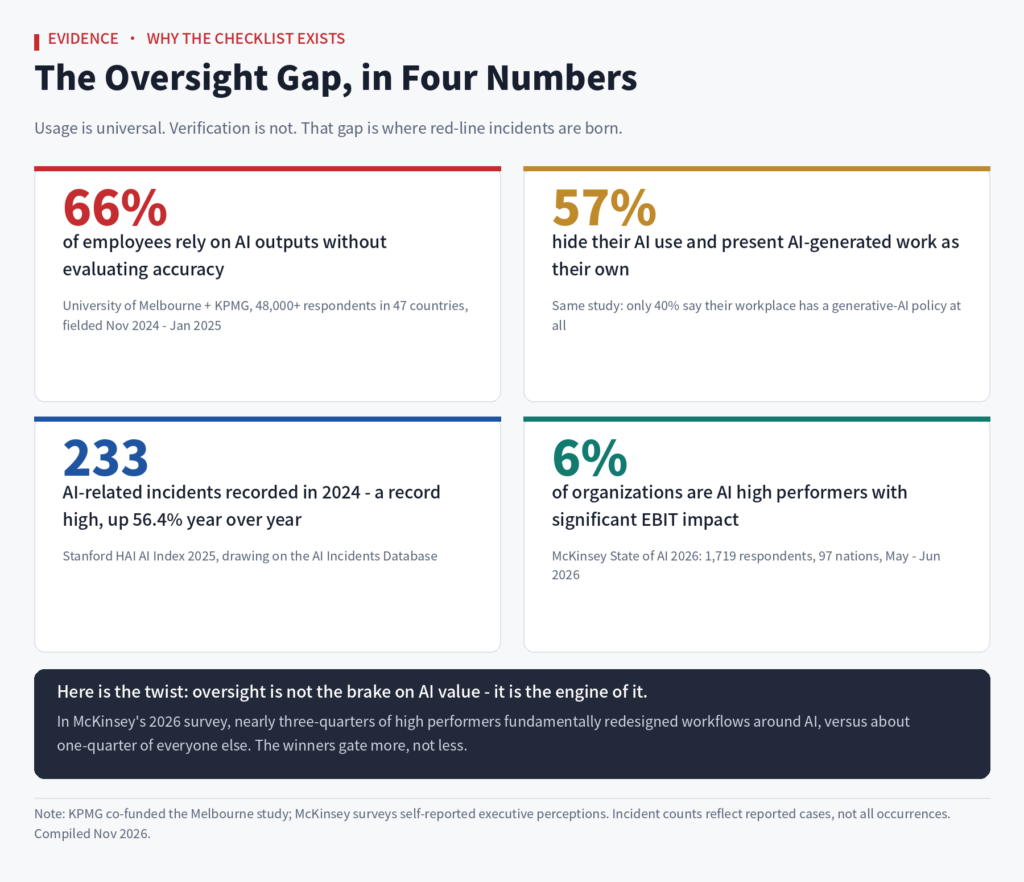
Here’s the twist that should sell your CFO on this whole exercise. McKinsey’s State of AI 2026 survey — 1,719 respondents across 97 nations, fielded May to June 2026, self-reported executive perceptions — found that only about 6% of organizations qualify as AI high performers with significant earnings impact. Nearly three-quarters of those high performers fundamentally redesigned workflows around AI, versus about one-quarter of everyone else. In the 2025 edition of the same survey, roughly 65% of high performers had defined human-in-the-loop processes — knowing exactly how and when model outputs need human validation — nearly triple the share among other companies. Oversight isn’t the brake on AI value. It’s the engine.
Red Line 1: Strategy Stays Human
Positioning. Budget allocation. Channel bets. Pricing. Brand voice definition. These are the decisions that determine what your company is — and they stay with people.
AI’s role here is genuinely useful: analysis, options generation, simulation. Ask it to model three budget scenarios, stress-test a positioning statement against competitor messaging, summarize what a channel shift would cost. Then a human decides. The machine builds the map; it doesn’t pick the destination.
The Boundary Table: Tactics vs. Strategy
The confusion always starts in the same place: “But our smart bidding already changes budgets automatically.” Yes — and that’s fine. The distinction is which parameter moves:
| Automated behavior | Classification | Verdict |
|---|---|---|
| Smart bidding shifts spend between keywords inside an approved budget | Tactic | Delegable within caps |
| An automation rule moves budget from brand search to a new channel | Strategy | Red line — human sign-off |
| AI rotates ad variants inside an approved claim library | Tactic | Delegable within limits |
| AI rewrites the value proposition those variants express | Strategy | Red line — human sign-off |
Daily check: did any automated rule change a strategic parameter today? If yes, that’s an exception, not a feature. Log it, revert it, re-approve it through a human.
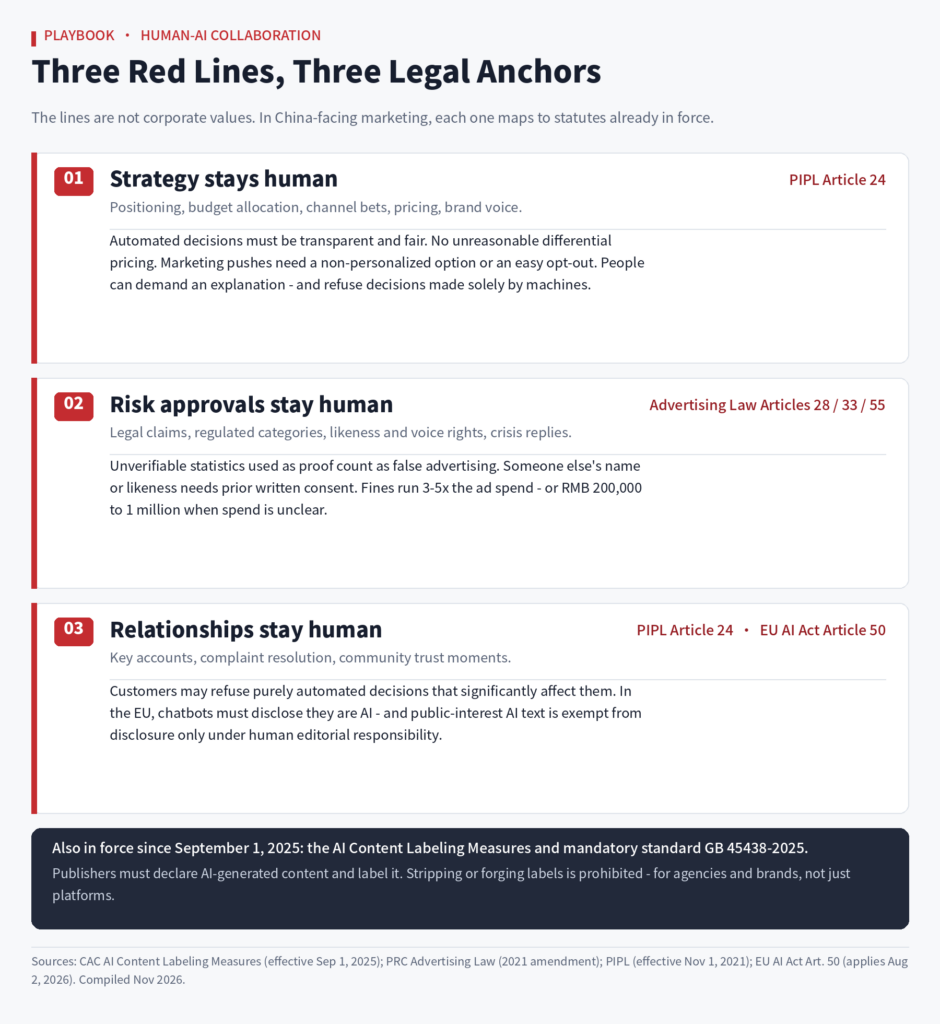
There’s a legal reason this line sits where it does. Under Article 24 of China’s PIPL, automated decision-making must be transparent and fair, and it may not impose unreasonable differential treatment on transaction prices — the algorithmic price-discrimination clause. If your pricing engine quietly experiments its way into discriminatory pricing, “the model did it” is not a defense. It’s a confession.
Red Line 2: Risk Approvals Stay Human
The scope: legal claims, regulated categories, likeness and voice rights, crisis responses, data-sharing decisions. If getting it wrong creates legal exposure or reputational damage, a human approves it before it ships. Every time.
This is the line with the sharpest legal teeth. China’s Advertising Law — verified against the 2021 amended text — makes the advertiser responsible for the truthfulness of ad content. Using fabricated or unverifiable research results or statistics as proof is explicitly defined as false advertising. Cited data must be true, accurate and attributed. Superlatives like “national-level,” “highest-level” and “best” are banned outright. Using a person’s name or likeness requires prior written consent — which is exactly what an AI-generated spokesperson or voice clone risks violating. And medical, drug, medical-device and health-food ads require pre-publication review by authorities, not just internally.
The penalties are not symbolic. False advertising draws fines of three to five times the ad spend; where spend can’t be calculated or is obviously low, RMB 200,000 to 1 million. Three or more violations within two years, or serious circumstances, push that to five-to-ten times spend or RMB 1–2 million, with possible license revocation. One hallucinated statistic in one ad variant can cost more than your entire quarterly content budget.
The Named-Reviewer Rule
Every asset class gets exactly one human approver of record. Not “the team reviews things” — a name. Ad copy: the performance lead. Regulated-category claims: legal counsel. Anything using a human face or voice: the brand manager who holds the consent documentation. The Advertising Law actually requires ad operators and publishers to maintain intake-registration, review and archive systems; your named-reviewer log is how you satisfy the spirit of that obligation on the brand side too.
Daily checks: was any AI-generated asset published without a logged approval? Did any prompt contain customer personal information? That second question matters more than most teams realize. PIPL requires internal management procedures, staff training, regular compliance audits, and advance impact assessments before automated decision-making or sensitive-data processing — with assessment records kept at least three years. Serious violations can draw fines up to RMB 50 million or 5% of the previous year’s turnover. A marketer pasting a CRM export into a public chatbot is not a productivity hack. It’s an unassessed data-sharing decision.
And label your AI content. Since September 1, 2025, China’s Measures for Labeling AI-Generated Synthetic Content — issued jointly by four ministries including the cyberspace regulator — require explicit, user-visible labels plus implicit metadata labels on AI-generated content, backed by a mandatory national standard, GB 45438-2025. The standard gets granular: on images, label text height must be at least 5% of the picture’s shortest side; on video, the opening label must persist at least two seconds. Publishers must proactively declare AI-generated content and use platform labeling tools, and nobody may maliciously strip or forge labels. When a government testing institute checked mainstream multimodal models against the standard in early September 2025, full compliance ran at 81.8% for text-to-image and 90.9% for text-to-video outputs — a small, undisclosed-size vendor sample, but enough to tell you that “the tool handles labeling” is an assumption, not a fact. Verify your own pipeline.
Red Line 3: Relationships Stay Human
Key-account communication. Complaint resolution. Community trust moments. Partnership negotiations. In these contexts AI may draft, summarize and route — it may never autonomously send.
Why so strict? Because relationships are where accountability lives. PIPL Article 24 gives individuals the right to demand an explanation for automated decisions that significantly affect them — and to refuse decisions made solely by machines. Personalized marketing pushes must carry a non-personalized option or a convenient way to opt out. Your customers, in other words, have a statutory right to a human in the loop for the decisions that matter to them.
If you operate in Europe, the same logic now has a second home. The EU AI Act’s Article 50 transparency duties apply from August 2, 2026: chatbots must disclose that they’re AI, synthetic media must be machine-readably marked, deepfakes must be disclosed. There’s one exemption worth memorizing — AI-generated text on matters of public interest escapes the disclosure duty when it has undergone human review and someone holds editorial responsibility. The law literally rewards the named-reviewer rule. Note that the EU’s 2026 Digital Omnibus deferred the high-risk system obligations to December 2027 and gave legacy systems a narrow marking grace period to December 2026, but the core transparency duties stayed on schedule. Don’t let headlines about “the AI Act delay” lull your chatbot team.
What about 24/7 service bots? They’re allowed — inside a lane. Order status, password resets, store hours: autonomous, fine. Complaints, refunds above a threshold, anything touching a key account: draft-and-route to a human, with the bot disclosing what it is. The line isn’t “no bots.” It’s “no unowned relationships.”
Daily check: did any customer-facing autonomous AI interaction happen today outside its approved lane? Weekly: sample five relationship-context outputs and confirm a human actually sent them.
The Legal Floor Under All Three Lines
Step back and notice what just happened. Each red line — strategy, risk, relationships — turned out to have a statute sitting underneath it. That’s not a coincidence. Regulators drew these lines because they’re the places where automated errors convert into harm: money, rights, trust. The checklist simply runs ahead of the enforcement.
The Delegation Matrix: What AI May Actually Do
Red lines tell you what’s forbidden. The matrix tells you what’s permitted — because a governance system that only says no gets routed around. Give every task an autonomy level, a gate and an owner. Anything unlisted defaults to draft-only.
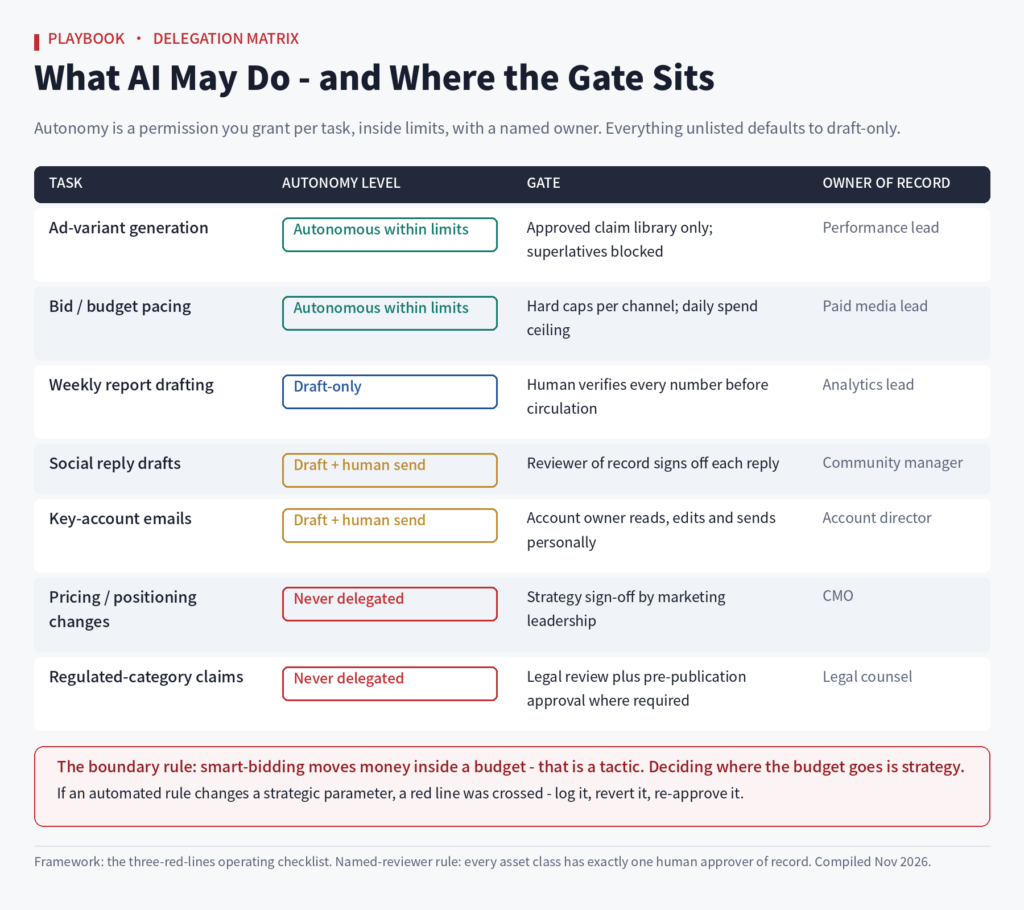
Three levels do all the work. Draft-only: AI produces, a human evaluates and uses or discards. Draft-plus-human-send: AI writes, a named human reviews, edits and personally sends. Autonomous-within-limits: AI acts alone inside hard boundaries — approved claim libraries, spend caps, rate limits — with logs reviewed daily. Notice that the two “never delegated” rows in the matrix are simply red lines 1 and 2 wearing work clothes.
The Daily 10-Minute Red-Line Audit
Governance that requires a committee meeting is governance that won’t happen. This routine fits in ten minutes with your morning coffee.
Morning, minutes one through six: open the automation logs. Compare yesterday’s automated actions against the three lines. Any strategic parameter moved by a rule? Any asset published without an approval entry? Any customer-facing autonomous interaction outside its lane? Flag exceptions; don’t investigate yet.
Minutes seven through ten: write the exceptions into the log. The template has five fields — date, asset or decision, line touched, reviewer, resolution. That’s it. The log is your audit artifact; when a regulator, a client or your own legal team asks “who checked this,” the log is the answer. It’s also, not incidentally, the shape of record PIPL’s impact-assessment and audit provisions expect you to keep.
Weekly: sample five AI outputs per asset class and verify gate compliance — was the claim in the library, did the named reviewer actually sign, did a human send the email. Sampling beats confessions, remember: 57% hide their usage, so audit the outputs, not the people’s self-reports.
Monthly: run the red-line incident review. Count exceptions by line, find the recurring pattern, and patch the SOP that allowed it. If the same gate fails twice, the gate is broken, not the people.
Escalation Scripts: What to Say When a Line Is Crossed
When a line is crossed, the first casualty is clear thinking. Scripts fix that. The sequence is always containment, correction, notification, SOP patch — in that order.
Scenario one: a hallucinated claim discovered after publication. Say this: “We published an ad variant containing an unverified claim. Pause the variant and every sibling generated from the same prompt batch now. Pull the source of the claim. Legal reviews exposure within the hour; we correct or withdraw publicly based on their read. Then we patch the claim-library gate that let it through.” Under the Advertising Law’s penalty structure, speed of containment is money.
Scenario two: personal information found in prompt history. “A prompt contains customer personal data. Restrict access to that history immediately, identify what data and whose, and log the scope. Privacy counsel decides notification duties today — not next week. Delete or de-identify per their instruction, then close the tool permission that allowed the paste.” PIPL’s breach-response duties require immediate remedial measures; your script should move at the same speed as the statute.
Scenario three: an autonomous reply sent to a key account. “A bot replied to a key account without human send. Disable autonomous sending for that account tier now. The account director reads the full thread and sends a human follow-up within two hours — owning the error, not blaming the tool. Then we re-scope the bot’s lane.” The relationship survives honesty far better than it survives a forwarded apology template.
Wire the Lines Into Tools, Not Documents
Here’s the rule that separates real red lines from decorative ones: a red line that lives only in a PDF is not a red line.
Build approval workflows into the content pipeline so an asset physically cannot publish without its reviewer’s logged sign-off. Put access controls on prompt history so customer data can’t be pasted where it shouldn’t go — and so the ones who need to audit can. Scope automation permissions to the delegation matrix: the bidding tool gets budget-internal rights, not allocation rights. If your stack can’t enforce a line, that’s a procurement requirement for the next tool you buy, not an excuse.
The EU AI Act’s Article 14 reads like a spec sheet for this wiring: humans assigned to oversee high-risk systems must be able to understand the system’s limits, resist automation bias, override its output, and stop it. Whether or not your marketing stack is legally “high-risk,” that’s a good engineering standard for any automation you run.
Training Drills: Make the Lines Muscle Memory
Once a month, run a thirty-minute drill. Inject a mock violation — a seeded unverifiable statistic, a fake PII prompt, a staged bot reply — and have the team run the escalation script cold. Score time-to-containment. Teams that drill contain incidents in minutes; teams that don’t discover them in retrospectives.
New hires get red-line certification before tool access. Not a slide deck — a walkthrough where they demonstrate the approval flow, find the exception log, and recite the containment sequence. Given that barely half of employees globally have received any AI training, thirty minutes of onboarding discipline is a genuine competitive edge.
Four Failure Modes That Erode Red Lines
Watch for these, because they’re how good systems quietly die. Lines defined but not logged — if there’s no artifact, there’s no line. Reviewer rubber-stamping — if approvals take four seconds each, your weekly sample will expose it. “The AI decided” as an excuse — the moment that sentence works in a meeting, accountability has left the building. And autonomy scope creep — a tool that starts within limits and quietly acquires new permissions without re-approval. Every autonomy expansion goes back through a human, same as day one.
The Printable Checklist
Daily: automation logs checked against three lines; every published AI asset has a logged approval; no customer PII in prompts; no out-of-lane autonomous customer interaction; exceptions logged with all five fields.
Weekly: five outputs sampled per asset class; gate compliance verified; reviewer speed sanity-checked; relationship-context sends confirmed human.
Monthly: incident review completed; recurring failure patched at the SOP level; one containment drill run and timed; autonomy scopes re-confirmed against the matrix.
Pin it next to the coffee machine. The all-hands deck can stay in the PDF.
The Bottom Line
Human-AI collaboration stops being deck-speak the moment it becomes procedure. Keep strategy, risk approvals and relationships in human hands; delegate everything else through explicit gates with named owners; audit for ten minutes a day; drill the escalations monthly. The evidence says most teams use AI without checking it, and the law — in China and increasingly in Europe — has already made the unchecked zones expensive. The companies converting AI into real earnings are the ones gating it hardest. Three lines, ten minutes, one log. That’s the whole system — and it starts tomorrow morning.