Somewhere on Xianyu right now, a college student is haggling over a three-year-old iPhone. A collector in Chengdu is unboxing a plush monster she waited months for. A young professional in Shanghai is listing the designer bag she carried twice. None of them will ever appear in your brand tracker. No survey will ask them how they feel about your logo. And yet, between them, they are doing something your focus groups never do: putting a real number on what your brand is actually worth.
We treat second-hand commerce as the place products go to retire. In China, it has become the place brands go to be audited. The second-hand price is the truest brand metric you will ever find, because it is the only one your marketing budget cannot touch. This piece walks through the scale of that market, the mechanism that makes resale a brand-equity signal, and the trust-infrastructure turn that changed the game in September 2025 — with the calibers labeled, because in this market the numbers come with footnotes you cannot afford to skip.
A Trillion-Yuan Market, If You Read the Labels
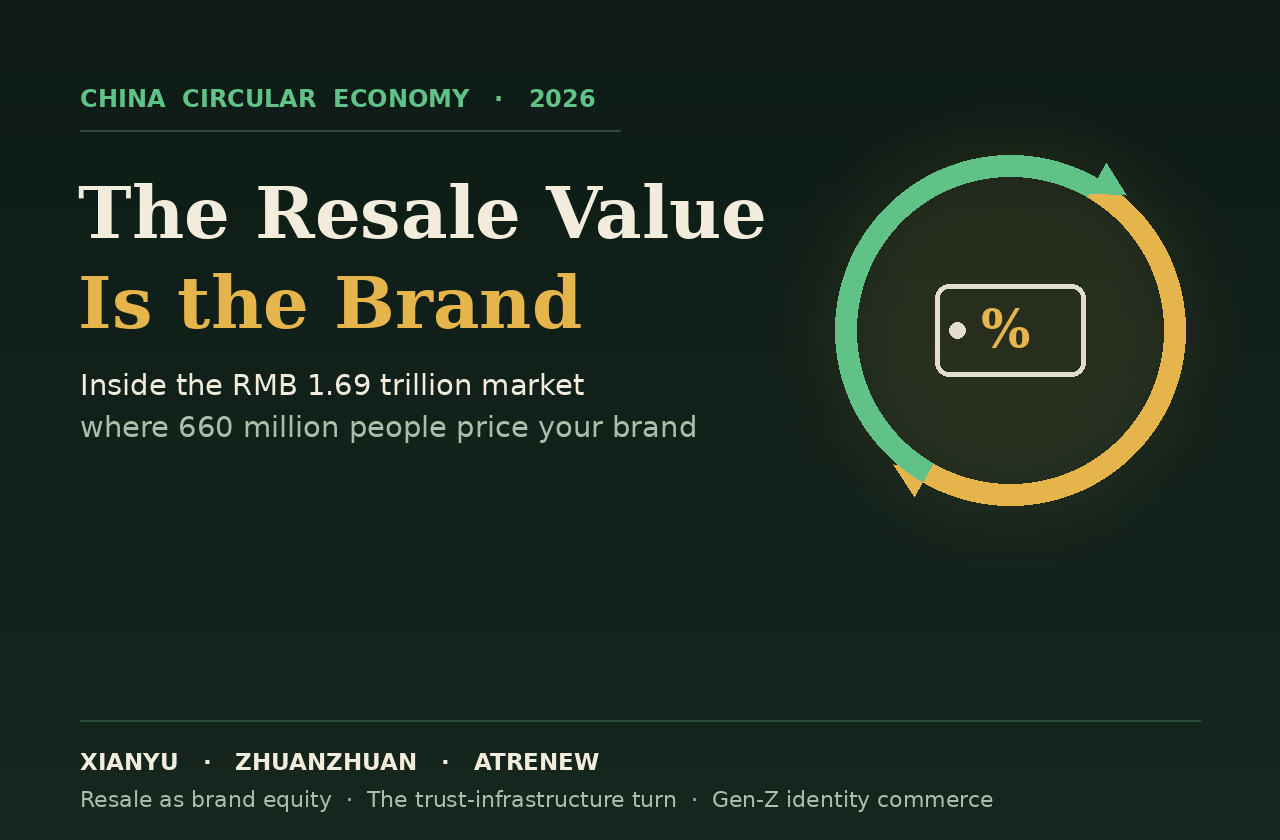
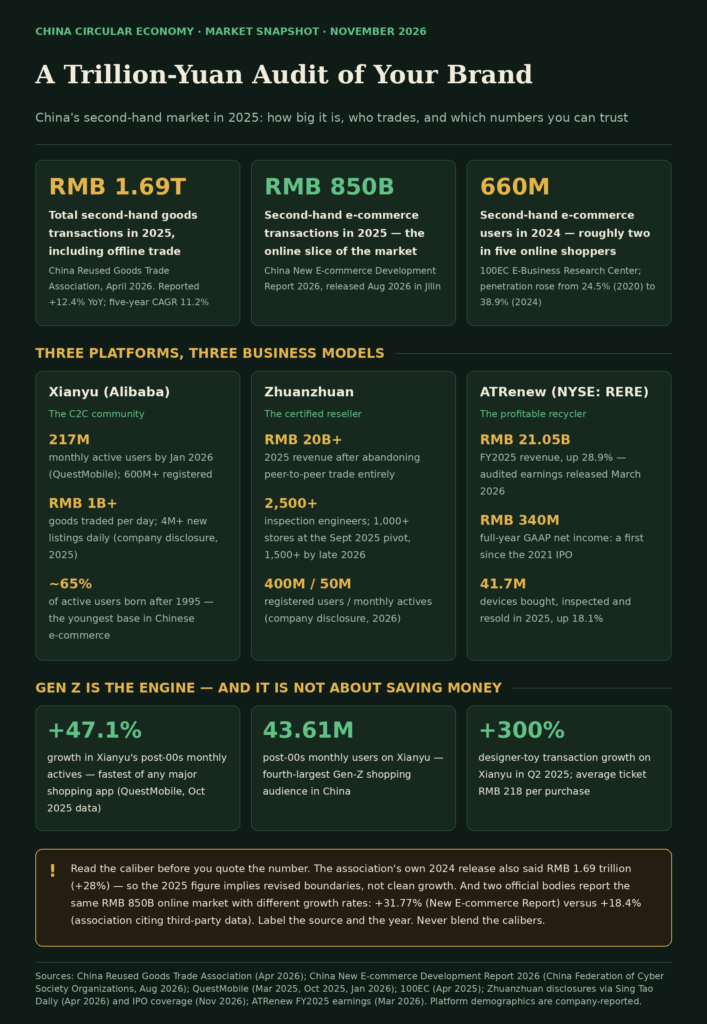
China’s second-hand goods market reached RMB 1.69 trillion in 2025, according to the China Reused Goods Trade Association, with reported growth of 12.4% and a five-year compound rate of 11.2%. Second-hand phones and digital products alone account for more than RMB 400 billion of that.
Here is the footnote most coverage skips: the association’s 2024 release also said RMB 1.69 trillion — with 28% growth attached. Two consecutive years, the same headline number, two different growth rates. That almost certainly means revised statistical boundaries rather than a market that stopped growing. Treat the level as indicative and the direction as solid; do not build a growth chart on it.
Three Numbers, Three Calibers
The online slice is cleaner. The China New E-commerce Development Report 2026, released in August 2026 by the China Federation of Cyber Society Organizations, puts 2025 second-hand e-commerce at RMB 850 billion, growing 31.77%. The association, citing third-party data, reports the same RMB 850 billion but 18.4% growth. Same level, different math — label whichever you quote. Meanwhile, the research center 100EC counted 660 million second-hand e-commerce users in 2024, with penetration climbing from 24.5% in 2020 to 38.9%. Roughly two in five Chinese online shoppers now buy used. This is not a fringe channel. It is a parallel economy with its own pricing system — and that pricing system is pointing at your brand.
The Platform Split: Community, Certification and the Recycler
Three platforms, three theories of the business. Xianyu, Alibaba’s marketplace, is the community: 217 million monthly active users by January 2026 per QuestMobile, more than 600 million registered, over RMB 1 billion in goods traded daily and 4 million new listings a day by company disclosure. Zhuanzhuan is the certified reseller: it passed RMB 20 billion in 2025 revenue after abandoning peer-to-peer trade altogether. ATRenew, the NYSE-listed parent of Aihuishou, is the recycler that finally made the math work: RMB 21.05 billion in FY2025 revenue, up 28.9%, and its first full-year GAAP profit — RMB 340 million net — after 41.7 million devices moved through its buy-inspect-resell pipeline.
Remember that split. It is not a minor strategic variance; it is three different answers to the same question of what second-hand commerce is actually selling.
Gen Z Isn’t Saving Money. It’s Trading Identity.
The demographics demolish the frugality story. Around 65% of Xianyu’s active users were born after 1995, per company figures carried by state media. QuestMobile’s late-2025 report found 43.61 million post-00s monthly actives on Xianyu — the fourth-largest Gen-Z shopping audience in China — growing at 47.1%, faster than any general e-commerce platform. What are they buying? Anime merchandise, designer toys, fandom collectibles. National-style guzi sales jumped 167% in Q1 2025; designer-toy transaction value rose more than 300% in Q2, at an average of RMB 218 per purchase. A Generation Z buyer on Xianyu is not stretching a budget. She is entering a fandom, exiting one, and pricing her identity along the way. Second-hand is identity commerce — and identity commerce is where brand meaning gets negotiated in public.
Why the Second-Hand Price Is the Truest Brand Metric
Strip away the campaign, the celebrity ambassador, the launch event. What is left? The number a stranger will pay for your product after you stop paying to promote it. That number is residual value, and it behaves like an audit of everything your brand ever claimed.
Luxury: The Receipt That Outlives the Campaign
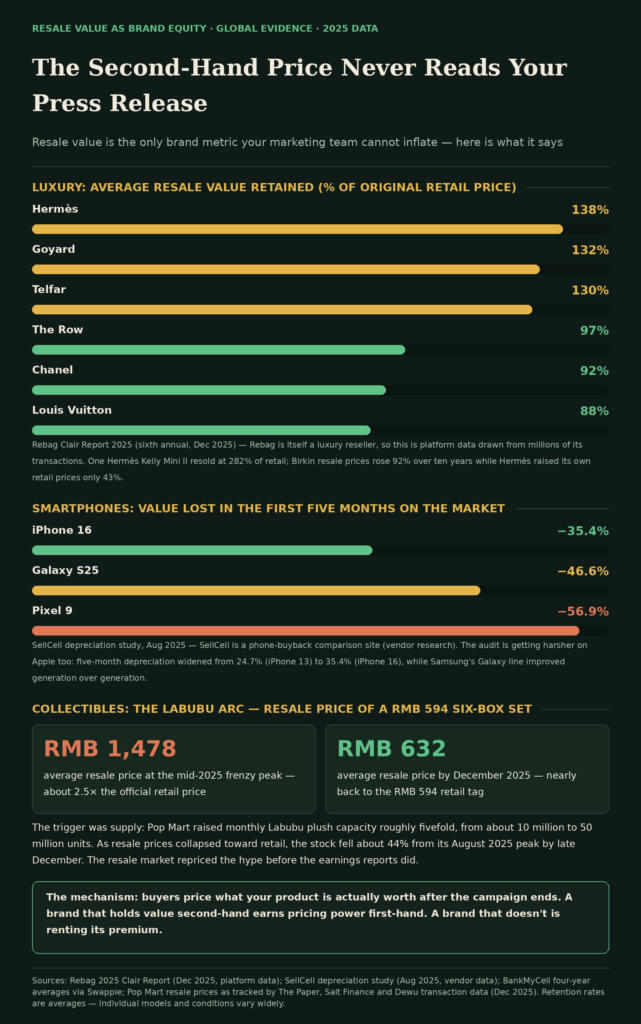
Rebag’s 2025 Clair Report — sixth edition, built on millions of transactions from the resale platform itself, so weigh it as vendor data — reads like a brand-equity league table. Hermès bags resold at an average 138% of original retail; Goyard at 132%; Telfar around 130%; The Row at 97%; Chanel at 92%; Louis Vuitton at 88%. One Kelly Mini II traded at 282% of its retail price. Over ten years, Birkin resale prices rose 92% while Hermès raised its own retail prices just 43%. The secondary market valued the scarcity story more aggressively than the brand itself dared to. That is pricing power you can see from space — and it was earned through decades of controlled supply, not through ad spend.
Phones: Depreciation as a Product Review
The same audit runs in electronics, mercilessly. SellCell’s August 2025 study — again, vendor research from a buyback comparison site — found the iPhone 16 lost 35.4% of its value in five months, versus 46.6% for the Galaxy S25 and 56.9% for the Pixel 9. Apple still wins. But the trend line is the story: the iPhone 13 lost only 24.7% in the same window, while Samsung’s Galaxy line has improved with every generation. Resale buyers, it turns out, notice which phones keep getting software support and useful AI features. BankMyCell’s four-year averages tell the long version: iPhones retain about 52.5% of value; Android flagships about 21.1%. Every depreciation curve is a product review written in money.
Labubu: When the Resale Market Calls the Top
And sometimes the audit turns violent. In mid-2025, a six-box Labubu set with a RMB 594 retail tag traded around RMB 1,478 on Chinese resale platforms. By December, the average was about RMB 632 — nearly back to retail — and some RMB 99 singles fell to 82. The trigger was supply: Pop Mart expanded monthly plush capacity roughly fivefold, from about 10 million to 50 million units. As resale premiums evaporated, the stock fell about 44% from its August peak by late December. Notice the sequence. The resale market repriced the hype months before the earnings reports confirmed the slowdown. If you want an early-warning system for brand heat, it already exists. It is the second-hand tab.
The Trust-Infrastructure Turn
For years the standard knock on second-hand was simple: you cannot trust it. Fraud, fakes, condition disputes. In 2025, China’s platforms stopped apologizing for that problem and started engineering around it — with industrial budgets.
Zhuanzhuan’s Bet: Kill the Flea Market
On September 22, 2025, Zhuanzhuan announced it would shut down the C2C free market it was founded on in 2015. Listings closed September 24, trading September 29, everything offline by October 31. The CEO’s open letter was blunt: peer-to-peer trade had become a haven for fraud and grey-market deals the platform could not fix. It contributed under 3% of GMV anyway. What remains is C2B2C: every item flows through official inspection — more than 2,500 quality-check engineers, standard reports, seven-day returns and a one-year warranty on most certified goods. The company has been profitable since 2022, passed RMB 20 billion revenue in 2025, and by November 2026 was reportedly filing confidentially for a Hong Kong IPO. Zhuanzhuan no longer sells a marketplace. It sells certainty, at a margin.
Xianyu’s Answer: A Jury of 7.5 Million
Xianyu attacked the same problem from the opposite direction: keep the community, industrialize its governance. Its trust stack runs from a proprietary credit score that screens counterparties, through an official inspection service for mid-trade authentication, to the Small Court — a peer-jury dispute system with 7.5 million volunteer jurors, 70% of them young. In 2024, 92% of disputes were resolved inside the community; only 8% needed platform staff. A February 2025 upgrade added more than 400,000 specialist jurors across ten verticals, so a dispute about an anime figure gets judged by people who collect anime figures. Where Zhuanzhuan inspects the object, Xianyu certifies the relationship. Both are selling the same product: trust.
Circular Stores and the State’s Rails
The turn has gone physical. Xianyu’s consignment-based Circular Stores reached about 30 locations across nine cities by August 2025; in January 2026 it opened an anime-themed store in Hangzhou stocked with 60,000-plus second-hand collectibles, where 90% of visitors were already Xianyu users. The honest caveat: foot traffic is thin, and some early community stores have closed — offline trust is expensive to test. Meanwhile Beijing is laying its own rails: the Ministry of Commerce named 10 pilot cities and 28 pilot enterprises for second-hand goods circulation in April 2025, targeting a standardized, traceable circular industry by 2027. Platforms, policy and consumers are converging on the same bet.

What Everyone Gets Wrong
Four errors keep circulating. First: second-hand sits outside marketing. It does not — it is the unsponsored measurement of your brand promise, updating daily. Second: second-hand means cheap. Gen Z pays premiums for fandom goods, and certified pre-owned commands more than uncertified because trust itself has a price. Third: one market, one number. The 1.69-trillion total, the 850-billion online slice and the older 645-billion research estimate are different boundaries; blend them and your chart lies. Fourth: C2C is the natural model. China’s number-two platform just executed C2C on purpose. The direction of travel is certification, service and accountability — the heavy stuff.
The Playbook for Brands
So what do you do on Monday? Start measuring: track your products’ resale prices and velocity the way you track share of voice. A widening resale discount is a brand-equity leak, visible quarters before it hits revenue. Design for the audit: durable materials, authentic serials, transferable warranties and long software support all show up in residual value — Apple’s curve is product policy, not luck. Plug into the trust infrastructure: trade-in programs and certified pre-owned partnerships let you rent credibility that platforms spent billions building; ATRenew’s profitable year was powered partly by national trade-in subsidies, which tells you where policy tailwinds blow. And show up in the interest communities — the guzi and designer-toy circles are not a discount channel; they are where your brand’s meaning is set by people who will never read your positioning deck.
The Counterargument, and Where It Breaks
Fair objections exist. Doesn’t resale cannibalize new sales? Partly — but a strong resale price lowers the effective cost of buying new, which is exactly how holds-value brands sustain first-hand premiums; the trade-in loop converts cannibalization into upgrade flow. Isn’t fraud still rampant? In uncertified corners, yes — that is precisely why the certification turn matters, and why your partnership choice is a trust choice. And aren’t these market numbers shaky? Some are, which is why every figure here carries its caliber and source. The direction — mainstream scale, Gen-Z identity demand, industrialized trust — survives every honest objection. What does not survive is the fantasy that this market is someone else’s department.
The Takeaway
China’s circular economy is a brand audit running in production, 24/7, priced in yuan. The brands that hold value there — Hermès, Apple, and briefly Labubu — earn the right to charge more at retail. The brands that do not are renting their premium from their own ad budget. Monitor resale as brand equity. Design for circulation. Borrow the trust infrastructure. Respect the fandoms. The second-hand price never reads your press release — which is exactly why you should.