The line between analyzing advertising and running it just got thinner. Xnurta, a Bellevue-based ad management platform, announced Wednesday that its Model Context Protocol integration now supports write operations, not just reads — meaning Amazon advertisers can create, adjust and optimize campaigns through natural-language instructions inside AI assistants like Claude and ChatGPT, rather than merely asking questions about their performance data.
The distinction matters more than it sounds. Read-only MCP connectors, which spread across adtech this year, turned chatbots into analysts: useful for pulling reports, useless for acting on them. Every insight still ended with a human retyping decisions into a campaign console. Xnurta’s update closes that loop. A conversation can now monitor performance, execute bulk adjustments to bids, budgets, keywords and targeting, and launch new campaigns from existing templates — with roughly 15 months of historical data and hourly reporting behind the answers. The company’s example is refreshingly mundane: returning Prime Day event budgets to pre-event levels with a single command.
The safety design is the part procurement teams should read twice. All budget, bid and archive changes require a preview and human confirmation before taking effect. Permissions are configurable, and changes apply within advertiser-defined guardrails. This is the emerging industry pattern — AI proposes, human approves — and it is quickly becoming table stakes rather than a differentiator. Any vendor offering agent-driven ad execution without an approval layer should now be asked why.
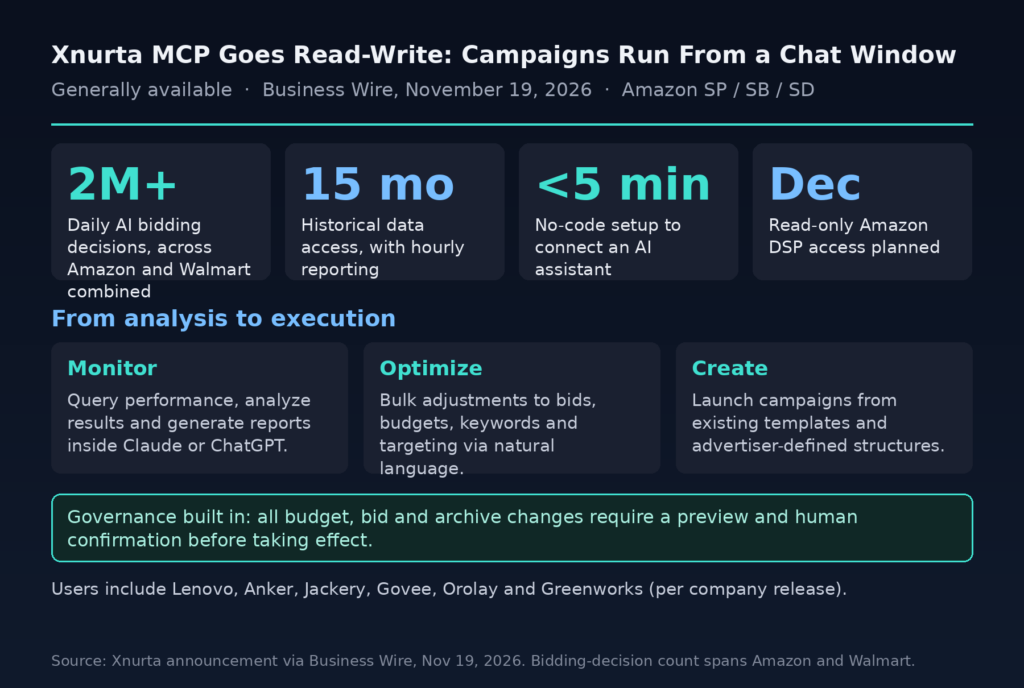
The scale underneath is not trivial. Xnurta says its AI Copilot already powers more than 2 million bidding decisions per day across Amazon and Walmart, and its customer list reads like a cross-border seller hall of fame: Lenovo, Anker, Jackery, Govee, Greenworks, Orolay. Setup is no-code and claimed to take under five minutes. Read-only Amazon DSP data arrives in December, with more retail media platforms on the roadmap — a hint that the agent console is being built to span networks, not just one.
“Connecting AI to advertising data was just the first step,” CEO Kashif Zafar said in the announcement. “The real transformation happens when AI can act on that information.” Strip away the launch language and the claim is structural: the interface layer of retail media is migrating from dashboards to dialogue.
For working marketers, three practical consequences follow. First, the operational ceiling drops — a two-person team can plausibly manage a campaign portfolio that previously justified an agency retainer, provided someone competent reviews the previews. Second, the skill mix shifts: writing precise instructions and auditing proposed changes becomes the job, while clicking through bulk-file spreadsheets fades. Third, the audit trail becomes a buying criterion. When an agent can spend money, you need logs of what it proposed, what was approved and by whom.
The wider context is a land grab. Meta shipped ads connectors for AI assistants; measurement vendors plugged MCP into reporting; now execution has arrived in retail media, the fastest-growing corner of digital advertising. The open question is whether Amazon itself blesses third-party agent execution at scale or absorbs the layer into its own console. Until that settles, the sellers who learn to drive campaigns conversationally — carefully, with the approve button firmly in human hands — will bank the efficiency gains first.