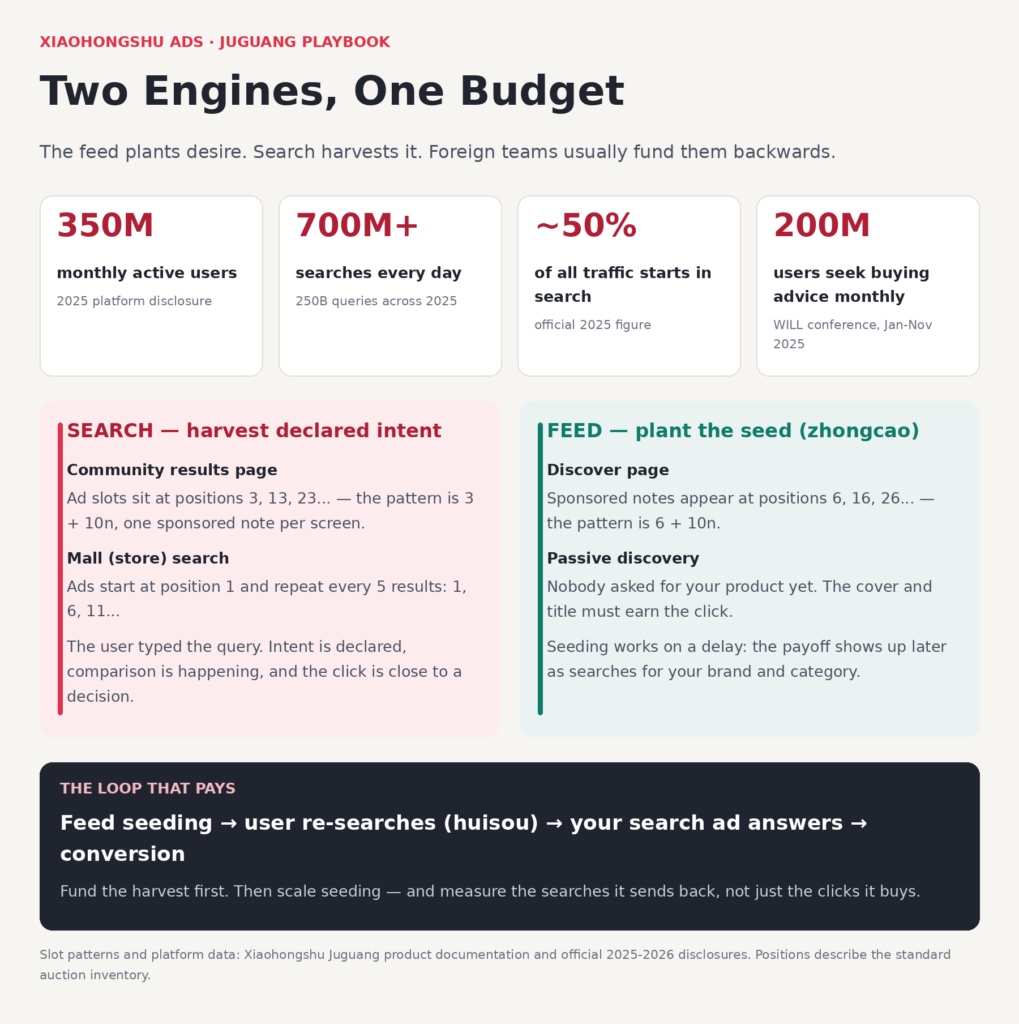
Most foreign teams run Xiaohongshu ads backwards. They pour budget into feed seeding, wait for conversions that never arrive inside the attribution window, and conclude the platform “doesn’t convert.” Meanwhile the platform’s own logic says the opposite: the feed plants desire, search harvests it. In 2025, Xiaohongshu users ran more than 700 million searches a day — roughly 250 billion across the year, by the platform’s own disclosure — and about half of all traffic now flows through search. Every month, around 200 million users ask the platform for buying advice, a figure Xiaohongshu shared at its December 2025 WILL business conference. This is not a social network with a search box bolted on. It is a search engine wearing a lifestyle feed as a disguise.
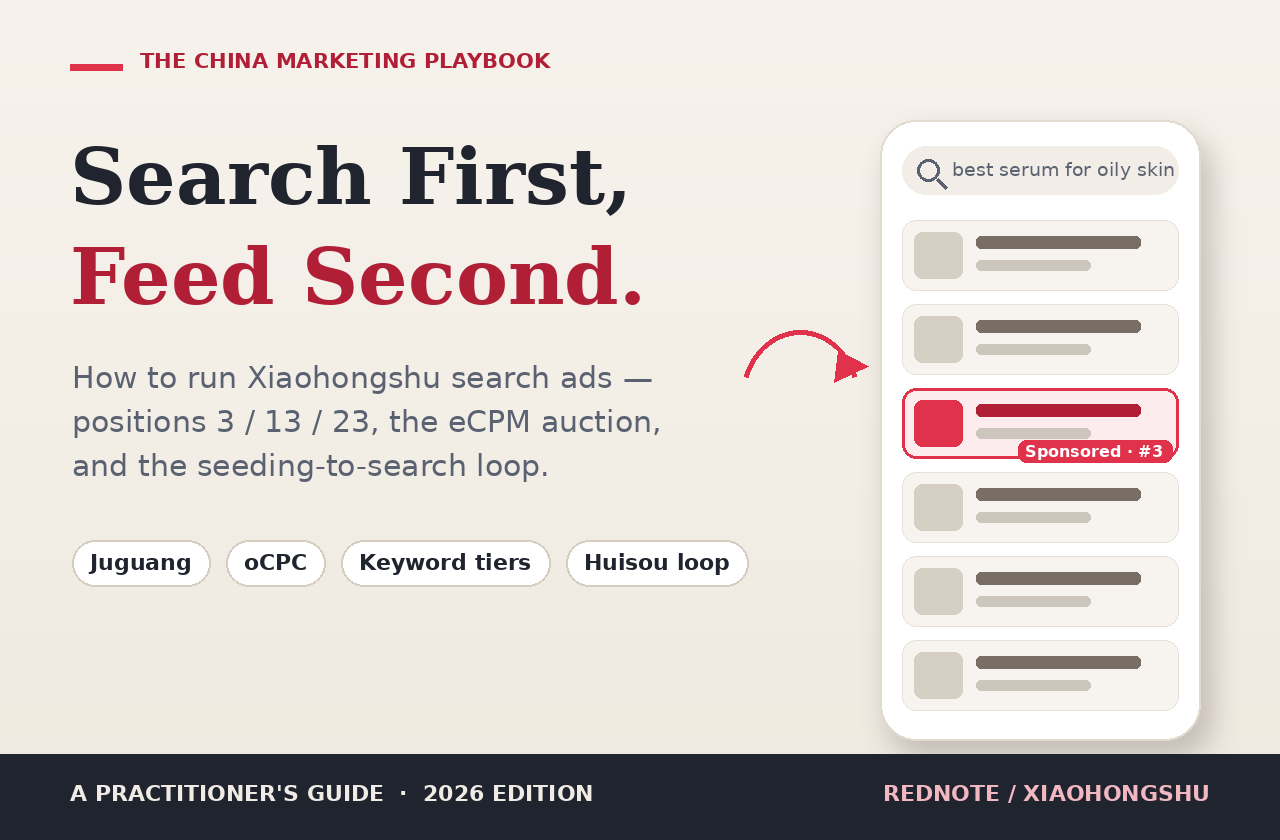
So here is the inversion this guide teaches: buy search first. Search ads sit at positions 3, 13 and 23 on the community results page, capturing people who typed their intent with their own thumbs. The auction ranks you by expected revenue, not bid alone, which means your creative is a cost lever — a better note buys cheaper traffic. Target-cost bidding holds your conversion cost inside a ±20% band, with an over-cost compensation mechanism behind it. And the highest-leverage audience most foreign teams never touch is keyword-interest targeting: feed users who searched your keywords in the past few days. Fund the harvest, then scale the seeding, and measure the loop between them. That is the whole playbook.
1. The Platform Logic: Why Search Comes First
1.1 A search engine in disguise
Start with the numbers, because they change how you should budget. Xiaohongshu’s official 2025 disclosures put monthly active users at 350 million and daily searches above 700 million. Search accounts for roughly half of total platform traffic, and close to 90% of those searches are actively typed by users — not served by an algorithm guessing what they might want. A third of monthly users open the search box before anything else. Read those together and the picture flips: the feed is where demand gets created, but search is where demand gets declared. Declared intent converts. Guessed intent browses.
One honesty note before we go further: these are the platform’s own numbers, announced at its own commercial conferences. Xiaohongshu has every incentive to make search look big. But the direction is corroborated by years of consistent product investment, and no credible third party disputes the order of magnitude.
1.2 The budget-order error
The typical foreign team’s first Xiaohongshu campaign is a feed campaign. It feels right — the platform is famous for seeding, the agency deck shows glowing lifestyle notes, and feed inventory is cheap and plentiful. Then reality arrives. Feed clicks come from people who were browsing, not buying. Conversion costs balloon. The team pauses everything and writes the platform off.
What actually happened? They funded the planting and starved the harvest. A user sees your seeding note on Tuesday, gets curious, and searches your category on Thursday — landing on a competitor’s search ad because you never bought the keyword. You paid to create demand someone else captured. The platform’s own framing, repeated across its advertiser materials, is blunt: feed seeding, search harvesting. Your budget order should match the platform’s physics, not your comfort zone.
2. Setup and Account Structure
2.1 Getting through the door
You cannot buy ads from a personal account. The path has three gates. First, certify a professional account as a business entity — the certification fee has held steady at ¥600 per year across recent sources. Second, submit industry qualifications: a business license plus category-specific permits (a food business license for food, filing certificates for medical devices, and so on). Third, open a Juguang advertising account, either directly or through an authorized agency.
Here is where guides lie to you — usually by accident. You will see entry thresholds quoted at ¥2,000, ¥5,000, ¥6,000 or ¥10,000, and daily minimums around ¥200. Our two-pass verification found all of these numbers in circulation, and they are all real somewhere: thresholds differ by channel (direct versus agency), by region, and by year, with 2026 self-serve openings commonly cited at ¥10,000 while some agency channels start lower. There is no single public price sheet. Treat any number in any guide — including this one — as a snapshot, and confirm current terms when you actually open the account. The mechanics in this guide are stable; the prices are fluid.
2.2 The campaign hierarchy
Juguang structures campaigns in three layers: plan, unit, creative. The plan holds your objective and budget. The unit holds targeting and bidding. The creative is the note itself — more on why that matters in Section 6. Five marketing objectives are available: product seeding, product sales, lead collection, livestream promotion, and track capture (a share-of-voice play that only runs on search). Pick the objective before you pick keywords, because it changes what the system optimizes and what you should measure. A seeding campaign judged by last-click sales will always look like a failure; that is a ruler problem, not a channel problem.
3. The Auction: Why Your Creative Is a Cost Lever
3.1 How eCPM ranking actually works
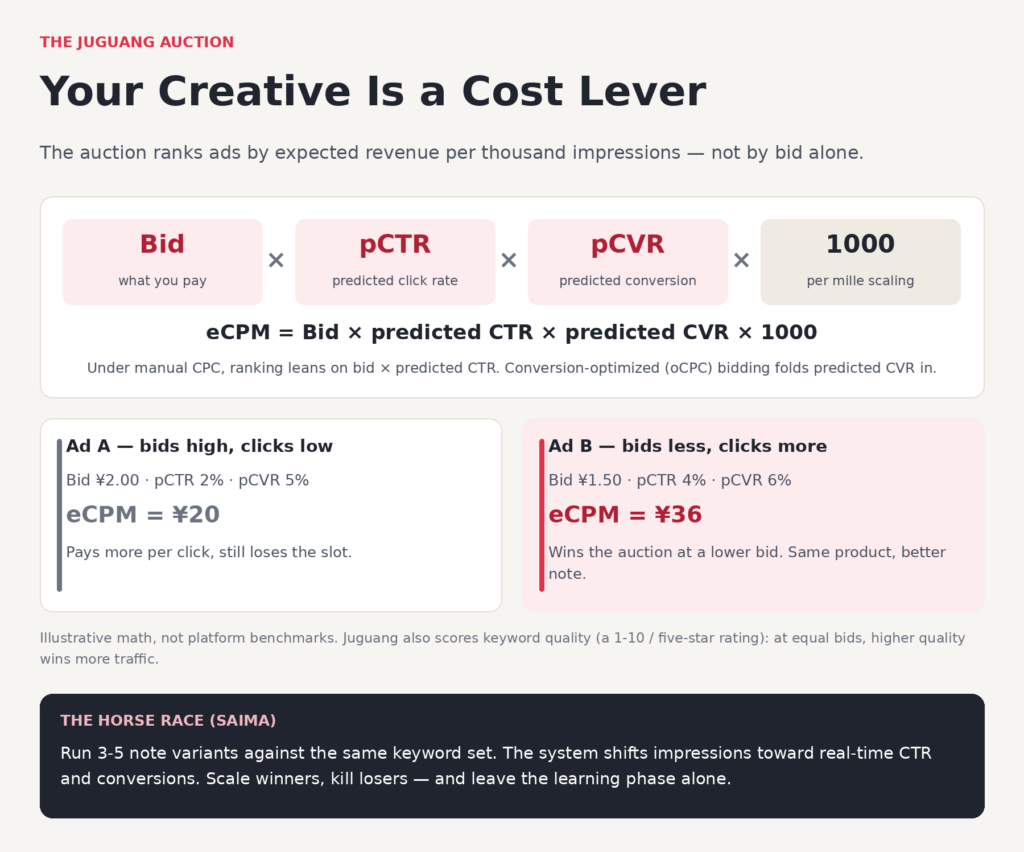
Juguang does not sell slots to the highest bidder. It ranks ads by eCPM — expected revenue per thousand impressions. Under manual CPC bidding, the ranking leans on your bid multiplied by predicted click-through rate. Under conversion-optimized bidding, predicted conversion rate joins the formula. The logic is simple: the platform earns when users click and convert, so it promotes ads users actually engage with.
The practitioner’s consequence is the part most media buyers miss: your creative quality lowers your traffic cost. A note with a 4% predicted CTR can beat a note bidding 33% more with a 2% predicted CTR — and pay less per click doing it. On most ad platforms, creative is a conversion asset. On Xiaohongshu, it is also a media-buying asset. The note is the ad, and the auction charges you for boring.
3.2 The horse race is the method
Because the system predicts engagement per note, you cannot know your best creative in advance — you can only race it. Operators call this saima, the horse race: build three to five genuinely different notes against the same keyword set, let the system shift impressions toward real-time CTR and conversions, scale the winner, kill the losers. Two disciplines make it work. First, fund it properly — an underfunded race never gathers enough signal to pick a winner. Second, leave the learning phase alone. Every early edit to bids or targeting resets the model’s calibration; practitioners commonly budget around ¥300 per day per plan and wait for roughly twenty conversions before judging, though those are operator heuristics, not published platform rules. The instinct to fiddle is the instinct that keeps you poor.
4. Bidding Modes: Control, Cost Caps, and Controlled Chaos
Three bidding philosophies, three jobs. Manual CPC gives you per-click control and unstable volume — use it while you learn which keywords convert. oCPC target-cost bidding (also labeled MCB in the interface) tells the system your target conversion cost and lets it bid per impression; the published cost band is ±20% of target, meaning the system aims to keep average cost under 120% of your number. Nobid removes the cost cap entirely: you set a daily budget, the system spends it and maximizes conversions, with no cost guarantee. Use Nobid when you must spend — cold starts, mega-promo windows — and accept the variance.
The safety net deserves its own paragraph because misreported versions circulate widely. Agency transcriptions of Juguang’s official compensation rule — consistent across four or more independent agencies, one citing the rule version effective since May 2023 — describe it this way: during the first seven calendar days after a plan’s first spend, if conversion cost exceeds 120% of target and you kept edits within limits (roughly two bid/targeting changes per day, one bid change per hour), the platform compensates the excess, calculated as actual spend minus expected spend times 120%. The stricter “24 hours and six conversions” version floating around knowledge-base blogs appears to conflate a different product’s rules; we discarded it. The full official text lives behind the advertiser login and does get revised — read the current cost-guarantee terms in your own console before relying on them. And notice the trap inside the generosity: the compensation dies if you tinker. The rule and the learning-phase discipline are the same lesson wearing two hats.
There is also a fourth dial worth knowing: site-wide smart delivery (Quanzhan Zhitou), where the system allocates one budget across feed, search and video inventory. It is convenient, and it obscures exactly the search-versus-feed split this guide wants you to control. Learn the split manually first; automate it after you understand it.
5. Keyword Strategy: Four Tiers of Intent
5.1 The tier map
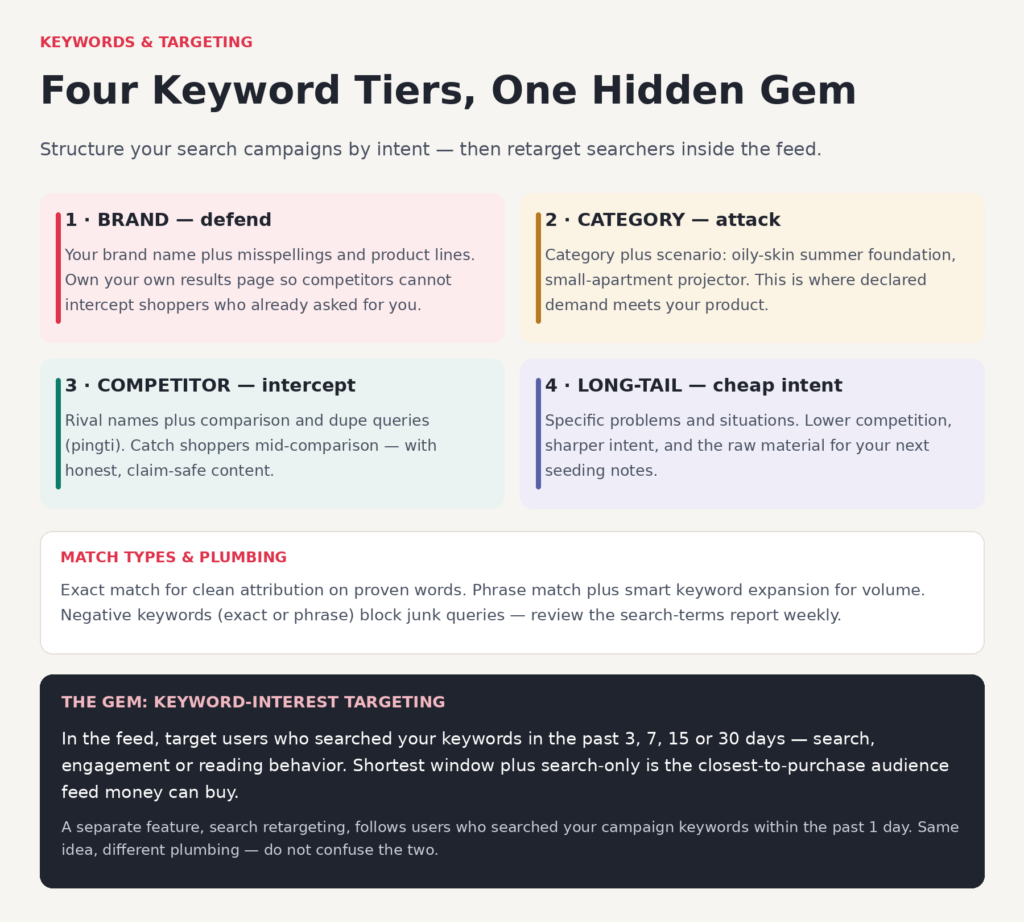
Structure search campaigns by whose intent you are buying. Brand words are defense: your name, product lines, common misspellings. If you don’t own your own results page, a competitor will rent it. Category words are offense: category plus scenario — “foundation for oily skin in summer,” “projector for small apartments.” This is the demand you want to meet at the moment of comparison. Competitor words are interception: rival names plus comparison and “dupe” (pingti) queries, catching shoppers mid-evaluation. Keep the content honest here; intercepted shoppers punish bait-and-switch faster than any other audience. Long-tail scenario words are the bargain bin: specific problems, lower competition, sharper intent — and a free research feed for your next seeding notes.
5.2 Match types and the plumbing nobody checks
Two match types are consistently documented in official product materials: exact and phrase. (Some 2026 practitioner posts claim a third “broad” option; the sources conflict, so plan around exact and phrase until your own console shows otherwise.) The volume unlock is phrase match plus smart keyword expansion, which mines adjacent queries from your seed list. The waste plug is negative keywords — exact-negative and phrase-negative — hidden a few tabs deep at the unit level. Review the search-terms report weekly and negative out the mismatches: wrong price tier, wrong gender, wrong use case. Ten minutes of plumbing saves more money than any bid tweak.
6. Creative and Targeting: The Note Is the Ad
6.1 Note-native or nothing
On Juguang, the ad is a note, labeled sponsored, sitting among organic notes in the same feed or results page. Stock photography and corporate copy die here. The structure that survives is painfully human: a specific pain point, a demonstrated solution, visible proof — real texture, real hands, real before-and-after. Video generally earns higher CTR than image-text, but the format matters less than the first frame and the title, because those decide the click the auction is pricing.
And the conversion surface extends below the note. Operators pin a summary comment (the “class representative” move), seed likely search terms into the comment thread, and answer objections in public. On Xiaohongshu, the comment section is landing-page real estate. Treat it with the same care.
6.2 The targeting gem: keyword-interest audiences
Here is the capability most foreign media plans skip. Inside feed campaigns, you can target users by keyword behavior: people who searched, engaged with, or read content around your keywords within a selectable window of 3, 7, 15 or 30 days. Choose the shortest window plus search-only behavior and you are buying the closest-to-purchase audience feed money can reach — people who declared intent days ago and haven’t finished deciding. A separate feature, search retargeting, follows users who searched your campaign’s keywords within the past one day. Same philosophy, different plumbing; don’t confuse the two settings. Layer this on top of second-level interest tags and DMP lookalike audiences built from your buyers, and your feed stops guessing.
7. Measurement: Judge the Loop, Not the Click
The metric set is familiar — CTR for creative, conversion rate for the note, CPA for the unit, GMV per mille for commerce — but the diagnosis logic is platform-specific. High impressions with low clicks? The cover and title are failing; fix the first frame, not the bid. High clicks with low conversion? The note promised something the product page doesn’t deliver; fix the mismatch. Rising costs during learning? You probably edited too much; stop touching it.
The deeper discipline is attribution. Seeding pays out on a delay: the note plants curiosity, and the payoff arrives days later as a search. Operators call the bridge metric huisou — the re-search rate, how often exposed users come back and search your brand or category. Xiaohongshu has been building official measurement for exactly this loop (its Lingxi insight platform, seeding-data products and audience-asset models were all showcased at the 2026 WILL conference, where the company also reported that merchants using its direct-to-marketplace seeding links grew 109% between the 618 and Double-11 festivals). We found no credible public benchmark for re-search rates, so be suspicious of anyone quoting one. Measure your own baseline: run search-only for two weeks, add seeding, and watch branded search volume lift. That lift — not the feed campaign’s last-click report — is what your seeding budget actually bought.
8. Risks and Honest Caveats
Three compliance lines are non-negotiable. China’s Advertising Law bans absolute claims — “number one,” “the best,” “national-level” — in any ad. The Internet Advertising Administration Measures (SAMR Order No. 72, in force since May 2023) require paid-ranking results to be conspicuously marked as advertising, and — this is the clause that reshaped influencer content — experience-sharing or review posts carrying purchase links must also be labeled as ads. Category licenses gate entire verticals; food and medical categories will stop a non-compliant advertiser at the qualification stage. None of this is optional texture; it is the price of entry.
Then the honest caveats. Slot positions and auction mechanics in this guide come mostly from agency transcriptions of official product documentation — agencies sell advertising services, so verify current behavior in your own console. Prices and thresholds move; we deliberately refused to freeze them. Compensation terms evolve; the version here is the multi-source-consistent one, not a guarantee. And the seeding lag is real: judged on a seven-day window, a healthy seeding program can look dead. If your reporting cadence can’t see the loop, fix the reporting before you kill the channel.
Conclusion: Fund the Harvest
Run Xiaohongshu ads in the order the platform actually works. Buy search first — positions 3, 13, 23, declared intent, four keyword tiers. Let the auction’s math work for you: better notes, cheaper clicks, horse-raced until one wins. Use target-cost bidding for control and Nobid when spending is the mission. Point keyword-interest targeting at recent searchers and stop paying the feed to guess. Then scale seeding with your eyes open, and measure the re-search loop it feeds. The feed plants. Search harvests. Most teams fund the planting and wonder where the crop went. Now you know where it went — and how to buy it back.