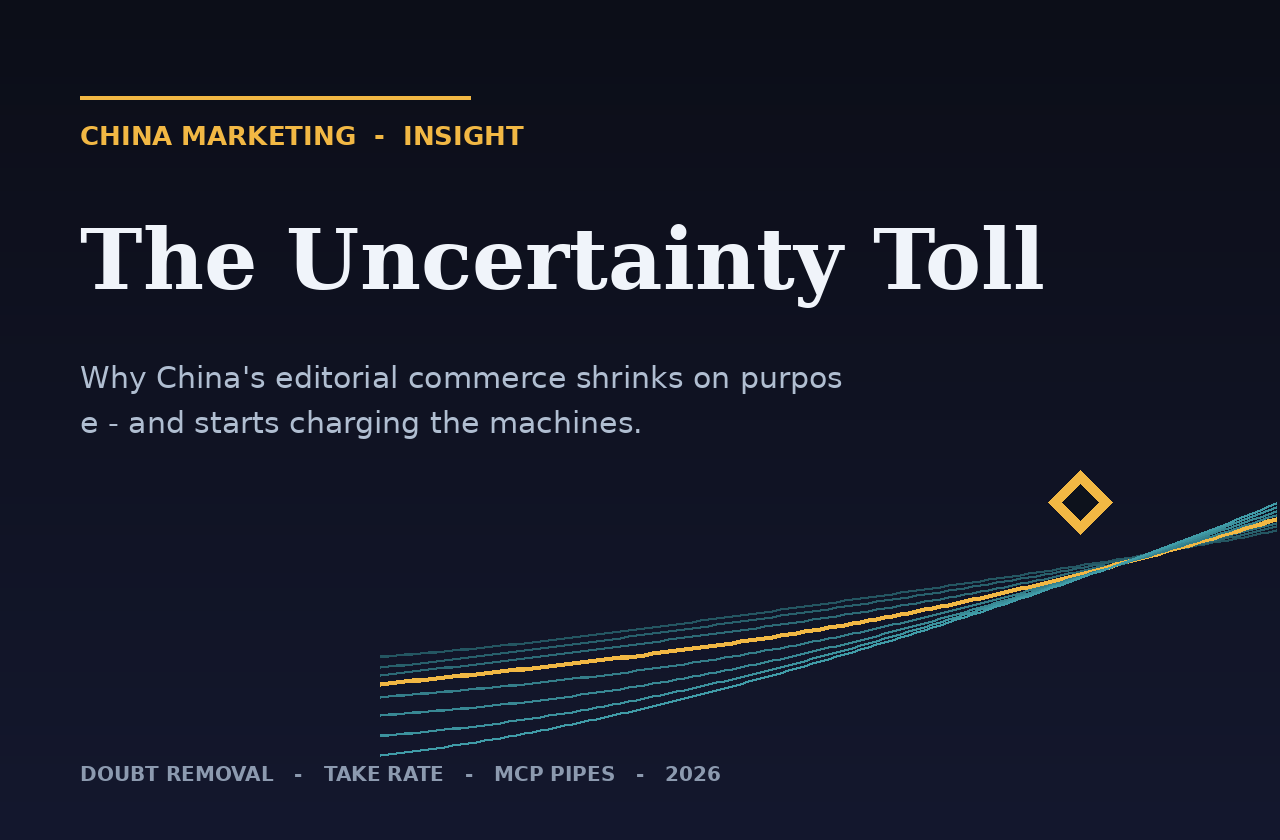
Here is a paradox worth sitting with. China’s largest editorial-commerce platform spent 2025 getting smaller on purpose — and its shareholders got richer. GMV at SMZDM, the review-and-deals site whose name means “what is worth buying,” fell 16.5 percent to RMB 16.1 billion. Revenue fell 15.15 percent. Yet net profit at operator Zhidemai Technology rose 14.99 percent, and gross margin crossed 50 percent. In an attention economy trained to worship scale, why would anyone shrink and win?
Because the slipstream never sold attention. It sold certainty. And certainty, it turns out, is priced per decision — not per pageview.
The Service Is Doubt Removal
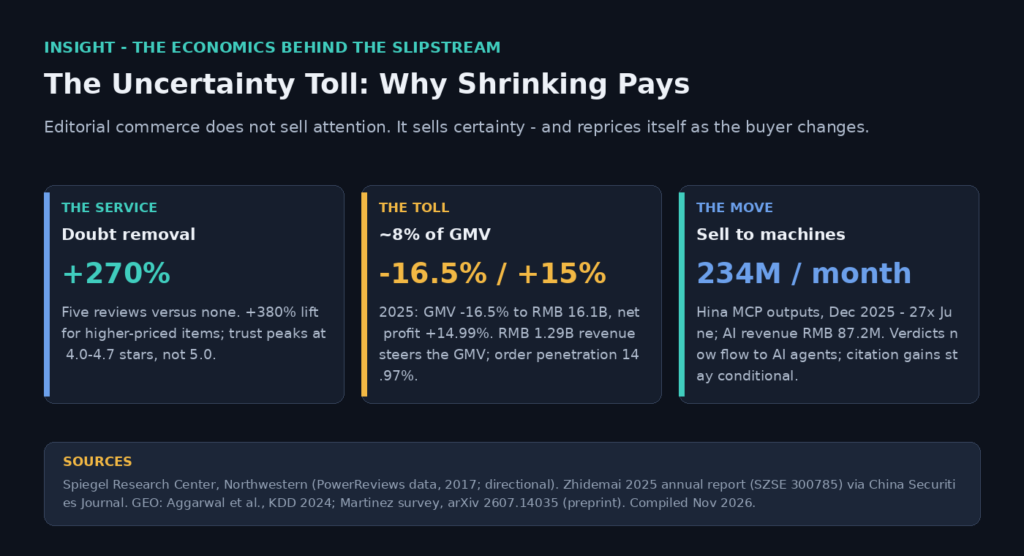
Recall what the academic evidence actually measures. Northwestern’s Spiegel Research Center found five reviews lift purchase likelihood 270 percent versus none, with the lift nearly doubling for higher-priced items — and peaking at 4.0-to-4.7 stars, not perfection. Read those numbers as a demand curve for doubt removal: the more expensive the mistake, the more a buyer pays — in time, in trust — for someone to absorb the uncertainty. Editorial is the cheapest doubt-removal technology ever built.
That reframes Zhidemai’s P&L. The company books roughly eight percent of the GMV it steers — RMB 1.29 billion of revenue on RMB 16.1 billion of transactions. Low-margin traffic businesses contributed volume but almost no toll; cutting them removed cost, not service. Meanwhile the share of app users who actually order rose to 14.97 percent. Fewer tourists, more buyers. The tollbooth does not care how many cars pass; it cares how many were genuinely going somewhere.
The Toll Is Migrating to the Machines
Now the deeper why. If certainty is the product, the customer does not have to be human. Zhidemai’s 2025 filing shows 56.59 percent of its 39.8 million content pieces were AI-generated, and its Hina MCP server pushed 234 million structured content outputs to AI agents in December alone — 27 times June’s level, across forty-plus partners, generating RMB 87.2 million in AI-related revenue.
Follow the incentive: an AI assistant answering “which robot vacuum should I buy” needs exactly what a review platform owns — verdicts with evidence. The platform that spent fifteen years monetizing human doubt is now wholesaling doubt-removal to machines that field the questions first. One honest caveat, per the research: KDD 2024’s citation gains are conditional on being retrieved, and a 2026 survey of 45 GEO studies found no guaranteed cross-platform traffic effect. The pipe is a bet on distribution, not a money printer.
But the direction is unmistakable. Attention businesses chase reach and decay. Certainty businesses chase decision quality and compound — in feeds, and now in answers. Shrinking was not retreat. It was repricing.