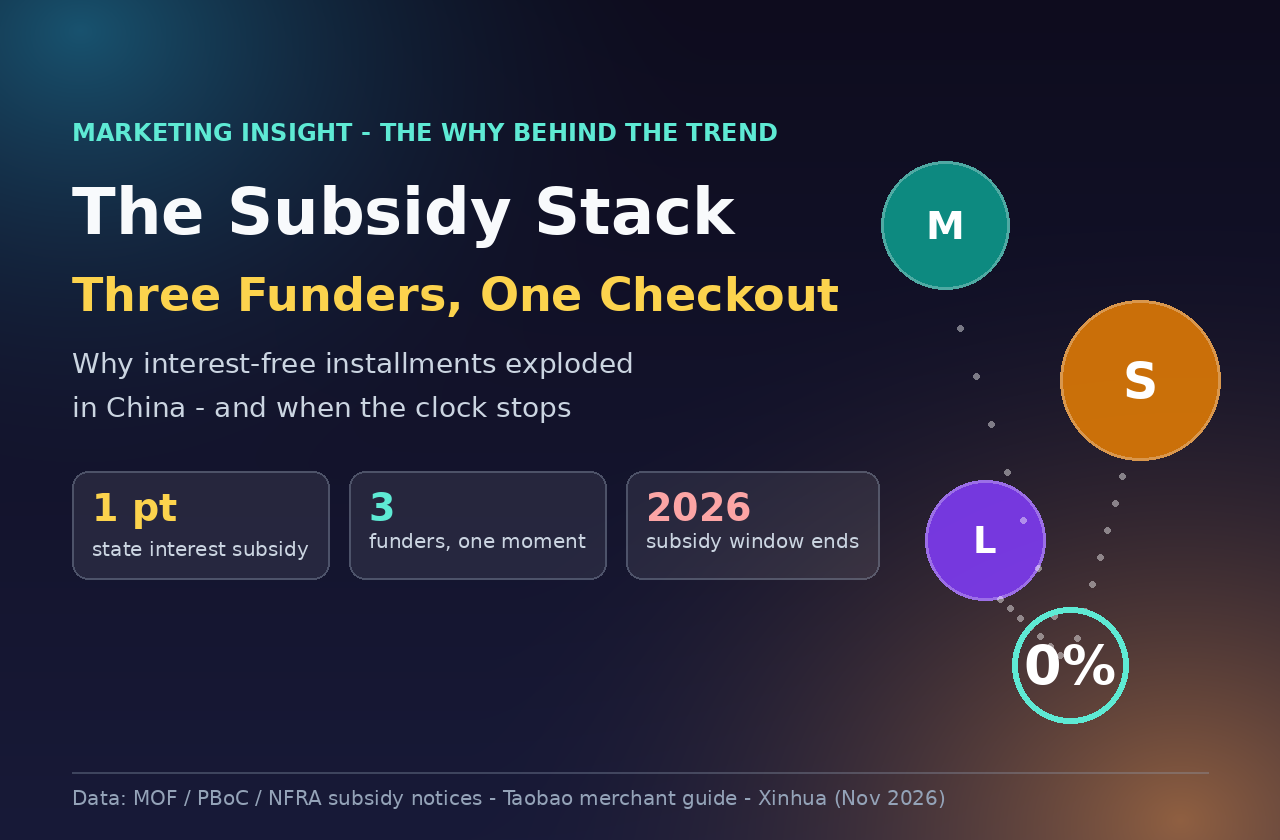
Every explanation of China’s installment boom starts with consumer psychology — big prices feel smaller in monthly slices. True, but incomplete. Psychology explains why shoppers click. It doesn’t explain why merchants, banks and the Ministry of Finance all rushed to pay for those clicks at the same time. The real engine is an incentive structure where three funders buy three different things at one checkout — and none of them is buying the same product.
Start with the merchant. An interest-free offer costs a service fee — reference rates run about 1.8%, 4.5% and 7.5% of order value for 3, 6 and 12 installments — charged only when a buyer actually chooses installments. Compare that with a straight 10% discount: the fee is cheaper, contingent, and it never touches the sticker price. The merchant isn’t buying generosity. They’re buying conversion without price erosion, which is why high-ticket categories adopted it first.
Then the state. From September 2025, a fiscal program subsidizes personal consumer credit by one annual percentage point, funded 90% centrally and 10% provincially; a January 2026 notice extended it to December 31, 2026 and pulled credit-card installments into scope. Notice what the government gets: consumption stimulus delivered through payment rails it never had to build, with authenticity checks pushed onto lenders and a ¥3,000 annual cap per borrower limiting leakage. It’s stimulus with somebody else’s distribution network.
And the lenders — 23 designated institutions including Ant’s consumer-finance arm — get authenticated loan volume at the exact moment of real demand, verified by the transaction itself. Customer acquisition that an ad budget could never buy this cleanly.
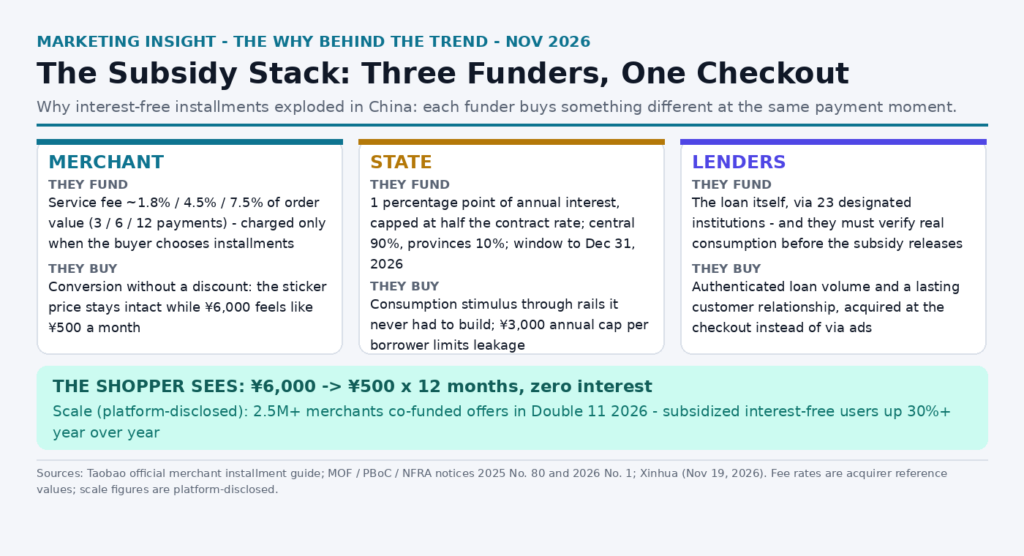
Stack the three incentives and the boom stops being mysterious. Platform-disclosed figures show the alignment working: more than 2.5 million merchants co-funded interest-free offers during Double 11 2026, and users of state-subsidized installments rose over 30% year over year. Nobody had to evangelize BNPL. Each party’s own ledger did the selling.
The catch is written into the same structure. The subsidy window closes at the end of 2026, the ¥3,000 cap binds heavy buyers, and the authenticity checks mean fake-order farming gets clawed back. Merchants who treat the state’s percentage point as permanent margin will reprice painfully when the clock runs out. The ones who treat it as a temporary discount on customer acquisition — and measure incremental orders while it lasts — get to keep the asset after the subsidy leaves: an installment-fluent customer base and a price image that never had to bend.
That’s the transferable lesson, and it travels better than any single tactic. When a growth channel explodes, don’t just ask what users feel. Ask who pays, what each payer buys, and when the clock stops. China’s checkout simply made all three answers visible at once.