Your content calendar is full. Your technical audit is green. Your pages are crawlable, chunked, and answer-shaped. And yet, when someone asks ChatGPT for the best tools in your category, your brand never comes up. Meanwhile a competitor with a thinner blog and a messier site gets named every time.
What’s going on? You’re optimizing a layer the model isn’t consulting.
Here’s the uncomfortable truth about AI visibility: before an engine decides whether to cite your page, it has already decided whether it knows your brand. That second decision runs on a different infrastructure entirely — knowledge graphs, Wikipedia, Wikidata, and the consistent echo of your name across the authoritative web. Call it the entity layer. You can’t blog your way into it, and this guide walks through exactly how to build it: the seven-layer entity stack, the 75,000-brand correlation evidence, the entity drift problem quietly killing your citations, and a 90-day roadmap that starts with the parts you fully control.
Two Supply Lines: Training Priors vs. Live Retrieval
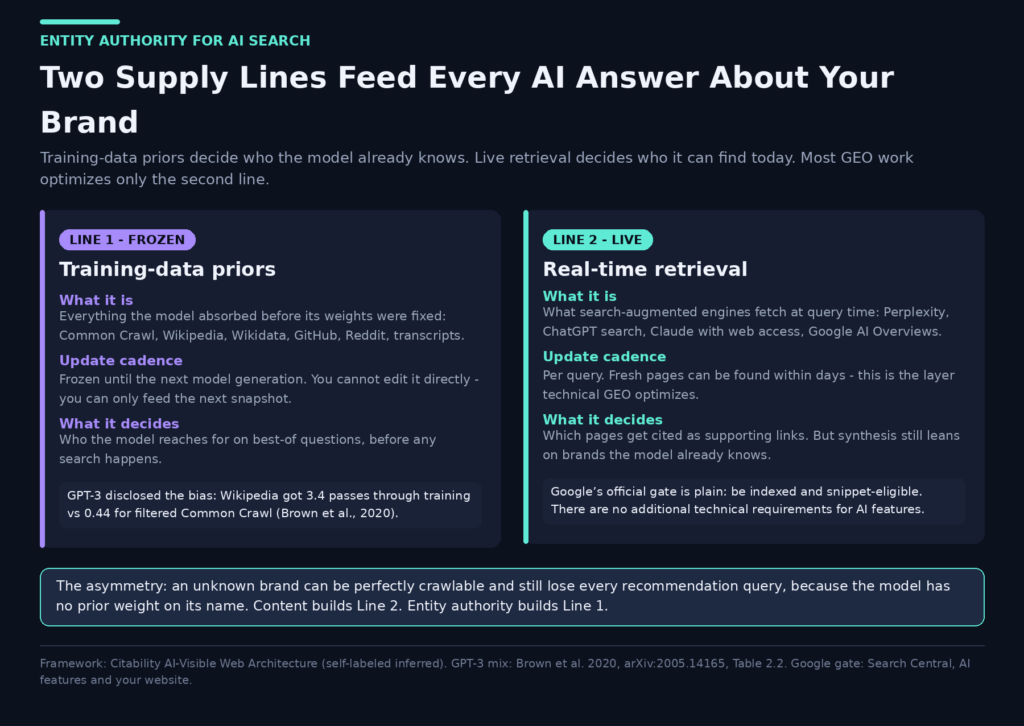
Every AI answer about your brand draws from two distinct knowledge sources, and they behave nothing alike.
The first is the training corpus: everything the model absorbed before its weights were frozen — Common Crawl, Wikipedia, Wikidata, GitHub, Reddit, podcast transcripts. This is the model’s prior. It updates only when the next model generation ships. The second is live retrieval: what a search-augmented engine (Perplexity, ChatGPT search, Claude with web access, Google AI Overviews) fetches at query time. This updates per query, and it’s the layer almost all technical GEO advice targets.
The open-source AI-Visible Web Architecture project — a framework maintained by the team behind the Citability audit tool, which honestly labels this chapter as inferred from observed behavior rather than measured fact — puts the asymmetry bluntly: an unknown brand can be perfectly crawlable and still lose every recommendation query, because the model has no prior weight on its name. Live retrieval partially corrects this, but in the synthesis step, training-known brands still get heavier weight, especially on “best of” questions.
Is the training bias real, or just practitioner folklore? The best public evidence comes from OpenAI itself. In the GPT-3 paper (Brown et al., 2020), the training mix table shows Wikipedia contributing just 3 billion tokens at a 3% sampling weight — but because sampling wasn’t proportional to size, Wikipedia text was seen 3.4 times during training, while the 410-billion-token filtered Common Crawl was seen just 0.44 times. Curated sources got roughly eight times the exposure per token of raw web crawl. Current labs don’t publish their mixes, so extending this to today’s models is inference — but it’s inference anchored to the one generation that showed its work.
The Entity Stack: Seven Layers, in Order of Leverage
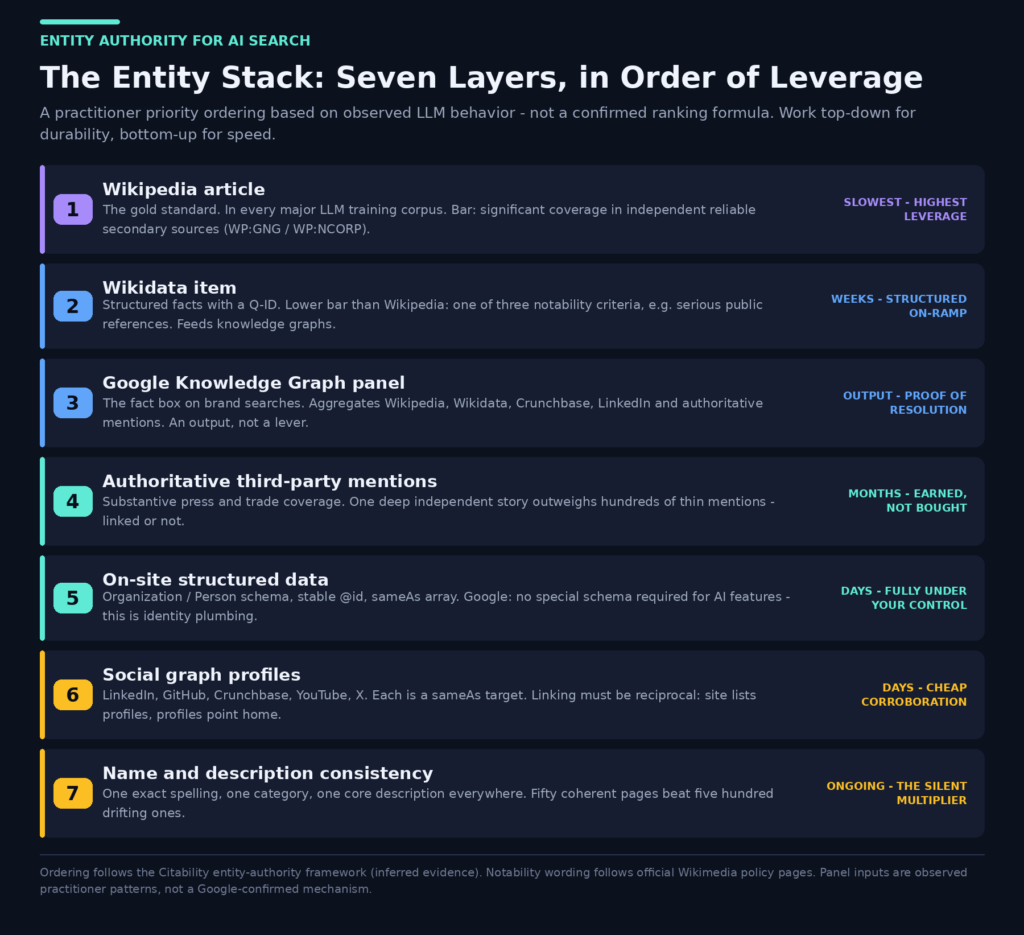
If entity authority is the goal, what actually builds it? The Citability framework proposes a seven-layer stack, ordered by observed leverage. Treat it as a practitioner priority list, not a confirmed ranking formula — nobody outside the labs has the weights. But it’s a useful map:
- Wikipedia article. The gold standard: present in every major LLM training corpus, gated by genuine notability.
- Wikidata item. Structured facts with a permanent Q-ID; a lower bar than Wikipedia, and heavily consumed by knowledge-graph-aware systems.
- Google Knowledge Graph panel. The fact box on branded searches — an output that proves the machine resolved you, not a lever you pull directly.
- Authoritative third-party mentions. Substantive press and trade coverage; one deep independent story outweighs hundreds of thin ones.
- On-site structured data. Organization and Person schema with a stable
@idand asameAsarray. - Social graph profiles. LinkedIn, GitHub, Crunchbase, YouTube, X — each a corroboration node, each requiring reciprocal links.
- Name and description consistency everywhere. The silent multiplier that makes every other layer legible.
Notice the shape: the top layers are slow and earned; the bottom layers are fast and fully yours. The strategic move is to work both ends at once — ship the cheap layers this week while playing the long game on coverage.
Wikipedia: The Gold Standard and the Notability Gate
Wikipedia’s general notability guideline requires significant coverage in multiple independent, reliable secondary sources. For organizations, the dedicated guideline (WP:NCORP) is stricter still: trivial or incidental coverage doesn’t count, press releases and articles substantially based on them don’t count, and coverage needs a regional, national, or international audience to weigh heavily. A funding-roundup mention and a founder interview won’t get you in.
This is the part vendors won’t sell you: most small brands simply don’t qualify yet, and no service can change that shortcut-free. The Wikimedia Foundation’s Terms of Use prohibit undisclosed paid editing outright — anyone compensated for contributions must disclose their employer, client, and affiliation — and English Wikipedia’s conflict-of-interest guideline very strongly discourages paid advocates from editing articles directly at all. Buying an article is a deletion risk and a sanctions risk, not a strategy.
The compliant path is boring and real: earn substantive independent coverage first, let notability follow, and let the community decide. Wikipedia is a long game measured in quarters, not a task for this sprint.
Wikidata: The Structured On-Ramp With a Lower Bar
Here’s where many GEO guides get sloppy, so let’s use the actual policy text. Wikidata does have a notability policy — claims that organizations face “no notability test” are wrong. An item is acceptable if it meets at least one of three criteria: it has a valid sitelink to a Wikimedia project page; it describes a clearly identifiable entity supported by serious, publicly available references; or it fulfills a structural need for other items. The policy itself admits the guidelines are intentionally a bit vague, and deletion disputes are settled by the community.
That’s a meaningfully lower bar than Wikipedia’s significant-coverage test — a real company with trade-press coverage or registry records can often qualify years before it merits an encyclopedia article. And you’re allowed to create your own company’s item, with two conditions: keep every statement neutral and referenced (registry records and independent coverage are strongest; your own site works for basic self-facts but won’t establish notability alone), and disclose paid contributions as the Terms of Use require — yes, that includes employees editing as part of their job.
Practically, start with the core statements: instance of (organization or business), official website, inception date, country, headquarters, founder, industry — each with a reference URL and a retrieved date. Then add external identifier properties (Crunchbase, LinkedIn, GitHub) that make the item machine-matchable to your other profiles. Unsourced statements get removed; promotional ones get the whole item nominated for deletion. Build the record, not the brochure.
0.664 vs 0.218: Why Mentions Out-Correlate Backlinks 3-to-1
Now the number crunch — because entity work sounds philosophical until you see the data.
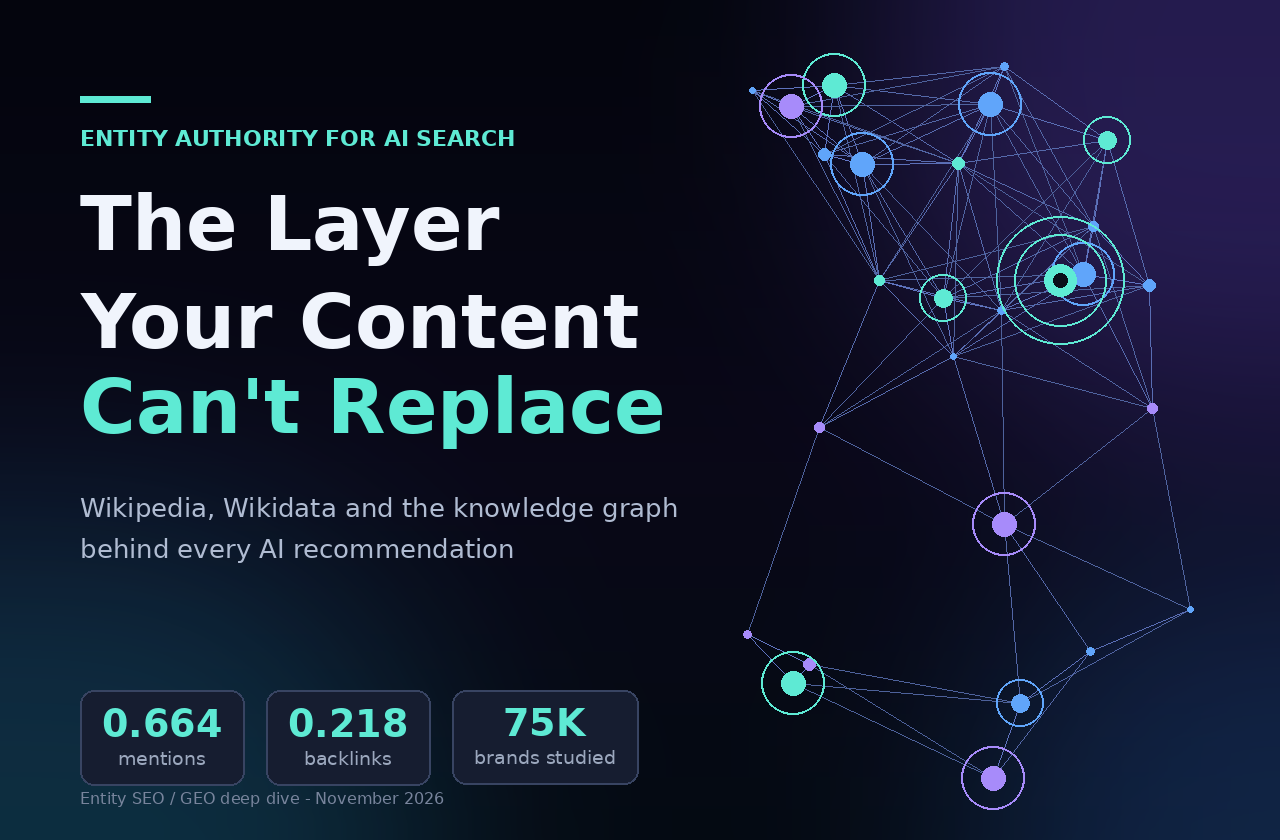
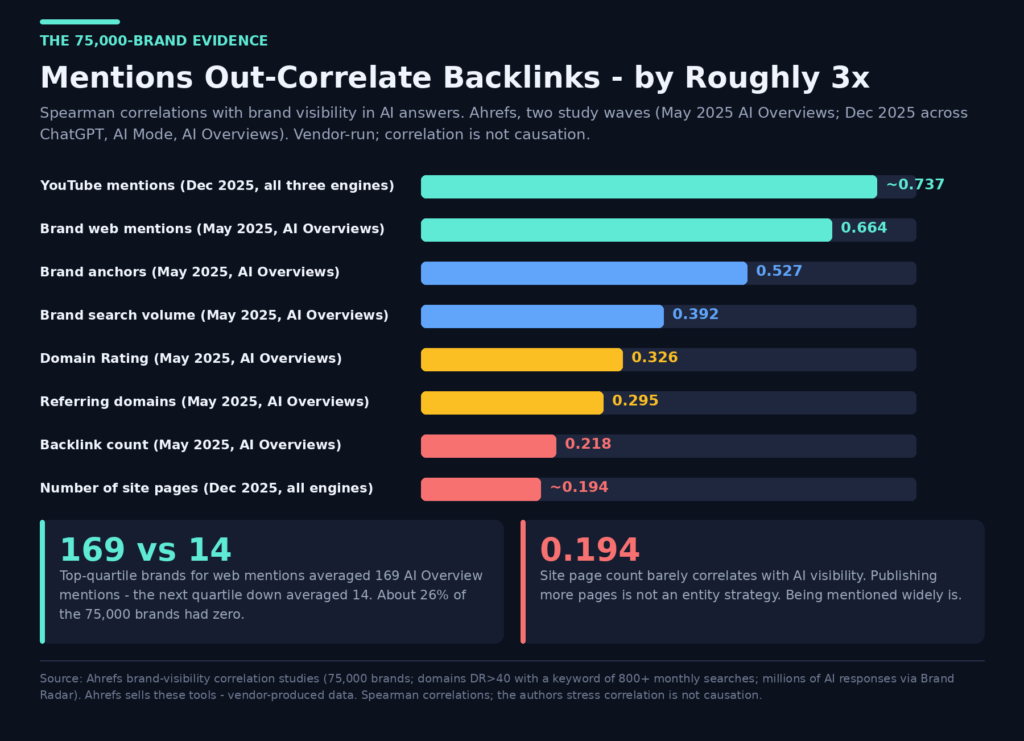
In May 2025, Ahrefs analyzed 75,000 brands against millions of AI Overviews responses. The strongest correlate of brand visibility wasn’t Domain Rating, backlinks, or traffic. It was branded web mentions — the plain-text appearance of your brand name across the web, linked or not — at a Spearman correlation of 0.664. Backlink count managed just 0.218. Brand anchors landed at 0.527, branded search volume at 0.392, Domain Rating at 0.326. The visibility cliff was brutal: brands in the top quartile for web mentions averaged 169 AI Overview mentions; the next quartile down averaged 14. About 26% of all 75,000 brands had zero.
In December 2025, Ahrefs expanded the study across ChatGPT and Google AI Mode and found a new leader: YouTube mentions (brand named in video titles, transcripts, or descriptions) at roughly 0.737, consistent across all three platforms. Web mentions held at 0.66–0.71. Meanwhile the number of pages on your site — the metric every programmatic-content pitch implicitly sells — correlated at just ~0.194. Publishing more is not an entity strategy.
Two caveats you should tattoo on the dashboard. First, Ahrefs sells the tools that measure these signals (Brand Radar, Site Explorer), so this is vendor-produced research — large-sample and methodologically transparent, but not neutral. Second, the authors themselves stress it: correlation is not causation. Big brands earn mentions because they’re big; mentions may be a marker of brand strength rather than a lever that creates it.
The platform split is strategically useful, though. AI Mode showed the strongest correlations with established-brand signals (branded anchors 0.628, branded search volume 0.466) — it behaves like a consensus engine that recommends who people already know. ChatGPT showed the weakest correlations with classic authority metrics (DR just 0.266), making it the most plausible entry point for emerging brands. And the three engines largely name the same brands anyway (output overlap correlations of 0.749–0.821), which tells you the entity layer is shared infrastructure, not a per-engine trick.
Why would unlinked mentions matter mechanically? Because language models learn from text, not from hyperlink graphs. A nofollow press mention, a podcast show note, a Reddit thread, a YouTube transcript — each places your brand name next to your category terms in corpora models actually read. The New York Times reported in 2024 that GPT-4 was trained on over a million hours of YouTube transcriptions. The old SEO currency was link equity. The new one is presence and consistency.
Entity Drift: Does Your Brand Have Four Personalities?
Here’s a diagnostic you can run in ten minutes. Open your website’s About page, your LinkedIn company page, your Crunchbase profile, and your most recent press coverage. Read the first sentence of each.
Are they the same company?
Practitioners call the failure mode entity drift: the website says “AI-powered customer analytics platform,” LinkedIn says “marketing automation and CRM,” Crunchbase says “data intelligence software,” and the trade press says “business intelligence tool.” Every description is defensible. Together, they’re a disambiguation problem. A model trying to anchor your brand to one canonical category can’t — so it hedges, or it skips you. The GEO agency LinkSurge, which sells entity-audit services, makes the practitioner claim that fifty tightly coherent pages outperform five hundred drifting ones in AI citation scenarios; treat the ratio as illustrative rather than measured, but the mechanism is consistent with everything the correlation data shows about naming consistency.
Audit yourself against four alignment points:
- Name: identical spelling and capitalization everywhere, including suffixes (Inc., Ltd., Labs) and spacing.
- Category: one canonical type across your schema, your Wikidata “instance of,” and directory categories.
- Core description: one or two sentences, near-identical across website, Wikidata, LinkedIn, and press materials.
- Related entities: founders, headquarters, flagship products carrying the same attributes wherever they appear.
The Four-Alignment Fix
Fix drift in the order of control. Your schema and Wikidata item are yours — align those first, this week. Profiles you administer come next. Press you can’t edit, but you can influence forward: every future pitch, release, guest bio, and podcast intro should reuse the canonical description verbatim. Newer consistent mentions from credible sources gradually outweigh older inconsistent ones in both retrieval and the next training snapshot. You’re not rewriting history; you’re changing the slope.
Entity Home Engineering: One Page the Machines Can Trust
The practitioner answer to drift is a concept Jason Barnard of Kalicube coined in 2019: the Entity Home — the single page on a site you control that acts as the algorithm’s primary source of truth about the entity, typically the About page. To be clear about provenance: this is a practitioner framework from a vendor that sells knowledge-panel services, not an academic finding and not Google terminology. Kalicube points to a granted Google patent on verified entity attributes (US12061594B2) as supporting mechanism, while honestly noting a patent describes a method, not proof of shipping.
The engineering pattern is sound regardless of branding:
- Pick one durable URL you own. The URL is part of the identity — don’t mint a second home and leave the first live.
- State the core facts plainly: who you are, what you do, who you serve, why anyone should believe you.
- Give the entity a persistent identifier in JSON-LD and never change it:
{
“@context”: “https://schema.org”,
“@type”: “Organization”,
“@id”: “https://example.com/#organization”,
“name”: “Example Analytics”,
“url”: “https://example.com/”,
“description”: “Example Analytics is a customer analytics platform for subscription businesses.”,
“foundingDate”: “2021”,
“sameAs”: [
“https://www.wikidata.org/wiki/Q123456789”,
“https://www.linkedin.com/company/example-analytics”,
“https://www.crunchbase.com/organization/example-analytics”,
“https://github.com/example-analytics”
]
}
- Make
sameAsreciprocal. Your site lists every profile; every profile links back to the canonical site. One-directional links are claims; two-directional links are corroboration. - Keep the markup honest — Google’s guidance is that structured data must match the visible text on the page. Schema that disagrees with your HTML is a defect, not an optimization.
What Schema Won’t Do (the 1,885-Page Reality Check)
Before you sell this internally as a citation hack, read the control group. In May 2026, Ahrefs tracked 1,885 pages that added JSON-LD between August 2025 and March 2026, matched each against three control pages with similar citation histories, and ran a difference-in-differences analysis across 30-day windows. Result: AI Overviews citations moved −4.6% relative to controls, AI Mode +2.4%, ChatGPT +2.2% — no meaningful lift anywhere. A parallel searchVIU experiment found five AI systems extracted only visible HTML when fetching pages directly, ignoring JSON-LD entirely.
The honest reading: pages with schema are about three times likelier to be AI-cited, but that’s selection, not causation — sites that bother with schema do everything better. The study only covered pages already heavily cited, so it can’t rule out that schema helps unseen pages get parsed and understood. And Google’s own AI-features documentation says it outright: there are no additional technical requirements beyond being indexed and snippet-eligible, and no special schema.org markup you need to add.
So why ship Organization schema at all? Because its job in this playbook isn’t ranking — it’s identity plumbing. A stable @id and reciprocal sameAs give crawlers, knowledge graphs, and retrieval systems one unambiguous answer to “which entity is this, and where are its other homes?” Build it as infrastructure. Don’t budget it as a traffic lever.
The Knowledge Panel Is a Receipt, Not a Lever
When you Google your brand and see the fact box on the right, that’s Google’s Knowledge Graph telling you it has resolved your entity. The graph launched in 2012 with 500 million objects and 3.5 billion facts; it has grown by orders of magnitude since, seeded from public sources like Wikipedia and structured databases, and reconciled against the wider web.
Two things follow. First, the panel is an output: practitioners observe it aggregating signals from Wikipedia, Wikidata, Crunchbase, LinkedIn, and authoritative mentions, but Google confirms no recipe — you earn it by making the underlying entity legible, not by requesting it. Second, the panel matters beyond Google because it’s visible in search results that other AI systems index and ground against, and because the same structured layer feeds Google’s own AI surfaces. Checking whether your brand triggers a correct panel is a free monthly audit. Checking what it says about you — category, founding date, founders — is the receipt for your alignment work.
Honest Expectations: What ~200 Sites Can and Can’t Tell You
Now let’s disappoint everyone selling certainty. Attrifast, a vendor that sells AI-revenue attribution to small sites, reviewed first-party attribution data from roughly 200 customer sites and found a pattern: sites with a confirmed Knowledge Graph entity plus a Wikidata item ran higher AI-referred session shares than entity-less peers in the same category and size band. The author’s own framing is the right one — directional, confounded, real-but-not-causal. Those same sites were also publishing better content and earning real links. Nobody running a real business holds all other variables constant, and anyone quoting you a clean “Wikidata added X% AI traffic” number is selling a story.
The same vendor’s informal query sampling suggests Wikipedia’s citation dominance is concentrated in definitional and who-is questions and largely evaporates on “best X for Y” and comparison queries — which is exactly where buying decisions happen. Small sample, self-reported, crude method; take the shape, not the decimals. The strategic implication survives the caveats: entity presence makes you eligible to be considered; it does not close deals by itself.
Two timeline realities to set with your stakeholders. Training-prior changes move on model-update cycles — quarters, sometimes longer. Retrieval-layer changes (description accuracy, citation appearance on search-augmented engines) can show up in weeks. Promise direction, never dates.
The Measurement Chain: From Entity to Revenue
Entity work fails in board meetings because teams report the wrong layer. Measure the chain in five stages, each with its own instrument:
- Entity established: Wikidata item live, schema deployed, panel present. Manual inspection. Binary.
- Correct representation: ask the engines who you are; score description accuracy against your canonical facts. A weekly prompt panel across ChatGPT, Perplexity, Gemini, and AI Overviews works — practitioners call the mention-share version “share of model.”
- Citation rate: your URLs appearing in AI answers for target queries. Visibility monitors, or the same manual panel logged consistently.
- AI-referred sessions: first-party analytics with AI referrers broken out — and remember the dark traffic problem: assistant apps strip referrers, so your measured AI share is a floor, not a ceiling. Google’s Search Console now reports AI-feature impressions, but doesn’t isolate its AI clicks from regular search.
- Revenue: join those sessions to conversions and payments. This is the only stage that pays salaries, and the only one your CFO actually cares about.
Each stage gates the next. If representation is wrong, citations won’t convert trust. If citations don’t happen, traffic can’t arrive. Report the chain, not a single vanity number.
The 90-Day Entity Roadmap
Days 1–14: own what you own. Pick the Entity Home page. Write the canonical two-sentence description. Deploy Organization schema with a persistent @id and a sameAs array. Align every profile you administer — name, category, description, links back home.
Days 15–45: the Wikidata sprint. Assemble serious public references (trade coverage, registry records). Create the item with referenced statements and external identifiers; disclose paid contributions per the Terms of Use. Audit your Knowledge Graph panel monthly and correct upstream facts when it’s wrong.
Days 46–90: consistency at scale. Standardize the boilerplate in every press release, pitch, bio, and podcast intro. Pursue the mention channels the correlation data actually favors: substantive trade coverage, YouTube appearances where your brand is named in titles and transcripts, genuine community participation. Start the weekly prompt panel now so you have a baseline before the slow layers move.
Beyond day 90: the Wikipedia long game. Keep earning independent, significant coverage. When the sourcing genuinely clears WP:NCORP, the community path exists — drafts through Articles for Creation, conflict-of-interest disclosed, editors deciding. Until then, no article is the correct outcome, not a failure.
Notice what’s absent: buying links for volume, mass-producing pages, buying an encyclopedia entry. The correlation data assigns those bottom-tier scores, and the policy pages assign the last one a deletion notice.
The Bottom Line
AI visibility has two supply lines, and content alone only feeds one. The entity layer — Wikipedia’s earned authority, Wikidata’s structured facts, a coherent Knowledge Graph presence, wide and consistent mentions — decides whether the model knows you before it ever reads you. The strongest public evidence, a vendor-run but large-sample 75,000-brand analysis, puts mention signals at roughly three times the correlation of backlinks, and page count near the floor. The controlled schema study says markup alone won’t rescue you. The honest attribution data says entity presence is directional, not a revenue guarantee.
So build it like infrastructure: cheap layers immediately, earned layers patiently, measurement across the whole chain. Fifty consistent pages and one canonical identity beat five hundred drifting ones. The machines are already asking who you are. Give them one answer, everywhere.