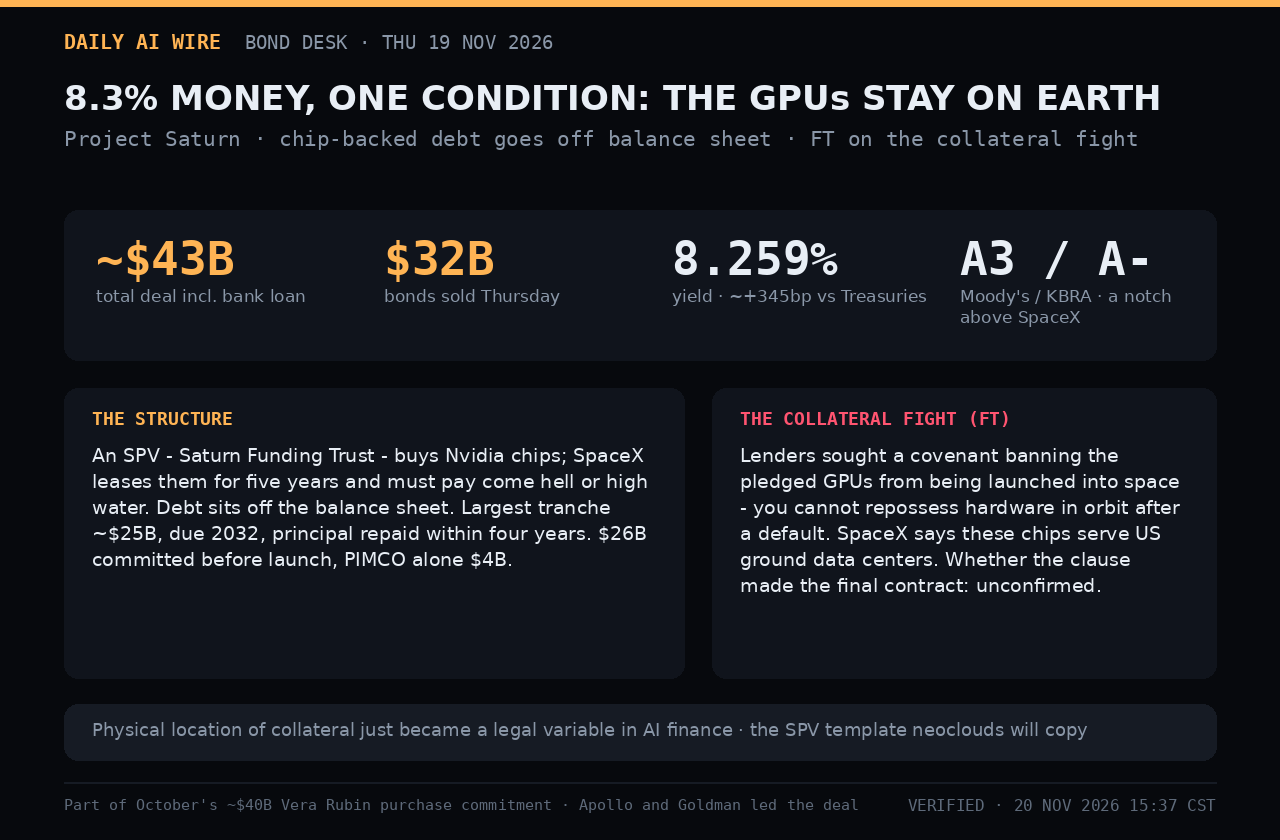
On Thursday, November 19, SpaceX sold roughly $32 billion in bonds — part of a ~$43 billion financing package including a bank loan — under a structure called Project Saturn, and the details read like science fiction written by credit analysts. An SPV named Saturn Funding Trust buys Nvidia chips (against October’s ~$40 billion Vera Rubin purchase commitment); SpaceX leases them for five years under a hell-or-high-water clause that forces payment through any setback, keeping the debt off its balance sheet. The largest tranche, about $25 billion, priced at 8.259% — some 345 basis points over Treasuries, extraordinary for paper Moody’s rates A3, a notch above SpaceX itself — with roughly $26 billion committed before launch, including $4 billion from PIMCO. Then the FT twist: lenders reportedly sought a covenant forbidding SpaceX from launching the pledged GPUs into space, because you cannot repossess collateral in orbit after a default. SpaceX says these chips will serve US ground data centers; whether the clause made the final contract remains unconfirmed. Either way, the physical location of collateral just became a legal variable in AI finance — and this SPV template is what every neocloud will try to copy next.