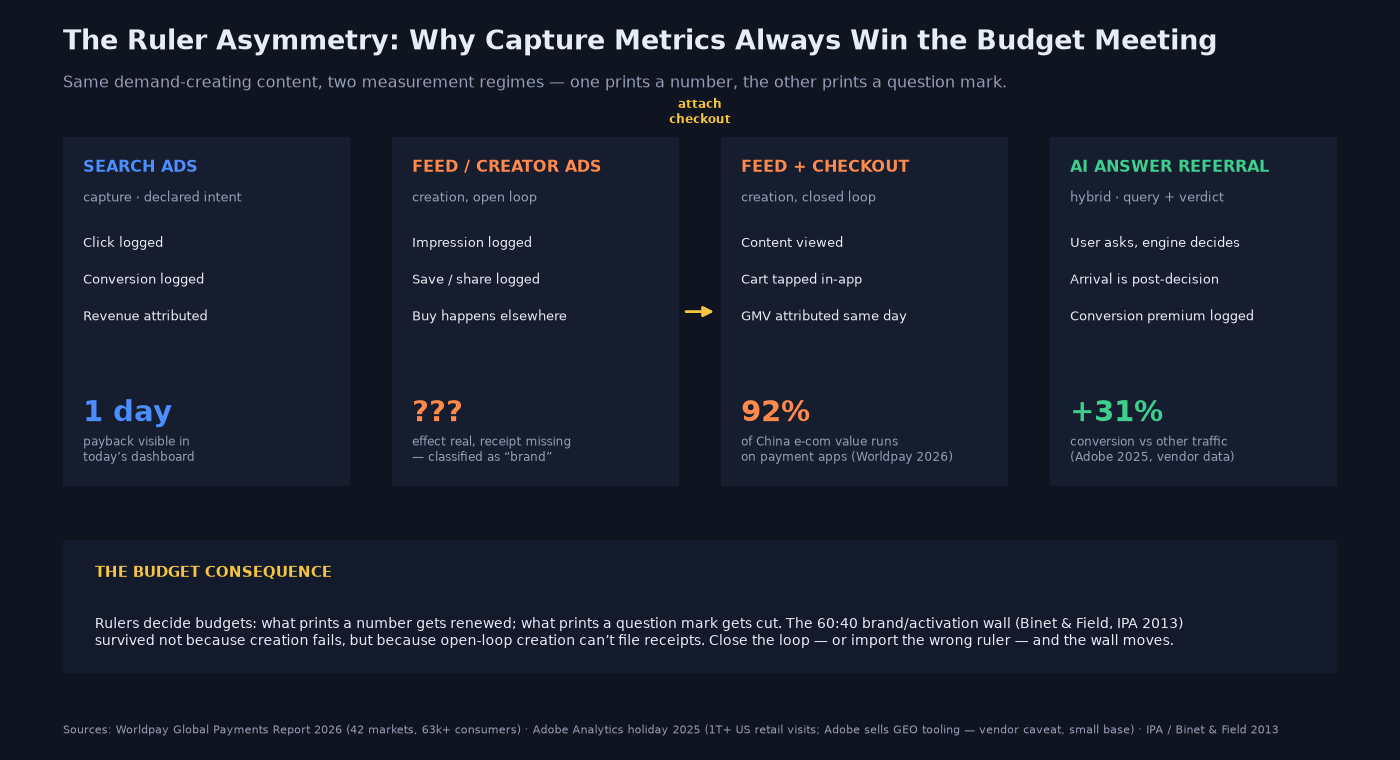
Here’s a scene from a thousand budget reviews. The performance lead projects a dashboard: search ads, $4.20 in revenue per dollar spent, attributable to the click. The content lead projects a mood board: a viral video, 2 million views, a spike in brand searches nobody can fully explain. One slide prints a number. The other prints a question mark. Guess which line gets renewed.
We usually explain the brand-versus-performance budget wall as doctrine — Binet and Field’s 60:40 rule, institutionalized from a thousand IPA case studies. But doctrine is the symptom. The mechanism underneath is a measurement asymmetry: capture channels produce their own receipts, and open-loop creation channels don’t.
The receipt machine
A search ad closes its own loop. The user declares intent, clicks, converts, and the revenue lands in the same log file. Payback is visible in today’s dashboard. A feed ad in an open-loop market does something stranger: it manufactures a want, then watches the user walk away to satisfy it somewhere else — a store, a marketplace, a search box three days later. The effect is real. The receipt is missing. So the CFO’s spreadsheet files it under “brand,” which in budget language means “unprovable,” which means “first to cut.”
Notice what this implies: the wall between brand and performance budgets was never a claim about psychology. It was an artifact of plumbing.
What happens when you attach the register
China ran the experiment at national scale. Payment apps carry 92% of e-commerce transaction value (Worldpay’s Global Payments Report 2026, 42 markets, 63,000+ consumers surveyed), and checkout sits inside the same app as the content. Suddenly the viral video files its own receipt: view, tap, GMV, same day, same log. Demand creation didn’t get better at marketing — it got better at accounting. That’s why Chinese budgets never hardened the 60:40 wall, and why “brandformance” debates there feel like imported folklore.
The exported proof is already visible: Momentum Works estimates content-led commerce climbed from 20% of Southeast Asian platform GMV in 2024 to 37% in the first half of 2026. Wherever checkout attaches to content, creation budgets start winning meetings they used to lose.
The AI twist: receipts return, but upstream
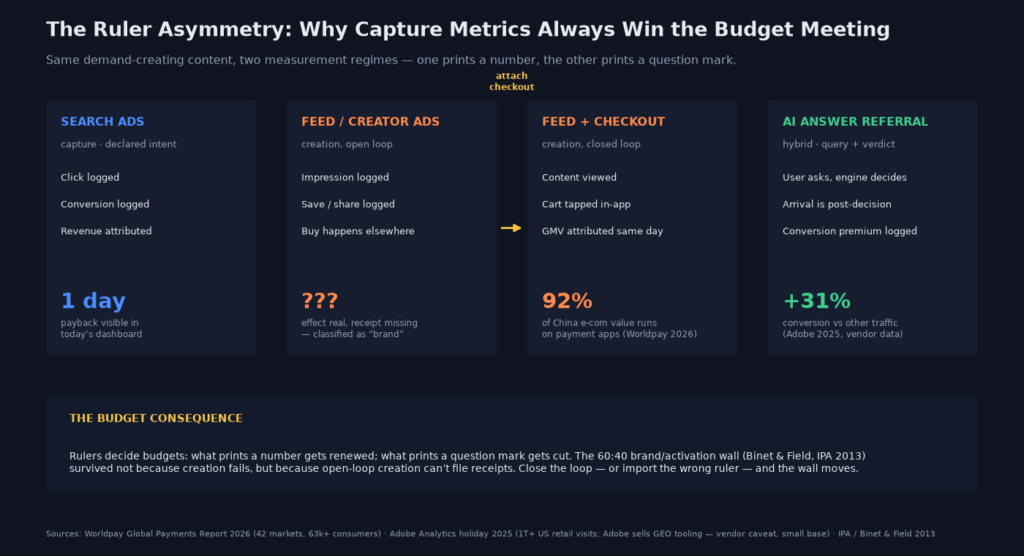
The merge adds a wrinkle. AI answer referrals behave like creation — the engine decided before the user arrived — yet they log like capture: Adobe’s holiday-2025 data shows them converting 31% better than other traffic. (Vendor caveat: Adobe sells GEO tooling, and the base is small.) The hybrid re-issues receipts to demand creation, but only to brands the engine already trusts. The asymmetry doesn’t disappear. It relocates — from “can you prove the sale?” to “can you prove you deserved the recommendation?”
The takeaway
Before arguing about brand versus performance, audit your plumbing. If your creation channels can’t file receipts, no deck will save their budget. Close the loop where you can; where you can’t, measure search-lift and cohorts — and refuse to let a capture-shaped ruler score a creation-shaped game. Budgets follow receipts. Make sure yours can print them.






