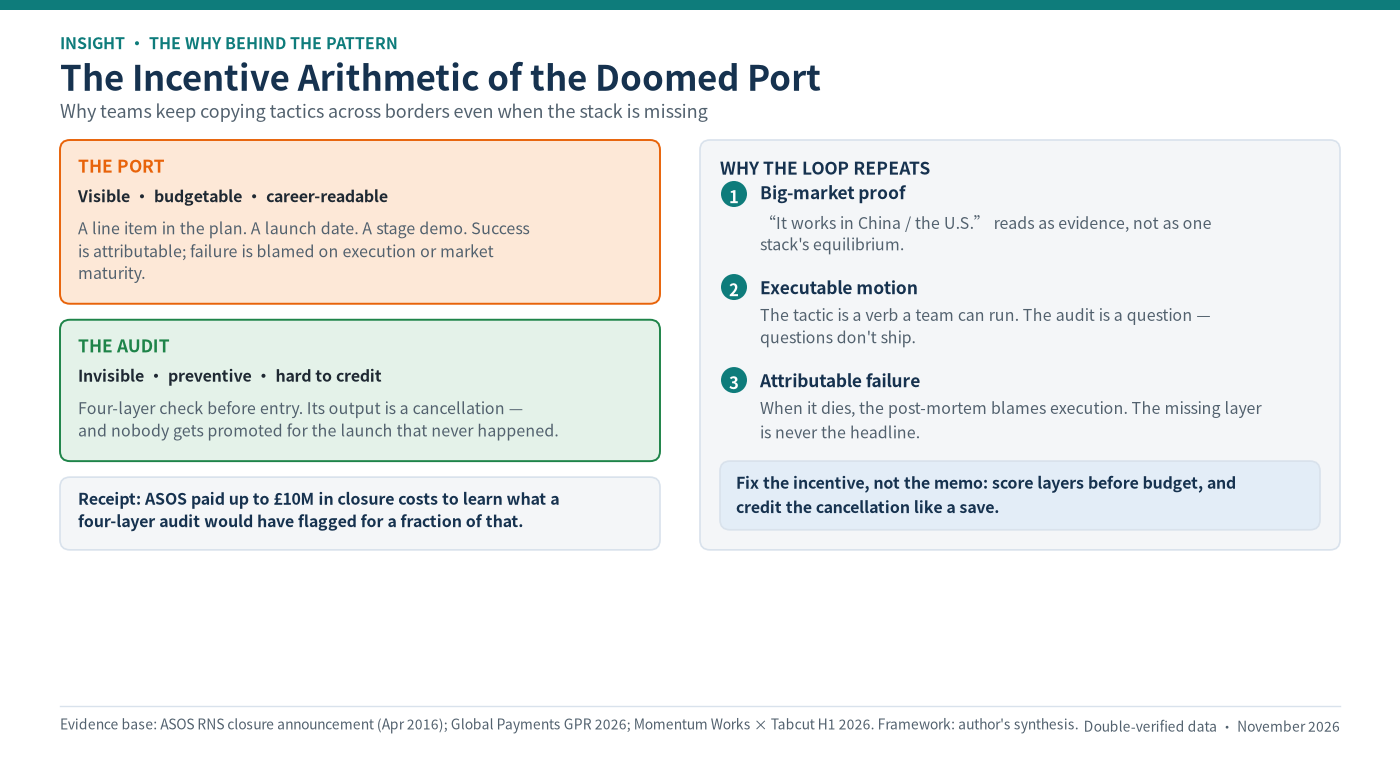
The four-layer transfer test explains why tactics die at the border. It does not explain the stranger fact: why smart teams keep sending them there. ASOS ran a competent China operation for three years and still paid up to £10 million in closure costs. Multiply that pattern across every documented exit — Topshop, New Look, Marks & Spencer — and you are looking at something more systematic than bad luck. You are looking at an incentive structure that pays for ports and starves audits.
Here is the asymmetry. A port is a visible, budgetable, career-readable act. It has a line item, a launch date, a deck with a hockey stick. If it works, the sponsor gets credit. If it fails, the post-mortem blames execution, timing, or “market maturity” — categories that protect the decision-maker. An audit is the opposite: invisible, preventive, and almost impossible to credit. Its best outcome is a cancellation, and nobody gets promoted for the launch that never happened. The four-layer test asks you to spend political capital proving that a popular idea should not run. The port asks you to spend money proving it should. Guess which one gets funded.
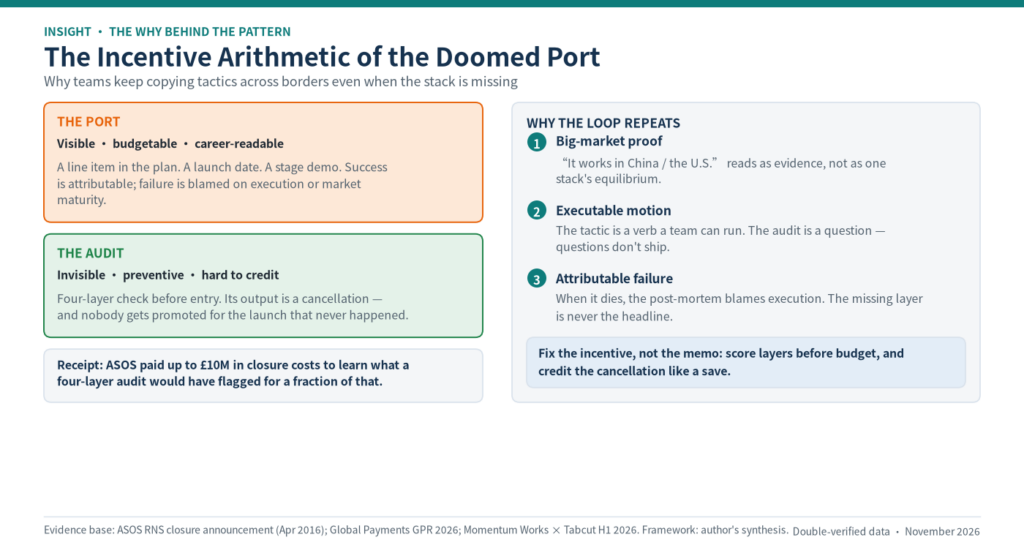
Three mechanisms keep the loop turning.
First, big-market proof is mistaken for universal proof. “It works in China” or “it works in the U.S.” reads as evidence, when it is really a description of one stack’s equilibrium. China’s 92% wallet share of e-commerce and America’s card-funded 40% are not interchangeable backdrops; they are the reason the same motion converts on one side and leaks on the other. But the proof travels as a headline, and the stack stays home as a footnote.
Second, the tactic is a verb a team can execute; the audit is a question, and questions don’t ship. A livestream programme has hosts, slots, and GMV targets. A four-layer audit has a spreadsheet and an uncomfortable conclusion. Organizations reward motion, so motion wins the budget meeting even when the spreadsheet is right.
Third, failure is attributable in a way that protects the port. When TikTok Shop’s U.S. live share slid from 14% to 8.2% while the shelf tab rose to 51.4%, the easy story was “American consumers aren’t ready for live.” The harder story — that the payment, trust, and seller-bench layers were never rebuilt — implicates the entry decision itself. Post-mortems prefer the first story because it preserves the next port.
The fix is not another memo about localization. It is an incentive redesign: score the four layers before the budget is committed, make the audit a gate rather than a suggestion, and credit the cancellation the way you credit a save. The team that kills a doomed port has just saved the £10 million closure cost — pay them like it. Until the ledger rewards prevention as visibly as it rewards launches, the border will keep collecting tuition from teams that already knew the answer.






