Every earnings season, someone reads JD’s record 4.6% retail operating margin and concludes the warehouses got more efficient. They didn’t — not by that much. The real story is quieter and more interesting: the mix changed.
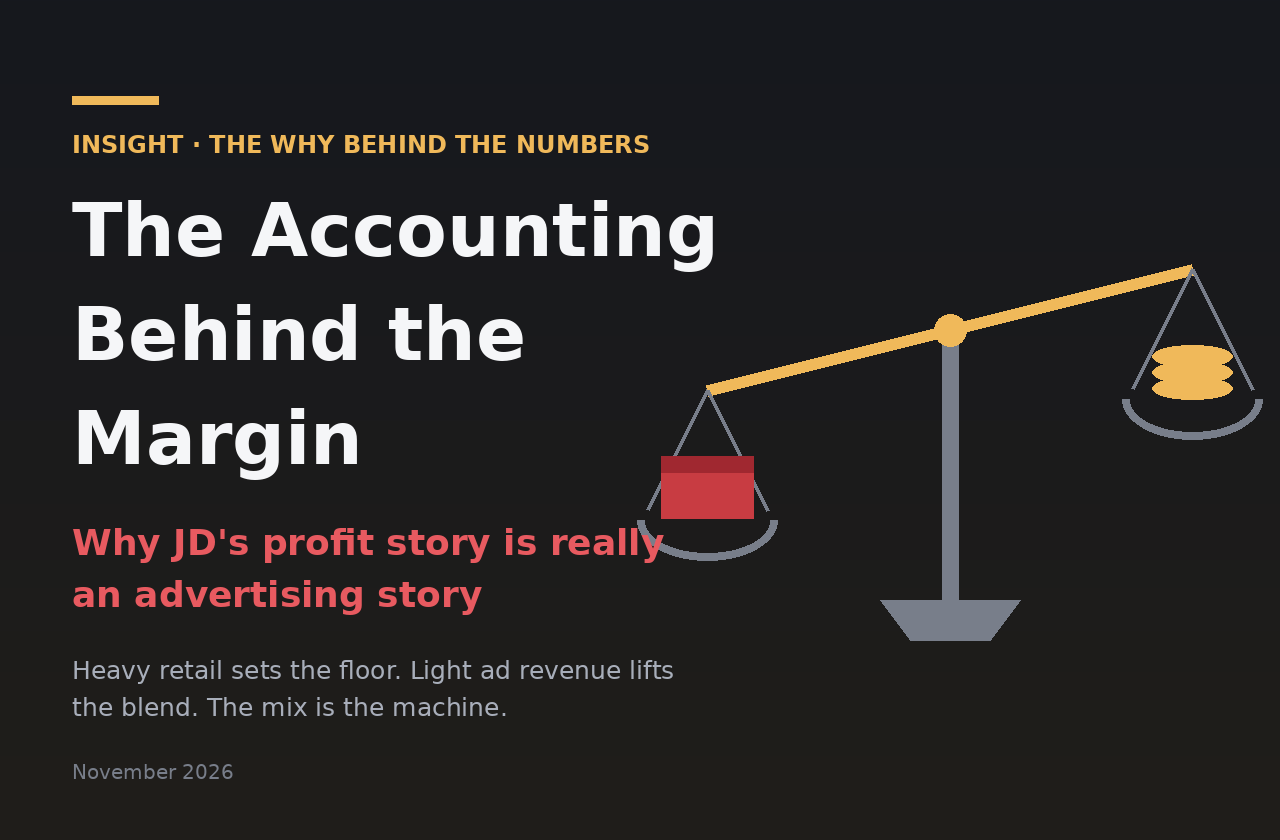
Here’s the mechanism. A company’s margin is a weighted average of everything it sells. JD sells two very different things under one roof. The first is heavy: first-party retail, where every yuan of revenue drags along a purchased product, a warehouse slot, a courier van. That business grew 10.3% in 2025, and its costs grow with it almost one-for-one. The second is light: marketplace commissions and advertising, where a yuan of revenue arrives with no goods attached. That line grew 18.9%, to RMB 107.1 billion. When the light business grows nearly twice as fast as the heavy one, its weight in the blend rises — and the average margin lifts even if nothing inside either business improves. That’s arithmetic, not magic.
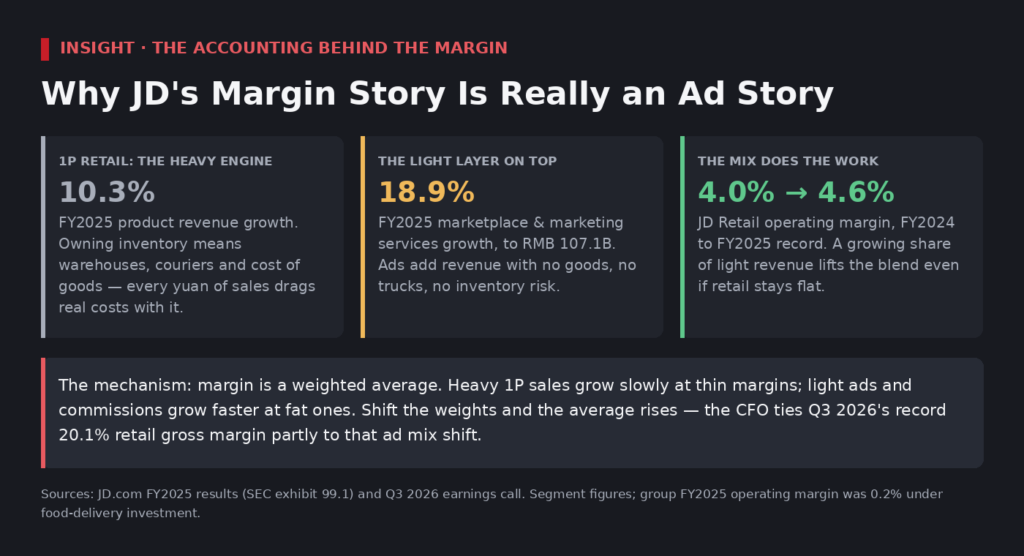
Management basically confirms it. The CFO attributed Q3 2026’s record 20.1% retail gross margin partly to the growing share of high-margin advertising revenue. Notice what’s not in that sentence: better refrigerators, cheaper trucks. The profit engine isn’t the store getting leaner. It’s the ad platform getting heavier.
Why does this matter beyond one company? Because it explains a puzzle in global retail media. Amazon, Walmart and JD all discovered the same loophole in retail accounting: the shelf and the billboard have different physics. Selling shelf space — ads — monetizes the same foot traffic twice, the second time at near-software margins. Walmart’s ad business grew 38% in a recent quarter while Baidu’s open-web search ads fell 22%. Money isn’t leaving advertising. It’s relocating to the one place where the viewer is provably a buyer.
And there’s a strategic trap hidden in the arithmetic. Once a retailer’s margin depends on the light layer, it must keep feeding that layer — more merchants, more auctions, more ad load on the same traffic. The retailer slowly becomes a landlord whose tenants fund the building. JD’s 750 million shoppers are the foot traffic; the eight-product ad stack is the rent collection system. The mix shift isn’t a phase. It’s the business model changing while the logo stays the same.