Ask a hundred economists where a perfectly competitive market’s profits go and they’ll say: to consumers. Ask where Pinduoduo’s merchants’ profits go and the honest answer is stranger — they go to the auction house. That’s the insight worth sitting with. The most underexplained fact in Chinese e-commerce isn’t that Pinduoduo’s prices are low. It’s that the platform turned the entire economic surplus of near-identical sellers into an ad product, and did it without ever raising a click price.
Here’s the mechanism, in three moves.
Move One: Manufacture Indifference
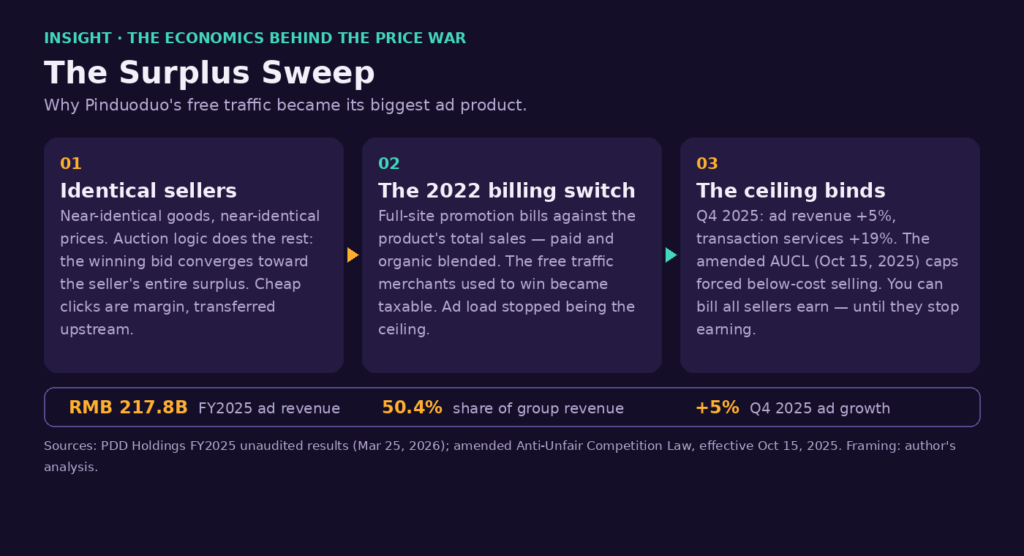
When thousands of white-label factories list functionally identical goods, no seller owns a reason to be chosen. Price becomes the only signal — and once price converges, visibility is the only remaining scarce asset. Auction theory tells us what happens next: when bidders are near-identical, competitive bidding transfers virtually the entire bidder surplus to the seller of the prize. Pinduoduo doesn’t sell products. It sells the prize, over and over, to people whose margins are the bidding currency.
Move Two: Expand What’s Billable
The 2022 launch of full-site promotion was the quiet masterstroke. Merchants set a target ROI; the system spans every placement and optimizes against the product’s total sales — paid and organic blended. Industry research describes the effective fee as a share of everything the item sells in a day. Read that as an economist: the platform stopped taxing transactions at the ad slot and started taxing the seller’s whole revenue stream. The organic traffic merchants used to earn as a reward for good conversion became part of the tax base. That’s why ad revenue could compound at 50%-plus for eight quarters while ad load barely moved. The bill grew because the base grew.
Move Three: Watch the Ceiling Appear
A tax on seller surplus has a hard limit: the surplus itself. By Q4 2025, PDD’s ad revenue grew just 5% year over year while transaction services grew 19% — the sweep had reached the edge of what merchants can pay. And the state moved the edge: the amended Anti-Unfair Competition Law, effective October 15, 2025, targets forced below-cost selling, while the refund-only rollback returns after-sales leverage to sellers. Group net income fell 12% in FY2025 even as revenue rose 10% to RMB 431.85 billion, half of it — 50.4% — still advertising.
The Takeaway
The takeaway isn’t moral, it’s mechanical. Pinduoduo built the purest surplus-extraction machine in commerce: indifference creates the auction, automation expands the base, and margin exhaustion sets the ceiling. Every “cheap traffic” pitch you’ll ever hear is an invitation to become the tax base. The winners on the platform are the sellers who refuse to be identical — who bring a real cost moat or a real difference, and thereby keep a surplus the auction can’t reach. Everyone else is bidding away their own existence, one target-ROI setting at a time. That’s the why behind the trend. The traffic was never cheap. It was prepaid — by the people selling into it.